Rolfing ZERO
Rolf Movement
A movement-oriented process for updating the sensory map behind posture, coordination, and ease.
Point 1
Explore standing, walking, sitting, and breathing as learned patterns.
Point 2
Notice unconscious effort before trying to correct it.
Point 3
Build more choices in movement through sensory awareness.
Background and further reading
In this guide
- Rolfing and Rolf Movement — What’s the Difference
- Body Schema and Body Image — When Sensation Changes, Movement Changes
- Tonic Function and Movement — Why You Move Better When You “Don’t Try Hard”
- Pre-movement — Before You Move, It Has Already Begun
- How a Session Proceeds
- Who Is It For
- Testimonials
- As a Rolf Movement Practitioner
- For Those Who Want to Take Rolfing Further
“I received the ten sessions, but I want to take it further.” “I want to raise the quality of my movement in yoga or Pilates.” “I want to change the very way I use my body.” Rolf Movement is a form of bodywork for people like these.
This Gateway Article explains what Rolf Movement is, how it differs from Rolfing, and who it suits.
Rolfing and Rolf Movement — What’s the Difference
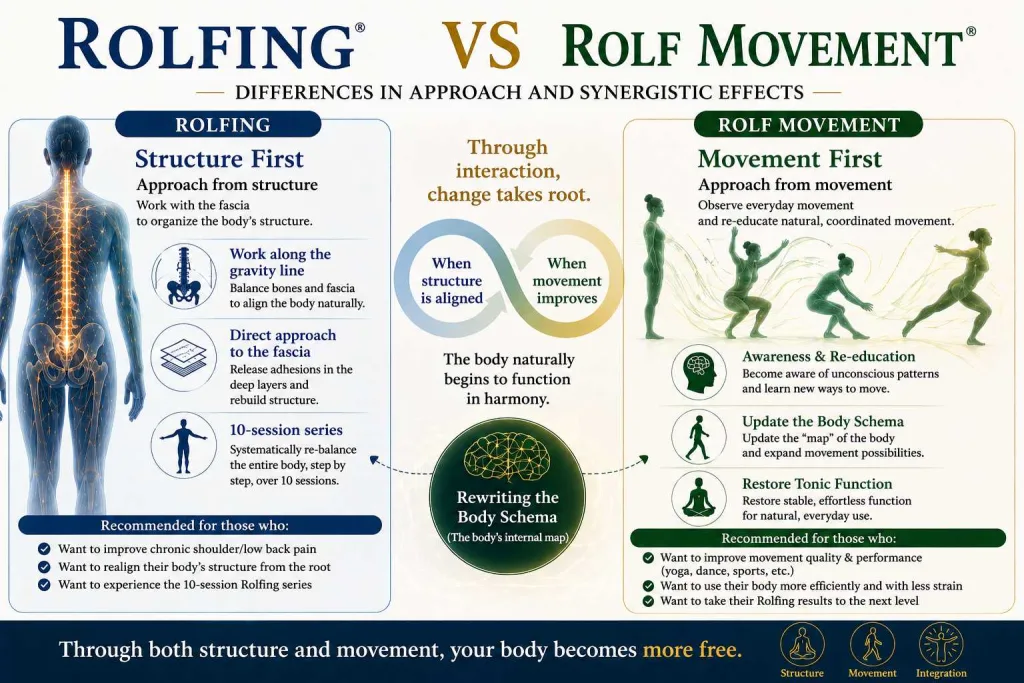
Rolfing and Rolf Movement are both forms of bodywork that trace their source to the thought of Ida Rolf, but their “entry point” differs.
Rolf Movement’s entry point is movement.
Rolfing’s entry point is structure. It works directly on the fascia, brings the skeleton into alignment with the line of gravity, and changes the body’s structure itself.
Rolf Movement enters through movement. It carefully observes everyday actions such as standing, walking, and sitting; notices unconscious patterns of tension and habit; and relearns more natural, more coordinated movement.
It isn’t that one is superior to the other. When structure becomes organized, movement changes; and as the quality of movement rises, changes in structure settle in more readily — there is this mutual interaction. For this reason, many clients receive Rolf Movement after completing Rolfing’s Ten-Series.
Body Schema and Body Image — When Sensation Changes, Movement Changes
There are two concepts that Rolf Movement holds central.
Body Schema — The unconscious map of the body
The Body Schema is the “map” of the body that the brain and nervous system hold unconsciously. It is the neurophysiological framework that automatically controls actions such as standing, walking, and reaching — and it is thanks to this map that we can move without conscious thought.
The source of this concept lies in the phenomenology of the French philosopher Maurice Merleau-Ponty. In his book Phenomenology of Perception, Merleau-Ponty argued that the body is not an “object” to which the brain issues commands, but a “subject” that engages with the world. We perceive the world “through the body,” and the Body Schema is the unconscious framework that forms the foundation of that perception — this is the philosophical origin of what contemporary neuroscience calls the “body map.”
When we walk, for example, we are not conscious of “raising the right foot so many centimeters, bending the knee to such an angle…” This is because the Body Schema processes it automatically. But when this map is distorted, unconscious movement produces chronic patterns of tension and distortions of posture. Much of stiff shoulders, low-back pain, and the sense that “something in the body is out of alignment” is the result of accumulated distortions in the Body Schema.
Merleau-Ponty’s thought — “the body is a subject open to the world” — is also why Rolf Movement aims not to “fix the body” but to “change how the body feels itself.” For those who want to explore this perspective more fully in the context of philosophy, brain science, and epistemology, the philosophy series at Mind and Bodywork Lab is an entry point (Only in Japanese).
Body Image — Conscious self-perception
The Body Image is the conscious image one holds of one’s own body, and it is influenced by emotion, memory, and cultural values. Self-perceptions such as “I have a hunched back,” “my body is stiff,” or “mine is a body that can’t move” are part of the Body Image. Trauma and long-held habits can fix the Body Image in place and unconsciously limit the possibilities of movement.
There is a scene I often witness in sessions. A client is trying to explain something. But as they begin to concentrate on the movement, the words stop. This is the sign that the head has stopped moving the body, and the body has begun to move. Most people move the body with the head, trying to react quickly to things — a modern society that prizes speed, efficiency, and thinking with the head makes us this way. In Rolf Movement, this shift from “head-led” to “led by bodily sensation” is carefully encouraged.
What Rolf Movement aims for is “changing the Body Image by rewriting the Body Schema.” When the body’s map is updated at the level of the nervous system, movement itself changes, and how the body feels itself — its very way of being — changes as well.
→ The Brain’s Navigation System for Posture — How the Body Map Shapes the Contours of “the Self”
→ Territorial Body and Body of Action
→ Rolf Movement — The Body Schema and the Six Perspectives in Detail
Tonic Function and Movement — Why You Move Better When You “Don’t Try Hard”
Tonic Function, proposed by the French Rolfer Hubert Godard, is the theoretical expert of Rolf Movement.
The Tonic Muscles (the deep antigravity muscles) work continuously and unconsciously in posture maintenance, breathing, and the like, and tire little. The Phasic Muscles (the superficial action muscles) move momentarily and intentionally, and tire easily.
Many modern people overuse the Phasic Muscles, and this is a structural cause of stiff shoulders, low-back pain, and chronic fatigue. In Rolf Movement, by restoring the sensation and function of the Tonic Muscles — which ought to work unconsciously — one recovers a natural way of being in the body: “stable without trying hard.”
→ Why Good Posture Is Not a Matter of Muscle Strength — Tonic Function and Its Relationship to Gravity
Pre-movement — Before You Move, It Has Already Begun
A perspective unique to Rolf Movement is “Pre-movement.”
In the moment before the actual movement occurs — “just before the transition from a standing posture to a sitting one” — the body has already begun to move. In that moment, where force gathers in the body and where it releases: in those signs, unconscious habits and patterns of tension appear.
Phoric Function and Fixed Point — Two perspectives for observation
When observing Pre-movement, what the Rolfer attends to is not the large movement. It is the Phoric Function (the sensation of subtle, directional movement) and the Fixed Point (a point in the body that has become fixed and unable to move). Where one can move and where one is locked — by reading these subtle differences, the unconscious patterns the client is unaware of in themselves come into view.
→ Where to Pay Attention in Movement? — Phoric Function and Fixed Point
The gap between Body Schema and Body Image — Between “what you think” and “what is happening”
Something often happens in a session: a client says, “I want to move here,” yet in fact it is somewhere else entirely that is locked. This is because there is a gap between the Body Image in the mind and the Body Schema held by the nervous system. In Rolf Movement, the very experience of noticing this gap between “what you think” and “what is actually happening” becomes the doorway to transformation.
The Rolfer observes this Pre-movement and conveys, carefully, what allows the person themselves to notice their habitual patterns of limitation. Not “being moved,” but “noticing for oneself” — this learning process is the essence of Rolf Movement.
Slowly, carefully, putting it into words
Awareness often does not become words. “Somehow different,” “it feels a little lighter” — those subtle changes of sensation are put into words slowly and carefully. This process of putting things into words encourages the rewriting of the Body Schema. When bodily sensation is linked to language, learning at the level of the nervous system settles in more readily.
→ To Encourage Bodily Awareness: Slowly, Carefully, Into Words
How a Session Proceeds
Each session proceeds in the flow of “observe → intervene → re-observe (Test → Intervene → Re-test).”
At the start of a session, the Rolfer observes the client’s way of standing, walking, and breathing (Body Reading). Which areas are over-tensed, and how the body deviates from the axis of gravity — this work of “reading the body” is the starting point of the session. This observation is not mere analysis. Mobilizing intuition and bodily sensation, it is the act of “listening” to what the client’s body needs.
Next comes an approach to fascia and movement, and after the session, the way of standing and moving is checked again. When the change is felt not only by the practitioner but by the client themselves, awareness of the body grows. As this “awareness” accumulates, the change persists even after the session ends.
→ What Comes into View Through Intuition and Body Observation…
Who Is It For
Those who have completed the Rolfing Ten-Series: Ideal for those who want to further consolidate and develop the body’s structure organized through the ten sessions. It is often received as a series of three to five sessions.
Practitioners of yoga, Pilates, dance, and the like: For those whose bodily movement is their profession or hobby, as an entry point to fundamentally rethinking the quality of movement. Rather than “learning how to do it,” you can have the experience of “how the body feels itself” changing.
Professionals who use voice and expression: Those in professions that use the “body as instrument” — voice actors, actors, singers, announcers, and others. When the body’s tension is released, the quality, resonance, and expressiveness of the voice often change.
Those who want to explore “why I can’t change” from the body: The state of “I understand it in my head, but I can’t move” is often a matter of the nervous system, fascia, and movement patterns. Rolf Movement raises the resolution on this.
Testimonials
Ms. Sachiko Aimoto, a freelance announcer, received Rolf Movement sessions, and her neck pain and stiff shoulders decreased dramatically. She reported a composite of changes: “I came to understand the movements of yoga and Pilates much better than before,” “when I practice the movement work before singing, the resonance of my voice is different,” and “my thinking became clear.”
→ Neck Pain and Stiff Shoulders Decreased Dramatically — Ms. Sachiko Aimoto’s Testimonials
For Those Who Want to Know More
- Rolf Movement — The Body Schema and the Six Perspectives in Detail
- The Brain’s Navigation System for Posture — How the Body Map Shapes the Contours of “the Self”
- To Encourage Bodily Awareness: Slowly, Carefully, Into Words
- Where to Pay Attention in Movement? — Phoric Function and Fixed Point
- Territorial Body and Body of Action
- Why a “Comfortable Posture” Exists — From the Perspective of Gravity, Fascia, and Rolfing
- Why Good Posture Is Not a Matter of Muscle Strength — Tonic Function and Its Relationship to Gravity
- What Is Rolfing’s Ten-Series? — Three Phases in Which the Body Changes, and the Flow of Each Session
The theme of how bodily movement connects with changes in perception and emotion is treated more fully at Mind and Bodywork Lab.
→ Mind and Bodywork Lab: How to Navigate This Site (only in Japanese)
As a Rolf Movement Practitioner
Not every Rolfer who can offer Rolfing can offer Rolf Movement. Offering Rolf Movement requires separately completing the certification training as a “Rolf Movement Practitioner.”
From July 2017 through December 2019, I completed the three-part training (Part 1–3) hosted by the ERA (European Rolfing Association) in Munich, Germany, and was certified as an ERA-certified Rolf Movement Practitioner. I am among the few holders of this ERA certification in Japan.
→ On the Path to Becoming a European Rolf Movement Practitioner — The Road to Certification
Rolf Movement is offered as a series of three to five sessions. A trial session is the place to begin, confirming current movement patterns.
→ Apply for a Trial Session
For Those Who Want to Take Rolfing Further
For those wavering between Rolf Movement and the Advanced level, or those who, having finished the ten sessions, want to reach somewhere more profound — I explain how it differs from an Advanced Rolfer’s session.
For those considering becoming a Rolfer — I explain the full picture, from the certifying bodies through Basic Training, Rolf Movement certification, and the Advanced level.
Hidefumi Otsuka (Ph.D.) | Certified Advanced Rolfer™ / Rolf Movement Practitioner
Completed a doctoral program at the Graduate School of Medicine, the University of Tokyo. After a career in the pharmaceutical industry, has offered Rolfing® sessions in Shibuya since 2015. Works under the theme of “the integration of thought, emotion, and body.”
FAQ
Frequently Asked Questions
Q. How is Rolf Movement different from Rolfing?
Rolfing works on the structure of the body directly, through hands-on fascial work. Rolf Movement works on how you use your body, through movement and sensory re-education. If hands-on work changes the structure, movement work lets the structure grow out of a changed way of moving.
Q. Is this exercise or personal training?
No. There are no strength routines and no forms to repeat. The work happens inside ordinary actions — standing, walking, sitting — by noticing where effort gathers and where the body lets go, and learning movement again through sensation. Nobody teaches you correct posture; you recover the coordination your body already has.
Q. What are body schema and body image?
Body schema is the map your brain and nervous system hold unconsciously — the framework that governs standing, walking, and reaching without your having to think about it. Body image is your conscious sense of your own body, shaped by emotion, memory, and cultural context. Rolf Movement works on the body schema so that body image shifts, and as it shifts, movement itself changes.
Q. What is tonic function?
It’s a concept proposed by the French Rolfer Hubert Godard, describing how the body stabilizes and coordinates itself in relation to gravity. It distinguishes tonic muscles, which support posture and breathing continuously and unconsciously, from phasic muscles, which fire quickly and intentionally and tire fast. Chronic tension often comes from living in phasic mode; recovering tonic sensation is what makes stability possible without effort.
Q. Do I need to complete the Ten Series first?
No. Rolf Movement can be taken entirely on its own. Some clients use it after the Ten Series to deepen integration; others come to it directly out of an interest in movement.
Q. What’s the difference between the three-session and five-session series?
The three-session series covers the foundations of movement re-education. The five-session series goes further into nervous system regulation and whole-body integration. Starting with three and continuing if it feels right is a perfectly reasonable path.
Q. What should I wear?
Something you can move in freely, without restriction. Because you’ll actually be standing, walking, and sitting during the session, clothing that lets the lines of the body show makes observation easier.
Q. I practice yoga, dance, or martial arts. Will this conflict with my training?
Not at all — practitioners are among the people this work suits best. It doesn’t correct your technique; it works on the physical foundation your technique rests on, so it sits alongside your existing practice rather than competing with it.
Q. What does it cost?
Single session: ¥23,000. Three-session series: ¥66,000 paid in full. Five-session series: ¥107,000 paid in full. All figures include tax and are English-session rates, which differ from the Japanese page.
For payment, booking, and other questions that apply across all services, see Start Here.
Rolfing ZERO