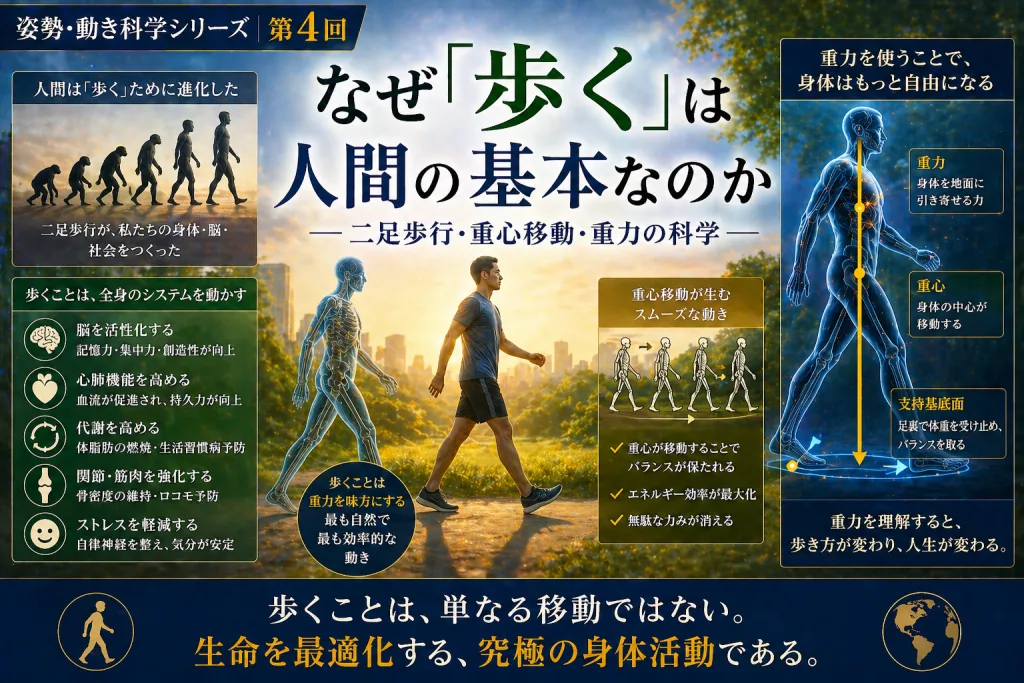
Posture and Movement Science Series — The Science of the Relationship Between Gravity and the Body | Part 4
Introduction
In Part 1, I explored the anthropology of “sitting.” In Part 2, I looked at the metabolic influence of sitting for long periods. In Part 3, I unraveled the science of “standing” and its relationship to Tonic Function.
In Part 4, I enter “walking.” Now that sitting and standing have been brought to a close, why does the human being walk? What kind of action is walking, and why is the human being so good at walking? — I consider this from the perspectives of evolution, anatomy, and Rolfing.
→ Part 1: What Is the Difference Between Squatting and Sitting
→ Part 2: Why Sitting for Long Periods Is Bad for the Body
→ Part 3: Why “Standing” Is Not Tiring — The Mechanism of Gravity and the Antigravity Muscles
The Human Being Is a Creature “Born to Walk”
The cheetah instantly runs down prey 100 meters ahead. The chimpanzee moves swiftly through the trees. So what is the characteristic of human locomotion?
The answer is “being able to walk long distances efficiently.”
In short-distance running, the human being falls far short of animals. But the efficiency of walking long distances on two legs is so high as to be beyond comparison with other animals. Daniel Lieberman, in his book Exercised, showed that bipedal walking can move the body with less energy than quadrupedal walking.
This highly efficient walking was the core of humanity’s survival strategy. “Persistence hunting” — chasing prey across the African savanna, walking for several hours and tens of kilometers until the prey tires and collapses — held together precisely because of the efficiency of this bipedal walking. And that power to walk spread humanity from Africa across the whole world. → Upright Bipedal Walking — Energy-Efficient, but with a Risk of Falling
→ Upright Bipedal Walking — Energy-Efficient, but with a Risk of Falling
“Walking” and “Running” Are Entirely Different Actions
Walking and running differ fundamentally in both the muscles used and the mechanical mechanism.
When walking, one foot is always in contact with the ground. The body’s center of gravity moves like an “inverted pendulum” — with the support leg as the axis, the body draws an arc and advances forward. Each time a step is taken, the body draws a mountain-shaped trajectory. At this time, the energy of gravity is skillfully used and converted into the propulsive force of the next step.
When running, there is a moment of “aerial suspension” in which both feet leave the ground at the same time. The legs move like hopping (a bouncing, spring-like pole), the Achilles tendon stretches and stores energy, and by recoil, pushes the body forward.
| Walking | Running | |
|---|---|---|
| Model | Inverted pendulum | Spring-mass model |
| Contact | One foot always in contact | Aerial suspension present |
| Energy | Converts gravity into forward force | Achilles tendon functions as a spring |
In short, “walking” is not “slow running.” It is an independent mode of movement that operates by an entirely different mechanical mechanism.
→ Why Can the Human Being “Run” for Long Periods of Time?
The Bodily Mechanism That Supports Gait
The human being can walk efficiently because the body’s structure is optimized for gait.
The S-curve of the spine absorbs the impact during walking. The impact arising each time a foot lands on the ground is distributed in the order of the arch, the knee, the hip joint, and the spine, minimizing the transmission to the head.
The rotation of the pelvis produces stride length. Each time a step is taken, the pelvis rotates left and right by about 4–5 degrees, and this widens the stride and raises energy efficiency. When the pelvis is stiff, the stride becomes small, and the linkage to the whole body is also lost.
The swing of the arms balances the lower body. When the right foot comes forward, the left arm comes forward — this contralateral movement causes rotation of the trunk and carries energy over into the next step.
When all of these are linked, walking becomes not “an action the brain commands,” but “an action the body generates automatically” — this is the scene in which Tonic Function (the automatic response of the deep muscles), treated in Part 5, is exercised in gait.
The Problem with the Modern Way of Walking
Observing the way of walking in a Rolfing session, a pattern common to modern people comes into view.
The stride is small, and the pelvis is not moving. From long periods of sitting, the iliopsoas has shortened, and the range of motion of the hip joint has narrowed. Because the pelvis cannot rotate, propulsive force is lost, and the burden on the knees and lower back increases.
The head is forward. The postural habits of the smartphone, desk work, and a forward-leaning posture draw the head forward. It is said that for every 5 cm the head comes forward, the burden on the neck roughly doubles. When the head’s position is off, the impact during walking can no longer be properly distributed across the whole spine.
Landing hard from the heel. Modern thick-soled shoes encourage an excessive dependence on the heel. When striking hard from the heel, the ground reaction force concentrates on the knees and lower back. Walking barefoot or in thin-soled shoes naturally changes the landing to the forefoot or midfoot, making it easier to disperse energy across the whole sole.
The Effect Walking Brings to the Brain
Walking directly influences not only the body but also the brain.
According to Daniel Lieberman’s research, walking is, for the human being, the most natural “activation of the brain.” During walking, three things — proprioception from the soles of the feet, the vestibular system, and vision — are integrated, and the brain continually keeps updating the body’s position within space. This process of integration gives a good influence to cognitive function, concentration, and mood.
Speaking from the perspective of Tonic Function, treated in Part 5, walking mobilizes all of Coordination, Perception, and Meaning. That walking is felt to “organize thought” and “change mood” is because the integration of body and brain is deepening.
Rolfing and “Walking”
Rolfing’s ten-session series ultimately aims at the integration of the “walking” posture. The 8th to 10th sessions are called “integration sessions,” and on the foundation of sitting and standing that has been organized up to then, they guide the whole body to coordinate within the dynamic action of walking.
As the session progresses, changes appear in the client’s way of walking. “Walking became easier,” “my feet feel as if they stick to the ground,” “my stride naturally widened,” “my shoulders came to sway” — these are signs that Tonic Function has begun to work automatically within gait.
Ms. Ayako Kakizaki, after completing Rolfing’s ten sessions, wrote this:
“I would like to recommend Rolfing to those who ‘want to take a pleasant walk.'”
A “pleasant gait” is not trying to walk correctly with conscious effort, but a way of walking in which the body moves naturally. That is also the culmination of the theme running through this whole series — “a body that can move naturally even when force is released.”
→ Ms. Ayako Kakizaki’s Testimonial
Posture and Movement Science Series — The Science of the Relationship Between Gravity and the Body (All 6 Parts)
Part 1: What Is the Difference Between Squatting and Sitting? — How Chair Culture Has Shaped the Body
→ Read Part 1
Part 2: Why Is Sitting for Long Periods Bad for the Body? — The Science of Visceral Fat, Chronic Inflammation, and Stress
→ Read Part 2
Part 3: Why Is “Standing” Not Tiring? — The Mechanism of Gravity and the Antigravity Muscles
→ Read Part 3
Part 4: Why “Walking” Is Fundamental to the Human Being — The Science of Bipedal Walking, Weight Shift, and Gravity (this article)
Part 5: Why Good Posture Is Not a Matter of Muscle Strength — Tonic Function and Its Relationship to Gravity
→ Read Part 5
Part 6: Why Does an “Easy Posture” Exist? — From the Perspective of Gravity, Fascia, and Rolfing
→ Read Part 6
Understanding posture and movement scientifically is one entry point for updating the “Recognition OS.” The theme of integrating thought, emotion, and body is explored in greater depth in the “Recognition OS” series at Mind and Bodywork Lab.
→ Mind and Bodywork Lab: How to Navigate This Site (only in Japanese)
A trial session is a place to begin by confirming what is happening within the body.
Hidefumi Otsuka, Ph.D. | Certified Advanced Rolfer™ / Rolf Movement Practitioner
Completed the doctoral program at the University of Tokyo Graduate School of Medicine. After a career in the pharmaceutical industry, has offered Rolfing® sessions in Shibuya since 2015, working under the theme of “the integration of thought, emotion, and body.”