
A note for readers outside Japan: this is the second half of a two-part article. Titles of works follow the Nara National Museum’s official English wording. Japanese terms are glossed on first use, and the one book cited at the end exists in English translation; details are in the References.
Introduction
Part One was about the body in Buddhist painting, as I saw it at The Nara National Museum‘s special exhibition “Buddhist Paintings of Nara: Reviving the Splendor of Classical Tradition.” Where sculpture presents the body through mass, painting presents it through two things only: the line of the contour, and the lines of the folds in cloth. And in the Kamakura period, Chōmyō — an ebusshi, a Buddhist painter-monk of the Nara-based painting atelier (Jp. nanto edokoro) — drew four guardian kings treading on rock, using nothing but line.
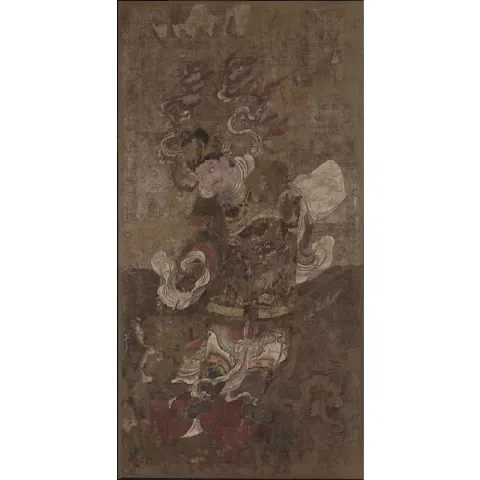
Part One left one piece of unfinished business. Almost nothing from the Heian period stayed with me. The National Treasure Eleven-headed Kannon (Jp. Jūichimen Kannon) was there, and I cannot reconstruct what was in front of me. I said the reason would come in Part Two.
The way toward that answer begins with a single temple.
The vanished temple — Uchiyama Eikyū-ji
Uchiyama Eikyū-ji, the subject of Chapter 5 mentioned in Part One, was where I stood longest that day.
Uchiyama Eikyū-ji was a temple in what is now Tenri, south of Nara. It was founded in 1114 by imperial vow of the Retired Emperor Toba. It developed as a major branch temple of Kōfuku-ji, and its complex was said to be splendid enough to be called “the Nikkō of the West,” after the great mausoleum complex north of Edo.
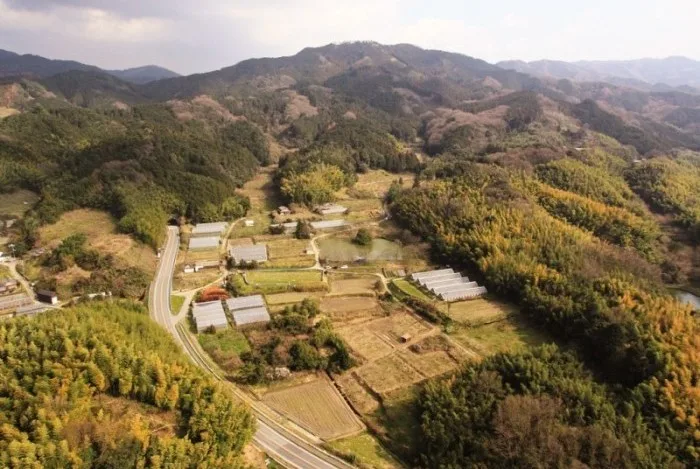
Now there is nothing.
It was abolished in the early Meiji years under the edict separating Shinto from Buddhism. The halls and pagodas were removed without a trace. What remains on the site is the pond that stood in front of the main hall, and a stone marker for the Kaya Gosho, where the Emperor Go-Daigo is said to have hidden in the fourteenth century. Even among temples struck by the anti-Buddhist movement, a case of disappearance this complete is said to be rare.
Not one building was left.
What survived were the paintings and images that had furnished the halls. They were dispersed. Chōmyō’s Four Guardian Kings, discussed in Part One, went to Boston; Kōen’s Fudō Myōō is in Setagaya, in Tokyo. The National Treasure known as the Ryōbu Daikyō Kantoku-zu — a pair of paintings depicting the revelation of the two great esoteric scriptures, thought to have been fittings for the altar platform of the temple’s Shingon hall — is in the Fujita Museum in Osaka.
That work carries another point of interest. It was painted in 1136, in the Heian period, by Fujiwara no Munehiro. Its painter was not an ebusshi of Nara but a court painter active in Kyoto, working in the yamato-e manner — the indigenous courtly style — for a great temple in Nara.
So this temple held both the work of a court painter of the capital and the work of the craftsmen of the Nara ateliers. Across a gap of a century or so, two hands of entirely different character were present inside the same temple.
This exhibition gathered what had been scattered back into one place, temporarily. The interior of a phantom temple, partially reassembled inside a gallery.
And one more work in this chapter I have not been able to forget.
Painted columns with Buddhist figures (Fujita Museum; on display until 23 August). Eight columns that are thought to have furnished the inner sanctuary of an octagonal building, painted with bodhisattvas and other figures. They may have furnished a building at Uchiyama Eikyū-ji.
An aside: the Ryōbu Daikyō Kantoku-zu, from the same museum, goes on display from 25 August, exchanged with these columns. What was on view the day I visited was the columns. Rotations of this kind decide what can be seen and what cannot.
The columns themselves were the picture surface.
I have been writing about a division between the flat and the solid, but this is neither. Bodies painted directly onto the structural members of a building. A person entering the hall would be surrounded by eight columns. Not surrounded by pictures. Entering a space where the building itself is covered in bodies.
And here I had to revise my own reading.
When the temple went, the solid was lost and the flat survived — that is what I had thought at first. What could be moved remained, and what could not, went.
But the columns were moved.
Not as building parts. As paintings. Cut away from their structure and treated as picture surfaces, they survived. The octagonal hall is gone; its eight columns are not.
What decided survival was not size. It was whether something could be cut out as a picture surface.
Isonokami Jingū, and the chickens
There is a personal discovery here too.
Uchiyama Eikyū-ji had developed as the jingū-ji of Isonokami Jingū — the Buddhist temple attached to a Shinto shrine, in the combined worship that was ordinary in Japan before the Meiji period. The separation edict cut the deity and the Buddha apart. The temple vanished; the shrine remained.
And of the buildings of Uchiyama Eikyū-ji, exactly one survived. The worship hall of the Sumiyoshi shrine that served as the temple’s tutelary shrine. Its main sanctuary burned in an arson fire in 1890, and the worship hall alone was left standing, derelict. In 1914 it was moved roughly eight hundred meters to Isonokami Jingū. It now stands as the worship hall of the subsidiary shrine Izumo Takeo Jinja. It is a National Treasure.
It was built in 1137 and reached its present form through renovations in the thirteenth and fourteenth centuries. Five bays by one, long and narrow, with the central bay left unfloored as an earthen passageway. It is said to be the oldest surviving example of the wari-haiden form — the “split worship hall,” a hall to be walked through rather than only stood before.
I have been to Isonokami Jingū. On 8 February 2025.
Tracing back what I remember from that visit surprised me a little. What is clearly there is the chickens.
Chickens run loose in the precincts of Isonokami Jingū. They are regarded as messengers of the deity, and they walk about paying no attention to visitors and climb up into the trees. In the winter precinct, they made an inordinate impression.
And of the National Treasure worship hall, I remember very little.
Which is to say I had already stood in front of the sole surviving structure of Uchiyama Eikyū-ji. Without knowing it.
The day before, at the ordination platform hall of Tōdai-ji, I had been thinking about exactly this. Thirty years ago I had walked straight past those stone steps. I had not done the reading, so I could not see. Different place, identical structure. It was in front of me, and I did not see it.
The way this single building survived gives one more thing to think about. A Buddhist temple building lived on as a Shinto shrine building. The Meiji separation was a movement to divide Buddha from deity, and what came through it was one hall that had moved its name over to the side of the deity. The force that tried to divide left behind the thing it could not finish dividing.
Kasuga mandala — a painting made before the division
There is one more work from this exhibition I keep returning to. The Mandala of Kasuga Shrine.
This is a general term for devotional paintings based on faith in Kasuga Taisha, the great shrine of Nara. They include the Kasuga miya mandara, depicting the shrine buildings and the landscape of the sacred precinct, and the Kasuga shika mandara, depicting the sacred deer regarded as the messengers of the Kasuga deity. These too were the work of the ebusshi of Nara. Works from the Museum of Fine Arts, Boston that had not been available to see in Japan were on display.
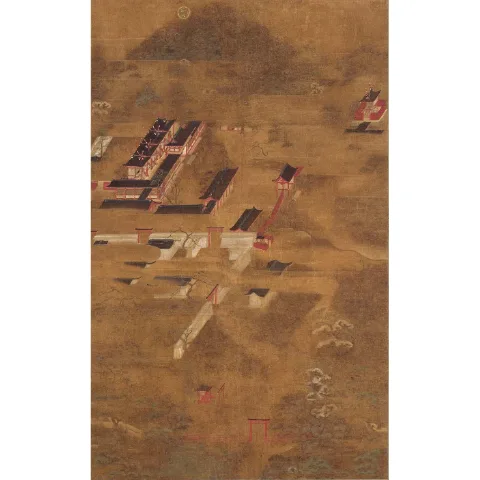
They belong to the category called suijaku-ga. The Buddha appears in the form of a native deity — paintings that give pictorial form to that idea, which held the two traditions together for centuries.
Here everything connects.
The Mandala of Kasuga Shrine is a painting of the world before deity and Buddha were divided.
And in the same exhibition stand the remains of a temple that vanished as a result of that division. The Four Guardian Kings of Uchiyama Eikyū-ji, Kōen’s Fudō Myōō, the eight columns. Objects from the temple attached to Isonokami Jingū.
Paintings depicting the combined worship, and the scar of the separation, sharing one exhibition.
What had been layered up over centuries was torn apart in a few years of the Meiji period. Written out like that it may be too simple. Still, walking the galleries, the weight of those two things being placed in the same room arrives ahead of the reasoning.
What stayed, and what did not
Now back to the question left over from Part One.
What stayed with me from that day:
- Chōmyō’s Four Guardian Kings. Treading on rock, weight in the middle of transferring
- The painted columns. A space enclosed by eight of them
- The Mandala of Kasuga Shrine. The shrine buildings, Mt. Mikasa, the sacred deer
- And the chickens of Isonokami Jingū, walking
What did not:
- The Heian Eleven-headed Kannon. A still, refined body
- The National Treasure worship hall. A building that has stood without moving for nearly nine hundred years
At first I thought that everything that stayed was moving. The guardian kings are transferring their weight; the chickens are walking. The eye picks up movement without being asked. No training and no knowledge required.
But the Mandala of Kasuga Shrine is not moving. It is a landscape view of shrine buildings and a mountain.
Thinking it through, I arrived at a second reason. That was a place I had walked the day before. Kasuga Taisha, Mt. Mikasa, Nara Park. The sacred deer in the painting — I had seen dozens of them lying in the shade the previous day.
So what stayed was of two kinds. Things that are moving, and places my own body has passed through.
Neither requires knowledge. Either the eye picks it up unbidden, or the body already knows it. Whatever is neither of those goes by.
The Heian Eleven-headed Kannon had no movement and was not a place I had been. So it did not stay.
And the worship hall was inside a place I had been. It still did not stay. Place, the body remembers. But what gets seen within that place is not settled without a way of seeing.
As someone who works with the body, this is a finding I want to set down honestly. The information a refined Heian body carries is held in stillness. I did not have the frame for reading it.
What comes of setting three periods side by side
Here I want to return to something I wrote more than ten years ago.
During Rolfing basic training I wrote twice about the history of painting and the body. The account of Western painting I gave then ran roughly as follows. In medieval Christian painting the body is rendered two-dimensionally; Giotto brings in three-dimensional space; Raphael handles symmetry mathematically; and the Impressionists arrive at depth through the vanishing point.
That account has a direction. From two dimensions to three. It can be written as progress.
The Buddhist painting of Nara does not go that way.
The Tenpyō of Nara is placed as the standard; the Heian period moves away from it toward refinement; the Kamakura period returns to Tenpyō. Not progress, but a going away from a standard and a coming back to it. And on the return, weight and movement have been added, so the place returned to is not the same place. Chōmyō’s Four Guardian Kings are, I think, the high point of that return.
There is also the case of Uchiyama Eikyū-ji. History does not only add. It also subtracts. Every hall and pagoda disappears, and the paintings and columns scatter across the country. What we look at now in a gallery is what was left after that subtraction.
This counts as evidence against the framework I set up more than ten years ago. The history of how the body is understood does not move in one direction. Western painting could be read as a progression because the material happened to have that shape, not because the history of bodily understanding is one-directional in its nature.
Looking again from the eastern side is what made that visible. In the previous article I wrote that this had become an occasion to revisit, from the East, a path I had traced more than ten years ago. What came out of the revisiting was a correction to the path itself.
Does a Rolfer see the body as line, or as volume?
To bring this back to the work.
During a session I move back and forth between two ways of looking.
Touching is three-dimensional. Mass, weight, direction, the relationship with the floor. What the hand is handling is a structure in three dimensions, and there is no line in it.
Looking is line. Contour, left-right difference, where the head is carried, how the arm falls from the shoulder. What gets read when a client stands and walks is almost entirely line information.
The structure of the Ten-Series corresponds to this as well. Session 3, working from the side to address the spread of space, is the work of grasping the body again as three-dimensional. Session 7, the face and head, addresses how a single point — the position of the head — changes the line of the whole body. That was precisely where, in the history of painting, Modigliani and Piero della Francesca came in.
Seeing as line, working in volume.
And that returns to the chickens of Isonokami Jingū. What is moving, the eye picks up unbidden. Ask a client to walk and the information comes out by itself. The difficulty is the body at rest. Reading what does not move requires having the reading in hand beforehand.
If looking at a large quantity of Buddhist painting amounts to training, this is where. Buddhist painting depicts nothing but bodies at rest. And they still read as bodies. It becomes teaching material for what it is that makes a body legible as a body, in line alone.
Volume in Ueno, line in Nara. Two days apart, both sides of how the body is seen.
Next, walking on my own feet. In August I go to Shikoku. What walking is — I would like to set that out next time as a matter of bone and tendon.
Related articles
- The History of Painting and the Body (1) — Viewing the Body Through the History of Western Painting
- The History of Painting and the Body (2) — How Do We View the Face and Head Through the History of Painting?
- The Body Carved in Three Dimensions — From the “Kūkai and the Treasures of Shingon” Exhibition, Toward Shikoku
- The History of Painting and the Body (3) — The Body Drawn as Line (Part One): Buddhist Painting, and Chōmyō of the Nara Ateliers
- The History of Painting and the Body (3) — The Body Drawn as Line (Part Two) — this article
References
- Special Exhibition in Collaboration with the Museum of Fine Arts, Boston, “Buddhist Paintings of Nara: Reviving the Splendor of Classical Tradition,” Nara National Museum, 18 July – 13 September 2026 (First rotation 18 July – 16 August; second rotation 18 August – 13 September)
- Chapter 5, “Uchiyama Eikyū-ji — Sculptors and Painters of Nara in Competition” (title translated from the Japanese)
- Four Guardian Kings (Kōmokuten, the Guardian of the West), by Chōmyō. Kamakura period, 13th century. Museum of Fine Arts, Boston (Fenollosa-Weld Collection)
- Painted columns with Buddhist figures. Fujita Museum (on display until 23 August)
- Ryōbu Daikyō Kantoku-zu (National Treasure), Heian period, 1136, by Fujiwara no Munehiro. Fujita Museum, Osaka (on display 25 August – 13 September)
- Fudō Myōō and Eight Youths (Important Cultural Property), Kamakura period; carved by Kōen, 1269; polychromed by Chōmyō, 1272. Setagayasan Kannon-ji, Tokyo
- Mandala of Kasuga Shrine, Nanbokuchō period, 14th century. Museum of Fine Arts, Boston (William Sturgis Bigelow Collection), and other works of the Kasuga mandala type
- Eleven-headed Kannon (Jp. Jūichimen Kannon, Sk. Ekadaśamukha) (National Treasure), Heian period, 12th century. Nara National Museum
- Official exhibition site, “Highlights: Chapter 5”: https://nantobutsuga2026.exhibit.jp/highlights/chapter5/ (in Japanese)
- National Treasure, Worship Hall of Izumo Takeo Jinja, Isonokami Jingū (formerly the worship hall of the Sumiyoshi tutelary shrine of Uchiyama Eikyū-ji; relocated 1914)
- Nakamura Hajime, Ways of Thinking of Eastern Peoples. An English edition exists: “Ways of Thinking of Eastern Peoples: India, China, Tibet, Japan,” edited by Philip P. Wiener. The Japanese series I read is fuller than the single-volume English edition.