
Sessions 4, 5, and 6 organize the medial line by way of what lies above the pelvis — the psoas major, the sacrum, and the spine — and what lies below it, the pelvic floor and the adductors: Session 4 working from the adductors to the area of the pelvic floor, Session 5 the psoas major and the diaphragm, Session 6 the spine and the sacrum.

Session 6 continues from Sessions 4 and 5, organizing with the medial line in awareness. In Session 6 the work runs along the back of the body.

The key location in Session 6 is the sacrum, sitting at the center of the back of the body. The sacrum is part of the pelvis, and also the place where the spine ends. Being connected to the spine, a distortion in the sacrum can produce distortions elsewhere along it. The sacrum also connects to the lower limbs by way of ligaments.
The pelvis consists of the hip bones — the ilium, the pubis, and the ischium. The sacrum joins the ilium precisely at the sacroiliac joint.

With the sacrum, what draws attention is the direction it faces in relation to the ilium.
In sitting, the width of the ilium narrows, the width of the sit bones widens, and the sacrum tilts forward relative to the ilium — nutation, from the Latin nutare, to nod.
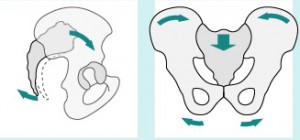
In standing, by contrast, the width of the ilium widens, the width of the sit bones narrows, and the sacrum tilts back relative to the ilium — counter-nutation, counter meaning the reverse.

Excessive counter-nutation produces problems. The various ligaments between the sacrum and the ilium, shown in white in the photograph below, may be under tension, or the piriformis, which maintains the position of the sacrum, may have gone slack.


Counter-nutation of the sacrum also affects the rectus abdominis and the obliques, directly opposite it.
For this reason, after releasing the unnecessary tension bound to the pelvis by way of the piriformis, the hamstrings, and the gluteus maximus, the work proceeds to release the tension around the ligaments of the sacrum.
Stated more explicitly, the goals of Session 6 are:
- Organize the medial line from the feet through the pelvis and the spinal column.
- Organize the medial line along the back: the ligaments around the sacrum, the abdominals, the piriformis, and so on.
- The results of body reading follow. The tasks carried over from Sessions 4 and 5 should be apparent.
- The chest is under compression from above and below — from the neck above, from the rectus abdominis below (same as Sessions 4 and 5).
- There is a left-right difference between the torso and the legs (same as Sessions 4 and 5).
- Bringing the medial line into awareness, the upper and lower body come apart — awareness around the ribs and abdomen is especially thin (same as Session 5).
- Effort in the abdominals intensifies the compression of the chest (same as Session 5).
What matters is the compression of the chest. Since the effort in the psoas major does not release easily, tension around the abdomen emerges along with it. Session 5 approached the tension in the rectus abdominis and the psoas major connected to it, through work on the psoas major; Session 6 was therefore met with an interest in how far the tension around the sacrum could be released, and what effect that would have on the whole body.
The work this time proceeded lying face down. To reach the region around the sacrum, the tension appearing along the surface near the feet — from the heels to the hamstrings — and along the back was released first. Then came the ligaments and muscles near the sacrum in the pelvis: the piriformis, the sacrotuberous ligament, the anterior sacroiliac ligament, the gemellus superior and inferior. Still face down, the fascia of the psoas major and around the sternum was released. What proved interesting was that the left side took longer than the right to let go.
Finally came a seated exercise. Bringing awareness to the tip of the sacrum, it is a re-education exercise for increasing the mobility of the sacrum. Remarkably, increasing that mobility let the effort leave the psoas major, and a sensation of hanging emerged. The sit bones came more fully to the ground while sitting, and there was a sense of the sit bones widening. With the sacrum freed, nutation registered as well, if only slightly. Breathing through the chest became available without much effort. Rising became possible without engaging the abdomen and back.

That thoracic breathing deepens in proportion to the freedom of the sacrum was interesting. What struck me as interesting about receiving Rolfing sessions is that the brain cannot keep pace with the changes in the body. The task with walking, for instance, is understood, yet it does not become habit easily. Presumably the brain takes time to digest a new movement of the body. In giving a Rolfing session, giving the brain sufficient space and time to digest matters as well.
Put the other way around:
Thought exerts a considerable influence on change in the body.
Next is Session 7. Connecting the head to the body as a whole is the task, and it is the last session of the medial line.
Note, August 2026
Two discoveries are recorded here.
One belongs to the body. Increasing the mobility of the sacrum let the effort leave the psoas major — effort that had not released no matter how much the front was worked. What Session 5 could not release by working the front came away through working the back (see “Session 5: Organizing the Psoas Major“). The idea that the body forms a pair, front and back — bidirectionality — appeared here as a direct instance.
The other took longer to bear fruit.
“The brain cannot keep pace with the changes in the body.”
“In giving a Rolfing session, giving the brain sufficient space and time to digest matters as well.”
Eleven years later, this observation turns out to have been organized as the concept of Closure.
Among the five Principles of Rolfing formulated by Jeff Maitland and others, the fifth is CLOSURE — giving an appropriate ending to the process. In the 2025 Advanced Training, the reason closure matters was explained this way: it is what allows what comes next to happen.
Closure is the process by which the experience of a session is settled bodily, digested through sensation, and given meaning integratively. It is positioned as the step that allows the client to feel the effect of the session in a lasting way and to move naturally into the next change (see “Journey to Becoming an Advanced Rolfer — A Summary of the Road to Certification“).
What this piece describes as giving the brain space and time to digest was precisely the question of digestion and integration. Even when the work changes the body, its settling requires a separate span of time.
And this piece experiences that from the receiving side. The passage about understanding the task with walking yet failing to make it habit is exactly that. On becoming a practitioner, how to handle this lag becomes the question.
“Thought exerts a considerable influence on change in the body.”
This line, too, connects to what came later. As the structure of the body changes, the patterns of emotion and thought change with it. Conversely, if the side of thought cannot receive the change, the change in the body does not settle either. That Rolfing is called transformation through the body rests on this running in both directions.