
From October 9 to 12, 2015, I am staying in Osaka for training in Source Point Therapy (SPT). I wrote about the first day separately (see “Learning the Blueprint: The Information Needed for a Human Being to Take Human Form“). Before covering days two and three, I want to think about the training more generally.
What has been good about coming to Osaka is getting away from Tokyo. It has let me look back calmly on the seventeen days of Chi Nei Tsang training.

Unlike that training, the SPT work makes complete sense to me technically. It is simple, and it is built so that you can practice it with confidence from the next day. Hiro’s own character has something to do with it, of course. He draws out what people are good at, without constraint. I have been able to learn in my own way, and at ease.
What makes a place that people gather to? Why do people follow Hiro? There is a great deal to learn here.

The Chi Nei Tsang training felt like the opposite. The feedback I received from Mr. Ouchi at my third attempt at the exam was useful to me, and at the same time it made me think about what kind of remarks actually raise my motivation.

I acknowledge that some of the feedback was useful. But some of it left me tilting my head.
Some examples: that early in the training there were times when I only interacted with certain people. That I looked at my phone often, and that shutting myself off without regard for those around me was not good. That by staying with particular people I was getting in the way of their interacting with others, and causing them trouble.
For my own part, there are times in a seminar when I want to stay inside my own world, and when I am concentrating I would rather not spend attention on the people around me. That is part of how I learn. I wanted to learn without constraint, and it felt as though the way I did that was being rejected.

Perhaps I sensed this without articulating it. Through the training I could not relax; I had to approach it with my guard up. My health was not good and fatigue set in. Between that and an atmosphere in which failure was not permitted, I am convinced that my inability to work at full capacity showed in the results of the midterm and final examinations.

Beyond the absence of any consideration for the fact that I could not bring my own character into the room, I was told that I look at people not as people but through objects and books. The way I learn was tied to a judgment that I was not connecting with clients, and stated as a conclusion.
I found it hard to follow. My motivation to practice Chi Nei Tsang has not risen, I have been thinking of stopping, and it has not settled in me. Some of that may be my own capacity. But I feel the atmosphere of a training carries a great deal of weight as well.

Why did this sit so badly with me?
Most likely because I had taken Giovanni’s Phase II. That education was the exact opposite of the feedback I received in Chi Nei Tsang.
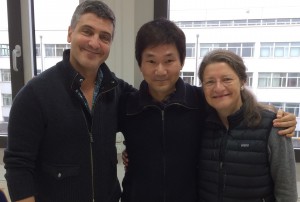
Giovanni took holding the space seriously, in order to build a safe environment for learning. Whether you looked at your phone, slept, ate, or talked with one particular person, no correction came, and the training moved on. That is how that person learns, and he respects it fully.
He was not simply leaving people alone, though. If someone looked even slightly sad or troubled, they would be called into another room straight away. Out of earshot of the others, he would listen quietly and offer a hand. In Phase II, even when it came to deciding who would pair up for sessions, he asked us to write down on paper if there was anyone we found difficult.
Giovanni also knew that how one connects with a client differs from person to person. His stance was to wait until each student found their own way to it, and he never imposed his own correct answer on anyone. Nor did he ever say that someone lacked the ability.

Then there was the feedback in the final interview. It reflects how Giovanni thinks — very specific, and tied directly to action.
To give part of it: under the question of where the student is able to bring their capacity to bear, he wrote that progress was visible across every item, with marked progress in manual skill and in connecting purpose with strategy, and that it was good that I was building a foundation while judging matters from my own experience.
Under the question of where the student needs support, he wrote that giving space to myself and to the client would make sessions easier to conduct, and that this would in turn refine my felt sense — the bodily sensing that precedes words — and help me in session.
I cannot overstate how much this feedback encouraged me, or what it meant to someone trying to make a life in bodywork. That a range of clients now come to me for Rolfing is, I think, thanks to having been given words like these.
On the evening of October 9, while in Osaka, I met an acquaintance, and the balance between freedom and order in education came up. Which of the two a training emphasizes changes what it is. Probably the fit between student and teacher is decided by each student’s own sense of what they need when they choose.
The training settles down soon. When it is my turn to teach, what will I be paying attention to? This has certainly been a good occasion to think about that.
Note, August 2026
The subject of this piece is the importance of choosing a teacher. But all I could actually write at the time was a comparison of how I had been treated in two places. Was I able to learn at ease? Was my way of learning respected? Impressions rather than criteria.
Ten years later, I set out what I look at when choosing a continuing education course, as four criteria (see “How to Choose Continuing Education — Four Things I Look At Before Signing Up“). The first of them is whether the feedback is grounded in observation.
What I wrote here became that criterion.
The difference between the two kinds of feedback
Giovanni’s final interview had two parts. Where is the student able to bring their capacity to bear? Where do they need support? Under the first, he wrote that there was marked progress in manual skill and in connecting purpose with strategy. Under the second, that giving space to myself and to the client would make sessions easier to conduct.
Both describe observed behavior. And both tell you what to do next.
The other feedback had a different shape. It began from observations — that I looked at my phone often, that I stayed with particular people — and moved to a judgment: that I look at people not as people but through objects and books. From there it arrived at a conclusion, that I was not connecting with clients.
From observation to character in a single step. At the time, all I could write was that it sat badly with me. I said I found it hard to follow.
Ten years to the words
After this, occasions to choose courses multiplied. Maintaining certification requires continuing education credits, and which courses fill them is up to the practitioner. What could not be chosen in the basic training became a matter of choice.
The four criteria are my attempt to put into words what I look at. Whether the feedback is grounded in observation. Whether the teacher has decided what not to teach. Whether the course works with principles rather than techniques. And whether the teacher does what they say.
The first of these came from this piece — written in October 2015, between days of training in Osaka, in the place where I noted that getting away from Tokyo had let me look back calmly.
Criteria only help, though, when the options are lined up in front of you. Neither of the two educations described here was chosen by me. Giovanni was assigned as the teacher for Phase II, and the Chi Nei Tsang training was part of a course I had enrolled in. What I received in places I could not choose became the criteria for choosing later.
In the 2025 Advanced Training, I studied the practitioner’s way of being with Ray McCall and Hiroyoshi Tahata — the question of what state the practitioner is in when meeting a client. There too, the way of being of the person teaching was at issue. This piece closes by asking what I will pay attention to when it is my turn to teach. Ten years on, that question is still open.