Why Life Changes When You Receive a Bodywork Session (Part 4 of 4)
Introduction
There is such a thing as ideal posture. Seen from the side, the ear, the shoulder, the hip and the ankle in one straight line — that is how it is described. Many people try to bring themselves into line with it and do not get there.
Why is it hard to line yourself up with an ideal posture? There is a reason.
Part 1 looked at how standing and breathing are already settled before thinking, through the phenomenological term prereflective.
Part 2 looked at which way a person is turned in relation to space. What one is turned toward is the surface, and to turn you need a point to turn from; that point is the core. It dealt with how those two stand to each other.
Part 3 introduced the point that trying to let go of tension is also will, and that allowing is not a way of doing but a way of being.
The whole layout is set out on the overview page.
- Why Life Changes When You Receive a Bodywork Session
- Why Good Posture Never Lasts — What “Prereflective” Means
- Why the Same Room Feels Wide One Day and Narrow the Next — What “Core” and “Surface” Mean
- Why You Cannot Relax Just by Deciding To — What “Allowing” Means
This fourth part is limitation and possibility. And since it is the last, it returns to the question we started with.
To be is to be a form
Jeffrey Maitland begins by introducing the word form. And he uses it as a word for speaking about human form.
Say form and we picture an outline, a contour. That is included, but what he means is wider. Living form, he writes, is the way, the style, the manner in which a person is or becomes who and what she is.
A more concrete formulation sits right alongside it. To be a human form is to be a mode of orientation in space. The orientation of Part 2 is here being called form. How you stand. How deeply you breathe. How much distance you keep in front of another person. All of it together is a person’s form.
So a conflict about who you are is not a problem confined to the mind. Any conflict at the level of self is already a conflict of form, he writes. The same conflict shows in the bodily manner in which a person is present.
And every form has a boundary. To have a boundary is to have a limitation. So to be is to be a form, and to be a form is to be limited.
Which can be put the other way round. Remove every limitation and boundary from the form that is body and self, and the person ceases to be. The same holds for a cloud, a dream, a wish, a box: it is because there is a boundary that the form can be the form it is.
Part 2 described the body in fear. Soft, collapsed, its boundaries gone vague. Not wanting to be there meant that it suited the person for their outline not to be clear. A form that has a form and wants to stop having one.
Maitland draws one further distinction. When a person is at odds with their own form, the limitation is experienced as the point at which they stop being. When they are not at odds with it, the same limitation becomes the place from which they begin being who they are. The habit of speaking of body and self as opposed to each other, he writes, comes out of the first experience.
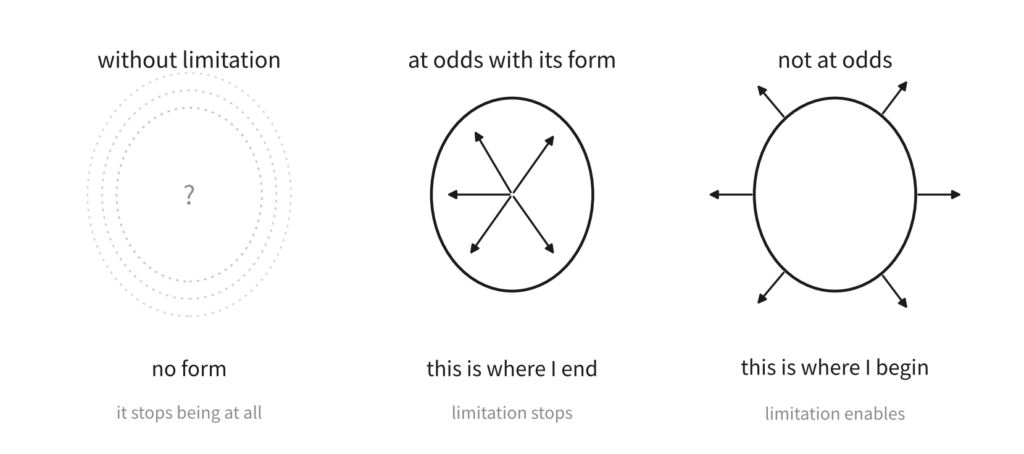
One limitation, experienced two ways. Working as what stops you, or working as the place something begins from. On the side of the limitation, nothing differs between the two.
Limitation is what makes possibility
Here comes the sentence from this book that gets quoted most.
Freedom is the creative appropriation of limitation.
To appropriate is to make something your own. The word comes from the Latin proprius, one’s own, and shares its root with property and proper. Not removing the limitation, and not putting up with it. Taking it on as yours, and making something out of it.
And he does not treat limitation and possibility as two separate things. A limitation limits some aspect of a life and at the same time affords a possibility. What is possible is always shaped by limitation. For a human being there is no unlimited possibility and no impossible limitation. The possible is always made possible by limitation.
The book gives examples. Bruce Lee is said to have had one leg shorter than the other. Rather than concluding that this ruled out mastering a martial art, he used the limitation the short leg imposed and developed a new kick that was hard to defend against. Henri Matisse, late in life, could no longer paint. So he changed materials, cut and pasted coloured paper from his bed, and left some of the most beautiful work he ever made.
In neither case did the limitation go away. What changed was the relationship to it.
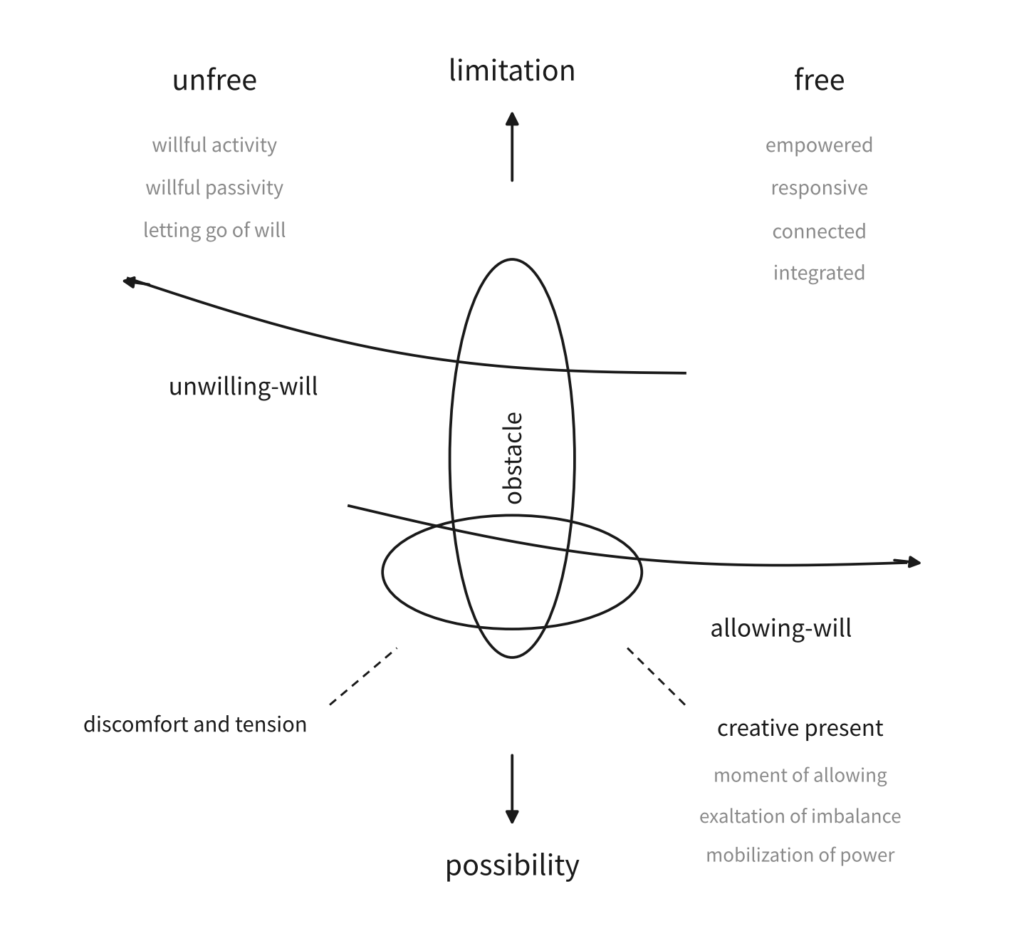
The vertical axis is limitation and possibility — limitation above, possibility below, one single axis. At the centre is the obstacle. The horizontal axis runs from unfree on the left to free on the right. The path of the unwilling-will veers off to the left before reaching the obstacle.
The path of the allowing-will, having come through the obstacle, swings down and around before going right. It does not go straight. That swing, Maitland writes, is the shape common to all transformation.
Gravity is a limitation that cannot be changed
In Rolfing, what this comes to is gravity.
Gravity cannot be changed. What Ida Rolf did was not to reduce gravity. It was to change the relationship to it — from carrying it as a burden to using it as support. Gravity itself is exactly as it was.
Rolfing, Maitland writes, is the creative appropriation of gravity. The same shape as the definition of freedom.
How the relationship to gravity is understood is set out on the page below.
And it is not only gravity. The skeleton, the history one has lived, the years one has lived them in — none of it can be changed. What can change is the relationship to it.
Assume an ideal body and you stop seeing the person
Here we return to the opening.
Maitland gives two drawbacks of working by a fixed procedure.
The first is that it presupposes the same outcome for every body. If the procedure is fixed, where it arrives is fixed too. The assumption that everyone who receives it will arrive at the same place comes in without being stated.
The second is that it cannot answer what is unique in each person. The order is decided in advance, so there is no rearranging it — this order for this person.
And behind the first assumption, one idea always comes in with it: that there is an ideal structure every body should strive to emulate. Maitland calls this somatic idealism. Formulism and somatic idealism, he writes, go hand in hand.
Elsewhere he puts it like this. Once you break free of these two, the work is no longer a matter of imposing a template on every person.
He writes about Ida Rolf herself as well. She understood the second drawback and did not always follow her own recipe. On the first she was less clear, and tended to use her idea of the ideal body as a standard — a standard for looking at clients’ bodies, and a standard for measuring whether her own work had succeeded.
Back to the line we began with. Trying to bring yourself into line with the ideal line does not work, and this is why. What you are lining yourself up with lies outside your own limitations. The shape in which ear, shoulder, hip and ankle fall into line is not the same shape for everyone.
Limitation decides when the work is finished
What, then, is the standard?
Embodied Being has a principle called Closure.
The definition runs like this. Closure has been reached when the whole person, in accordance with their own changing and unchanging limitations, is able to maintain the changes that have occurred without further intervention.
The end is not decided by whether an ideal shape has been reached. It is decided in accordance with that person’s limitations. So even within the same ten sessions, where the work ends differs from person to person.
And changing limitations and unchanging limitations are written separately. What can be altered, and what cannot. For what cannot, you change the relationship instead. Everything above takes the form of a clinical judgment here.
Not becoming someone else, but becoming more yourself
Back to the first question. Why does life change when you receive a bodywork session?
As set out in the overview, the trans in transformation means across, not alter. Not changing the form, but taking up a different relationship to it.
So transformation is not deciding on an ideal figure and bringing yourself into line with it. The limitation stays as it is, and the relationship to it changes. And as a result, a person’s being who they are comes forth without conflict.
Someone who finished the ten sessions wrote this.
Having received Rolfing, I feel that my life changed, and there is also a sense that I was able to return, from a path I had been proceeding along off-course, to my original path.
My life changed, and I returned to my original path, stand side by side in one sentence. Becoming someone else and becoming more yourself are two ways of saying the same event.
The words come afterwards
Maitland writes that solving a Zen koan takes three kinds of understanding.
The first is experiential understanding: actually knowing your own true way of being. The second is manifested understanding: being able to show that understanding bodily, without conflict. The third is conceptual understanding: being able to say the first two in words.
The three can happen at once, he writes, but usually the conceptual arrives afterwards. Minutes later, sometimes days, sometimes years.
The scene at the opening of Part 1 comes back here. What could not be said during the session becomes words on the way home or the next morning. That was the order of the three understandings.
And this series itself stands in the same place. The words come after the experience. But it is only in words, on his account, that the whole of it is complete.
The limits of this view
Three things are worth saying.
The first is that accepting limitation can be put to work as a justification for giving up. Stop at “it cannot be changed, so there is nothing to be done,” and that is the resignation that belongs to the unwilling-will. What Maitland says is the reverse: leave the limitation as it is, and make something from there. In words the two look much alike.
The second is that which limitations are the changing ones and which are not cannot be settled in advance. You find out by working. Decide it will not change and you stop touching it; decide it will and you force the person. This is not a place where a principle produces the answer.
The third is the handling of suffering. The book cites Nietzsche, the nineteenth-century philosopher who carried severe limitations in his own body, and who spoke of having reached health through illness. Maitland writes that this is not put correctly. Transformation is not always accompanied by suffering. And he puts it that in order to transform without suffering, one must first pass through the suffering of transformation. It is not an argument for making suffering the point.
Summary
To be is to be a form. A form has a boundary, and a boundary is a limitation. Take every limitation away and the form is gone.
Limitation does not take possibility away. It makes it. For a human being there is no unlimited possibility and no impossible limitation. So freedom is not removing limitation but taking it on as your own and making something from there.
Gravity cannot be changed. Neither can the skeleton, nor the history one has lived. What can change is the relationship to them. Which is why lining yourself up with an ideal shape does not work.
Here is what the four parts have shown, in one piece. How you stand is settled before thinking; its direction appears as the shape of a space; tension will not let go because you try to let it go; limitation cannot be erased. Every one of them says the same thing: it does not go as you intend.
And that is exactly why it changes. Where the side that tries to make things go as intended steps back, a person’s being who they are comes forth. That is what it means to say: not becoming someone else, but becoming more yourself.
References
Jeffrey Maitland, Spacious Body: Explorations in Somatic Ontology, North Atlantic Books, 1995
Jeffrey Maitland, Embodied Being: The Philosophical Roots of Manual Therapy, North Atlantic Books, 2016