The Path to Becoming a Rolfer — A 12-Year Training Record
A twelve-year training journey: where I studied, who I learned from, and how the work deepened.
ON THIS PAGE
- CHAPTER 1: The Encounter (2013)
- CHAPTER 2: Basic Certification (2014–2016)
- CHAPTER 3: Rolf Movement Certification (2017–2019)
- CHAPTER 4: Continuing Education (2016–2017)
- CHAPTER 5: Learning Source Point Therapy (2015–2020)
- CHAPTER 6: IMAC (2015–2021)
- CHAPTER 7: Trauma and Attachment (2013–2023)
- CHAPTER 8: Advanced Certification (2025)
- Twelve Years of Deepening Lead to the Work I Do Today
- For those who want to know why I chose this path
- For those who want to change from thought and recognition
Why did a PhD from the pharmaceutical world choose the path of Rolfing? I wrote about that reason and that mission in detail in “From PhD (Medicine) to Certified Rolfer®.”
This page records the trajectory of the twelve years of training that followed: where I studied and what I learned, who I trained under, and what changed at each stage. It is a map for those who want to understand the background behind the depth of the work.
CHAPTER 1: The Encounter (2013)
Through seven years of practicing Ashtanga Vinyasa Yoga, my bodily awareness grew steadily sharper. At the same time, it became clear that the tension held in my shoulders and neck was keeping the postures from deepening.
While trying various approaches, I met the Alexander Technique through Toshihiro Aramaki, a fellow practitioner. After several sessions the pain in my neck improved, and that is where my interest in bodywork began.
Later I met the Rolfer Akinori Ito, and in December 2013 I began receiving Rolfing.
From December 29, 2013, I received weekly sessions — ten in all — through March 2, 2014. The experience of tension releasing through a fascia-based approach was fundamentally unlike any bodywork I had tried before.
- How I Found Rolfing — Searching for a Way to Deepen the Postures
- After Completing the Ten Sessions
- Yoga — Nearly Twenty Years of Practice, and a Summary of Forty-Five Days of Training
CHAPTER 2: Basic Certification (2014–2016)
Immediately after completing the ten sessions, a conviction took shape: I want to learn this. In July 2014, I left the foreign pharmaceutical company where I had worked, and — while setting out on a journey around the world — took part in Rolfing Basic Training in Munich, Germany.
The training was structured in four phases:
- Phase I (August 2014, 15 days): Foundations of movement, anatomy, and touch (Munich)
- Phase II (October–November 2014, 33 days): Integration of the body (Munich)
- Phase III (February–March 2015, 30 days): Practice of the work (Munich)
- Phase IV Supervision (December 2016, 6 days): Supervision (Munich)
These 84 days of training were an experience of relearning, from the ground up, the relationship between body structure, gravity, and fascia. If my eleven years at the pharmaceutical company had dealt with life at the molecular level, then Rolfing was a world that dealt with the whole body living within gravity.
In March 2015 I was certified as a Certified Rolfer™, and in July of that year I began practicing in Shibuya.
- What It Takes to Become a Rolfer — An Overview of Qualifications, Organizations, and Training, Explained by a Rolfer
- Becoming a Certified Rolfer in Europe — The Certification Training of the European Rolfing Association
- What Is Rolfing’s Ten-Series? — Three Phases in Which the Body Changes, and the Flow of Each Session
CHAPTER 3: Rolf Movement Certification (2017–2019)
Two years after I began practicing as a Rolfer, I started exploring Rolf Movement, an education devoted specifically to movement.
I took part in training hosted by the ERA (European Rolfing Association). After thirty days across Parts 1 to 3, I was certified as a Rolf Movement® Practitioner in December 2019. I studied under seven teachers.
Beyond an approach to structure — fascia and posture — the addition of movement education, of how to move and how to relate to gravity, gave the work a new depth.
- On the Path to Becoming a European Rolf Movement Practitioner — The Road to Certification
- Where Rolf Movement Came From — A History from Ida Rolf to the Present
- How the Rolf Movement Practitioner Certification Works — The 30-Day Requirement and Choosing Where to Train
- What Is Rolf Movement? — Bodywork That Explores the Quality of Movement
CHAPTER 4: Continuing Education (2016–2017)
Once you are certified, what you study next is yours to decide. It is the one stage on a Rolfer’s path where the content of the learning is your own choice.
Between September 2016 and July 2017 I took six workshops, twenty-nine days in all.
- Neural Fascial Mobilization (Jonathan Martine, 12 days, Tokyo): approaching the neural fascia
- Bone Work (Sharon Wheeler, 5 days, Tokyo): working directly with bone
- Structural Integration for the Cranium (Sharon Wheeler, 4 days, Seattle): a structural approach to the cranium
- Trauma Workshop (Lael Keen, 1 day, Tokyo): the body and trauma
- Dimensions of Integration (Gael Rosewood, 4 days, Tokyo): integration from the side of movement
- Peter Schwind WS (3 days, Munich): fascia and structural integration
Sharon Wheeler and Gael Rosewood both studied directly with Ida Rolf, around 1969 and 1970. From them I could hear firsthand what Rolfing had been like before it was systematized.
- Continuing Education After Rolfing Certification — The 18-Credit Framework and a Map of the Teachers
- How to Choose Continuing Education — Four Things I Look At Before Signing Up
CHAPTER 5: Learning Source Point Therapy (2015–2020)
Beginning in October 2015, just after my Rolfing certification, I started training in Source Point Therapy. Module 1 and 2 (2015, Osaka), a supplementary course (2017, Osaka), and Module 3 (2020, Osaka) — fourteen days in all, a course of learning that spanned five years.
Accessing the body’s blueprint through light, sound, movement, and touch deepened Rolfing’s own philosophy that the answer lies within the body.
- Source Point Therapy — A Summary of Fourteen Days Across Five Years of Training
- Source Point Therapy──Energy work that connects to Blueprint – health template/field
- SourcePoint Therapy
- What Is Energy Work?
CHAPTER 6: IMAC (2015–2021)
During the same period as Source Point Therapy, I also began studying IMAC (Integrative Movement Assessment & Conditioning). It was developed by Hiroki Sato, a Rolfer who worked in the NFL and MLB as an athletic trainer and who has interpreted for osteopathy courses for more than fifteen years.
From the introductory course in December 2015 to the post-integration class in December 2021 — twenty-one days in all, a course of learning that spanned six years. I took the basic courses between December 2015 and April 2016, and then stopped. My hands had little experience, my grounding in anatomy was thin, and what I studied did not stay with me. I returned two and a half years later, in November 2018, and continued through December 2021.
It began as a way of assessing the body through the range of motion of the joints and muscles, moved on to the viscera and embryology, and developed into an assessment that incorporates the meridians. The largest thing from those six years is that I became able to confirm what changed before and after the work, somewhere other than in my own sensation. Biodynamic craniosacral work, which the Rolfing curriculum does not cover, I also studied with him.
Of the Rolfers in Japan, he is the one who has influenced me most.
In 2019, as the meridians were entering IMAC, I took a course in East Asian Medicine itself. Six days in all, taught by the acupuncturist Masamichi Abe, running from April to October at about one day a month. I wanted to know what IMAC was measuring through range of motion, from the side of the thing being measured. Yin-yang and the five elements, qi and blood and fluids, the meridians, and pattern differentiation. Over six months I went once through how East Asian Medicine sees a body.
- IMAC — A Summary of Twenty-One Days Across Six Years of Training
- East Asian Medicine — A Summary of Six Days Across Six Months of Study
CHAPTER 7: Trauma and Attachment (2013–2023)
The first time I encountered trauma as a subject was in April 2013. Within the yoga teacher training there was a one-day course on the relationship between trauma and yoga, taught by three teachers, one of them a psychosomatic physician.
Four years later, in March 2017, at a one-day workshop held alongside the Japan Rolfing Association’s general meeting, I had my first contact with Somatic Experiencing (SE). The teacher was Lael Keen, who lives in Brazil. She began by saying that half of a Rolfing ten-series goes well in the ordinary way, and that the other half calls for some approach to trauma.
That single day led, four years later, to thirty-three days.
From February 2021, twelve days of the SE beginning level (Ariel Girretto). Then, across 2022 and 2023, sixteen days of DARE (Dynamic Attachment Repatterning experience) with Patricia Meadows, and five days of Eye of the Needle (SE Master Class) with Dave Berger. For the latter two I was there as the interpreter, and studied while I worked.
Translating is work you cannot do without understanding. There is a clear difference between feeling you have understood something you heard and putting it into another language. The passages I could not translate were the passages I had not understood.
What I studied in DARE was attachment theory: how a child’s bond with a caregiver shapes later relationships and the regulation of emotion, and how that continues to appear in the body now, as breath, as muscular tension, as posture.
Rolfing works on the form of the body, but the change does not stay in the physical domain. How you connect with others, how you meet yourself — it reaches there too. The memory of connection written into the body affects breath, muscular tension, and posture.
The content of the training itself cannot be written here, but I wrote a five-part series on the attachment theory I studied in DARE, from the standpoint of Rolfing.
- Attachment Is Inscribed in the Body (Part 1) — A Five-Part Attachment Theory Series
- Trauma and Attachment — The Body’s Wisdom in the Autonomic Nervous System (Part 2) — A Five-Part Attachment Theory Series
- Attachment Can Be Rewritten — Relational Repatterning (Part 3) — A Five-Part Attachment Theory Series
- Rolfing Rewrites the Map of Safety — Restoring Connection through the Lens of Polyvagal Theory (Part 4) — A Five-Part Attachment Theory Series
- Rolfing and the Power to Reconnect: From Attachment to Integration (Part 5) — A Five-Part Attachment Theory Series
CHAPTER 8: Advanced Certification (2025)
In July 2025, I was certified as a Certified Advanced Rolfer™.
These 24 days of training were an experience of integrating ten years of practice. A decade had passed since my Basic certification, and I felt that the way I saw the body, touched it, and put it into words had changed at its very foundation.
- Journey to Becoming an Advanced Rolfer — A Summary of the Road to Certification
- Why Are Advanced Rolfer Sessions “Profound”? — Three Differences, Ten Years After Rolfer Certification
Twelve Years of Deepening Lead to the Work I Do Today
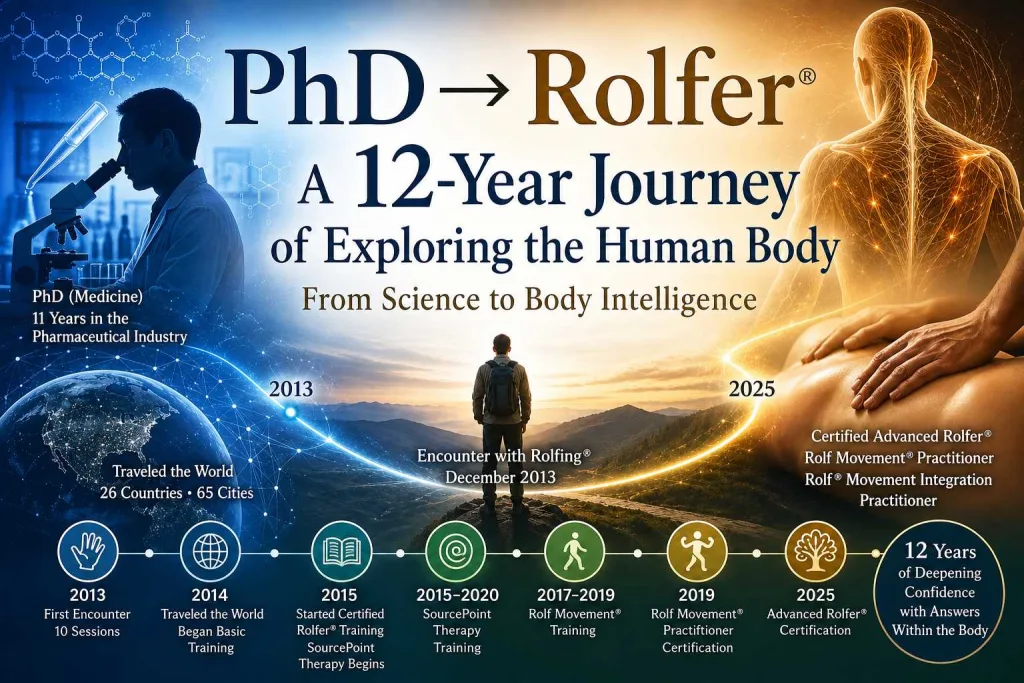
From my first session in 2013 to my Advanced certification in 2025: twelve years.
Basic certification (2015) → learning Source Point Therapy and IMAC (2015–2021) → continuing education (2016–2017) → Movement certification (2019) → Advanced certification (2025). This trajectory is not a mere accumulation of qualifications.
It is a path along which the conviction that the answer lies within the body has settled, session by session, into an ever-deeper felt sense.
Eleven years at a pharmaceutical company, a round-the-world journey across 26 countries and 65 cities, and these twelve years of inquiry as a Rolfer — every one of these experiences has become the ground for facing a single question: why can’t I move, even when I understand it in my head?
| Date | Milestone |
|---|---|
| December 2013 | Encounter with Rolfing; received 10 sessions |
| July 2014 | Left the foreign pharmaceutical company; set out on a round-the-world journey |
| August–November 2014 | Basic Training Phase I & II (Munich) |
| February–March 2015 | Basic Training Phase III; Certified Rolfer™ |
| July 2015 | Began practicing in Shibuya |
| October–November 2015 | Source Point Therapy Module 1 & 2 (Osaka) |
| December 2015–April 2016 | IMAC basic courses (Osaka) |
| September 2016–July 2017 | Continuing education: 6 workshops, 29 days (Tokyo / Seattle / Munich) |
| December 2016 | Basic Training Phase IV Supervision (Munich) |
| December 2017 | Source Point Therapy supplementary course (Osaka) |
| 2017–2019 | Rolf Movement® Practitioner training (Europe) |
| November 2018–December 2021 | IMAC: viscera, basic and advanced courses, integration, post-integration (Osaka / Tokyo) |
| April–October 2019 | East Asian Medicine course, 6 days (Kanagawa) |
| December 2019 | Certified as Rolf Movement® Practitioner |
| October 2020 | Source Point Therapy Module 3 (Osaka); training completed |
| February–November 2021 | Somatic Experiencing, beginning level (12 days, online) |
| January 2022–May 2023 | DARE (16 days, online, attending as interpreter) |
| June–July 2023 | Eye of the Needle / SE Master Class (5 days, Makuhari, attending as interpreter) |
| July 2025 | Certified Advanced Rolfer™ |
For those who want to change from the body
Start with a trial session to see what is happening in your body
For those who want to know why I chose this path
If you would like to read the mission and philosophy behind why a PhD from the pharmaceutical world chose the path of Rolfing — rather than the training record itself — see here.
For those interested in working as a Rolfer
What happened after certification — how the practice has held together as a business over twelve years, and what worked and what did not — is on a separate page.
→ Working as a Rolfer — A Record of Finding Clients and Running a Practice
For those who want to change from thought and recognition
Mind and Bodywork Lab addresses the very same question — “Why can’t I move, even when I understand it in my head?”— from the perspectives of philosophy, neuroscience, and cognitive bias. An approach from the body, and an approach from thought: knowing both lets transformation reach deeper.
→ Mind and Bodywork Lab: How to navigate this site (in Japanese)
Author: Hidefumi Otsuka (Ph.D.) | Certified Rolfer™, Certified Advanced Rolfer™, Rolf Movement® Practitioner, SourcePoint Therapy Practitioner. Based in Shibuya, Tokyo.
Rolfing ZERO