
Start Here: A Guide to This Site
The guide to this whole site: PhD x Somatic Intelligence, Recognition OS, and how Rolfing works from the body up.
START HERE
Start Here
Not sure where to begin? Choose a subject that interests you, or start with the practitioner’s background.
01 / ENTRY
Choose an Entry Point
Find the first page that fits your interests and what you want to explore.
02 / PERSON
Meet the Practitioner
From a PhD in Medical Science to Certified Rolfer™: the path and perspective of Hidefumi Otsuka.
4 GATES
Four Entry Points
Begin with the question closest to yours.
Discover Rolfing
What is Rolfing? Start with how it differs from massage and manual therapy.
Body and Emotion
Why do emotions stay in the body? Explore fascia, the autonomic nervous system, and traumatic memory.
GATEWAY
Explore Ten Themes
What happens in the body? Who does the work? What changes, and what does the evidence say?
What Is Happening in the Body?BODY
Fascia as a Way of Seeing
What is fascia, and why does it change? The work touches the network that connects the body.
Gravity as a Way of Seeing
Why is gravity a source of support, not only a load? Posture and emotion share an underlying function.
Perception as a Way of Seeing
Why does perception differ from person to person? When perception changes, the body can change with it.
What Energy Work Is
What happens during the time without touch? The aim is not to fix the body, but to create conditions in which it can organize itself.
The Practitioner’s PerspectivePRACTITIONER
Where Does Your “Being” Come From? — Phenomenology
What is “Being”, and why does it matter more than technique? What you see changes where your hands can reach.
How People ChangeEXPERIENCE
Yoga × Rolfing Gateway
Which layers can yoga reach, and which remain beyond it? Deepening a pose and finding ease in the body are not the same thing.
What Science SaysSCIENCE
Posture and Movement Science Series
Revisit sitting, standing, and walking through science. Good posture is not simply a matter of muscular strength. Six articles.
Somatic Psychology Series
Why can understanding fail to lead to action? Explore a structural problem, not a weakness of will. Four articles.
Attachment Theory Series
Why are memories of connection inscribed in the body? Attachment is not a fixed personality, but a pattern that can change. Five articles.
YOUR GUIDE
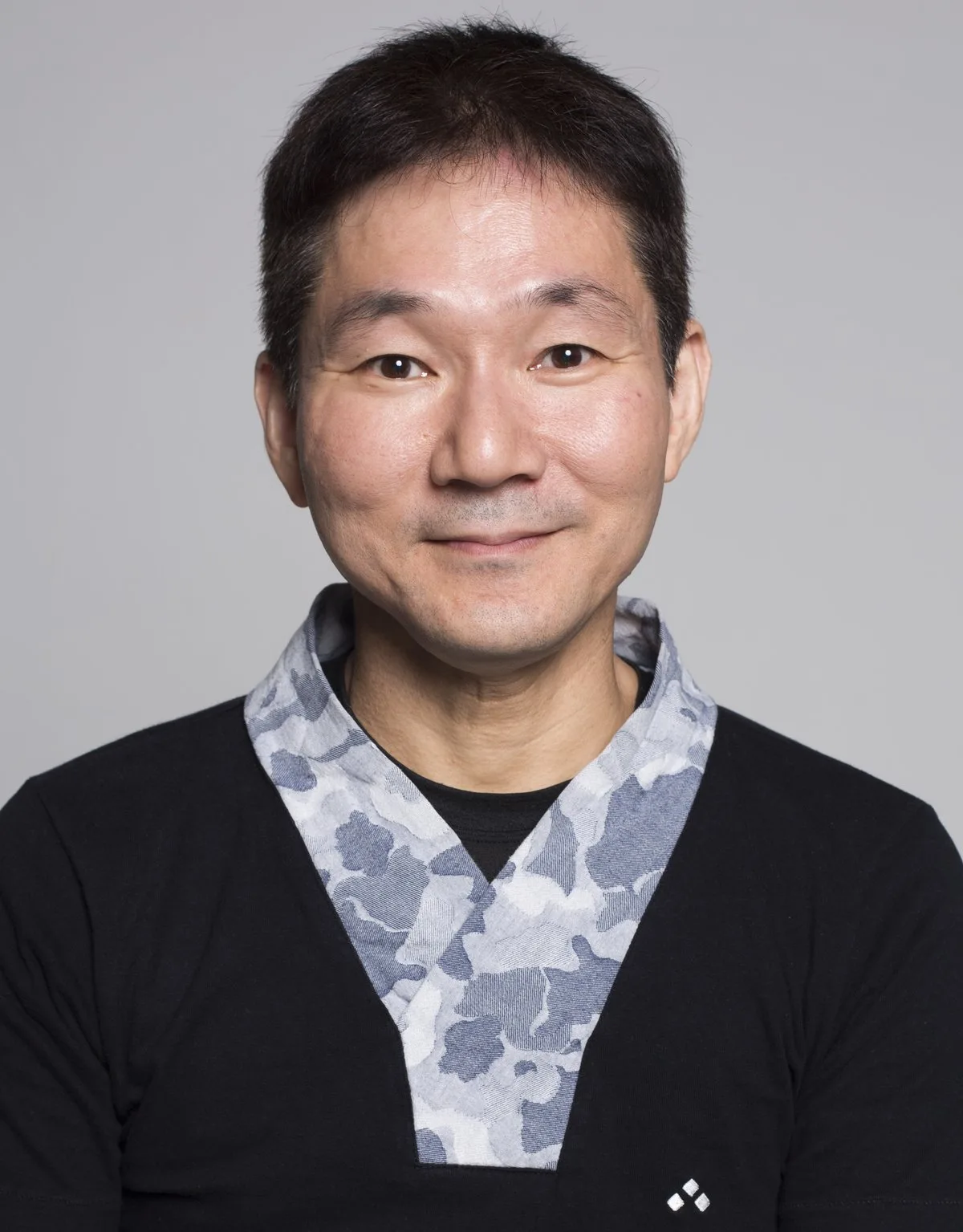
Between Science and Bodily Experience
After earning a PhD in Medical Science and working in medical marketing in the pharmaceutical industry, I became a Rolfer™ to explore change through the body. This site brings scientific perspectives and lived bodily experience together to make Rolfing easier to understand.
Use these pages as a way to understand your own body, not as a set of difficult concepts to memorize.
FAQ
Frequently Asked Questions
Q1. What is Rolfing?
Rolfing is a somatic practice systematized by the American biochemist Dr. Ida Rolf (1896–1979), combining hands-on fascial work with movement re-education. Through a series of ten sessions, it reorganizes the relationship between your body’s structure and gravity. There are roughly 1,950 certified Rolfers worldwide, and around 130 in Japan.
Q2. How is it different from massage or Japanese seitai?
Massage and seitai generally aim at relieving symptoms. Rolfing aims at structural transformation — changing the pattern itself rather than easing its effects. Instead of working on the place that hurts, it addresses how the whole body organizes itself in relation to gravity.
Q3. What is the difference between Rolfing, Rolf Movement, and SourcePoint Therapy?
Rolfing works with the structure of the body through hands-on fascial work. Rolf Movement works with how you use your body, through movement and sensory re-education. SourcePoint Therapy works with the body’s field, using minimal or no touch. Think of them as three layers of the same body: structure, movement, and field.
Q4. Is this the same Rolfing I know from the US or Europe?
Yes. The certification comes through the same international Rolfing training lineage that traces back to Dr. Ida Rolf. I completed Phases I–III with the European Rolfing Association in Munich (2014–2015), certified as a Rolf Movement Practitioner in 2019, and completed Advanced Rolfer certification in 2025. If you experienced Rolfing in your home country, the framework will be familiar.
Q5. Do I have to commit to ten sessions?
No. The 10-Series is the classic format, but you can start with a single trial session (90 minutes total). Single sessions are also available on their own, and there is never pressure to continue.
Q6. Does it hurt?
Sensations vary from person to person, but most clients describe it as “comfortable discomfort.” Pressure is checked and adjusted throughout the session — if something is too much, it changes immediately.
Q7. Isn’t Rolfing pseudoscience?
It’s a fair question, and one I take seriously as a PhD. Fascia research has grown substantially over the past two decades, but the evidence base has real limits, and I don’t overstate what it shows. I address the criticism directly, including the Wikipedia critique, in a dedicated article rather than brushing past it.
Q8. Who will I be working with?
Hidefumi Otsuka, PhD — Certified Advanced Rolfer™ and Rolf Movement® Practitioner. PhD in Medical Science (Immunology) from the University of Tokyo Graduate School of Medicine, followed by more than a decade in medical marketing in the pharmaceutical industry before turning to somatic practice. Sessions have been offered in Shibuya, Tokyo since 2015.
Q9. What is the “Recognition OS”?
The Recognition OS is the underlying system beneath your thoughts, emotions, and actions — and it is not located only in the brain. It is physically inscribed in fascial tension patterns, autonomic nervous system habits, and the internal body map your brain uses to move you through the world. Rolfing is a way of rewriting that operating system through the body rather than through thought alone.
Q10. Is this medical treatment?
No. Rolfing is not a medical procedure and is not intended to diagnose or treat any condition. If you are under medical care or being treated for a specific condition, please let me know in advance and consult your physician.
Q11. Is it covered by health insurance?
Rolfing is not covered by Japanese national health insurance. A receipt is provided on request, which some clients submit to employers or to international private health plans that include complementary bodywork — coverage depends entirely on your policy, so check with your provider first.
Q12. I’m only in Tokyo for a limited period, or I travel frequently. Can I still do the 10-Series?
Often yes, with planning. The standard interval is one to two weeks between sessions, but a compressed schedule can work if your assignment is short, and a longer interval is workable if you travel. Let me know your timeline when you book and we can shape the series around it. If the window is too tight for ten sessions, a shorter series or single sessions may serve you better.
Q13. Where are you located, and is English really OK?
Shibuya, Tokyo. Sessions are fully available in English, including anatomical and technical vocabulary — executives, researchers, expats, and DeepTech professionals are especially welcome. No Japanese is required at any point, including booking. Access details are on the Contact page.
Q14. How do I pay?
Payment is made in cash at the end of each session, which is still common practice in Japan. Credit cards — MasterCard, VISA, AMEX, JCB, DINERS, and Discover — are also accepted; please mention it in advance if you’d like to pay by card. The same applies to Rolfing, Rolf Movement, and SourcePoint Therapy.
Q15. How do I book, and what if I need to cancel?
Booking is by inquiry through the Contact page, in English. If you need to change or cancel an appointment, please let me know as early as you can so the time can be offered to someone else.
Background and further reading
In this guide
About This Page
Welcome to Rolfing ZERO.
This is the Start Here page for English-speaking visitors — executives, researchers, expats, and global professionals based in Tokyo. It maps out what Rolfing® is, who I am, and where to go next depending on your question.
Rolfing ZERO is run by Hidefumi Otsuka, PhD — a Certified Advanced Rolfer™ and Rolf Movement Practitioner who earned his doctorate in Medical Science (Immunology) at the University of Tokyo Graduate School of Medicine and spent over a decade in medical marketing in the pharmaceutical industry before turning to somatic practice in 2015.
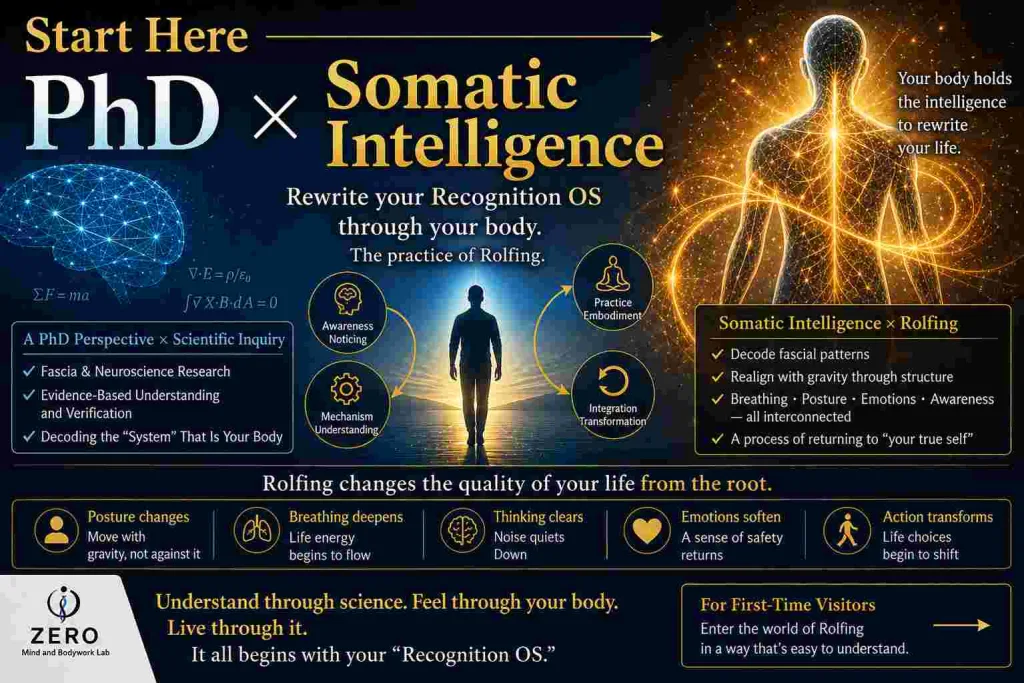
This site approaches Rolfing through a distinctive lens: PhD × Somatic Intelligence — where scientific rigor meets embodied practice.
Life is not a competition. It is an experience.
SECTION 1: Start From Your Question
Different people arrive at Rolfing with different questions. Choose your entry point.
▶ “My chronic shoulder or back pain doesn’t respond to massage.”
Massage addresses symptoms; Rolfing addresses structure — the relationship between your body and gravity, organized through the fascial network.
▶ “I feel like emotions or old stress are stored in my body.”
Talking alone doesn’t always reach it. The body keeps its own record — in the nervous system, in fascial tension, in posture. Polyvagal theory and somatic psychology explain why.
▶ “Isn’t Rolfing pseudoscience?”
A fair question — and one I take seriously as a PhD. I address the Wikipedia critique directly and walk through the current state of fascia research, including its genuine limits.
▶ “I’m an expat. Can I actually do this in English?”
Yes. Sessions are fully available in English, and many of my clients are international professionals living in Tokyo.
Rolfing in Tokyo for Expats (English Available) — A Guide to Finding the Right Approach
▶ “What exactly is the 10-Series?”
The classic Rolfing protocol: ten structured sessions that systematically reorganize the whole body in three phases.
What Is Rolfing’s Ten-Series? — Three Phases in Which the Body Changes, and the Flow of Each Session
▶ “I’m a yoga practitioner. Can Rolfing deepen my practice?”
Twenty-plus years of Ashtanga Vinyasa practice meets Advanced Rolfing. How structural integration changes your relationship to asana — from effort to organization.
Gateway Yoga × Rolfing Gateway ── 20 Years of Ashtanga, and the Encounter with Rolfing
▶ “I want to hear from people who’ve done it.”
Testimonials of Those Who Experienced Rolfing — Classified by Symptom and Purpose
SECTION 2: The Body as an Operating System
The problem: “I understand it, but I can’t change.”
You’ve read the books. You’ve done the coaching. Intellectually, you know exactly what to do — and yet the same patterns repeat. The tension returns. The old reactions fire before you can think.
This is not weak will. It’s that a different pattern is written at the level of the body itself.
The Recognition OS
I call this underlying system the Recognition OS — the operating system of perception.
Just as a computer’s OS runs beneath every application, each of us has a foundational system beneath our thoughts, emotions, and actions. Crucially, this OS is not located only in the brain. It is physically inscribed in the body: in fascial tension patterns, in autonomic nervous system habits, in the internal body map your brain uses to move you through the world.
This is why insight alone doesn’t change us. An operating system written into the body cannot be rewritten by thought alone. It changes through the body, through relationship, through practice.
The four layers
In my personal credo, the Recognition OS consists of four layers:
- The Logic OS — scientific and analytical thinking. The layer I trained through my PhD.
- The Sensory OS — embodiment and felt sense. The layer refined through Rolfing, yoga, BJJ, and meditation.
- The Dialogue OS — coaching and relationship. The layer that matures through deep conversation.
- The Perspective OS — cross-cultural experience and diverse worldviews. The layer that expands through travel, reading, and encounter.
When these four layers integrate, a person operates at their real capacity.
What Rolfing works on
Rolfing works primarily on the Sensory OS. Through hands-on work and movement re-education across the 10-Series:
- Your relationship with gravity reorganizes
- Breathing changes
- Posture changes — not through effort, but through structure
- Your ability to sense your own body from the inside sharpens
This is not treatment. It is a rewriting of the Recognition OS through the body.
PhD × Somatic Intelligence is the attempt to integrate the Logic OS and the Sensory OS — and Rolfing ZERO is where that integration is practiced.
SECTION 3: About Hidefumi Otsuka
Born in Tokyo, 1971. Spent seven years of childhood in the United States.
PhD in Medical Science (Immunology), University of Tokyo Graduate School of Medicine. After completing the doctorate, worked for over a decade in medical marketing in the pharmaceutical industry, including work in the neuroscience field.
In his thirties, a growing recognition that the Logic OS alone was not enough led him toward somatic practice. Since 2015, he has offered Rolfing® sessions in Shibuya, Tokyo.
Credentials:
- Certified Advanced Rolfer™ (Advanced certification 2025; one of few in Japan)
- Rolf Movement Practitioner
- CTI Co-Active Coaching training
Ongoing practices: 20+ years of Ashtanga Vinyasa Yoga, meditation, Brazilian Jiu-Jitsu.
List of Certifications and Training
From Ph.D. (Medical Researcher) to Certified Rolfer®
SECTION 4: PhD × Somatic Intelligence in depth
After the entry-point Gateways, for those who want to go further. Selected from an archive of 400+ articles (English translations ongoing), organized into four themes.
[Start here] Prefer a curated path?
The essential articles for executives and global professionals are collected in one place:
- Rolfing® for Leaders & Expats: The Somatic Archive — the full curated collection
[Philosophy] How Body and World Meet
The quality of your decisions depends on your axis. Building a new foundation of perception from the body–gravity relationship.
- Teaching Is One Thing. Learning Is Personal — The Limits of Education and How to Prepare the Body for Better Decisions in the Age of AI
- Why Does Organizing the Body Let You Decide for Yourself? — Rewriting the Subconscious Through the Body
[Mechanism] Why “I Can’t Move” Changes
Not the Weak Willpower but a physical brake that can be released. The mechanics of transformation.
- Fascia Is the Body’s Network — Discovering Your Core Through Structural Integration
- Why “the Head Understands, but the Body Won’t Move” — An Introduction to Somatic Psychology
- The Brain’s Navigation System for Posture — How the Body Map Shapes the Contours of “the Self”
[Practice] Strategic Body Design
Quieting the noise of thought, turning knowledge into experience.
- The Moment Words Disappear in a Session — Simply Waiting for the Body to Begin Moving
- Entering Nature― What Kumano Shugendō and Rolfing Reveal About Relationship ―
[Action] Where to Begin
Beyond “treatment,” toward transformation. The first step into a new everyday.
- The First Hour — Four Things I Listen For in a Rolfing Consultation
- What Is the Difference Between Physiotherapy and Rolfing?── Recovery vs Transformation, and the Underlying View of the Body
- The Difference Between Self-Improvement and Self-Discovery──The Essence of the Rolfing Approach
- What Is the Difference Between Squatting and Sitting — The Influence of Chair Culture on the Body
SECTION 5: The Scientific Series
The scientific side of PhD × Somatic Intelligence, explored across three systematic series.
Posture & Movement Science — The Science of Gravity and the Body
Posture, movement, and gravity through the lenses of neuroscience, kinesiology, and evolutionary anthropology.
- What Is the Difference Between Squatting and Sitting — The Influence of Chair Culture on the Body
- Why Sitting for Long Periods Is Bad for the Body — The Science of Visceral Fat, Chronic Inflammation, and Stress
- Why “Standing” Is Not Tiring — The Mechanism of Gravity and the Antigravity Muscles
- Why “Walking” Is Fundamental to the Human Being — The Science of Bipedal Walking, Weight Shift, and Gravity
- Why Good Posture Is Not a Matter of Muscle Strength — Tonic Function and Its Relationship to Gravity
- Why a “Comfortable Posture” Exists — From the Perspective of Gravity, Fascia, and Rolfing
Somatic Psychology — Integrating Thought, Emotion, and Body
Somatic psychology, attachment theory, and neuroscience on the relationship between mind and body.
- Why “the Head Understands, but the Body Won’t Move” — An Introduction to Somatic Psychology
- Why Trauma Does Not Heal Through Words — The Mechanism of Fascia, the Autonomic Nervous System, and Body Memory
- Why Organizing the Body Raises Judgment and Performance — From the Perspective of Rolfing and Brain Science
- The Three Approaches That Break Through “Understanding Yet Unable to Change” — The Difference Between Therapy, SE, and Rolfing
Attachment Theory — How Relationships Are Inscribed in the Body
Attachment patterns live in the body. Trauma, the autonomic nervous system, and polyvagal theory explain why Rolfing can redraw the “map of safety.”
- Attachment Is Inscribed in the Body
- Trauma and Attachment — The Body’s Wisdom in the Autonomic Nervous System
- Attachment Can Be Rewritten — Relational Repatterning
- Rolfing Rewrites the Map of Safety — Restoring Connection through the Lens of Polyvagal Theory
- Rolfing and the Power to Reconnect: From Attachment to Integration
SECTION 6: For Yoga Practitioners & Expats
Yoga × Rolfing
Living in Tokyo
- Rolfing in Tokyo for Expats (English Available) — A Guide to Finding the Right Approach
- Rolfing® for Leaders & Expats: The Somatic Archive — the full curated collection
- Why Can’t We Act Even When We Know What to Do? — Fixed Patterns in the Body and the Rolfing 10-Series
Conclusion
Life is not a competition. It is an experience.
That is the opening line of my personal credo.
When you understand something intellectually but cannot change, the answer is not in your thoughts. It is in your body.
Rather than reading more — experience what happens when your body itself begins to reorganize. That felt shift is the real entry point.
Book a Trial Session
Transformation, not correction.
Start with a 60-minute trial session and find out what is actually happening in your body.
[Book a Trial Session here]
Hidefumi Otsuka, PhD | Certified Advanced Rolfer™ / Rolf Movement Practitioner PhD
in Medical Science (Immunology), University of Tokyo Graduate School of Medicine. After a career in medical marketing in the pharmaceutical industry, offering Rolfing® sessions in Shibuya since 2015. Working at the intersection of PhD × Somatic Intelligence and the Recognition OS.
Not correction. Transformation.
Start with a 90-minute trial session and notice what is happening in your own body.
No obligation to commit to the Ten Series. Shibuya, Tokyo / 90 minutes / Sessions available in English.