
Introduction
Since June 2015, I have offered Rolfing sessions. In the past, in “How Rolfing Differs from Seitai and Massage — “Symptom” or “Structure”?“, I wrote about the difference from seitai. In short, the difference from seitai is that Rolfing approaches the “fascia.” That is the decisive factor: balance comes into order, and the effect lasts.
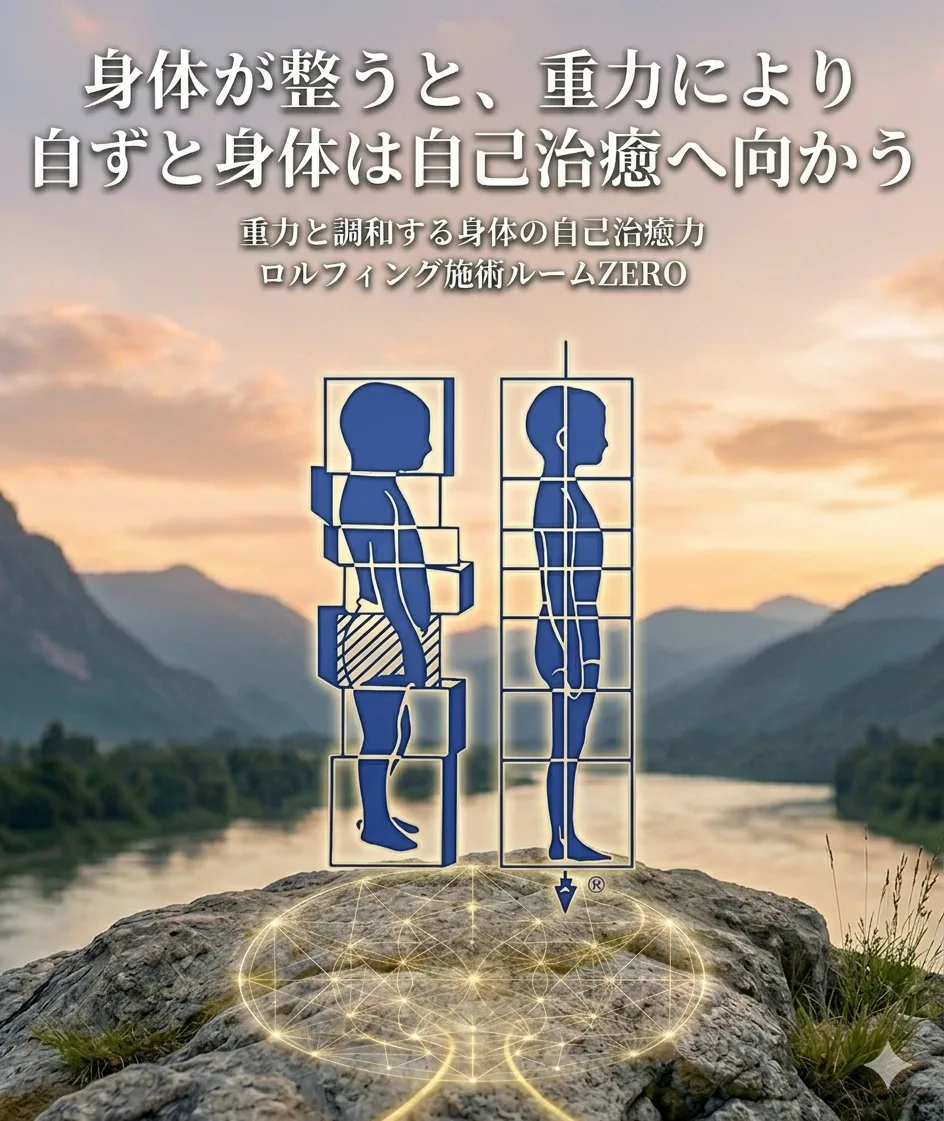
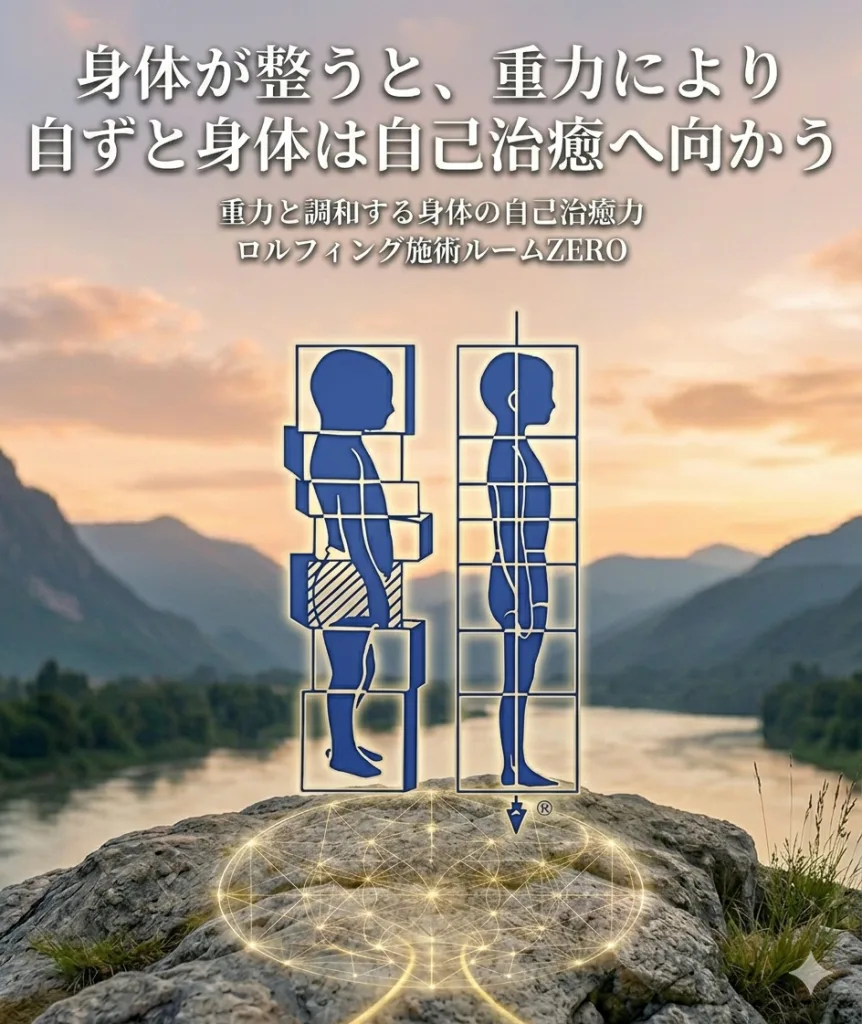
In fact, Rolfing pays attention to one more thing besides the “fascia” — “gravity.”
Ida Rolf, the founder of Rolfing, left these words:
“When the body gets working appropriately, the force of gravity can flow through. Then, spontaneously, the body heals itself.”
This time, I want to gather some thoughts on this gravity.
As the Relationship with Gravity Deepens, the Power of Self-Healing Rises Too
While a fetus is inside the womb, it is in a weightless state.
Passing through the birth canal, when a baby is born, the very first thing it feels is “gravity.”
As if predicting that “gravity” exists, the baby is able to build a good relationship with it.
In the process of growing into an adult, without fearing failure and through repeated trial and error, a person is able, before they know it, to shift the posture from crawling on all fours to walking on two legs. What makes it possible to organize posture in this way is that the “relationship” with “gravity” can be built unconsciously.
I feel that if a human being can build a relationship with “gravity,” the power of self-healing advances, and a sense of ease and safety toward the environment becomes possible.
Muscles That Work Under the Influence of Gravity — Two Kinds
When placed within “gravity,” a human being is thought to work the muscles “unconsciously” in order to counter gravity.
(Image)
The French Rolfer Hubert Godard, who looked after me when I once went to Paris, held that the therapeutic effect of gravity through Rolfing can be explained using the theory of “Tonic Function” — that two kinds of muscle work when placed within gravity.
The two muscles are:
- The muscle that works transiently (Phasic): the Phasic Muscle
- The muscle that works continuously (Tonic): the Tonic Muscle
The “Transient” Working Muscle — Bringing Fatigue
The “transient” working muscle is one that works momentarily, involved in sprinting, weightlifting, and lifting objects.
It works when lifting something with effort, and requires an energy source (glucose). Because of this, a sense of fatigue sets in, and the body tires easily. When tension appears in the body from daily stress, stiff shoulders and low-back pain can be said to be the Phasic Muscle working actively.
It exists largely on the outside (the superficial layer) of the body, and stiff shoulders and low-back pain are often the outer muscles in tension. In a world of much stress and desk work, these muscles are placed in a state of tension.
The “Sustained” Working Muscle (Tonic Muscle) — Tireless
The “sustained” working muscle is involved in maintaining posture. Requiring almost no energy (oxygen only) and working slowly and continuously, it is not easily overtaken by fatigue. By rights, this is the muscle that should be working, but it exists largely on the inside (the deep layer) of the body. Unless the superficial muscles are released, it does not work.
When stiff shoulders and low-back pain do not improve even with yoga or Pilates practice, it is because the superficial muscles are not released, so awareness does not reach the inner muscles (the deep muscles).
This muscle is known to “hold many muscle spindles (spindles).”
A muscle spindle is a sensor of the muscle, known as a sensory organ that detects the stretching and shortening of the muscle.
For instance, in yoga or meditation, there is sometimes an instruction to “be aware of the body.” What switches on at that moment is the muscle spindle.
When the body detects gravity, the muscle spindle switches on, so it is thought that — even without being aware of gravity — the continuously working muscle, rich in spindles, can move unconsciously.
The “Sustained” Working Muscle: Elements of Coaching
Interestingly, Hubert Godard extends the idea of “Tonic Function” all the way to the body’s structure, the mind, and ways of thinking.
The “sustained” working muscle, it turns out, is influenced by four elements.
Specifically:
- Bodily structure (the body’s posture and composition, gravity, and so on) (structure)
- How the whole body moves in cooperation (coordination)
- How the world is seen (perception)
- How meaning is given to the world (meaning)
Points 3 and 4 are close to the idea of a person’s way of being (Being) — precisely the domain of coaching. Combined with 1 and 2, the Rolfing side, the “sustained” working muscle can be brought to work synergistically.
For anyone whose interest is stirred, feeling it is best. I hope for a visit to a Rolfing session.
Conclusion: The Body Knows the Art of Setting Itself in Order
What Rolfing aims for is not to forcibly “cure” something from the outside. It is to restart the “self-healing process” the body originally holds, within the ceaseless flow of energy that is gravity.
When the structure comes into order and harmony with gravity is regained, the body is freed from excess tension and begins, of its own accord, to head from within toward repair and integration. This, too, is a manifestation of the life force we originally hold.
For anyone who feels they are “maintaining the body through effort,” letting go of that force once — the natural power of healing that arises from entrusting the body to gravity is something to experience in the body itself.
[Experience] Steps to Switch On “Self-Healing”
At the Shibuya studio, sessions are offered with an environment set up to draw out the body’s innate “power to come into order.”
Harmonizing with Gravity and Feeling Self-Healing: A Trial Session
When resisting gravity stops and gravity becomes an ally, what change occurs in the body? The breath widens, circulation improves, and the body fills from within. Through the session, the process by which the body regains its own balance is there to be felt.
▶ Details and inquiries about the trial session here
Gravity Is the Greatest Ally in Support
We can never escape gravity for our whole lives. But gravity is not a force that crushes; set right, it becomes the greatest ally, one that supports and heals.
For the body to come into order and grow friendly with gravity — this is the first step toward trusting a person’s own life force and living more richly.
I look forward, from the heart, to being present together for the process by which the body regains its original radiance and comes into order of its own accord.