
Somatic Psychology Series — Toward the Integration of Thought, Emotion, and Body | Part 2. First draft: December 2023. Updated: April 2026.
Introduction
In Part 1, I stated that “unable to move even though the head understands” is a structural problem coming from the division of body and mind. “Understanding” through language has trouble reaching the patterns soaked into the body.
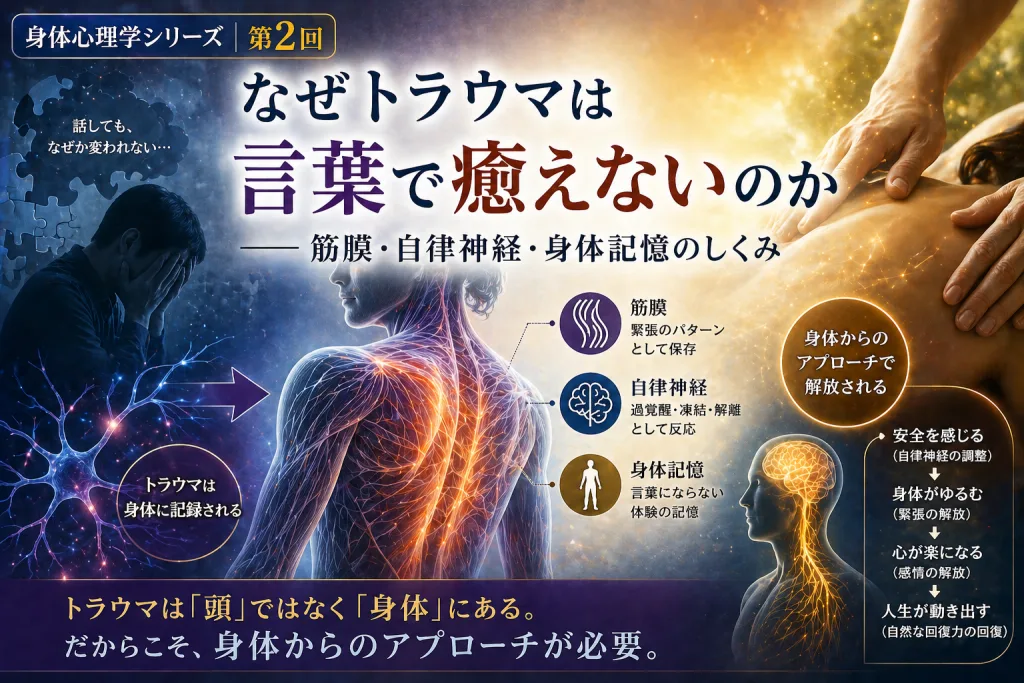
So, how is the memory inscribed in the body released? At its core is “the relationship between trauma and fascia.”
→ Part 1: Why “the Head Understands, but the Body Won’t Move” — An Introduction to Somatic Psychology
A Company Employee’s Experience — When the Body Changed, the Way the World Looked Changed
The company employee Ms. Elaine Reiko Yamada, after completing Rolfing’s ten sessions, wrote this.
Not only bodily changes (the neck bending backward with ease; the congestion of the hip joints disappearing), but the following occurred as changes of the mind:
“I no longer wanted to fix even the sides of myself I had disliked.” “Even when placed in a situation where I used to blame myself, I became able to think instantly, ah, this was not the place for me to be.” “Somehow, I became steady in the gut.”
This is not the result of being told, in cognitive therapy, “let’s change the way of thinking.” It is the result of the state of the autonomic nervous system changing through the release of the fascia, and the body becoming able to feel “safety.” By the body changing, the patterns of emotion, self-recognition, and even interpersonal relationships change — this is the transformation that the Holistic (whole) approach brings about.
→ Ms. Elaine Reiko Yamada’s Testimonial
Trauma Is Not Only “Big Events”
Hearing the word “trauma,” extreme experiences such as war, abuse, and major accidents tend to be imagined. But in somatic psychology, trauma is considered by dividing it into two kinds.
“Big-T” Trauma (Trauma) arises from experiences directly linked to a crisis of life — accident, disaster, violence, loss.
“Small-t” trauma (trauma) arises from everyday accumulation. “An environment where emotion must be suppressed,” “an experience of relying on someone but not being responded to,” “an experience of continually having personal sensations denied” — even though these appear at a glance to be “no big deal,” by being repeated, they come to be inscribed in the body.
At the site of a session, clients who, while saying “I have no trauma or anything,” shed tears along with the release of the fascia are not few. That is a sign that small-t trauma had accumulated in the body.
Trauma Is Recorded in the Body
Bessel van der Kolk pointed out that “the body keeps the score (The Body Keeps the Score).” Past experience is recorded not as verbal memory, but as the body’s tension patterns, posture, breathing, and reactions.
Why does it not heal through words? The answer lies in the structure of the brain. The “language area” and the “system that governs the body’s autonomic reactions” operate as separate circuits. Even with the realization in counseling that “the reason it became so is now understood,” the body’s patterns do not change — this is not a problem of ability, but a structural problem of the brain.
The “Three Neural States” Shown by Polyvagal Theory
Stephen Porges’s Polyvagal Theory explains the autonomic nervous system in three stages.
The ventral vagal system (safety and connection) is activated when in an environment where a person can feel at ease. It is a state of connecting with others through smiling, tone of voice, and eye contact, in which learning, growth, and transformation are prone to occur.
The sympathetic nervous system (fight and flight) is activated when danger is felt. The heart rate rises, the muscles tense, and preparation to fight or flee is made. Chronic stress is this state continuing.
The dorsal vagal system (freezing and shutdown) is activated when falling into extreme danger or a “nothing can be done” situation. Sensation becomes dull, and dissociation, listlessness, and rigidity of the body occur. This is the state of “freezing (Freeze).”
The ventral vagus (safety) → connection, learning, transformation
 ↓ when danger is felt
The sympathetic nerve (fight and flight)  → fight, flee
 ↓ in a situation where flight is impossible
The dorsal vagus (freezing) → shutdown, dissociation
Trauma is “fixed” because this energy of freezing remains in the body without being released.
The “Response That Did Not Complete,” Taught by Animals
Peter Levine, from the observation of animals, clarified the essence of trauma.
After danger has passed, an animal trembles its body and completely releases the energy produced by the shock. By going through this process, the animal can live without dragging trauma along.
Because the human being has a brain, this process tends to become half-finished. The thoughts “trembling is embarrassing,” “crying is not allowed” obstruct the release of energy. As a result, the frozen energy keeps remaining inside the body — in the fascia.
Levine showed that, by releasing this “response that did not complete,” trauma heals. This is the core of Somatic Experiencing (SE).
The “Counseling Without Using Words” That Rolfing Performs
Rolfing’s approach traces the reverse path of language. Awareness is directed not to “what happened,” but to “what is happening inside the body now.” Through the approach to the fascia, it changes the state of the autonomic nervous system, and supports the process by which the frozen response is released naturally.
When the fascia that had been frozen for many years is released in a session, the body often trembles, or a deep breath arises naturally. This is a sign of the frozen nervous system being released — what SE calls “discharge.” “Somehow tears came,” “I suddenly remembered something from long ago,” “the blockage in my chest came off” — this is not coincidence.
The changes of Ms. Elaine Reiko Yamada at the opening — “became steady in the gut,” “stopped blaming myself” — were, in terms of Polyvagal Theory, a process in which a shift occurred from “the freezing of the dorsal vagus” to “the safety of the ventral vagus.”
→ Trauma Workshop – Lael Keen — How to Incorporate the Thinking of Trauma into a Session?
A Safe Place Supports Transformation
For transformation to occur, there is one more condition. A “safe place.”
As Polyvagal Theory shows, deep transformation occurs only in a state where the ventral vagal system (safety and connection) is activated. When the body feels “here is safe,” for the first time, tension that had been frozen for many years begins to be released.
The relationship in which the practitioner, while touching the body, carefully receives the client’s responses — this functions as a re-experience of the “safe relationship” that attachment theory shows. The body knows the state it ought to be in. The practitioner only supports that path.
→ Attachment Is Inscribed in the Body
Somatic Psychology Series — Toward the Integration of Thought, Emotion, and Body (All 4 Parts)
Somatic Psychology Series — Toward the Integration of Thought, Emotion, and Body (All 4 Parts)
The question “unable to move even though the head understands” is unraveled from four angles.
Part 1: Why “the Head Understands, but the Body Won’t Move” — An Introduction to Somatic Psychology
→ Read Part 1
Part 2: Why Trauma Does Not Heal Through Words — The Mechanism of Fascia, the Autonomic Nervous System, and Body Memory (this article)
Part 3: Why Organizing the Body Raises Judgment and Performance — From the Perspective of Rolfing and Brain Science
→ Read Part 3
Part 4: The Three Approaches That Break Through “Understanding Yet Unable to Change” — The Difference Between Therapy, SE, and Rolfing
→ Read Part 4
For Those Who Want to Update the Recognition OS “From the Body”
Handling the questions “why do I think this way” and “why does my judgment waver” from the perspectives of philosophy, brain science, and cognitive bias is Mind and Bodywork Lab’s “Recognition OS” series. An approach from the body, and an approach from thought. By knowing both, transformation becomes deeper.
→ Mind and Bodywork Lab: How to Navigate This Site (in Japanese)
For Those Who Want to Change from the Body
It is possible to begin by confirming, in a trial session, what is happening in the body.
→ Applying for a Trial Session
Hidefumi Otsuka (Ph.D.) | Certified Advanced Rolfer™ / Rolf Movement Practitioner
Completed a doctoral program at the Graduate School of Medicine, the University of Tokyo. After a career in the pharmaceutical industry, has offered Rolfing® sessions in Shibuya since 2015. Works under the theme of “the integration of thought, emotion, and body.”