
A note for readers outside Japan: the sources cited at the end are all Japanese-language publications, and none of them exists in English translation. The Postal Museum Japan, in Tokyo, provides only limited English signage. Japanese terms are glossed on first use.
Introduction
Last time I wrote about seeing the exhibition “Kūkai and the Treasures of Shingon” in Ueno. Carved wood does not move. But what those figures are trying to express is a body that sat, stood, formed hand gestures, and walked.
In August I will cross Mt. Tsurugi and go on to Zentsū-ji, the temple in Shikoku associated with Kūkai’s birth. Before that, I want to look at how walking has been treated in Japan.
Japan has two extreme cultures of the legs. One is the hikyaku — the courier who ran the highways in relays, carrying information. The other is Shugendō — the mountain ascetic tradition, in which entering the mountains and walking is itself the practice.
The first asks how fast. The second discards speed altogether. The same two legs, doing opposite things.
The mechanics of walking itself I covered in Part 4 of the Posture and Movement Science Series. Here I want to pull together the points where Japanese culture and the legs have met.
Those Who Moved Along the Highways
A Name That Means “To Relay”
I want to start with why they were called tsugi-bikyaku.
Hikyaku — literally “flying legs” — is a word for a runner-messenger, in use since the medieval period. The prefix tsugi, “to join” or “to hand on,” was added because the system worked by changing runners from post station to post station along the highway.
So the name itself refers not to how they ran but to how they were joined. The tsugi-bikyaku was a relay. No single person ran from Edo to Kyoto. Porters were handed off at each post station, and every runner covered only his own leg, at full effort.
The stations along the Tōkaidō stood about nine kilometers apart on average, and more than half the intervals were under ten — roughly the distance of a modern 10K road race. A dozen or more such legs were linked end to end in a single day.
The reference works give four to five days for the run between Edo and Osaka. This was an era in which an ordinary traveler took ten days or more on the same road.
So this is not a story about the superhuman physiques of Edo-period Japanese. It is a story about an institution that maximized what human legs could do.
Running in Pairs
I also want to look at the figure of the man who ran a single stage.
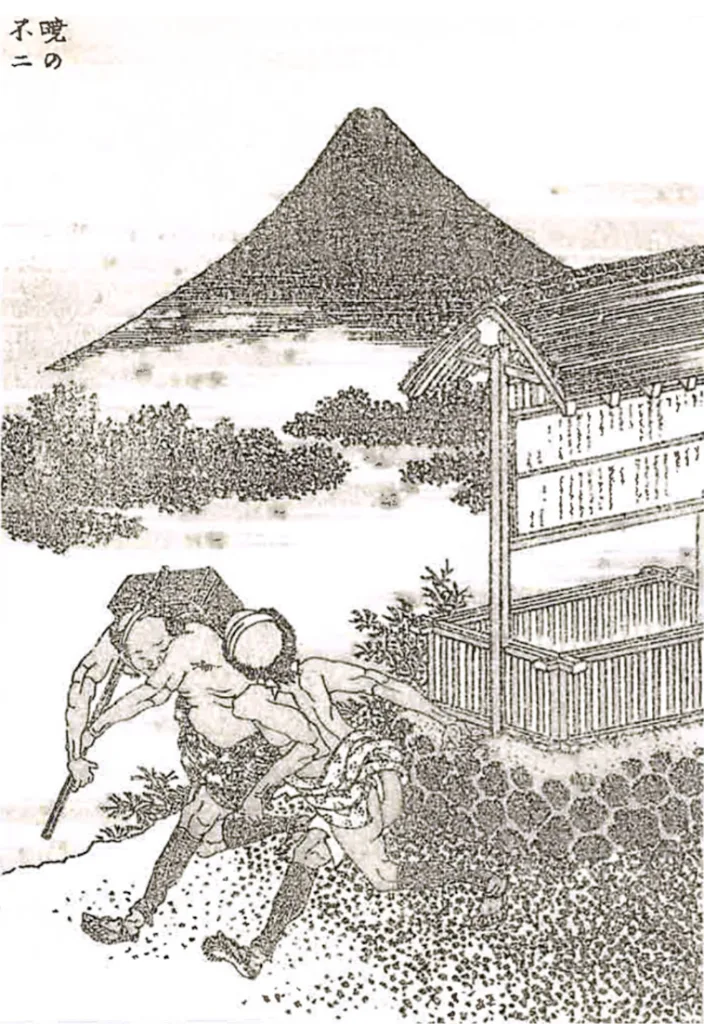
The shogunate’s official couriers ran in pairs. One carried on his shoulder a small wicker box bearing the tag goyō — “official business.” The other carried a tall lantern on a long pole. By day the lantern-bearer ran as the relief man; at night he lit the lantern and led the way.
What they carried were documents issued under the seal of the rōjū, the senior councilors of the shogunate — the highest level of official correspondence, and available only to a restricted set of offices. Not only letters: gifts presented to the shogun also traveled by courier.
The Legs as Institution
The outline of the institution is clear enough.
In 1633, the shogunate granted each station along the highways an allowance of rice for the maintenance of the relay couriers. The post stations kept the men; the shogunate supported them with rice. The running cost of the communications network was accounted for in grain.
The speed of information was the speed of legs, and nothing else.
Where Speed Had a Price, and Where It Did Not
Couriers were not a shogunal monopoly. The domains had their own courier services, and the towns had commercial courier houses. For the town couriers, the fees are said to have been tiered by speed — the tighter the deadline, the higher the charge.
So there was indeed a domain in which speed carried a price. But it was only one part of the whole.
The historian Makishima Takashi points out that the label “domain courier” is too broad. The conventional categories do not account for the historical record, and in particular they leave out an entire layer — the village-relay service, contracted out to village headmen within a domain’s own territory. That layer usually drops out of the story altogether.
The Runners Were Farmers
Makishima has drawn out a case from the Tsu domain in Ise province, working from village documents.
The Asada family, headmen of Nishi-Hokkeno village in Yamashiro province, held the domain’s post as agent for the official village-relay courier service. They registered men from the surrounding area as courier attendants and had them run in rotation. These were not professional runners. They were men who farmed, and who took on the courier work as a duty owed to the domain. In some cases a son inherited the role.
Wages were handed over in a lump at the end of the year to the head of the courier group, and distributed from there. The costs were borne, in the main, by the village. Makishima writes that it was the villages that sustained the domain courier system.
The price of legs was not set by a market. The shogunate’s couriers were supported with rice; the village-relay couriers were carried by the villages as an obligation. What had a price attached was the service offered by the town courier houses — not the communications network itself.
At the Joints, There Were People
There is something else the Asada family’s ledgers record.
A courier who had completed his handover was given a bowl of rice with tea poured over it, if he wanted one. If a through-courier came at a moment when nothing was ready, he was sent on with a boxed meal. On a day when the Kizu River was running high, two men were sent where one would have sufficed. If a bridge had washed out, extra ferry fare was handed over. If the man on duty could not come, a substitute was found. Candles were issued. A damaged lantern was re-covered. On the way home, an oiled-paper umbrella might be lent, and on occasion money as well.
Makishima writes that this was not merely a matter of passing the item along; consideration was extended to the man whose duty was done.
On a diagram of the institution, all of this can be drawn as lines and points. But at the knot where the lines met there was a headman’s house, and a man who had finished running was sitting in it, eating.
The institution turned with bodily fatigue entered into its accounts.
The Legs Did Not Exit All at Once
While writing this piece I went to the Postal Museum Japan in Oshiage. To put the result plainly: there was almost no exhibit on the couriers. What the museum covers is the Meiji-era founding of the postal service and everything after. A miss.
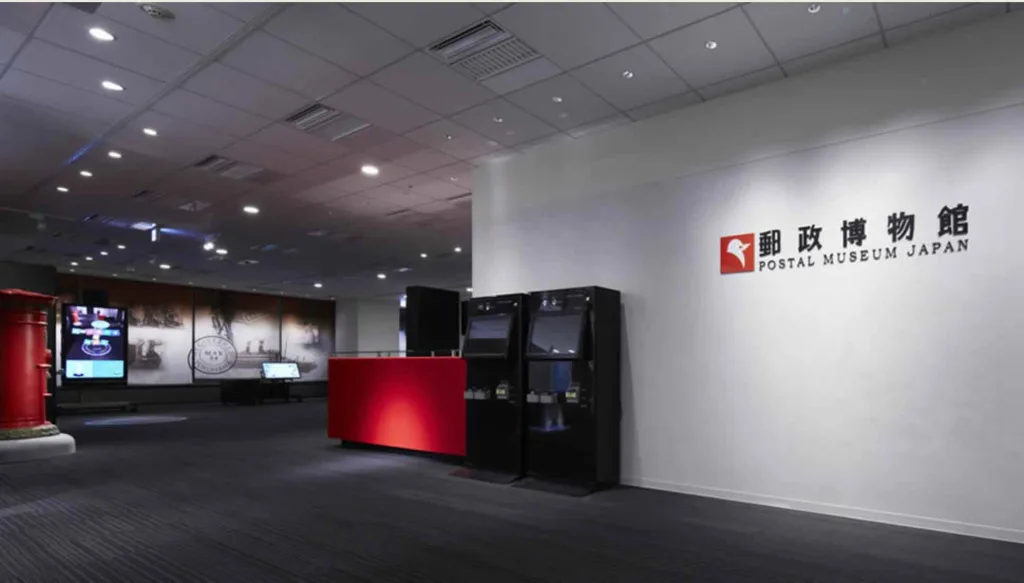
But I was taught something else instead.
An interpretive panel titled “Carrying — Mail and Vehicles” states that at the founding of the postal service, mail was carried from person to person, through a succession of post offices, by relay. After that came horse carriage, railway, automobile, aircraft — each era using the newest transport system available.
Reading it, I saw that I had been framing this wrongly. What ended was the courier as an occupation. Not the courier’s method.
When the postal service began in 1871, the mail-handling offices were set up in a corner of the post-horse stations along the Tōkaidō highway — the existing buildings, refitted. The clerical work was taken on by the men who had run those stations: the managers and elders. At the postal office in Osaka, clerks from the established courier houses, men versed in the handling of correspondence, were hired as officials.
The same building. The same people. A different name on the work.
This is not something I came up with. I could not find it in the exhibition rooms, but the museum publishes a research bulletin, and the answer was there. According to a paper by Inoue Takurō, Japan’s postal system was created by repurposing the Edo-period post-station system, and the view that it should be understood as an import from the West is mistaken — a position originally argued by Yabuuchi Yoshihiko, and now the standard one.
And one further point. Communication, which through the Edo period had been inseparable from transport and haulage, was separated from it during the Meiji era. On Abe Akio’s reading, that separation is precisely what modernization consisted of.
The Couriers Did Not Fade. They Were Prohibited.
Nor did the couriers simply see out their role and retire.
In 1870, on learning that a postal service was to be founded, the courier houses submitted a petition for its withdrawal. It was rejected. Five of the established courier houses then opened a joint company as a competing service. This is the point worth pausing on: at that moment, the branches and agencies of those five houses were spread across the whole country, and their network far exceeded the postal system as it then stood.
The couriers’ network was larger than the state’s.
Maejima Hisoka, the architect of the Japanese postal system, moved not to crush that network but to absorb it. He explained the principles of a modern postal system to Sasaki Sōsuke, who represented the courier house Izumiya; the persuasion is said to have taken about half a year. In 1872 a national land-transport company was established.
But persuasion alone did not carry the transition. In 1873 the conveyance of correspondence was made an exclusive function of the state, and private courier operation was prohibited. In 1875 the station-level transport companies were dissolved, and a single national company was given charge of overland transport across the country — the firm that became today’s Nippon Express.
The couriers did not withdraw of their own accord. They were folded up by law and consolidated into one company.
Even so, the post stations became post offices and the runners became postmen, and the structure of handing on remained exactly as it was.
From the Carrying Body to the Pulling Body
Three models in the exhibition room showed me this.
On the left, a mounted courier. In the center, a figure in Japanese dress and a sedge hat pulling a wooden cart. On the right, a uniformed official in Western clothing pulling a red two-wheeled cart. All three are pulling. Leaning forward, gripping the shafts, throwing their weight ahead of them.
The way force is transmitted is entirely different from the posture of a courier running with a load on his shoulder. When a load is carried, the weight passes vertically down through the spine. The body works as a column, and the legs manage the risk of falling. When a load is pulled, horizontal propulsion has to be generated. The use of the pelvis and everything below it changes, and so does the way the foot drives into the ground.
The same two legs, given wheels, began doing different work.
In one room, every stage of the handover stood side by side. The carrying legs, the pulling legs, the horse. And the panel wrote the rest of it forward, into the automobile and the aircraft.
For two hundred and sixty years, what carried information through Japan was the human leg. That did not end at the close of the nineteenth century. It stopped carrying and turned to pulling, and then handed the pulling force over to the horse, to steam, to the internal combustion engine. Over a hundred and fifty years, it let go a little at a time.
Parcel delivery still hands packages from depot to depot. The structure has not changed since the official document box was passed from station to station.
“He Ate Meat and Could No Longer Run”
During the same period in which the legs were being replaced, someone tried to measure the performance of those legs by the standards of Western science.
Erwin von Baelz, a German physician, came to Japan early in the Meiji era, taught at the Tokyo Medical School, and later served as physician to the imperial household.
The occasion is said to have been a journey to Nikkō. Rickshaw pullers took him from Tokyo to Nikkō in a single day without relief — in a time reportedly little different from making the journey by relays of horses.
Astonished, Baelz looked into what the men ate: brown rice balls, pickled plums, daikon pickled in miso. A plain diet, far below the protein intake then held as the standard in Germany.
So he set up an experiment. He hired two pullers in their twenties, put one on the customary diet and the other on a meat-centered one, and had them run a fixed distance every day. The man on meat accumulated fatigue and within days asked to be returned to his original food. Once returned, he could run again. The man on the customary diet kept running for three weeks.
The report was published in Germany in 1901. I have not consulted the original.
From here on, this needs to be read with care.
Baelz tied the result to the conclusion that Japanese food suits the Japanese body, and added arguments about differences in intestinal length. That part is not supported by present-day medicine.
The interpretation of the experiment is also held to be wrong by modern physiology. In endurance exercise, muscle glycogen is the principal energy source. If rice is reduced in order to increase meat, a decline in running capacity follows as a matter of course. The problem was not that the man ate meat. It was that he ate less carbohydrate.
Even so, from the Meiji-era dietary reform movement onward the story has gone on being used as evidence for the superiority of Japanese food, and it still circulates in the context of nutrition education.
Read as a record, though, something else comes into view.
At the very moment when an institution was replacing the legs, there was an attempt to measure the performance of those legs on a Western scale. And the figures that came out were read, at the time, as showing that the Japanese body was the better one. That was the response on the side of the body while the handover was under way.
The couriers disappear, the pullers pull, and the work passes to horses and machines. In the course of that, a bodily capacity in the process of being lost became, for the first time, an object of measurement.
Measurement usually comes after the exit has been decided.
Hijiri and Hikyaku — Bodies That Move Along the Boundary
The courier network overlaps with another group moving along the same highways: the hijiri, the wandering holy men who guided pilgrims.
In March I attended a lecture by Fuke Toshihiko of Mii-dera, and what stayed with me was a structural point: the person at the boundary is the one who holds the information. Pilgrimage in that era was not open to everyone, and knowledge of which road to take was restricted. The people who held it were the hijiri, who stood between the mountains and society.
What the couriers carried were letters. What the hijiri carried was knowledge of the road. The moving body was itself the network. The lodgings that served pilgrims and the post stations the couriers relayed through both sit at intermediate points — neither everyday space nor sacred ground.
The Same Village, the Same Man
The overlap reaches deeper than that.
The village-relay couriers were farmers who took the duty in rotation alongside their farming. On the Shugendō side, most local practitioners lived in villages as well, performing prayers and healing while entering the mountains at set seasons. Both were inherited within households. Two networks, both carried by part-time men living in villages.
And they actually intersect. According to Makishima, the Tsu domain had couriers carry protective talismans from Kasuga Shrine and from the temples at Kasagi, in prayer for the recovery of an ailing lord. Couriers were used for talismans because the matter was recognized as urgent.
The same man from the same village carried the domain’s circulars and the shrine’s talismans alike. The speed of a letter and the speed of a prayer were measured on the same two legs.
Entering the Mountains
The couriers moved horizontally. What follows moves vertically.
In Shugendō, walking is not a means to practice. Walking is the practice. Moving along a ridge is not preparation for meditation; the act itself is the end.
What made most sense to me in Fuke’s lecture was the framing of Shugendō as a system for transforming the self by entering the mountains, dying once, and being born again. Ritual death and rebirth. Not something to be grasped by the head — something that can only happen by being undergone in the body.
Shugendō was organized in the medieval period and divided into two branches: the Honzan school, centered on Shōgo-in and affiliated with Tendai, and the Tōzan school, centered on Daigo-ji and affiliated with Shingon. The latter stands in Kūkai’s lineage.
In the prologue to this series I wrote that what Kūkai brought back was not doctrine but procedures, implements, and ways of using the body. Shugendō can be described as that same thing placed in the mountains. Instead of hanging a mandala, forming the hand gestures, and chanting the syllables — walking the ridge.
Seeing a mountain not as an object to be understood but as a counterpart to be in relationship with is something I wrote up separately, from walking in Kumano.
→ Entering Nature― What Kumano Shugendō and Rolfing Reveal About Relationship
A Culture That Asks About Speed, and a Culture That Discards It
For the courier, walking is a means. So speed is the question, and in the town courier houses it went as far as becoming a price.
For Shugendō, walking is the end. Arriving quickly carries no meaning; if anything, the accumulation of days is itself part of what is imposed.
In the same era, on the same archipelago, and carried by the same part-time men from the same villages, these two coexisted.
Where the first one leads is to not using the legs at all. And in fact the couriers were folded up by law, and the work of carrying passed to wheels and machines. Whatever is a means gets replaced by a better means.
The other is still walking. An act that is its own end cannot be shortened by technology.
Toward Mt. Tsurugi
Mt. Tsurugi, which I will climb in August, stands at 1,955 meters in Tokushima Prefecture. It is the second-highest mountain in Shikoku, and a mountain of Shugendō.
I think again of the conjecture by Miyasaka Yūkō that I mentioned in the prologue — that during the three years after his return from China, when Kūkai was not permitted to enter the capital, he walked Shikoku, and that this became the origin of the pilgrimage circuit. There is no documentary support for it. But if it were so, then Kūkai walked not as a courier walks but as a Shugendō practitioner walks. Not in order to arrive quickly, but in order to confirm something again by walking.
As a Rolfer, there are things I want to check on myself before four days of this. What the range of motion in the hip joints looks like after long hours of sitting. How far the foot sinks, and how stiff it is. A foot that has only walked on pavement is not prepared for a mountain path, where the conditions change with every step.
I am going to a place where walking becomes practice. The next piece will be a record of the walking itself.
(Walking — a series in three parts)
- Prologue: The Body Carved in Three Dimensions — From the “Kūkai and the Treasures of Shingon” Exhibition, Toward Shikoku
- Part One: The Legs That Held a Country Together — Couriers, Shugendō, and Two Japanese Ways of Walking (this article)
- Part Two: What Happened Walking Shikoku
Related Article
- Why “Walking” Is Fundamental to the Human Being — The Science of Bipedal Walking, Weight Shift, and Gravity (Posture and Movement Science Series, Part 4)
References
All sources below are Japanese-language publications; none is available in English translation.
- Postal Museum Japan (Sumida, Tokyo), permanent exhibition. Visited 3 August 2026. Interpretive panel “Carrying — Mail and Vehicles,” three courier-conveyance models, Meiji-era mail handcart, and related material.
- Inoue Takurō, “The Formation Process of Modern Postal Service in Japan: The Formation of a Postal Network from the Official Communications Infrastructure,” Bulletin of the Postal Museum, no. 2, 2011.
- Makishima Takashi, “The Courier System of the Tsu Domain in the Mid-Edo Period: An Examination of the Hikyaku-chō of the Asada Family, Headmen of Nishi-Hokkeno Village, Yamashiro Province,” Bulletin of the Postal Museum, no. 5, 2014.
- Makishima Takashi, “Courier Houses as Seen Through the Diaries of the Established Couriers: An Examination of the Goyō Entries,” Bulletin of the Postal Museum, 2015.
- Kokushi Daijiten and Nihon Daihyakka Zensho, entries for hikyaku and tsugi-bikyaku.
- Katsushika Hokusai, One Hundred Views of Mount Fuji (National Diet Library Digital Collections).
- NIPPON EXPRESS Holdings, official corporate history (entries for the land-transport company of 1872 and the national transport company of 1875).
- Erwin von Baelz, nutritional experiment on rickshaw pullers, reported in Germany in 1901. Original not consulted. On the interpretation, see the note in the body of this article.
Hidefumi Otsuka (Ph.D.) | Certified Advanced Rolfer™ / Rolf Movement Practitioner Completed a doctoral program at the Graduate School of Medicine, the University of Tokyo. After a career in the pharmaceutical industry, has offered Rolfing® sessions in Shibuya since 2015. Works under the theme of “the integration of thought, emotion, and body.”