Rolfing ZERO
Why Advanced Rolfer Sessions Go Deeper
Why Advanced Rolfer sessions go deeper: working with structure, perception, timing, and the whole person.
Point 1
Depth is not simply stronger pressure or deeper tissue.
Point 2
The session listens for timing, readiness, and whole-body relationships.
Point 3
Useful after the 10-Series or when themes are more complex.
Rolfing ZERO
Start with a single session, and let the body decide.
Background and further reading
In this guide
- Introduction
- The Two Stages of Rolfing — How Basic and Advanced Differ
- A Brief History of the Rolfing Associations — Why Advanced Is “Different”
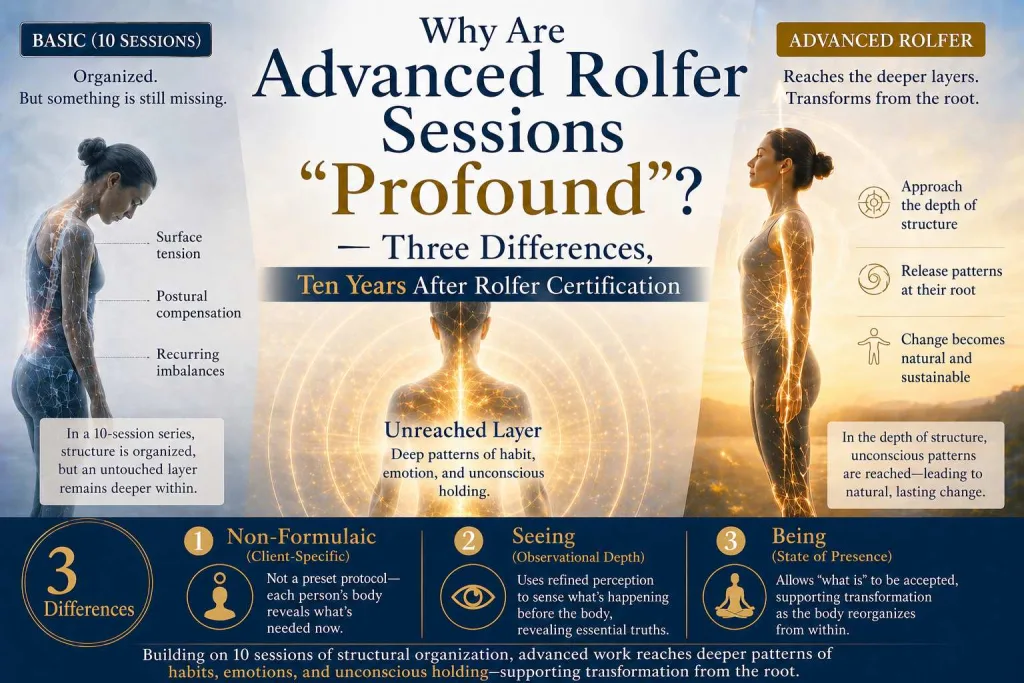
- Difference ① — Non-Formulaic (Individually Responsive)
- Difference ② — Seeing (The Capacity to Observe)
- Difference ③ — Being (The Art of Being)
- How a Session Proceeds
- Rolf Movement or Advanced Series — Which to Choose
- Who Is It For
- Testimonials
- Exploring the Advanced Series Further
- For Those Who Want to Deepen Rolfing Knowledge
- As a Certified Advanced Rolfer
Introduction
“I’ve finished the ten sessions. I really did change. And yet — I have the feeling there’s still something more.”
I sometimes hear words like these from clients who have completed Rolfing’s Ten-Series. Their body is more organized, their movement has changed, their chronic pain has eased — and still, they sense a “layer that hasn’t yet been reached” far within the body.
That sense is correct. Beyond the structure organized through the Ten-Series, the body holds a further layer in which habits, emotions, and unconscious patterns of tension are inscribed. An Advanced Rolfer’s session is aimed precisely at reaching that layer.
This Gateway explains what an Advanced Rolfer is, how it differs from the Basic level, and what kind of change unfolds when you receive a session.
The Two Stages of Rolfing — How Basic and Advanced Differ
There are two stages of certification for a Rolfer: “Rolfer™” and “Advanced Rolfer™.”
A Basic-level Rolfer has completed roughly 89 days of training and, within the systematic framework of the Ten-Series, has learned an approach to fascia, gravity, posture, and movement.
An Advanced Rolfer is someone who, after Rolfer certification, has accumulated three to five or more years of practical experience and continuing education (18 units or more), and on that foundation has gone on to complete the 24-day Advanced Training (AT).
But the difference between the two is not merely a matter of credentials or years of experience. The very “way of being (Being)” in the session is fundamentally different. What produces that difference is a shift that occurred within the history of Rolfing: the turn “from Formulaic (procedure-centered) to Non-Formulaic (individually responsive).”
If you want to know the full path to becoming a Rolfer — from Basic Training through continuing education and Advanced certification — I cover it in detail in a separate Gateway article.
A Brief History of the Rolfing Associations — Why Advanced Is “Different”
To understand the essence of the Advanced level, it helps to know a little about the history of the Rolfing associations.
In the association founded in 1971 by Rolfing’s originator, Dr. Ida Rolf (today the DIRI: Dr. Ida Rolf Institute), both the Ten-Series and the Advanced five-session series originally followed a fixed “procedure (Formulaic Series).” Working in a set order, on set regions of the body — this was early Rolfing.
In 1989, the association split into two lineages: one that faithfully carried on the procedure, and one — centered on Jeff Maitland and Jan Sultan — that chose to turn toward the “Non-Formulaic.”
Sultan put it this way: clinging to the procedure risks placing too great a burden on the client. Every client’s body is different. Past injuries, emotional patterns, habitual tension — all of these differ. Proceeding strictly by the procedure is not necessarily “what this person needs right now.”
In this way, Maitland and Sultan evolved Rolfing toward a Non-Formulaic style — one that “builds each session individually, grounded in principles.”
My own Rolfing Instructors, Ray McCall and Hiroyoshi Tabata, are direct heirs of this Maitland philosophy. The reason the Advanced level is “profound” is that this philosophy lies at the foundation of the session.
→ What It Takes to Become a Rolfer — An Overview of Qualifications, Organization, and Training, Explained by a Rolfer
→ Reflecting on the Personalities of Ray McCall and Hiroyoshi Tahata
Difference ① — Non-Formulaic (Individually Responsive)
Responding to “Your Body”
The Ten-Series at the Basic level has a clear framework for organizing the whole body systematically. This framework is profoundly important; it is designed to resolve the structural problems shared by many clients.
At the Advanced level, one faces the question that lies beyond a profound understanding of that framework: “What does this client need now?”
A scene that often arises in sessions: a client reports that their shoulders feel tight. But as the Rolfer reads the whole body, it becomes clear that the root of the problem is not the shoulders but, say, an asymmetry in the pelvis or a bias in the breathing pattern. Rather than “approaching the shoulders” as the procedure dictates, the work unwinds the structural cause at the root — this is what Non-Formulaic means.
You transcend the form only after mastering it
Non-Formulaic does not mean discarding form. It means responding to what the client’s body presents, on the basis of an understanding of the Ten-Series framework down to the marrow.
“You cannot transcend a form you do not know” — this is a principle shared not only by Rolfing but by martial arts, music, and every craft and art. Only after ten years of session experience and continuing education does a response that transcends form become possible.
→ What Is Rolfing? — Integrating the Body Through Positional Strategy
→ What Is Rolfing’s Ten-Series? — Three Phases in Which the Body Changes, and the Flow of Each Session
Difference ② — Seeing (The Capacity to Observe)
Going beyond “looking”
What Maitland emphasized most in the AT was “Seeing” — the capacity to observe.
“This is not mere visual inspection. It is listening to the body with the whole sensory apparatus.” — Jeff Maitland (Rolfer and philosopher)
What Maitland recommends is the Somatic Sensorium — the full mobilization of bodily sensation. Receiving with the whole body — not only sight, but touch, proprioception, and intuition — is what “observation” is.
“‘Seeing with your own eyes’ is misleading. To receive with the whole body is to observe.” — Jeff Maitland
Reading Pre-movement
Where this “Seeing” is most fully exercised is in reading the subtle change that occurs before a movement begins — “Pre-movement.”
“Just before rising from a standing posture to sit,” the body has already begun to move. In that moment — where force gathers in the body, and where it releases — the signs of an unconscious tension pattern appear. Through Seeing, the Rolfer reads a pattern of which the client is entirely unaware.
Something that often happens in a session: a client says, “I want to move here,” yet in fact it is somewhere else entirely that is locked. This is because there is a gap between the image in the mind and the actual body map held by the nervous system. The very experience of noticing this gap becomes the doorway to transformation.
→ Beyond “Looking” — On Fundamental Vibration, Right Action, and Neutrality~ Reflections on the Final Days of Training
→ What Is Rolf Movement? — Bodywork That Explores the Quality of Movement
Difference ③ — Being (The Art of Being)
From “doing” to “being”
What I learned most profoundly through the AT was not technique but “Being” — a way of being.
Jeff Maitland, both Rolfer and philosopher, says:
“Right action arises when we allow what is to show itself.”
Rather than carrying out the session with the intention “it must be done this way,” one responds to “what the client’s body needs now.” This shift from “Doing” to “Being” is what the Advanced Training aims for.
The difference clients feel
There are words those who have received it often say: “I don’t know what was done, but I changed,” “It didn’t feel like something was done to me — it felt like my own body changing.” These are signs that the Rolfer’s “way of being” has reached the body.
When a Rolfer holds the intention to “change” the client, the client’s body can react to that intention and brace itself. When a session is carried out from the posture of “Being,” the body changes more naturally, and more profoundly.
What I have come to feel most strongly through ten years of session experience is that this difference in “way of being” is directly tied to the quality and reach of change.
How a Session Proceeds
The basic flow of an Advanced session is the same as in Rolfing: “observe → intervene → re-observe (Test → Intervene → Re-test).”
At the start of a session, the way of standing, walking, and breathing is observed (Body Reading). But Body Reading at the Advanced level does not stop at structural analysis. The signs that precede movement, the subtle changes in breathing, the root of the tension pattern — mobilizing the full Somatic Sensorium, it is the act of listening to “what the body needs.”
Next comes an approach to fascia, movement, and breath — not as a procedure, but as a Non-Formulaic response in the moment. After the session, the way of standing and moving is checked again. When the change is felt not only by the practitioner but by the client themselves, awareness of the body grows.
As this “awareness” accumulates, the change persists even after the session ends. This is why Advanced sessions are felt to be ones in which “change settles in more readily.”
Rolf Movement or Advanced Series — Which to Choose
“Should I receive Rolf Movement or the Advanced level?” — this is a question I often get from people who have completed the ten sessions.
Rolf Movement begins from “learning movement.” Within daily actions like standing, walking, and sitting, it is a process of noticing one’s own unconscious tension patterns and relearning more natural movement. It suits those who want to “cultivate bodily sensation,” “raise the quality of movement,” or “build the capacity to change the body for themselves.”
The Advanced level begins from “a still-more-fundamental structural layer.” It works on the root of the recurring patterns that lie beneath the body organized through the ten sessions. It suits those who feel “the same problem has come back again,” “there’s a layer the ten sessions didn’t reach,” or “I want to change a chronic pattern at its root.”
A guide for when you’re unsure
Rolf Movement suits you if: you want to cultivate bodily sensation for yourself; you want to change the quality of your everyday movement; you want to make it the foundation of a practice such as yoga, dance, or martial arts; you seek a process of “noticing for yourself, changing for yourself.”
The Advanced level suits you if: you’ve finished the ten sessions but there is still a layer that hasn’t been reached; the same pattern keeps recurring; you want to be touched somewhere more fundamental; you want to be changed from the root while receiving a session.
You can also receive both
The two are not mutually exclusive. Working on the underlying structure with the Advanced level, and settling that change into movement with Rolf Movement — this combination often brings the most profound change.
→ What Is Rolf Movement? — Bodywork That Explores the Quality of Movement
If you have not yet received Rolfing, or want to confirm the effects of the ten sessions, I recommend beginning here.
→ What Is Rolfing’s Ten-Series? — Three Phases in Which the Body Changes, and the Flow of Each Session
→ Testimonials of Those Who Received Rolfing — Classified by Symptom and Purpose
→ Gateway Yoga × Rolfing Gateway ── Why Is There a “Layer That Cannot Be Reached” Even After Continuing Yoga | 20 Years of Ashtanga, and the Encounter with Rolfing
Who Is It For
Those who have completed the Rolfing Ten-Series: Ideal for those who want to develop further and consolidate the structure organized through the ten sessions. Also suited to those who want to reach the recurring pattern of “it was organized once, but it broke down again.”
Those in whom a chronic pattern recurs: The same stiff shoulders, low-back pain, or tension keep returning. Being mindful of posture doesn’t last. You want the “root” to be addressed — if that’s how you feel.
Practitioners of yoga, Pilates, dance, martial arts, and the like: For those whose movement is their profession or their field of inquiry, as an entry point to fundamentally rethinking the quality of movement. Rather than “learning how to do it,” you can have the experience of “how the body feels itself” changing.
Those who feel “there’s still something more”: Those who, having finished the ten sessions and genuinely changed, still sense a layer that hasn’t been reached. That sense is correct. The Advanced level is aimed at reaching that layer.
Testimonials
From clients who received Advanced sessions after completing the Rolfing Ten-Series, I often hear voices like these: “The sensation was completely different from the ten sessions,” “a feeling of changing from far within the body,” “I don’t know what was done, but from the next day my movement was different.”
Exploring the Advanced Series Further
I have documented the full process of the Advanced Training across 37 articles.
- Decision to take ADVANCED ROLFING TRAINING @TOKYO, JAPAN
- Reflecting on the Personalities of Ray McCall and Hiroyoshi Tahata
- What Is Spinal Biomechanics? — Deep Techniques and Somatic Impact Ida Rolf Never Taught
- How Do We Face Things When They Don’t Go Well? — The Atmosphere of Participating within Japanese Participants
- Beyond “Looking” — On Fundamental Vibration, Right Action, and Neutrality~ Reflections on the Final Days of Training
- Journey to Becoming an Advanced Rolfer — A Summary of the Road to Certification
For Those Who Want to Deepen Rolfing Knowledge
- What Is Rolfing’s Ten-Series? — Three Phases in Which the Body Changes, and the Flow of Each Session
- Testimonials of Those Who Received Rolfing — Classified by Symptom and Purpose
- What Is Rolf Movement? — Bodywork That Explores the Quality of Movement
- Gateway Yoga × Rolfing Gateway ── Why Is There a “Layer That Cannot Be Reached” Even After Continuing Yoga | 20 Years of Ashtanga, and the Encounter with Rolfing
- Why Shoulder Pain and Low-Back Pain Are Not Healed by Massage? — The Science of Fascia, Posture, and Gravity
- Why Do Emotions Stay in the Body? ──Understanding Rolfing Through the Body’s Memory — The Science of Fascia, the Autonomic Nervous System, and Trauma
- The Path to Becoming a Rolfer — A 12-Year Training Record
- What It Takes to Become a Rolfer — An Overview of Qualifications, Organization, and Training, Explained by a Rolfer
As a Certified Advanced Rolfer
Not every Rolfer holds the Advanced certification. Only those who, after Rolfer certification, have accumulated continuing education and then completed the 24-day Advanced Training may carry the title.
In July 2025, I completed the AT in Ichigaya, led by Ray McCall of the United States and Hiroyoshi Tabata of Japan, and received certification as an Advanced Rolfer. It was ten years after my Rolfer certification (2016, ERA — European Rolfing Association).
Basic Training (89 days, Munich), Rolf Movement Training (ERA, Munich), continuing education in fascia, cranial work, and neuro-fascial work, and then the Advanced Training — together, these brought my study of Rolfing to a natural waypoint. From Basic certification to the present, I have had the opportunity to learn from 25 instructors.
For those who want to know the full certification process in detail — the differences among certifying bodies, and the overall picture from Basic through continuing education to Advanced — please see this article. → What It Takes to Become a Rolfer — An Overview of Qualifications, Certifying Bodies, and Training
→ What It Takes to Become a Rolfer — An Overview of Qualifications, Organization, and Training, Explained by a Rolfer
→ List of Certifications and Training
Advanced sessions are offered as a series of three to five sessions. You can begin with a trial session, in which we confirm the current state of your body and the direction to take.
Hidefumi Otsuka (Ph.D.) | Certified Advanced Rolfer™ / Rolf Movement Practitioner
Completed a doctoral program at the Graduate School of Medicine, the University of Tokyo. After a career in the pharmaceutical industry, has offered Rolfing® sessions in Shibuya since 2015. Has practiced and taught Ashtanga Vinyasa Yoga since 2006. Works under the theme of “the integration of thought, emotion, and body.”