Introduction
On 26 July 2026, I visited a special exhibition of Shino-ryū kōdō — the Shino school of the Way of Incense — held at Hakusasonsō, the Hashimoto Kansetsu Memorial Museum, close to Ginkaku-ji in Kyoto. The villa and garden were built by Hashimoto Kansetsu (1883–1945), a painter who worked in Nihonga, the Japanese-style painting that uses mineral pigments and glue on paper or silk rather than oil on canvas. The house is now open as a museum.
Kōdō needs a word of introduction, since it is the least known outside Japan of the three classical arts of refinement, the others being chadō, the way of tea, and kadō, the way of flowers. It is not incense-burning in the sense of scenting a room. A small quantity of fragrant wood is warmed — never set alight — in a burner that is passed from guest to guest around a seated circle. Each person cups the burner, draws the fragrance in a few times, and passes it on in silence. Often the gathering takes the form of a game in which the incenses are compared and identified, and the answers written down. The whole art turns on a single faculty: the ability to attend closely to something almost too faint to register.
The exhibition was titled “The Orthodox Way of Incense — Shino-ryū: Five and a Half Centuries, a Bloodline of One-to-One Transmission.” It marked the succession of the twenty-first-generation head of the school, the Iemoto.
The word deserves a note of its own. In the Japanese arts, the Iemoto system vests authority in a single hereditary grand master who holds the school’s teachings, licenses its practitioners, and decides what may change and what may not. The title passes down one line, and the line is the school. This exhibition offered the rare chance to hear the Iemoto himself speak about the tradition. The opportunity came to me through a friend, the artist Miyake Mai, and Yohaku, the otona no terakoya she hosts — a “temple school for grown-ups (in Japanese site only),” borrowing the name of the neighbourhood schools that taught commoners’ children in the Edo period.
On display were the incense implements that successive Iemoto have guarded and handed down across the generations: hanging scrolls and calligraphy by past masters, an Edo-period register of disciples, even raw blocks of fragrant wood. There stood the celadon incense burner “Aoyagi,” said to have belonged to Ashikaga Yoshimasa (1436–1490).
Yoshimasa was the eighth Ashikaga shogun, and an indifferent ruler who became one of the most consequential patrons in Japanese history: tea, incense, ink painting, the garden, and the small tatami room all took recognizable shape under him. And there stood the sixty-one famous incenses, among them the storied Ranjatai. Standing before them as the commentary unfolded, one could almost feel the weight of five and a half centuries made tangible through the objects themselves.
Incense, Tea, and Noh, Resonating Within the Register List
What drew me most was the monjinchō, the register list of disciples. Following the names down the list, people connected to the tea ceremony and to Noh begin to appear. Noh is the masked classical theatre that reached its present form in the fourteenth century, and it is worth knowing that these three arts were not separate hobbies but the shared practice of one social world. The register conveys how incense, tea, and Noh were carried on as a single continuous fabric, within the same circle of people.
My own paternal grandfather was a Noh performer who lived in Nagoya, and he practiced tea as well; his home, I am told, had its own Noh stage. I have some experience of the tea ceremony myself. So this register felt less like a distant historical record than a document brushing against my own lineage. Incense, tea, and Noh may look like separate arts, but they branch in fact from a single root. What they share is that each is a culture received through the body. Rather than being grasped by the intellect, they are learned by repeating the forms, honing the senses, and letting the practice come to dwell in the body itself. I felt that I, too, faintly belong to that lineage.
What the First Iemoto, Shino Sōshin, Built
The history of incense itself runs deep. According to the Nihon Shoki, the chronicle completed in 720 that stands as one of the two oldest surviving histories of Japan, the country’s incense culture opens in 595 — the third year of Empress Suiko — when a piece of fragrant wood drifted ashore on Awaji Island in the Inland Sea. Incense was thereafter prized within Buddhist ritual, and by the Heian period (794–1185) aristocrats were blending fragrances and using them, alongside waka poetry, as a means of expressing themselves.
It was in the Muromachi period (1336–1573) that incense was organized into a “Way.” The founding of kōdō in fact falls at almost the same moment as that of the tea ceremony. The setting was the Ōnin War, a succession dispute that burned much of Kyoto between 1467 and 1477 and opened a century of civil war; and it was against that disorder, at Jishō-ji in the eastern hills of the city — better known as Ginkaku, the Silver Pavilion — that the foundations of kōdō were shaped.
The man who shaped them was Shino Sōshin (1443–1523). He served Yoshimasa as a dōbōshū, one of the cultural attendants who managed the shogunal art collection, appraised what entered it, and directed the aesthetic life of the court. In an age when, it is thought, hard-to-bear odors hung over the capital, a culture of turning the heart toward fragrance was born and grew.
The work Sōshin left behind still forms the backbone of kōdō. One achievement was to establish the etiquette for savoring fragrance — the form of monkō. Another was to sort, at Yoshimasa’s command, the many famous incenses handed down within the shogunal house, and from them to select and define the sixty-one famous incenses.
Ranjatai stands at their center, and it warrants explaining. It is a single great log of agarwood, brought to Japan in the eighth century and preserved ever since in the Shōsōin, the imperial repository at Tōdai-ji in Nara. Across more than a thousand years only a handful of rulers have been permitted to cut a fragment from it, and the cut marks remain in the wood, labelled with their names. Yoshimasa was one of those few, and the piece said to have passed from him to Sōshin descends from that cutting.
And in the course of that selection, Sōshin established the rikkoku gomi — the six countries and five tastes — the standard for discerning fragrant wood. That standard of appraisal has been handed down unchanged to the present Iemoto, and is still used today to judge fragrant wood.
Taking Sōshin as its founder, the Shino school has continued for five and a half centuries since — transmitted from a single master to a single heir, never once broken, through to the twenty-first generation. Until the fifteenth head, the school’s seat was in Kyoto. Amid the upheavals that ended the Edo period and brought the Meiji Restoration of 1868, the school found ties with the Owari Tokugawa, one of the three cadet houses of the ruling clan, seated at Nagoya, and moved there. A single family, handing down an art of the senses across more than five centuries — standing before the register and the implements, I felt the weight of that fact anew.
There is a private coincidence inside that move. Nagoya is where my grandfather kept his Noh stage and practiced tea, and Nagoya is where the Shino school has been seated since the fifteenth head. The register I had been reading in Kyoto is older than his lifetime, so his name is not in it. But the circle it records — incense, tea, and Noh held together by the same people — went on in the city where he lived, and he stood somewhere inside it. The distance between that document and my own family is shorter than I assumed when I walked into the room.
Not “Smelling” but “Listening”
What stayed with me most deeply that day was learning that in kōdō, fragrance is not smelled but “listened to.”
Not “to catch a scent,” not “to smell,” but “to listen.” Because the fragrance of the wood is not sniffed unconsciously but savored with directed attention, the practice is called monkō — “listening to incense.” The usage is said to derive from the Shujing, the ancient Chinese Book of Documents.
Folded into this single word is a shift in one’s whole stance toward the senses. Smell is, among the five senses, an especially passive one. Draw a breath, and the scent enters whether one wills it or not. Most of the time we process it outside of awareness. Yet the moment the word “listen” is applied, fragrance turns from something that merely arrives into something one goes out to meet. From receiving to attending. An unconscious reaction becomes an object of consciousness.
Monkō, then, is the practice of deliberately turning attention toward a sensation that would ordinarily never rise into awareness. And this way of directing attention is, I think, a single backbone running through the whole of Japan’s culture of the body.
Speaking of Scent in Terms of Taste — Braiding the Five Senses into One
Within that rikkoku gomi lives yet another idea about the senses.
The “six countries,” rikkoku, divide fragrant wood — that is, jinkō, known in English as agarwood or aloeswood — into six: kyara, rakoku, manaka, manaban, sumotara, and sasora. Agarwood is not ordinary timber. It is the dark, resin-saturated heartwood that certain Southeast Asian trees produce only in response to infection, which is why so little of it exists, why no two pieces are alike, and why it has been traded as a luxury for well over a thousand years. The six-way division classifies wood by kidokoro, its grade, with names largely derived from places of origin. Among them, kyara is held to be something apart, and is called the king of fragrant woods.
The intriguing part is the “five tastes,” gomi. The quality of a fragrance is expressed through the vocabulary of taste: sweet, sour, pungent, bitter, and salty (kan). A sweetness like honey, a sourness like plum, a pungency like clove, a bitterness like phellodendron bark, a saltiness like a cloth that has wiped away sweat. (Phellodendron bark, kihada, is a standard bitter drug in East Asian medicine — the reference would have been as immediate to a fifteenth-century practitioner as clove or plum.) A single piece of wood holds several of these tastes at once, and the strength and combination of them shape a fragrance beyond words.
What is caught by smell is “listened to” in the language of hearing and “savored” in the language of taste. Kōdō does not treat the five senses as separate windows. Rather, by braiding several senses together and translating each into the others, it manages at last to catch something too subtle for smell alone to gather. Faced with fragrance — invisible, impossible to hold — human perception can cross its own borders this freely. That discovery lies folded within the old framework of rikkoku gomi.
The Discipline of Subtraction
Kōdō is built upon paring away everything superfluous. The eyes are closed, the clutter of information set aside, and only a single thread of fragrance is left in the room. Not by adding but by subtracting, the essential rises into view.
That stance dwells even within each individual implement. In monkō, the wood is never thrown into the flame and burned. Over charcoal buried in the ash of the burner a ginyō is laid — a thin sliver of mica — and upon that, in turn, a finely split piece of fragrant wood is set. The heat of the charcoal, held off by the mica, reaches the wood gently. Not burned, but warmed. In that way the faintest layer of fragrance alone is allowed to rise, never lost within smoke. Draw off the fire, draw off the smoke, and listen to what still remains. Here too the discipline of subtraction is carried through.
This stance belongs not to kōdō alone. It breathes in the way the tea ceremony’s movements are pared of waste, and in the forms of Noh, whose motion is cut back to its very limit. Not enriching by addition but clarifying by subtraction — and then gathering the body’s whole attention upon the one point that remains at the last. What Japan’s arts have refined over long stretches of time may well be this precision of the senses, this turning toward a single point.
Where I Now Stand: Receiving Through the Body
I now work as a Rolfer, my hands on people’s bodies day after day. Rolfing is a form of hands-on structural bodywork that addresses posture and movement through the connective tissue, over a series of sessions. I gently invite people to turn their attention back toward bodily sensations that ordinarily flow past outside of awareness — how they stand, the depth of the breath, how the weight is carried. From merely “having” a body toward “listening to” it. And so I wait for a person’s own inherent order to emerge from within.
Doing this work, I could not hear the account of monkō as someone else’s story. To listen to fragrance and to listen to the body differ only in their point of entry; the faculty being cultivated is the same — the power to turn attention toward what usually slips by unnoticed, and to go out to meet it. It is surely of a piece with what my grandfather was honing in his practice of Noh and of tea. Changing in era and in form, a culture of receiving the world through the body is handed down in just this way.
The phrase “one-to-one transmission” — isshi sōden, from a single master to a single heir — took on a new weight for me at this exhibition. That the transmission of fragrance went unbroken for five and a half centuries is surely because it was something books alone could not convey. The sense of listening to fragrance cannot be exchanged for words. Passed from master to disciple, from body to body, only then does it come to dwell in the next generation.
On the afternoon I was allowed to listen to three incenses — the burner cupped in both hands, three quiet breaths, then passed on — I felt, within that old discipline, the root of a culture I have long been close to brushing against me. To listen to incense, and to receive it through the body. Japan’s culture has gone on handing down this delicate faculty across five and a half centuries.
Reference
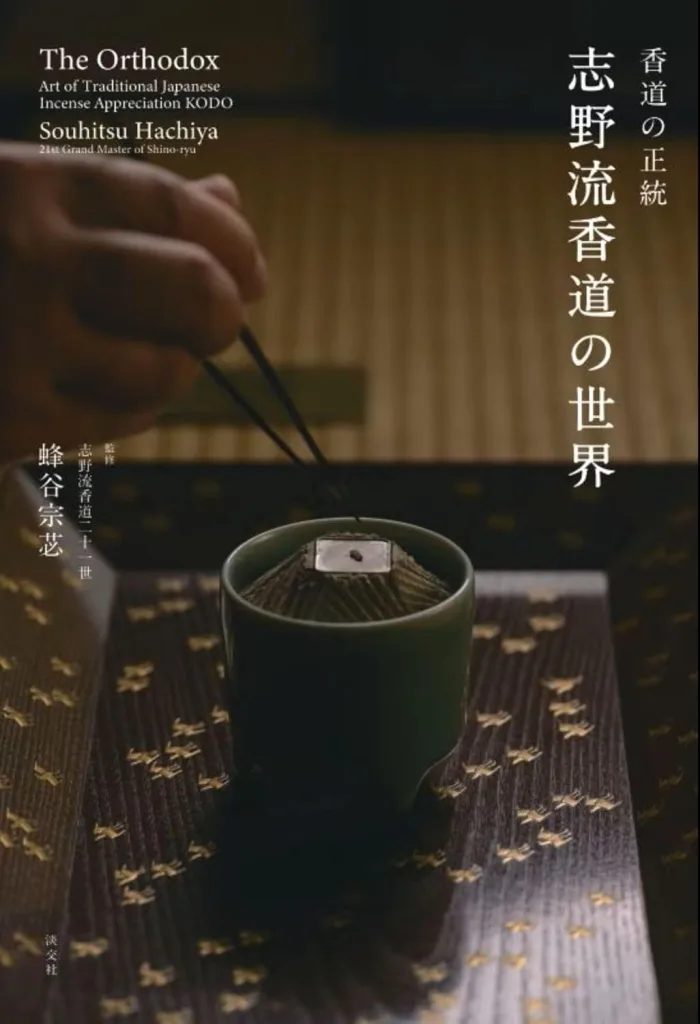
Hachiya Sōhitsu, Kōdō no Seitō: Shino-ryū Kōdō no Sekai (“The Orthodox – Art of Traditional Japanese Incense Appreciation KODO”). Written by the twenty-first-generation Iemoto of the Shino school — the succession that this exhibition marked. Available in Japanese only; no English edition exists.