
A note for readers outside Japan: the exhibition discussed here is presented with English-language information as well as Japanese, so it is accessible without reading Japanese. The books cited at the end vary — see the References section for which editions are available in English.
Introduction
On Thursday, 23 July 2026, at three in the afternoon, I went to see the exhibition “Kūkai and the Treasures of Shingon Buddhism” at the Heiseikan of the Tokyo National Museum in Ueno.
Kūkai (774–835) is the monk who brought esoteric Buddhism from Tang China to Japan and founded the Shingon school. Esoteric Buddhism is the strand that works through ritual, image, and formula rather than through doctrine alone — mandalas, hand gestures, chanted syllables. Kūkai is also, by wide agreement, one of the two or three most consequential figures in Japanese cultural history, and he is more often called by his posthumous title, Kōbō Daishi, than by his own name. Both names appear in this article and in the exhibition; they refer to the same person.
The exhibition marks the 1,250th anniversary of his birth and runs from 14 July to 6 September. Eighty-eight treasures have been gathered for it. Shingon divided into branches over the centuries, and eighteen temples now stand as the head temples of those branches; those eighteen, together with affiliated temples, lent the works. Bringing them into one room is itself unusual.
Perhaps because it was a weekday afternoon, the galleries were nearly empty. It was possible to stand in front of a single image for as long as I wanted. I want to record how crowded the museum was that day, since that is one of the things that decides the quality of viewing.
Exactly one month after seeing this exhibition — 22 to 25 August 2026 — I will head for Shikoku, the smallest of Japan’s four main islands and the island where Kūkai was born. After staying in Takamatsu in Kagawa Prefecture, I will go to Mt. Tsurugi in Tokushima Prefecture, a peak of 1,955 metres and a mountain with a long history as a site of ascetic practice. From there I go on to Zentsū-ji in Kagawa, the temple built on the ground where Kūkai was born.
To see Kūkai in Ueno, and then to walk in Shikoku the land where Kūkai walked. This is the first piece in a series that begins in that order.
Why I decided to go
Why Kūkai at all? The answer is a book. Fifteen years ago I read Shiba Ryōtarō’s Kūkai no Fūkei — published in English as Kukai the Universal — and that is where my interest in him started. This summer I read it again.
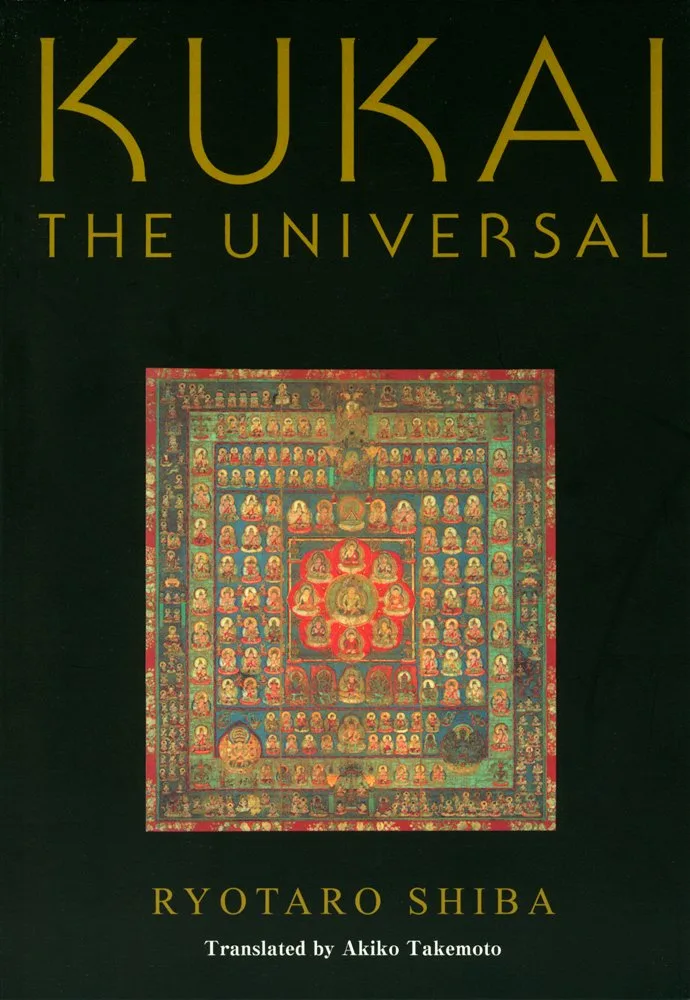
Shiba (1923–1996) matters here. He is the historical novelist most widely read in postwar Japan, and for a great many Japanese readers, their picture of a given historical figure simply is Shiba’s picture of him. He worked from vast source material, but he wrote fiction, and the two facts sit awkwardly together.
The first time, I remember simply finding it interesting. This time, something different remained with me as I read. Shiba must have worked through an enormous body of source material — so why is the book so subjective? Isn’t the focus on Kūkai’s genius too narrow? And then there is the treatment of Saichō.
Saichō (767–822) is the other founding figure of this period. He established the Japanese Tendai school on Mt. Hiei, the mountain northeast of Kyoto, was Kūkai’s older contemporary, and for a time borrowed texts from him before the two men fell out. Anyone reading about early Heian Buddhism meets the pair of them together. In Shiba’s book, Saichō comes off badly no matter how one reads it. Some of that is unavoidable in a biography of Kūkai, but what Saichō left behind as an educational structure, and how he trained his disciples, barely enters the frame at all.
How do other writers see the same man? I wanted to find out.
And having followed Kūkai through text, I wanted to see him once as a physical object. What stands in the galleries are the actual things — objects Kūkai brought back from Tang China, or made in Japan afterward.
What I saw in the galleries
Four things stayed with me.
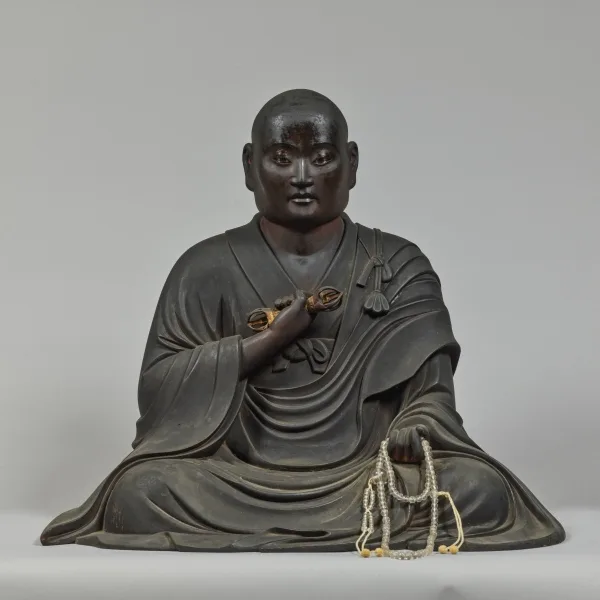
The presence of the seated image of Kōbō Daishi. Edo period, seventeenth century, from the collection of Kongōbu-ji, the head temple of the Shingon complex on Mt. Kōya in Wakayama. Standing before this wooden sculpture, I had the sense of being spoken to. Feeling that a sculpture has force is not in itself an unusual experience, but in this case the force does not come from any showiness in the modeling. It comes from how the posture is settled. (The photograph below is from the official website of “Kūkai and the Treasures of Shingon Buddhism.”)
The lines of the mandala. A mandala is a diagram of the Buddhist cosmos — deities arranged in a fixed geometry — hung and used as a working instrument during ritual, not as decoration. I was startled by the delicacy of the line drawing inside the scroll. The lines are close to the limit of what the naked eye can follow, and drawn with an even thickness throughout.
The precision of the sculpture. What occupied me as I looked was the thought that this might be the summation of the scientific technology of its era. Selecting the wood, carving it, laying down the lacquer, applying the gold. This is materials science, and it is precision machining. That Buddhism came across not only as thought but as a technical system is conveyed by the images themselves.
The fineness of the small images. Small-scale images were also on display, and the smaller the dimensions, the harder the work becomes. Even so, the density of the modeling does not drop.
What I saw this time was the first-half installation. Japanese exhibitions routinely rotate fragile works — paintings and scrolls in particular — partway through a run, so that no single piece stays under light for the full period. From 11 August a different set of works goes up, and I intend to go once more.
What happens when a Buddhist image is seen as a body
From here on, this is the view of a Rolfer.
What I kept feeling in the galleries was a question: why did anyone try to model the body this three-dimensionally, this precisely?
In fact I have handled a version of this question before. During my Rolfing basic training, my instructor Giovanni Felicioni used the history of painting to explain ways of seeing the body, and I wrote up that material in two parts (“The History of Painting and the Body (1)” and “(2)”).
The outline was roughly this. In medieval Christian painting, the body was rendered two-dimensionally. Giotto brought in three-dimensional spatial representation; Raphael treated left–right and front–back symmetry mathematically; the Impressionists arrived at depth through the vanishing point. By the time of Matisse and Monet, weight is placed not only on the foreground but on the background as well.
That progression corresponded to the structure of the Rolfing Ten Series, the sequence of ten sessions in which the work is classically delivered, each session taking up a different territory of the body. Session 1 addresses the upper body, Session 2 the lower body, Session 3 works with the extension of space from the side, recasting the body as three-dimensional. Session 7 addresses the face and head, and there too the head studies of Piero della Francesca and Modigliani were referenced.
In other words, the history of painting and the history of sculpture can both be read as records of how human beings have perceived their own bodies. This was a path I traveled once more than ten years ago, and for me it transformed how I look at the history of painting.
This exhibition became an occasion to revisit that path from the Eastern side. If Western painting moved from two dimensions to three over several centuries, where does esoteric Buddhist sculpture stand? At minimum, the images I saw in the galleries were conceived as three-dimensional from the outset. They are not images made to be seen from the front; they are images that come into being by walking around them.
Three ways of thinking in the East
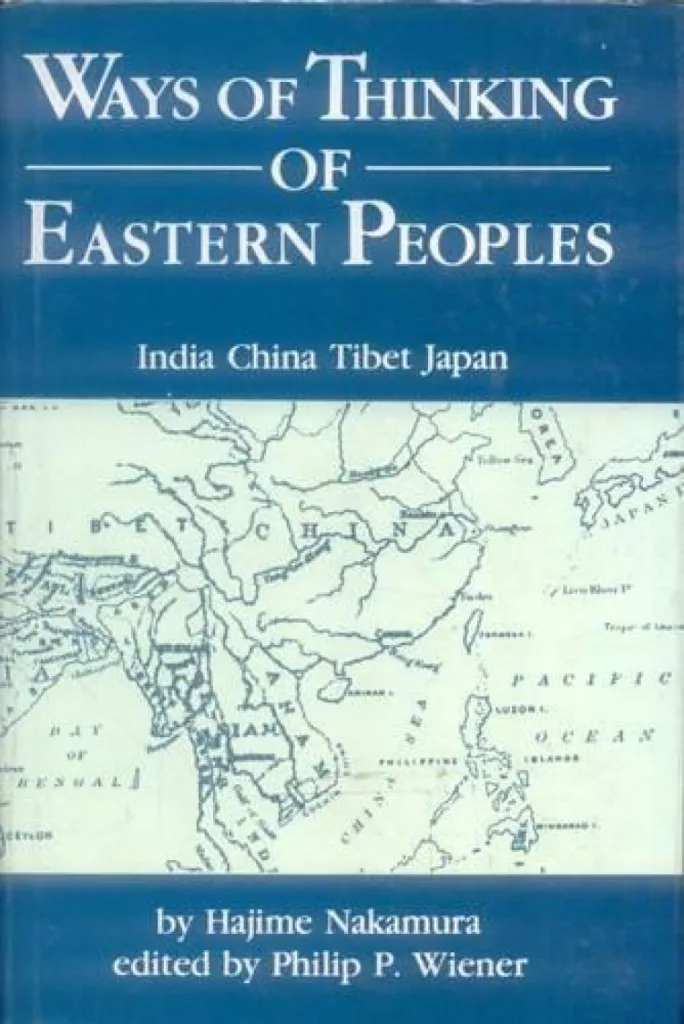
Here I want to draw on the framework of Nakamura Hajime’s Ways of Thinking of Eastern Peoples. Nakamura (1912–1999) was a Buddhist scholar and Indologist at the University of Tokyo, and one of the few Japanese scholars of his generation whose comparative work reached a Western readership. (The Japanese edition is a four-volume series; the volume drawn on below is Ways of Thinking of the Japanese People.) Nakamura identified a characteristic pattern of thought in India, China, and Japan respectively.
In summary:
India. A tendency toward the universal. Abstract thinking predominates, and abstract nouns are favored. The universal is valued over the particular, and the phenomenal world is held lightly. The sense of time is thin, and historical writing did not develop. Logic reached a high level of development, but was not tied to practical concerns.
China. The reverse: concreteness. What is particular and perceptible is valued; the orientation is this-worldly and practical. Abstract thinking and formal logic did not develop. In their place, historical writing developed to an extraordinary degree.
Japan. “Acceptance of the given reality.” The phenomenal world is taken as real just as it is. No transcendent world is posited; everything is completed in this world, in this body. Human relations and human obligation are treated as absolute; thinking is intuitive and emotional, and logical thought is weak.
(This threefold classification had a large influence on Japanese intellectual history, but it has also been criticized as overly schematic. I use it here as an auxiliary line for looking at the exhibition.)
Holding this framework while standing in the galleries changes what becomes visible.
The precise lines of the mandala, the machining accuracy of the sculpture, the apparatus of ritual. What is there is the power to work the concrete to its limit. Seen as a product of what Nakamura calls Chinese thinking, that overwhelming level makes sense. Doctrine refined as abstraction in India was translated into concrete objects and techniques in China, and Kūkai carried that to Japan.
What did Kūkai bring back?
What drew me in most was the display concerning the Goshichinichi no Mishuhō and the NHK film of the rite.
The rite needs a word of explanation. The imperial court’s New Year was divided in two: the first seven days of the first month were given to court and Shinto observances, and the second seven — the “latter seven days,” goshichinichi — to this Buddhist rite, performed in a Shingon chapel inside the palace itself. Kūkai petitioned for it and received imperial permission in 834; he performed it himself the following New Year, the year he died. It has continued ever since, and is still carried out each January, now at Tō-ji in Kyoto.
Watching the film, what I felt was the sensation of what Kūkai was actually doing coming into view directly in front of me. Hanging the mandala, laying out the ritual implements, forming the mudrās — the prescribed hand positions — and chanting the mantras. What I had read on the page as “esoteric ritual” appears instead as an accumulation of concrete procedures that use the body.
It was not thought that crossed over. It was procedures, implements, and ways of using the body that crossed over. That framing fits better with what I saw in the galleries.
Shiba Ryōtarō, and another image of Kūkai
To check the discomfort I felt on rereading Shiba’s book, I looked for other commentators. What I came upon was Miyasaka Yūkō’s Kūkai Ronyū, published on the website Encyclomedia Kūkai.
Miyasaka stands at the opposite end from Shiba in almost every respect. Born in 1950, he is an ordained Shingon priest, took a doctorate in philosophy at the University of Pune in India, specializes in Indian philosophy and esoteric Buddhist studies, and heads Chizan Denbōin, the senior research and training institution of his branch of Shingon. A Sanskrit-trained scholar writing from inside the tradition, then, as against a novelist writing from outside it. Their arguments (Miyasaka’s is titled “The Trajectory of Kūkai”) stand on quite different footing.
Before the Meiji era, Japanese Buddhism worked from the biography of the Buddha transmitted through China — the “Northern transmission,” which differs from the Pali sources better known in the West. In that version, Śākyamuni left home at nineteen, underwent twelve years of practice, and attained enlightenment at thirty. Miyasaka argues that both Saichō and Kūkai found special meaning in that age of nineteen. Saichō obtained the qualification for ordination at Tōdai-ji at nineteen, then withdrew to Mt. Hiei within three months and imposed twelve years of practice on himself. Kūkai’s reason for leaving the state college — the academy in the capital that trained sons of the aristocracy for official careers — after about a year, Miyasaka holds, came from the same resolve.
And when Kūkai completed his practice at thirty, Miyasaka writes, sokushin jōbutsu — attaining Buddhahood in this very body, in this lifetime, rather than over countless rebirths — was not a “doctrine” but an accomplished fact. In Chang’an, Kūkai received the full esoteric transmission from the master Huiguo, who selected him within months of meeting him and died shortly afterward. Kūkai recorded that encounter as coincidence, and Shiba judged him “dishonest” for doing so; Miyasaka takes clear exception to that as well.
One further passage answered the point that had been bothering me. Miyasaka positions Saichō as a forerunner — “the first person in the history of Japanese Buddhism who tried to become the Buddha.” On that basis, he writes that the founders of Kamakura Buddhism emerged from Saichō’s lineage, while the Shingon school never produced anyone who surpassed Kūkai. The point carries weight: Hōnen, Shinran, Dōgen, and Nichiren, whose schools between them account for most Japanese Buddhists today, all trained on Saichō’s mountain some four centuries after his death.
The Saichō that Shiba depicts and the Saichō that Miyasaka depicts are so different that they hardly seem to be the same person.
I have no intention of adjudicating which is correct at this point. But I understood that trying to grasp Kūkai through the image constructed by a single writer will not work. Over this summer’s reading, I intend to gather a few more viewpoints.
Why walk
There was one more passage in Miyasaka’s essay that caught my eye.
After returning to Japan in 806, Kūkai spent three years without permission to enter the capital. During that period, after staying in Kyushu, he returned to his native Shikoku and may have walked through various parts of it. And those traces may have become the origin of the pilgrimage — so Miyasaka speculates.
The pilgrimage he means is the Shikoku circuit: eighty-eight temples strung around the perimeter of the island, roughly 1,200 kilometres on foot, walked continuously for centuries and still walked today. It is the best-known pilgrimage route in Japan, and Kūkai is held to be its origin — the walker is understood to be accompanied by him the whole way.
This is not a claim backed by documentary evidence. But if the speculation is correct, then walking in Shikoku amounts to a repetition of the time in which Kūkai reconfirmed with his own body what he had brought back from Tang China.
A month from now, I will cross Mt. Tsurugi in Tokushima and head for Zentsū-ji in Kagawa. As a walking distance it is only a small fraction of the pilgrimage. Even so, having seen in a gallery in Ueno bodies carved in three dimensions, actually moving my own body to go to the same land seems to me to have meaning.
A wooden image does not move. But what that image is trying to express is a moving body. A body that sat, stood, formed mudrās, and walked. What fixed that as sculpture is what stood in the galleries.
The next piece takes up the act of walking itself: the mechanism by which the arch of the foot is reassembled with every step, the elastic energy stored in the tendons and returned, and the relationship with gravity. Before walking the land Kūkai walked, I want to put in order what walking is.
(Walking — a series of three)
- Prologue: The Body Carved in Three Dimensions — From the “Kūkai and the Treasures of Shingon” Exhibition, Toward Shikoku (this article)
- Part One: What Is Walking — Arch, Elasticity, Gravity
- Part Two: What Walking in Shikoku Did
References
Note on languages and editions:
- Special Exhibition “Kūkai and the Treasures of Shingon Buddhism,” Tokyo National Museum, Heiseikan, 14 July – 6 September 2026. Exhibition information is provided in English as well as Japanese.
- Shiba Ryōtarō, Kūkai no Fūkei. An English edition exists: “Kukai the Universal.” I read the Japanese original, and the wording discussed above reflects the Japanese text.
- Nakamura Hajime, Ways of Thinking of the Japanese People (from the series Ways of Thinking of Eastern Peoples). An English edition of the collected work exists: “Ways of Thinking of Eastern Peoples: India, China, Tibet, Japan,” edited by Philip P. Wiener. The four-volume Japanese series I used is more detailed than the single-volume English edition.
- Miyasaka Yūkō, “The Trajectory of Kūkai” (Encyclomedia Kūkai). Available in Japanese only; no English version exists.