Introduction
Rolfing is carried out across ten sessions. The circumstances under which Ida Rolf developed Rolfing were taken up in “Training Phase I: Completing the First Week.”
According to Ida Rolf’s Rolfing and Physical Reality, when the training of practitioners and teachers began in the 1950s, the search for a method applicable to every body led to the devising of a single format. That format became the ten-series, approaching the body from the Sleeve toward the Core.
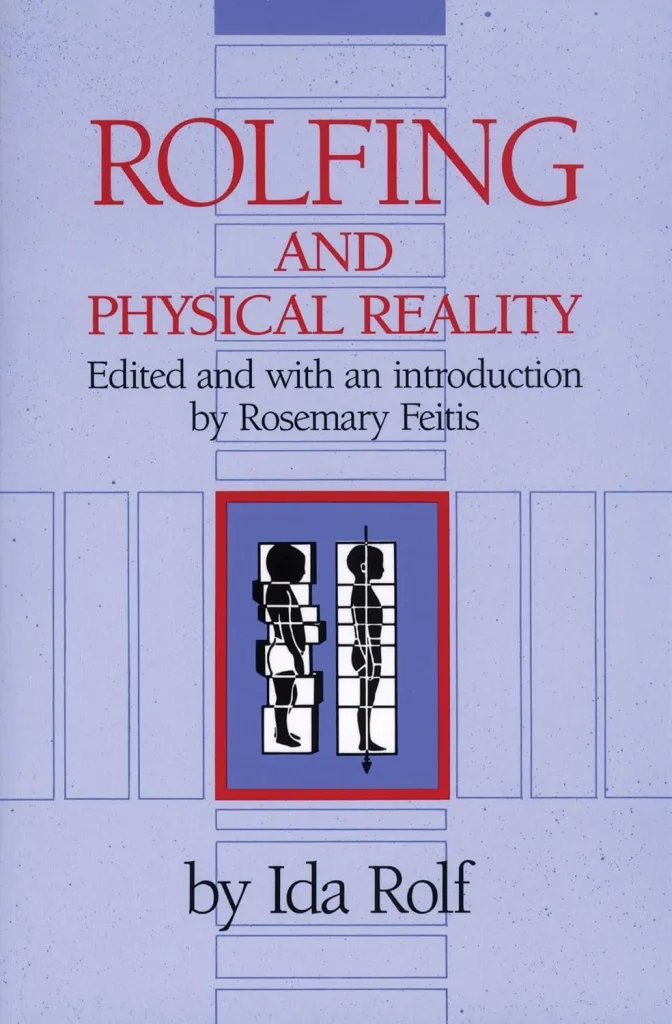
The ten-series proceeds through the Sleeve sessions in the first, second, and third; the Core sessions in the fourth, fifth, sixth, and seventh; and the integration of the whole in the eighth, ninth, and tenth. The reason for beginning at the Sleeve is to approach the body the way an onion is peeled one layer at a time. Put another way: removing, one by one, the pins in the surface layers of the body that obstruct movement — taking the pins out.

Sessions 1 through 3, the Sleeve sessions, run as follows.
- Session 1 centers on bodywork for the upper body, freeing the breath, and organizes the balance of up and down.
- Session 2 works through the lower body so that the feet, which form the foundation, move freely — freeing the foot — and organizes the balance of left and right.
- Session 3 approaches from the sides of the body and organizes the balance of front and back, integrating the first and second sessions.
Carrying out each session requires body reading — the observation of the body — a goal drawn from that observation, and a strategy, the approach that follows from the goal. Where to place attention in each of these is learned through two demonstration sessions given by the teacher and the associate teacher, through practice of the manual work, and through working on one another among the students.

As for body reading, every session begins by observing gait and breath — repetitive movements that everyone performs. That they apply to every person is much of the reason. And what characterizes the work is that in every session it proceeds so that the upper and lower body move in linkage.

What follows will take up how the body is approached, specifically, in each session.
Note, August 2026
This piece introduces the ten-series as a format devised by Ida Rolf in the 1950s, applicable to every body — a procedure moving from the Sleeve toward the Core, peeling the onion one layer at a time.
What the 2025 Advanced Training brought was the history of how that procedure was later deconstructed.
Both the ten-series and the advanced five-series, intended for those who had completed the ten, originally came with fixed procedures — formulaic series. The latter was developed not by Ida Rolf but by her successors, Peter Melchior and Emmett Hutchins. In 1989 the Rolfing organization split into the Guild for Structural Integration and RISI, now the Dr. Ida Rolf Institute.
The Guild, founded in Hawaii and centered on Melchior and Hutchins, took the path of holding faithfully to Ida Rolf’s teaching and preserving the procedures. RISI, centered on Jeff Maitland and Jan Sultan, moved instead toward a form not bound by procedure — the non-formulaic approach (see “Journey to Becoming an Advanced Rolfer — A Summary of the Road to Certification“).
In Ray McCall’s words, adhering rigidly to the procedure risks placing too much burden on the client. Maitland and others therefore established a style in which sessions are built from principles, according to the individual. The framework appearing in this piece — body reading, goal, and strategy — is its prototype.
The difference between basic and advanced training lies here as well. The basic treats each person as an average human being and teaches the procedure. The advanced honors the uniqueness of each person and builds the session to fit the client.
That said, the procedure itself was not rejected. The ten-series is one way of delivering Rolfing, not the whole of the concept — that is the settled understanding. The procedure described in this piece is still taught in the basic training today.