Introduction
The 24-day schedule ended on Friday, July 11, 2025, and I received certification as an Advanced Rolfer. With the entire training schedule now complete, I’d like to offer a summary.
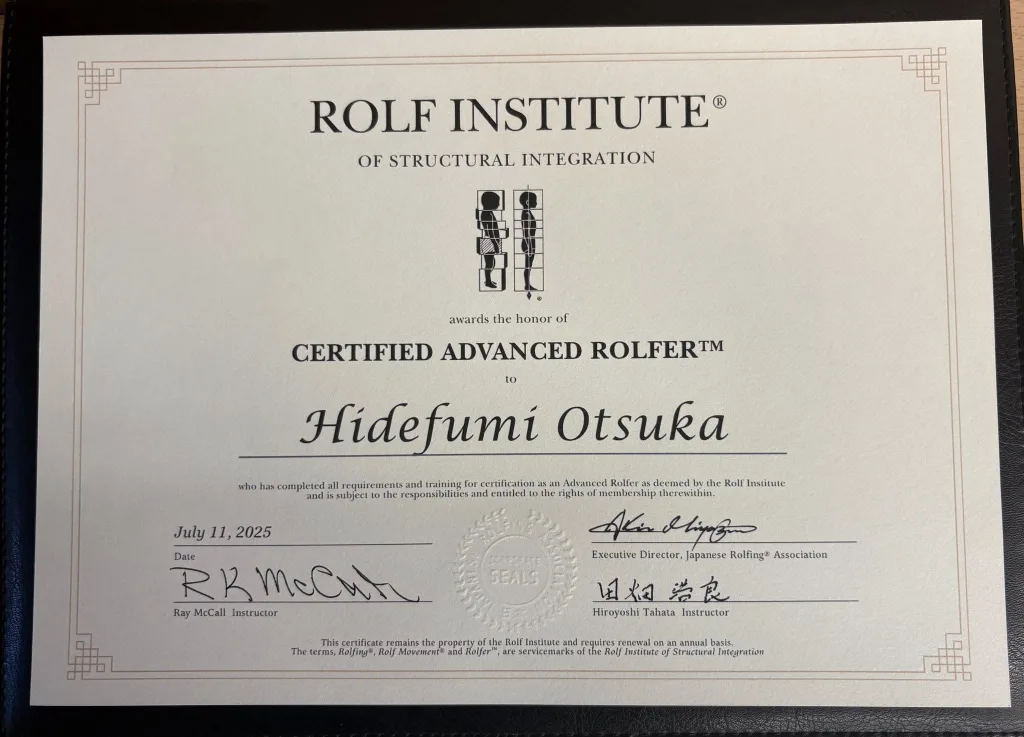
The Advanced Rolfing Training (AT) was a long-haul training totaling 24 days, divided into two parts: Phase 1 (the first half, April 8–25, 2025, 12 days) and Phase 2 (the second half, June 24 – July 11, 2025, 12 days).
To receive (Advanced Rolfer) certification, one needs to have earned 18 credits of Continuing Education Training plus three to seven years of session experience (see “Decision to take ADVANCED ROLFING TRAINING @TOKYO, JAPAN“). Having met these conditions, I took the AT, ten years after being certified as a Rolfer.
How I accumulated those eighteen credits I have set down separately: the framework and the distribution of teachers in “Continuing Education After Rolfing Certification — The 18-Credit Framework and a Map of the Teachers,” and what I looked at when choosing each course in “How to Choose Continuing Education — Four Things I Look At Before Signing Up.”
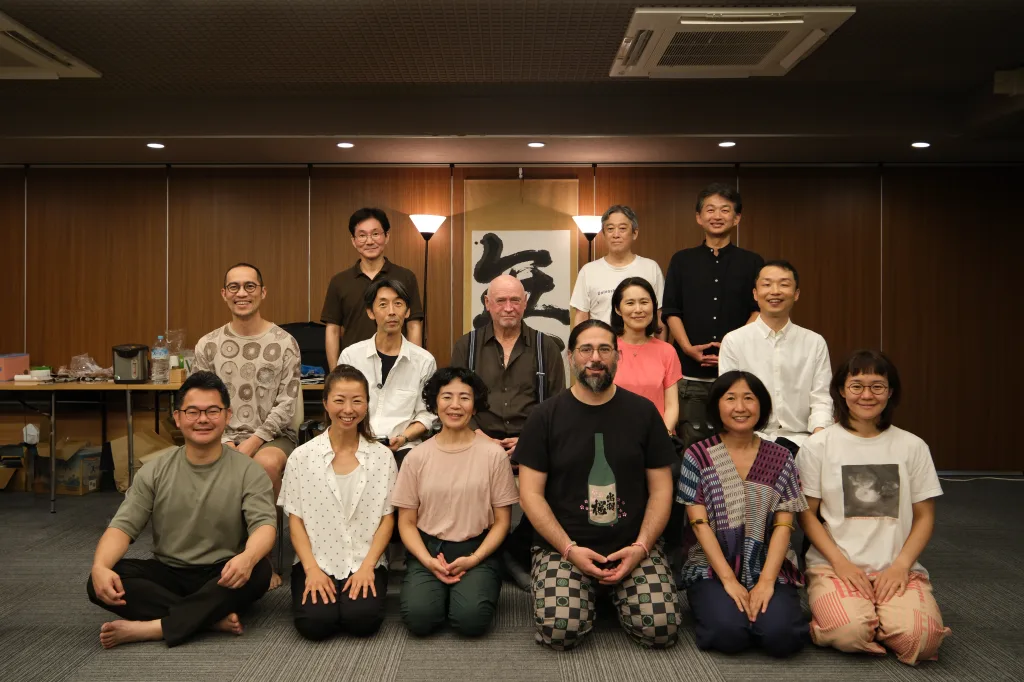
The two training instructors were Ray McCall from the United States and Hiroyoshi Tahata from Japan (on the instructors, see “Reflecting on the Personalities of Ray McCall and Hiroyoshi Tahata“); the interpreter was Satomi Furukawa. I summarized the atmosphere of the class in “How Do We Face Things When They Don’t Go Well? — The Atmosphere of Participating within Japanese Participants.”
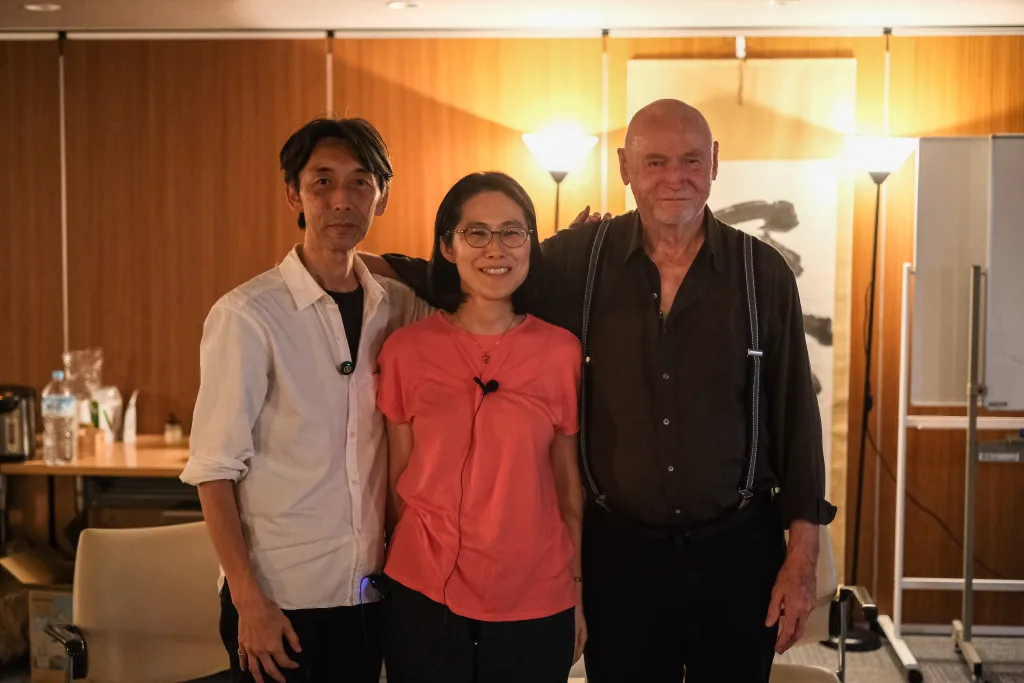
Until now I had studied with the European Rolfing Association, centered in Munich, but this was the first time I received training from these two. I enrolled hoping to re-examine Rolfing from a different perspective.
In the AT’s Phase 1 curriculum, I practiced five sessions with outside clients and three sessions among the students. In Phase 2, I gave three sessions with outside clients and three sessions among the students, respectively.
I learned various skills as well (see, for example, “What Is Spinal Biomechanics? — Deep Techniques and Somatic Impact Ida Rolf Never Taught” and “What Is Rolfing? — Integrating the Body Through Positional Strategy“), but above all, what I learned was the way of being as a bodyworker.
In this summary, I’d like to focus on the question: how did I come to cultivate this way of being?
The History of the AT + The Split of the Associations + The Influence of Jeff Maitland
I was fortunate that, from July 2024, I received a contract-work assignment that made it financially possible to take the AT. Because of this work, it became difficult to leave Tokyo. As a result, I ended up taking the AT in Ichigaya, Tokyo (see “Decision to take ADVANCED ROLFING TRAINING @TOKYO, JAPAN“).
Ray and Tahata are greatly influenced by the philosophy of the Rolfer Jeff Maitland. Why did Maitland’s philosophy exert such a large influence? Before that, we need to look at the history of the Rolfing associations.
The History of the Rolfing Associations — From Formulaic to Non-Formulaic
Looking at it historically, the teaching activity of Rolfing’s originator, Dr. Ida Rolf (hereafter Dr. Rolf), was consolidated in 1971 under RISI (Rolf Institute of Structural Integration; now the Dr. Ida Rolf Institute, DIRI). From here, the training of Rolfers began in earnest.
The split into two organizations, RISI and the Guild
At the time, both the Rolfing Ten-Series and the Advanced five-session series (for those who had completed the ten sessions) had fixed procedures (formulaic series), and were taught that way. The latter was developed by two people, Peter Melchior and Emmett Hutchins. Unfortunately, in 1989 it split into the Guild for Structural Integration (hereafter the Guild) and RISI. Each went its own way.
The Guild, centered on Melchior and Hutchins, held fast to teaching the session procedures faithful to Dr. Rolf’s teaching. The name was not newly coined at the time of the split. It was the name Dr. Rolf herself had given her own group in the 1960s, and the two of them took it up again. Jan Sultan, who was present at the split, has said in a later interview that they opened the Guild in Hawaii.
RISI, on the other hand, centered on Michael Salveson and Jan Sultan, changed toward a form not bound by procedure (described as non-formulaic). In the beginning there was no difference between the curricula of the Guild and RISI. It was only afterward, out of a need to differentiate from the Guild, that RISI added Maitland’s philosophy and other content to its training (see “Why Take Advanced Training? First day and history of training“).
In the video interview below, Sultan shares how he thought about the split into RISI and the Guild, as well as the form not bound by procedure.
Rolfing training is divided into Basic (Basic Training, BT) and advanced (Advanced Training, AT), but it uses and teaches the same techniques. Where, then, lies the difference between BT and AT? Whereas BT teaches procedures, treating each person as a similar, average human being, AT offers sessions tailored to the client, while honoring each person’s uniqueness.
My own BT was with the European Rolfing Association, based in Munich (see “Becoming a Certified Rolfer in Europe — The Certification Training of the European Rolfing Association“).
How, then, does one offer a session tailored to the client while honoring their uniqueness? This is where Maitland’s philosophy enters.
RISI and Jeff Maitland’s Philosophy
Just among the ideas introduced in the AT, one can list the Three Questions, the Five Principles of Rolfing, the kinds and classification (Taxonomy) of approaches, Somatic Sensorium, the three paradigms of treatment (Relaxation, Corrective, Holistic), Orthotropism, the four approaches through which healing comes about, and more. I plan to explain each of these in this summary, but they are ideas established with Maitland at the center.
I will speak about the above ideas from here, but encountering them became a great foundation for me as a bodyworker. At Ray’s recommendation, during the AT period I read and drew on Jeff Maitland’s Embodied Being – The Philosophical Roots of Manual Therapy (not yet translated into Japanese), and approaching the AT this way made the content of the training grow more profound still.
Three Questions
What symbolically expresses Maitland’s way of thinking is the Three Questions.
- Where do you start? (With what approach/way of thinking do you begin the session?)
- What do you do next?
- When are you done? (When do you judge that it’s finished?)
The Three Questions ask not about the technical flow of the session, but about the practitioner’s perceptual state and way of being. Ray emphasized a way of being in which the client can feel reassurance and safety in the perception that serves as the session’s starting point. As a result, the client naturally connects with needed resources and expands their possibilities (see “Jeff Maitland – Three questions, state, perception, self-organize“).
Ray and Tahata both emphasize light touch. The background to this is that, from the 1980s onward, cranial approaches entered the Rolfing community. Cranial osteopathy begins with William Garner Sutherland, and from there, by way of those who studied with him, biodynamic thinking developed.
In parallel, Dr. John Upledger founded craniosacral therapy and began teaching cranial work to people beyond osteopaths, and the territory became widely known.
Unlike the strong pressure of Dr. Rolf’s era, the direction shifted toward placing greater importance on a proper presence that allows the body and space to reorganize naturally. This idea is one form of energy work, and it was a central theme treated in this AT (see “Understanding Energy Work and Bodywork Through the Lens of Information” and “The Relationship Between Energy Work and Body Awareness“). For the whole picture of how energy work has been placed within Rolfing, see “What Energy Work Is — Where the Word Points, and How It Entered Rolfing.”
For Ray, the way of being is the sensation of the body’s axis (LINE), and through a focus around the sacrum, it is a process by which the client’s axis is evoked. Tahata aimed for a bodily state in which an appropriate tension (tonus) is maintained, through the center of gravity of the hara (see “Neutrality and HARA – How do we maintain Neutrality?“).
How to Cultivate Neutrality
In this AT, we also did work to cultivate the sensation of Neutral in order to cultivate the way of being. Three points can be raised (see “How to cultivate ‘Neutrality‘” and “What is ‘Listening Touch’?“).
1. Shape the Hand
When touching the client, rather than trying to “do” something with your own “hand,” you stay conscious of “having the client’s body shape your hand.” Through the hand, you receive the body’s information and attend to it. This becomes the basis of neutral touch.
2. Finding Back Space
When awareness is biased too much toward the “here and now,” the body shrinks or leans excessively forward. By deliberately sensing the space behind, that is, the “back space,” the center of gravity returns to the middle, and one can stand in a stable, neutral position.
3. Connecting to the Hara
Directing awareness to the “Hara,” the center of body awareness, is also a key to cultivating Neutral. The Hara is not merely a muscle; it is the place that supports one’s own “axis” and “sense of presence.” When you direct awareness to the Hara as if tuning a radio to it, you can maintain an unwavering sensation and a state open to the other person.
By cultivating Neutral, “presence” arises (see “What is ‘Presence’“), and “Right Action” — which appropriately balances the two of Letting (leaving things to happen) and Making (engaging to bring things about) — becomes possible (see “Practicing ‘Right Action’“).
INTENTION and INTENTIONALITY
Having cultivated the awareness of Neutral, the next step is to become conscious of believing that the other’s body is self-organizing.
As a hint for this, Ray introduced two ways of grasping things (perceptions): INTENTION and INTENTIONALITY (see “The Difference Between Intention and Intentionality – Understanding Neutrality“).
Intention is based on causal thinking and privileges the practitioner’s understanding. Intentionality, on the other hand, is the stance — under the premise that consciousness is always pointing toward something — of grasping the relationship with the client itself as the field of change.
This kind of stance shifts treatment from something linear and developmental (Developmental) to something nonlinear and emergent (Fruitional). In other words, what is called for is the attitude of trusting that change occurs, rather than making change occur.
How Does One Offer a Different Session to Each Person?
In AT, one offers sessions tailored to the client while honoring each person’s uniqueness. How can one achieve this?
It is by training the capacity to observe, and by offering sessions through a creative process — listening for the client’s needs while flexibly combining the Five Principles of Rolfing and the kinds and classification (Taxonomy) of approaches (see “Designing Individual Sessions through Framework“).
How Was the Advanced Five-Session Series Deconstructed?
The Advanced Training itself was begun by Dr. Rolf. She ran it four times herself, then entrusted it to her close students Melchior and Hutchins.
After that, the procedure of the Advanced series (the Recipe, the Formulaic Series) settled into place:
Return to the body’s axis (LINE) Place into the Z position and the C position Organize the HINGE of the knees, elbows, and shoulders
The ones who made this five-session procedure were not Dr. Rolf, but Melchior and Hutchins.
According to Ray:
“Clinging to this procedure risks placing too great a burden on the client.”
Maitland, Sultan, and others found a problem here, and changed it into a Non-Formulaic style that builds each session individually, grounded in principles (see “Principles and Observational Skills in Rolfing — Jeff Maitland’s Approach“).
Sultan has spoken about his motive in a later interview. Dr. Rolf said repeatedly that to take someone beyond the basic Ten Series, you need higher and higher levels of specificity. And yet what was handed down was a form organized around positions. He saw a contradiction there, and chose to teach not the procedure but the capacity to recognize patterns, and greater regional specificity.
Training the Capacity to Observe
What Maitland emphasized most was training the capacity to observe (Seeing).
“This is not mere visual inspection. It is listening to the body with the whole sensory apparatus.”
He recommended obtaining information through the Somatic Sensorium (the full mobilization of bodily sensation).
Ray, too, said in the AT:
“‘Seeing with your own eyes’ is misleading. To receive with the whole body is to observe.”
In short, it is to sense through the Somatic Sensorium (not “trying to see,” but “opening and receiving”).
For reference, Maitland proposes three stages for training the capacity to observe (Seeing) (see “Waiting for ‘Things as They Are’ to Emerge — How Can We Recognize It?“).
① Shift your intentionality or orientation
Let go of self-centered intention, and change into a state open to the “object” (the client).
② Active Seeing — Engage your somatic sensorium
Mobilize not only sight but touch, hearing, interoception, and more, sensing with the whole body. This is the so-called “feeling-nature (the sensitivity of being).”
③ Letting what is show itself
Wait for and receive the change the client’s body naturally shows.
On top of this, he says it is good to consider the Five Principles of Rolfing described below.
The Five Principles of Rolfing
The Five Principles of Rolfing were established centered on Maitland and on Sultan, who received teaching directly from Dr. Rolf:
- WHOLISM: see the body as a unified system.
- SUPPORT: encourage stability and self-support.
- ADAPTABILITY: heighten the capacity to respond flexibly to the environment.
- PALINTONICITY (two-directionality): adjust the balance of opposing forces.
- CLOSURE: give the process an appropriate “ending.”
What matters is to observe the client, discern which principle is now lacking, and design the session accordingly.
In Maitland’s own writing, these are set out as six, with continuity added.
How to Flexibly Use Each Taxonomy?
The body is a single “integrated being,” yet it has different layers:
- Structure (fascia, skeleton)
- Function (movement, patterns)
- Emotion and the nervous system
- The energy field
To organize these appropriately and choose “from which perspective should I work now?”, the idea of classification (Taxonomy) becomes necessary.
The main Taxonomy comprises the following five:
- Structural/segmental (intervention into skeletal and fascial structure)
- Biomechanical (improvement of movement and function)
- Functional (emphasizing movement and patterns)
- Psychobiological (the relationship with emotion and the nervous system)
- Energetic (working on the information field or field)
By choosing which Taxonomy to look at preferentially, according to the client’s state, it becomes possible to offer a more profound, more precise session.
The Four Approaches Through Which Healing Comes About
After the training ended, I obtained the article Maitland wrote for the association’s journal in 2007. Reading it, I could see where what I had received over those twenty-four days had come from.
In the article he divides the ways healing comes about into four.
The direct approach applies energy or force directly against a restriction or fixation, producing change in a predetermined direction. An osteopathic or chiropractic thrust is typical, and Rolfing’s fascial work belongs here too.
The indirect approach makes use of the body’s intelligence and its drive toward health. Rather than correcting the distortion, you move slowly in the direction of it. At the limit a stillpoint arrives, after which the structure unwinds on its own. What the practitioner does in the latter half of the technique is to suspend their own will and drop the intention to change anything.
The approach to the organizing forces is represented by the work of William Garner Sutherland — the line that ran from the inherent motion within the cranium to the phenomenon he called the Breath of Life. Here the practitioner begins by using no technique at all. There is no pressure, no attempt to move anything, no intention to change.
The first stage of the work is not to change the client but to fundamentally change one’s own orientation toward the client.
In the zero-distance approach, the work is done without touching the client. Healing arises not from the application of a technique but from the practitioner’s intentionality. Maitland declines to call this an energy approach. Energetic techniques can be found within all four, so naming only the fourth that way would not be accurate.
The question differs from that of the three paradigms. The paradigms divide what is being aimed at. The four approaches divide how healing comes about. Aim and method: it is the four approaches that answer what you actually do once you stand in the holistic paradigm.
At the center of the article is the distinction between intention and intentionality. Intention is one kind of technique, and whether it works depends on the practitioner’s intentionality. So the claim that intention matters more than technique does not hold. What holds is that intentionality matters more than intention and more than technique.
The account of intention and intentionality I received in the AT had its source in this article (for the detail, see “How Healing Comes About — Jeffrey Maitland’s Four Approaches“; on how the article relates to energy work as a whole, see “What Energy Work Is — Where the Word Points, and How It Entered Rolfing“).
“Transformation” Occurs Through Physically “Yielding”
YIELD work does not belong to Tahata alone. It came out of a shared inquiry with Carol Agneessens, a Rolf Movement Instructor. The two published “Yielding” under both their names in the June 2012 issue of the association’s journal, where they write that they had been working on the subject together for more than ten years by then.
In the process of obtaining his qualification, Tahata was also influenced by Rebecca Carli-Mills.
Nor did the two of them coin the word yield. It names the first developmental movement as described by Bonnie Bainbridge Cohen within Body-Mind Centering. It is neither a passive surrender nor a doing of nothing. It is an active movement into relationship, and is held to underlie all other movement.
In a session, with the client in a relaxed state on the table (supine, prone, on the side), one finds a neutral place (1st Position) and, by remaining there, works on the client’s system. The principle lies in the client yielding themselves to the contact surface as they lie on the table. Just as with anchoring — the foundation for adherent cells — in molecular cell biology, only once a stable foundation is formed does inner change occur.
Transformation comes about through the practitioner’s side organizing the field (see “Neutrality and Waiting for Change — Yield Work and Changes Between Sessions“).
The two of them state plainly that yield is not a technique. It is an embodied state of awareness; the practitioner does not “do” yield. Whether the session is structural, movement, or craniosacral, it can be threaded through any of them. Their joint article carries a diagram setting out how yielding relates to the Principles of Rolfing Structural Integration. It is treated not as one item inside a taxonomy but as something that runs across them.
Its institutional place follows the same line. In November 2015 the journal carried an interview on yield in its Rolf Movement Faculty Perspectives column. The workshops held in Japan are recognized for credit toward Rolf Movement certification. I hold a Rolf Movement Practitioner certification from Europe myself, and yield was not part of that curriculum (see “On the Path to Becoming a European Rolf Movement Practitioner — The Road to Certification“). In the course announcement issued by the Japanese Rolfing Association, Tahata is likewise introduced as someone exploring the energetic taxonomy using the concepts of ma and yielding.
At the same time, it is referred to within the discussion of energy. In the June 2017 issue given over to energy, Kathy McConnell names Tahata’s yield as an important source of inspiration in an article whose subject is the use of the hands: resting the backs of the fingers lightly to evoke motility throughout the body, sliding the back of the hand beneath the body to invite the client’s system to yield to gravity. Written that way in an issue devoted to energy — and still called an approach to Rolf Movement.
In relation to Maitland’s four approaches, yield does not sit inside any one of them. The four divide how healing comes about; yield is a matter of how the practitioner is. It belongs on the side of intentionality, not intention (see “How Healing Comes About — Jeffrey Maitland’s Four Approaches“).
For reference, during the AT period Tahata described YIELD work using the words “the integrity of the system” rather than the word energy.
Not Over-Involved, but Not Indifferent Either
For transformation to occur in a session, it matters what kind of “way of being” the practitioner engages the client with.
The key to this is the stance of “Neutral,” which Ray expressed as “Kind Indifference.”
In short:
- Not getting excessively caught up in the client’s experience
- But at the same time, watching over them with profound interest
This exquisite balance opens the field of transformation (see “How Do We Build Relationships with Clients? — Between “Engagement” and “Trust” as a Rolfer®“).
The osteopath Jim Jealous expressed this as:
“The process is none of your business. Observe, but do not become part of the story.”
As stated above, change is not something the practitioner makes, but something that occurs from within the client. The practitioner’s role lies in organizing, trusting, and waiting for the field in which that change is born (see “More Than Technique — The Question of ‘Being‘”).
This kind of way of being is something that should be tuned through the body, and Ray spoke of it as Fundamental Vibration, sharing a parable from the words of Zen (see “Beyond ‘Looking’ — On Fundamental Vibration, Right Action, and Neutrality“).
The orthotropism Maitland proposes — just as a sunflower naturally stretches toward the sun, the human body, too, holds within it a force that, in harmony with gravity, seeks to head upward. Rolfing’s role lies in supporting that, without getting in its way (see “Not About Adjusting the Body, But Trusting Its Capacity to Self-Organize — Embodied Wisdom of Neutrality and Verticality“).
Not organizing, but yielding to the force that seeks to organize itself — this, one can say, is the essence of the neutral way of being.
What helped me cultivate this sensation was the Eye of the Foot work.
Spatial-Awareness Work — The Sensation of Having “Eyes” in the Soles
This is the sole-of-the-foot work that Ray says he treats in every training (see “Space Is Not “Nothing” — It Is “Something”: A Perceptual Shift Beginning with the “Eye of the Foot”“).
Supposing that “there are eyes in the soles of the feet,” one opens and closes them and observes what changes occur in the body and in space. When the eyes “close,” the body contracts and the sense of ground-contact becomes scarce. When they “open,” on the other hand, the pelvic floor and diaphragm soften, and the connection with space grows rich. By consciously repeating the opening and closing while walking, one’s sense of distance and of unity also changes.
Through this experience, my understanding deepened that space is not “nothing” but a “field with quality” that holds a relationship with us. When you direct awareness not to the object but to the “between,” the body’s sense of support and of reassurance also expands. Just as one participant felt space to be “a presence with density,” space comes to appear as an object that holds a “responsive relationship” with the body.
Through the soles of the feet, many participants also sensed both the inner center line and the outer horizontal line. As the body’s tension eased and the sense of self expanded, relaxation and concentration, release and a sense of core, coexisted. I feel this is perhaps a process of seeking not relaxation but “appropriate tension.”
This experience became a practice for recovering the relationship between space and the body. We do not merely exist within space; we exist within a relationship with space.
Personally, I found it interesting that, after doing this work, the perceptual precision of the instructors’ demonstrations rose dramatically.
Energy Work Grasped Through the Lens of Information
A distinctive feature of this AT was that it took up energy head-on. Ray said that this was the first AT to place energy at its center.
There is a similar account in Europe, though. Andrea Clusen, who assisted in the final stage of my basic training, writes of the Advanced Training in which she was certified that it was the only such course to have had the energetic taxonomy as its leading notion. Her certification was in 2010. I have not been able to confirm what that course contained.
The framework of the course itself was standard. The announcement issued by the Japanese Rolfing Association lists a client-centered series grounded in the principles of intervention, the internal logic of the Ten Series, neck work, back work and tracking, positional strategies, core connectivity, and the development of perception. The word energy does not appear.
The announcement did, however, close with this: a portion of the course will include the instructors’ latest interests, innovations and discoveries. The AT has an agreed allowance in which roughly five of the twenty-four days may be given to what the instructors themselves are pursuing.
And in the same announcement, Ray is introduced as someone who has been exploring the field of the energetic taxonomy in recent years. Tahata, likewise, is introduced as exploring the energetic taxonomy using the concepts of ma and yielding. It was a course in which both instructors were working in this territory.
The energetic taxonomy itself is not new. Among the aims of the AT, evaluation through the structural, geometric, functional, worldview and energetic taxonomies, a touch that integrates direct, indirect and energetic techniques, and accurate sensing at a distance, have long been set out.
In the basic training (BT), on the other hand, it is not taken up. Maitland has said that energy work should not be taught at the first stage, that it only confuses students, and that it should be handled at the end of the training, after clear touch, presence, and a grounded, calm way of being have been established (see “Understanding Energy Work and Bodywork Through the Lens of Information“).
According to the Rolfer Kevin Frank, one can think of bodywork as an approach to physical structures such as fascia and the skeleton, and energy work as an approach to an invisible field of information, considering them separately.
The two are not opposed; one can grasp them as the two ends of a continuum that share the common element of the transmission of information. In short, both bodywork and energy work can be understood as the exchange of information (see “Understanding Energy Work and Bodywork Through the Lens of Information” and “The Relationship Between Energy Work and Body Awareness“).
From the perspective of the exchange of information, energy work can be grasped from the following four perspectives.
1. A living organism is a self-organizing system
A living organism responds self-organizingly to informational stimuli from outside, and is thought to rebuild order. Ray expresses this as “the body is a system that can self-regulate.”
2. Energy is a “field” as an informational structure
In Bob Schrei’s Source Point Therapy, a field of order-information (a blueprint) is said to exist around the body, and the body is connected to it. This grasps the body as an “open system” that is always exchanging information with the outside.
3. A holistic vision beyond dualism is energy
Beyond the dualistic separations of ordinary science — subject and object, mind and body, inside and outside — one finds meaning in the relationships among the constituent elements themselves. Kevin Frank expresses it as “there is essentially no distinction between bodywork and energy work. Everything is ‘information.'”
4. Jeff Maitland’s way of thinking about energy
For Maitland, energy work is “holding the field in which healing naturally occurs.” The practitioner’s role lies not in causing healing, but in holding the space in which healing occurs. As a result, what is as it is comes to show itself.
What Is Integration?
In the AT, alongside “Neutral,” the theme of “Integration” is placed at the center. Regarding integration, Ray speaks as follows (see “What Is Integration? Evoking Health” “What is Integration? It is not just “Putting Things Together” ” and “The Second Half Begins“).
Three points of integration
I learned that there are the following three points in encouraging integration.
1. Promoting the capacity for self-regulation
Believe in the capacity for self-regulation within the client, and support it. Be not an existence that “makes” change, but one that organizes the “field where change occurs.”
2. Harmony with gravity
Dr. Rolf thinks of integration as harmony with gravity. As the body receives the support of gravity, a state arises in which one can stand and move with minimal effort.
3. Recovery of wholeness
Integration can be seen as a process of recovering a whole connection that includes not only the musculoskeletal system but also sensation, emotion, and the level of consciousness. One aims not at a particular part but at integration as the whole of human existence.
The Basic Process for Encouraging Integration — “Test → Intervene → Re-test”
By repeating “Test → Intervene → Re-test” in a session, it is possible to verify integration.
Specifically:
Test: Observe the client’s way of standing, movement, and sensation. It matters not to impose “what should be done,” but to listen to the voice of the client’s body.
Intervene: Carry out the minimum necessary action. From the energetic dimension, one emphasizes not “what to do” but “what kind of field to create” and “what naturally occurs.”
Re-test: After the intervention, observe the client’s response again. Here, rather than imposing change, you watch for whether natural self-regulation has begun.
By repeating this cycle, the process of integration is naturally born from within the client themselves. Furthermore, one can judge whether the approach was good.
How to Think About Closing
A distinctive feature of a Rolfing session is that it has an ending — a closing. In the AT, we also took up what one should keep in mind in order to close effectively.
For example:
“One of the reasons closures are important is because it allows what is next to happen.”
Closing is the process of physically “settling” the experience of the session, sensorially “digesting” it, and integratively “giving it meaning.” One comes to grasp it as an important step that allows the client to continue to feel the session’s effects and to transition naturally to the next change.
For that:
- Observe the client’s state: Carefully observe what state the client is in at the close of the session. Choose a concerted or organic closing as needed.
- Aim for dynamic stability: So that the client can continue to self-regulate after the session, aim, ideally, to end the session in a state of dynamic stability, and proceed with the closing accordingly.
- Consider the balance of core and sleeve: Be conscious of the relationship between the client’s core and sleeve, and promote a state in which they can respond flexibly to information from outside.
These are said to matter (see “Why Is Closing Important for Integration?“).
The neuroscientist and psychiatrist Daniel J. Siegel states the following about “integration” in The Developing Mind (3rd edition):
“Integration creates a flexible, adaptive, coherent, energized, and stable (FACES) flow of energy and information.” — Daniel J. Siegel, The Developing Mind (3rd ed., 2020)
I read this book during the AT period and learned a great deal from it, so when being conscious of integration in my own sessions, I intend to incorporate this way of thinking.
Conclusion
I have run quickly through an overall summary of the AT. The distinctive feature of this AT was energy work — and how one cultivates the practitioner’s way of being. There was much that was abstract, but the learning was great.
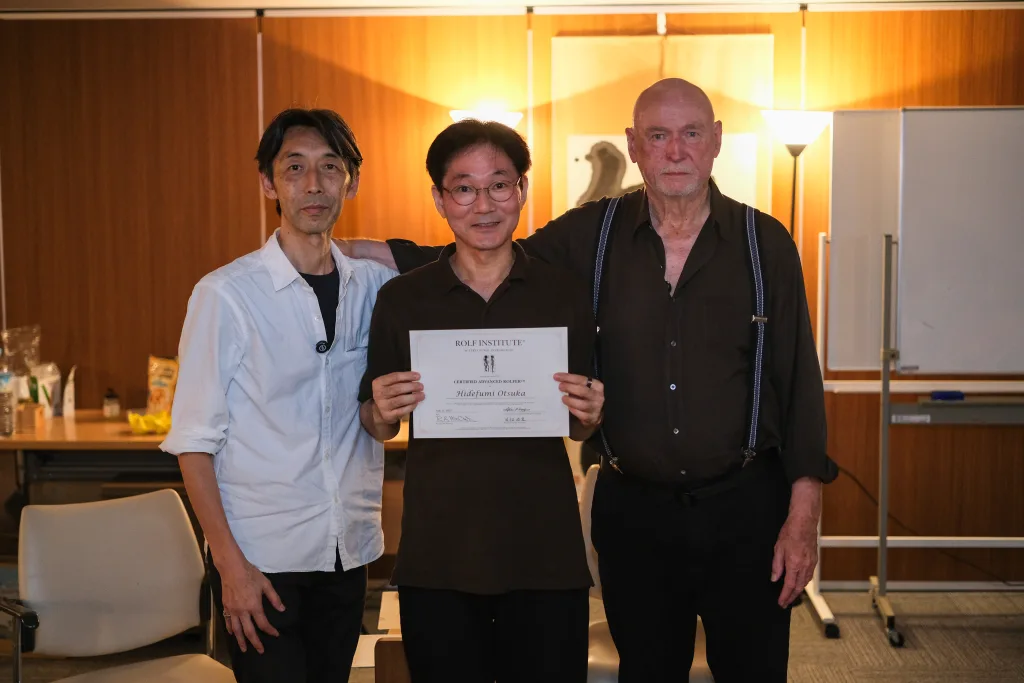
Basic Training, then continuing education, Rolf Movement, and the Advanced Training. My study of Rolfing has come to a natural waypoint.
From here, too, I want to apply myself day by day so that I can return what I have learned to my clients.
Related Articles on the Rolfing Training
- What It Takes to Become a Rolfer — An Overview of Qualifications, Organizations, and Training, Explained by a Rolfer
- Becoming a Certified Rolfer in Europe — The Certification Training of the European Rolfing Association
- Continuing Education After Rolfing Certification — The 18-Credit Framework and a Map of the Teachers
- How to Choose Continuing Education — Four Things I Look At Before Signing Up
- On the Path to Becoming a European Rolf Movement Practitioner — The Road to Certification
- What Energy Work Is — Where the Word Points, and How It Entered Rolfing