
A note for readers outside Japan: the Nara National Museum provides an English-language page for this exhibition, and the titles of works used here follow the museum’s official English wording. Japanese terms are glossed on first use. The one book cited at the end exists in English translation; details are in the References.
Introduction
On 23 July, at the Heiseikan of the Tokyo National Museum in Ueno, I saw the exhibition “Kūkai and the Treasures of Shingon Buddhism.” Two days later, on 25 July, I went to Nara.
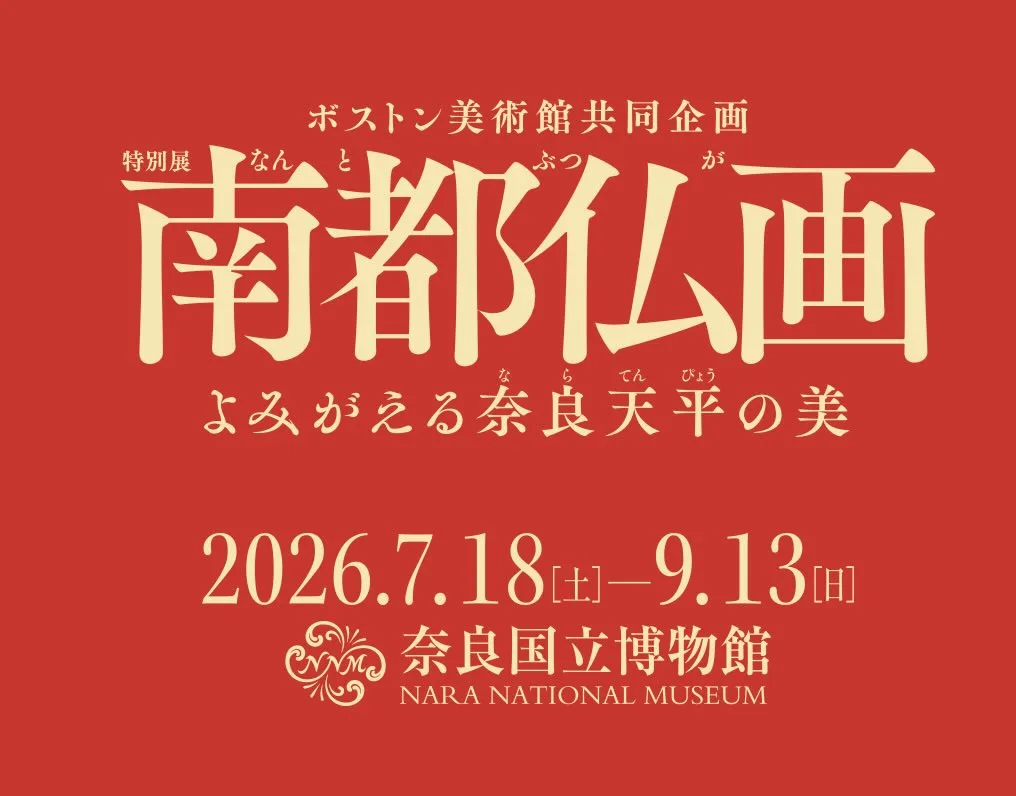
There I had the chance to spend a long time with the special exhibition at The Nara National Museum: “Buddhist Paintings of Nara: Reviving the Splendor of Classical Tradition.” It is an international collaboration with the Museum of Fine Arts, Boston, and Buddhist paintings associated with Nara have come home together for it.
The previous article dealt with carved wooden images. A body that comes into being as the viewer walks around it. A body as mass. This exhibition offers a different vantage point altogether. The body in Buddhist painting has no mass. There is only line.
Standing in the first gallery in front of the Kondō Hall murals of Hōryū-ji — destroyed by fire in 1949, and shown here as high-resolution color images reconstructed by digital means from surviving glass photographic plates — and looking at their color, I began thinking — as a Rolfer — about the question that runs under this whole exhibition:
If there is nothing but line, why does a body still read as a body?
This will run long, so I have divided it in two. Part One is about the body in Buddhist painting itself, and about the workshops that produced it.
What “Buddhist Paintings of Nara” means
A note on the term first.
Nara was once known as Nanto, literally the “Southern Capital” — the capital lying to the south when seen from Heian-kyō, present-day Kyoto. It is the name used in contrast to the northern capital.
The Buddhist painting handed down in that city from ancient times is known collectively as Buddhist paintings of Nara (Jp. nanto butsuga). It is not the name of a school or a technique. It is the name of a place, and of the lineage that ran through that place.
Borrowing the exhibition’s own account, the sequence runs like this.
Nara period (710–794) — Richly cosmopolitan Tenpyō painting adorns the great temples, and becomes the model for generations to come.
Heian period (794–1185) — Buddhist painting in the refined taste of the court aristocracy is widely made and venerated.
Kamakura period (1192–1333) onward — This is the era of revival for the Buddhist establishment of Nara. Revivalist works are produced on the basis of Tenpyō iconography. The Buddhist painters affiliated with the Nara-based painting atelier (Jp. nanto edokoro) take on not only paintings and illustrated handscrolls but also the decorative coloring of Buddhist sculpture.
The modern era onward — The Tenpyō Buddhist painting of Nara is acclaimed as a classic of Japanese art, serving as a source of ideas for modern Japanese nihonga painting and at the same time becoming an object of official cultural property protection.
The exhibition traces the period from the late seventh century to the late sixteenth in eight chapters. It is the first attempt to follow the history of Buddhist paintings of Nara as a whole.
One thing caught on me here.
In this lineage, the standard is placed at the beginning. Tenpyō comes first, and goes on serving as the criterion for the ages that follow. The later periods move away from it, or come back to it.
The shape of the story is different from the one I followed through the history of Western painting. That difference will matter in Part Two.
The scale of the exhibition
The scale is worth recording. The Nara National Museum and the Museum of Fine Arts, Boston spent nearly two decades planning this collaboration. It runs from 18 July to 13 September 2026. Thirteen works with Nara associations from the Boston collection have returned to Japan together, and alongside outstanding works held in Japan they make up 171 items — paintings, sculptures, handscrolls — spanning the late seventh to late sixteenth centuries, arranged in eight chapters. Nineteen are designated National Treasures and sixty-nine Important Cultural Properties.
The day before, I had been walking Tōdai-ji, Kōfuku-ji and Gangō-ji. This museum came in between. I have written about Nara as a chapter of Buddhist history separately.
→ Nara After Thirty Years, and the Ordination Platform That Was There (Part One) (in Japanese)
Why Boston
The word “homecoming” — satogaeri in Japanese, the word used for a married daughter returning to her parents’ house — carries an undertone here. Reading down the checklist, one line recurs: Fenollosa-Weld Collection.
A video in the gallery explained how that came about. I stood and watched it for a while.
In the anti-Buddhist movement that followed the 1868 edict separating Shinto from Buddhism, an enormous number of Buddhist images and paintings were destroyed, and temple treasures were sold off for almost nothing. Even the five-storey pagoda of Kōfuku-ji was put up for sale, and came close to being dismantled.
The day before, I had looked up at that pagoda and thought that it was unchanged from thirty years ago. But a hundred and fifty years ago, that pagoda nearly ceased to exist.
Ernest Fenollosa arrived in Japan in 1878, invited to teach philosophy and related subjects at the University of Tokyo. Among his students, serving as his interpreter, was Okakura Tenshin — known abroad as Okakura Kakuzō, later the author of The Book of Tea.
The two of them travelled through the old shrines and temples of the Kansai region on survey. The story of their having the shrine in the Yumedono of Hōryū-ji opened, in 1884 (some accounts say 1886), is well known. Behind doors that had not been opened for two hundred years, wrapped in cotton cloth, stood the Guze Kannon. Tenshin wrote of that moment that it was the greatest joy of his life.
And Fenollosa argued strongly for the protection of cultural property. The survey work he and Tenshin carried out formed the ground on which the Law for the Preservation of Ancient Shrines and Temples was enacted in 1897 — the ancestor of Japan’s present cultural property legislation.
At the same time, Fenollosa was buying.
What he assembled passed through the hands of Charles Goddard Weld and entered the Museum of Fine Arts, Boston, where it came to be called the Fenollosa-Weld Collection. Fenollosa himself became the first curator of the museum’s Japanese department when it was established in 1890. With the collections of Edward Morse and William Sturgis Bigelow added, Boston became the museum holding the finest collection of Japanese art outside Japan.
The person who protected and the person who carried away were the same person.
This is a place where simplifying does no good. It is true that these things survived because they were bought. Had they not been sold, they might have been burned or left to rot. But because they were bought, they are not in Japan. The word “homecoming” shoulders both of those at once.
And this bears directly on the subject of this article.
What could cross the ocean were the paintings. A hall cannot cross. A painting can be rolled and carried. In the destruction of that period, only what could be moved could also escape.
The clearest case of that is a single temple, which I will write about in Part Two.
What separates the body in sculpture from the body in painting
The sculptures I saw in Ueno were not images made to be seen from the front. They come into being as the viewer moves around them. They have weight, they have mass, they have a relationship with the floor.
Buddhist painting has none of that. What it has is line.
As I looked, I came to think that these lines are of two kinds. Nothing in the labels said so. It was simply easier to see that way.
The first kind determines the outside of the body. The contour. A single line divides where the body ends and space begins.
The second kind indicates the inside of the body. The lines that describe the folds of cloth. In Buddhist sculpture and painting this treatment of drapery is called emon. How the folds are made to run shows the quantity of flesh underneath, and the way gravity is falling through it. The position of the knee, the thickness of the belly, the way the arm drops from the shoulder. None of it is depicted, and all of it is there.
When I look at a client’s body in a Rolfing session, I am doing something similar. Through clothing, I infer the structure underneath from the way the fabric folds. The painters of these works were doing the reverse operation. Drawing the line so that the inference will follow.
Buddhist painting, then, was a technique for compressing information about the body into a one-dimensional element and transmitting it. Seen that way, the meaning of its fineness changes. Drawing a thin, even line is not the object. The whole of an understanding of the body rides on the decision of a single line. That is why it cannot be anything but fine.
The Tenpyō line — what “cosmopolitan” contains
Tenpyō Buddhist painting of the Nara period became the standard for later ages. Exhibitions and commentaries describe it as cosmopolitan.
I would like to reread that description as a statement about line. Cosmopolitan means, in effect, where the line came from. It came from Tang China, and from further west than that. The Kondō wall paintings of Hōryū-ji, placed at the opening of the exhibition, were described as reflecting continental modes of expression brought back by the embassies to Tang China — a powerful line drawing.
Powerful, not delicate. A different word from the one applied to the Heian works.
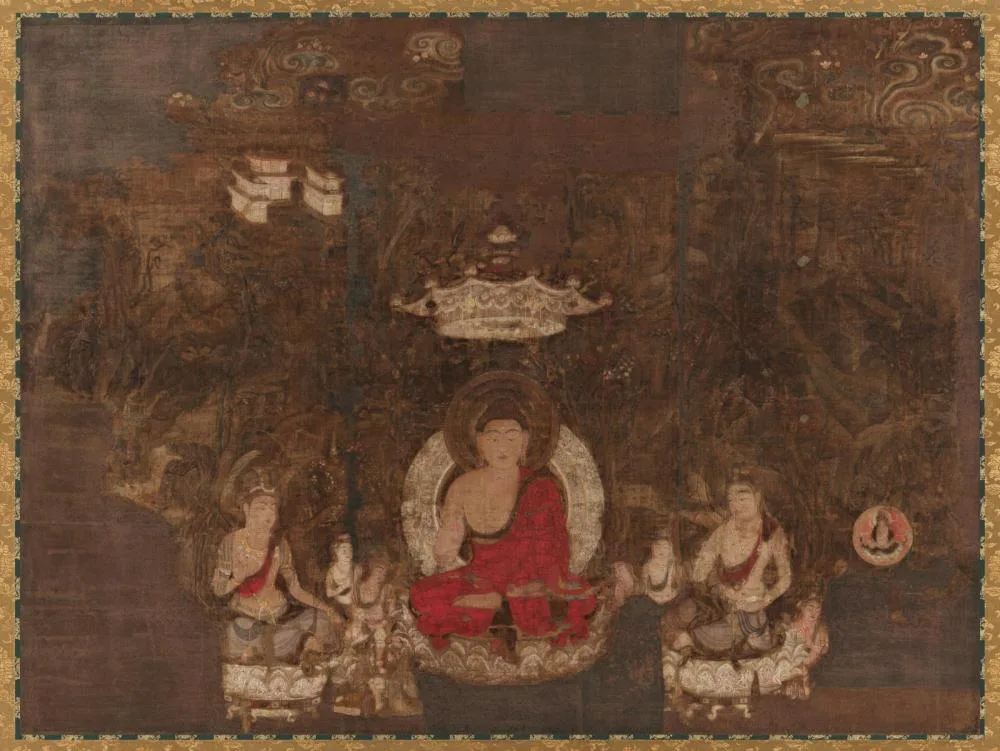
And in this chapter I stopped in front of Shaka, the Historical Buddha, Preaching on Vulture Peak, also known as the Hokkedō konpon mandara. Nara period, eighth century; transmitted at the Hokke-dō of Tōdai-ji, now in the Museum of Fine Arts, Boston. It depicts the historical Buddha expounding the Dharma on Vulture Peak.
The day before, I had been walking that same Tōdai-ji. The hall is in Nara and the painting is in Boston. Here too, what could be moved and what could not have been separated.
And looking at this painting, a question I had been carrying since the previous day took shape.
The same word, mandala, is being used for entirely different kinds of picture.
The day before, at Gangō-ji, I had looked at the Chikō Mandala — said to depict the Pure Land as it was revealed to Chikō, a monk of the Nara period. What I had been thinking about then was how it differed from the Womb and Diamond Realm mandalas that Kūkai brought back from Tang China. The Chikō Mandala is a picture of a place to be reached. The two-realm mandala is a diagram of the structure of the cosmos. An object of longing, and a map of a system of understanding. They look like the same format, and their functions are entirely different.
→ Nara After Thirty Years, and the Ordination Platform That Was There (Part One) (in Japanese)
Now a third had arrived.
The painting known as the Hokkedō konpon mandara is a picture of an event. The Buddha is preaching, and around him are those who are listening. It depicts something that happened, at a particular time, in a particular place. Not a structure, not a destination. A scene.
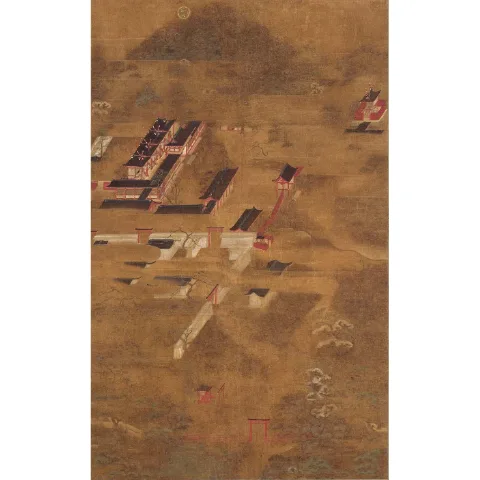
And this exhibition held a fourth. The Mandala of Kasuga Shrine, which I will discuss in Part Two. That one depicts shrine buildings and the sacred mountain behind them — a landscape view, which is to say something close to a map.
Set side by side:
- Hokkedō konpon mandara (8th century) — a scene. An event that took place.
- Chikō Mandala (Nara period onward) — a place. The Pure Land longed for.
- Womb and Diamond Realm Mandalas (9th century, Kūkai) — a structure. The system of the cosmos.
- Mandala of Kasuga Shrine (Kamakura period onward) — a landscape. A sacred precinct that actually exists.
All four are called mandalas. What they set out to depict — event, place, structure, landscape — could hardly be more different. One word doing four different jobs.
Two days of walking in Nara let me see these four in sequence, and so follow the shift in the word itself.
The way the body is drawn changes with them.
The bodies in the preaching scene face one another and take the posture of listening. Bodies within a relationship. The bodies in the Pure Land painting are placed as part of a landscape. The bodies in the two-realm mandalas occupy a single point within an ordered system, and their posture and attributes are determined by that position. Bodies within a coordinate grid.
Within a relationship, within a landscape, within a coordinate grid. Where the body is placed changes the line that is drawn.
The Tenpyō line is probably called powerful for reasons connected to this. In the event of preaching, someone is speaking toward someone else. Bodies that face each other require direction. And producing direction requires strength in the line.
The Heian line — on not remembering
In the Heian period, against the background of court culture, refined Buddhist painting spread. The National Treasure Eleven-headed Kannon (Jp. Jūichimen Kannon; Heian period, twelfth century, Nara National Museum) was on display.
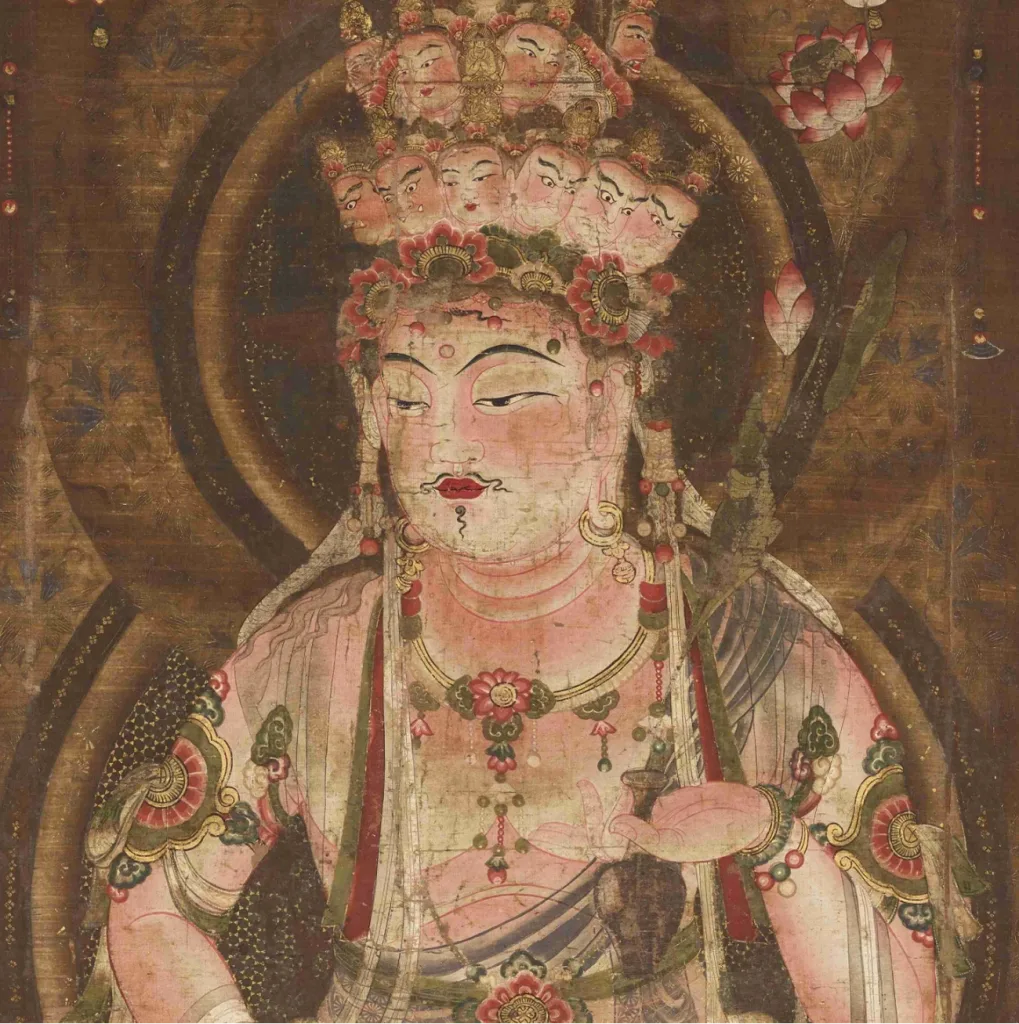
To be honest, almost nothing from this period stayed with me.
Thinking back on the exhibition after returning home, this surprised me. It is a National Treasure. It is one of the centerpieces of the show. And still I cannot reconstruct what was in front of me.
Setting out the reasoning first: if the assessment “refined” is restated as a statement about the body, it means making the body slender and long, and drawing the weight out of it. The relationship with gravity changes. Where the Tenpyō images are settled on the floor, the bodies in refined Heian painting begin to lift off it.
From the Rolfing side, this is not somebody else’s problem. A body with the weight drawn out of it looks beautiful. But in an actual body, the attempt to draw weight out appears as the tension required to hold the body up. A body that looks beautiful and a body that is at ease are not the same thing. What Heian Buddhist painting presents is the former.
Kamakura, and the workshop — an ebusshi named Chōmyō
Chapter 5 was titled “Uchiyama Eikyū-ji — Sculptors and Painters of Nara in Competition.” Here I stopped.
In the Kamakura period, as Buddhist doctrinal study revived around Tōdai-ji and Kōfuku-ji and ritual was put back in order, demand rose sharply for the polychroming of principal images and for Buddhist paintings. Meeting that demand were the ebusshi — Buddhist painter-monks — of the Nara-based painting atelier (Jp. nanto edokoro), the body responsible for Buddhist painting at medieval Kōfuku-ji. Three of them were prominent: the Shōnami-za, the Handa-za, and the Shiba-za.
In the Shōnami-za there was an ebusshi named Chōmyō.
This man was extraordinary.
The Four Guardian Kings in the Museum of Fine Arts, Boston (Kamakura period, thirteenth century, by Chōmyō). The kings stand on rocks in the sea. They are moving. The way a foot is put forward, the twist through the pelvis, the turn of the flying scarves. From line alone it is possible to read which way the weight is transferring at this moment.
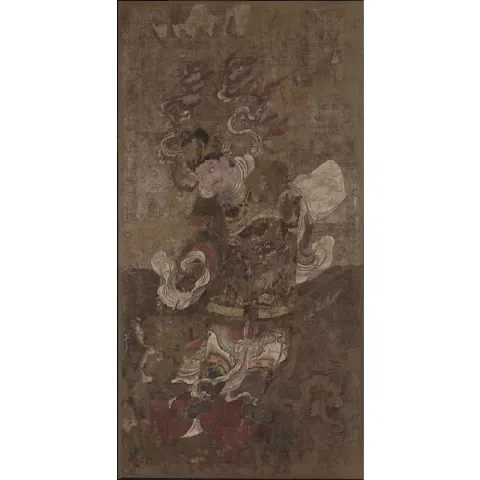
Where the Heian bodies of the previous section had lifted off the floor, these are treading on rock. The weight has come back.
And one more work. The Fudō Myōō and Eight Youths at Setagayasan Kannon-ji in Tokyo carried this record:
Carved by Kōen in 1269. Polychromed by Chōmyō in 1272.
The carver was the sculptor Kōen, a grandson of Unkei. Three years later, the painter Chōmyō laid color and line onto the surface of the image.
The day before, I had seen the guardian figures by Unkei and Kaikei at the Great South Gate of Tōdai-ji. An image carved by Unkei’s grandson, polychromed by an ebusshi of the Nara ateliers. The lineage of sculptors and the lineage of painters cross on the body of a single image.
The person who made the volume and the person who drew the lines on its surface are recorded as separate people. And three years stand between them. That much time passed between the completion of the carving and the laying on of color.
Here the question at the center of this article takes a concrete form. Sculpture and Buddhist painting were not separate genres. Within a single image, mass and line were divided between two hands.
What this shares with the Renaissance workshop
And this structure was familiar.
The workshop of Verrocchio, which Leonardo da Vinci entered in his teens, was in Florence. Verrocchio himself was a sculptor, a painter and a goldsmith, and in his workshop painting, sculpture, bronze casting and metalwork all went on in the same place. Leonardo learned to paint, to make images and to work metal simultaneously. A number of the painters of his generation passed through that workshop.
Between the flat and the solid there was no boundary. That single point is what the Nara ateliers and Verrocchio’s workshop share.
And this structure has a consequence. When a hand that works in three dimensions draws in two, the line becomes a line that knows about mass. Leonardo’s later move into human dissection did not come out of speculation. It follows continuously from the demands of a workshop that needed knowledge of the inside of the body in order to make images. It was a place where knowledge of the body accumulated as handwork rather than as theory.
This is close to what was happening in Rolfing training. When Giovanni Felicioni used the history of painting to teach how to look at the body, he was not teaching art history as general culture. He was teaching in order to build the eye. The touching hand and the seeing eye are grown in the same place.
The two traditions, though, go in different directions.
The Renaissance workshop eventually pushed the individual genius forward. Leonardo, Michelangelo. The name becomes the value of the work itself.
Where the Nara ateliers diverge
The Nara ateliers did not go that way. Chōmyō’s name survives. But not as the signature of a genius. In the exhibition commentary I came across this line:
A document survives recording that Chōmyō finished his work and returned home to his residence in Nara — the earliest known record of an ebusshi based in the Southern Capital.
A record that he went home.
That expresses very well what kind of name has survived here. Not a signature inscribed on a work. Closer to an employment record.
And one more piece of evidence that this workshop faced toward transmission sat in the same chapter.
A wooden black-lacquered zushi — a cabinet shrine for holding images — in the collection of Daizen-ji in Fukui, Kamakura period, fourteenth century. On the doors at its sides, the Four Guardian Kings are painted. The label read: identical in form to the Boston work by Chōmyō.
The iconography has been copied as a type. And carried as far as Wakasa, on the Japan Sea coast.
Temples burn. They are torn down. Images are lost. But iconography can be copied. Only what has been extracted as line gets reproduced and carried far. The lines Chōmyō drew were drawn again by another hand after he was gone, and remain on the doors of a cabinet in Fukui.
The ebusshi of the Nara ateliers maintained this lineage until the end of the Muromachi period, preserving and transmitting the iconography and painting style particular to the Southern Capital. A workshop that faced not toward the individual but toward inheritance.
From the same structure, one went toward the individual name, and the other toward the copied type.
And the temple where this workshop competed no longer exists
The title of Chapter 5, once more:
“Uchiyama Eikyū-ji — Sculptors and Painters of Nara in Competition”
Chōmyō painted the Four Guardian Kings, Kōen carved the Fudō Myōō, and Chōmyō laid color on its surface. Sculptors and painters tested their skill against one another with this temple as their stage.
That temple is now gone without a trace. Not one hall or pagoda remains. And yet the Four Guardian Kings and the Fudō Myōō are here, in front of me.
Part Two will be about that temple. A temple where every building disappeared and only the paintings survived. And that account leads into a more personal question: what, out of this whole day, actually stayed in memory.
Related articles
- The History of Painting and the Body (1) — Viewing the Body Through the History of Western Painting
- The History of Painting and the Body (2) — How Do We View the Face and Head Through the History of Painting?
- The Body Carved in Three Dimensions — From the “Kūkai and the Treasures of Shingon” Exhibition, Toward Shikoku
- The History of Painting and the Body (3) — The Body Drawn as Line (Part One) — this article
- The History of Painting and the Body (3) — The Body Drawn as Line (Part Two): A Vanished Temple, and What Stays in Memory
References
- Special Exhibition in Collaboration with the Museum of Fine Arts, Boston, “Buddhist Paintings of Nara: Reviving the Splendor of Classical Tradition,” Nara National Museum, 18 July – 13 September 2026 (First rotation 18 July – 16 August; second rotation 18 August – 13 September)
- Chapter 5, “Uchiyama Eikyū-ji — Sculptors and Painters of Nara in Competition” (title translated from the Japanese)
- Four Guardian Kings (Kōmokuten, the Guardian of the West), by Chōmyō. Kamakura period, 13th century. Museum of Fine Arts, Boston (Fenollosa-Weld Collection)
- Wooden black-lacquered zushi, Kamakura period, 14th century. Daizen-ji, Fukui
- Fudō Myōō and Eight Youths (Important Cultural Property), Kamakura period; carved by Kōen, 1269; polychromed by Chōmyō, 1272. Setagayasan Kannon-ji, Tokyo
- Eleven-headed Kannon (Jp. Jūichimen Kannon, Sk. Ekadaśamukha) (National Treasure), Heian period, 12th century. Nara National Museum
- Official exhibition site, “Highlights: Chapter 5”: https://nantobutsuga2026.exhibit.jp/highlights/chapter5/ (in Japanese)
- Nakamura Hajime, Ways of Thinking of Eastern Peoples. An English edition exists: “Ways of Thinking of Eastern Peoples: India, China, Tibet, Japan,” edited by Philip P. Wiener. The Japanese series I read is fuller than the single-volume English edition.