
During the Rolfing training, photographs of paintings come up often. I have touched once before in this blog on the body and the history of painting (see “The History of Painting and the Body (1) — Viewing the Body Through the History of Western Painting“); Here, in the second article in the series, I would like to return to the subject.
In Session 7, the face and head are dealt with. The face is a sensory organ important for perceiving the outside world. It is a session for learning how this connects with the interior of the body — what this blog calls bodily sensation — and an important session for coming to see what makes Rolfing interesting.
Before entering the main theme of the head and face, I would like to touch on the representation of the head and face in art (this content, too, comes from Giovanni).
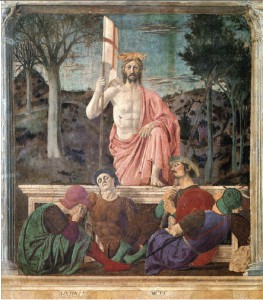
Giotto and Raphael of the Renaissance came to reflect a way of grasping the body three-dimensionally in their art (see “The History of Painting and the Body (1) — Viewing the Body Through the History of Western Painting“). Piero della Francesca, by grasping the head and face three-dimensionally as well, captured the sensation that the world widens together with the head and face. It can be said that he expresses, through the face, the state of a mind that is settled.

In fact, this same method of expression can be recognized in the Buddhist statues of Gandhara in India, from the second and third centuries. Through the position of the head, balance, a sense of unity, and a sense of the whole appear. It looks as though — entering into one’s own mind and reflecting inward, through a stable head and feet, and through the figure with palms joined together — it conveys the teachings of Buddhism.


The last to take up is Amedeo Modigliani, an artist of the early twentieth century. In Modigliani’s works, through his own distinctive way of depicting the face and head, he devises a method of expression in which the features of the person come to appear. The work below, for instance, by rendering the face with a long neck, succeeds in expressing the emotions that appear through the three-dimensionality of the body — the person’s human beauty and intelligence among them.

What painting reveals is that, depending on how the position of the head is depicted, what the person is thinking and their expression change. Looking at painting this way opens another kind of interest.
Note, August 2026
This piece takes up, through painting, the theme of the position of the head expressing a person’s interior. Piero della Francesca expresses a settled mind by grasping the face three-dimensionally; the Buddhist statues of Gandhara show a sense of the whole through the position of the head; Modigliani expresses the quality of a person by rendering the neck long.
Session 7 takes up the same theme from the side of the body.
Seen from eleven years on, what that session addresses is the inner ear — the vestibular system. The inner ear is the sensor that perceives the position of the body in space, and it bears closely on postural balance. When the inner-ear sense is awakened, the head comes to rest naturally right above the spine. It is a session in which a widening field of vision, a changed voice, and breathing that grows deeper still are commonly experienced.
What the first part of this pair addressed was the responsive relation between body and space (see “The History of Painting and the Body (1) — Viewing the Body Through the History of Western Painting“). The Eye of the Foot, which Ray McCall reportedly introduces every time in the Advanced Training, is an exercise for apprehending space from the sole of the foot. Session 7, by contrast, apprehends space from the position of the head.
The sole of the foot and the head. A pair, above and below.
And at the time this piece was written, the head and neck were a task of my own as well. After Session 4, three things were named as tasks going forward: letting unnecessary effort leave the psoas major, breathing available from the clavicles to the chest, and movement around the neck, at the AO joint in particular — the joint between the first cervical vertebra and the skull (see “Session 4: Organizing the Pelvic Floor“). Even at the stage of Session 6, the tension around the neck was noted as not releasing easily.
While looking at the position of the head in paintings, the position of my own head remained unresolved. Session 7 is the session that enters that task directly.