Rolfing ZERO
The Rolfing 10-Series
A ten-session process for reorganizing the body step by step through fascia, posture, breath, and gravity.
Point 1
Each session works with a different layer of the body.
Point 2
The process connects structural change with everyday movement.
Point 3
There is no obligation to complete the 10-Series; you can start with one session.
SESSION FEES
Session Fees & Duration
Fees are shown in Japanese yen and vary by session language.
| Session | Japanese | English |
|---|---|---|
| Trial session | ¥10,000 | ¥15,000 |
| Single session | ¥18,000 | ¥23,000 |
| 10-session series, paid in full | ¥160,000 | ¥210,000 |
| 5-session series, paid in full (Advanced / Rolf Movement) | ¥82,000 | ¥107,000 |
| 3-session series, paid in full (Advanced / Rolf Movement) | ¥51,000 | ¥66,000 |
Trial session: approximately 90 minutes (30-minute consultation + 60-minute hands-on session).
You can pay session by session (¥18,000 Japanese / ¥23,000 English). For the 10-session series, you can also pay for all ten at once (¥160,000 / ¥210,000) or for five at a time (¥82,000 / ¥107,000), both at a discounted rate. Paying for three at a time is generally not available for the 10-session series. Cash and credit cards (Mastercard, VISA, AMEX, JCB, Diners, Discover) are accepted.
Background and further reading
In this guide
- Why Ten
- Three Phases
- Spatial Axes
- Breathing and Walking
- How a Session Runs
- Change Is Not Produced; It Occurs
- A Restriction Is Not a Fault
- What Counts as Organized
- Phase One (Sessions 1–3): Releasing the Sleeve
- Phase Two (Sessions 4–7): Integrating the Core
- Phase Three (Sessions 8–10): Integrating the Whole
- Between the Sessions
- What Changes Over Ten Sessions
- Testimonials
- Where the Number Ten Came From
- Reading Further
- After the Ten, and Going Further
- Before You Book
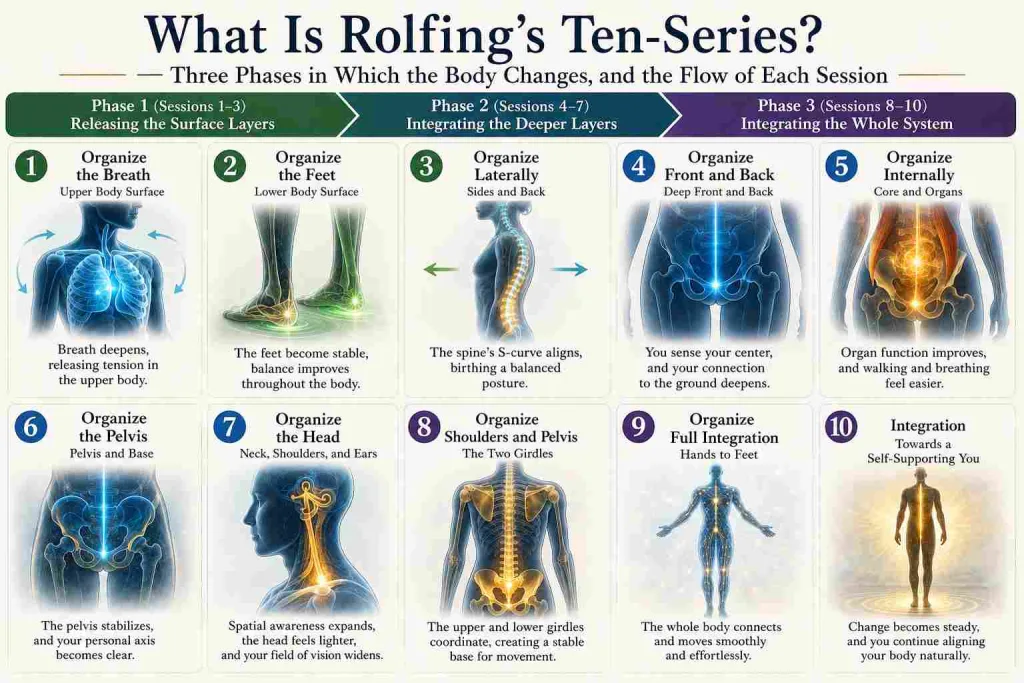
Why ten sessions? What happens in each one? What changes if you go through it?
This page lays out the whole of the ten-series. Links to the individual sessions are collected here as well, so you can start from whichever one interests you.
If a term gets in the way, come back to this.
Why Ten
Rolfing does not finish in one or two sessions.
There is an order to how a body changes. Until the superficial fascia releases, the core cannot be approached. Until the core is organized, the whole does not integrate. Going through that order is what makes a change settle, and what lets it continue after the sessions end.
Where the number ten came from is another matter, and less certain. The series once ended at seven. That story is at the bottom of this page.
Three Phases
Phase one, sessions 1 to 3, is the release of the sleeve. Hands go to the layer wrapping the outside of the body, and the ground gets prepared for going deeper.
Phase two, sessions 4 to 7, is the integration of the core. Pelvic floor, psoas, sacrum, neck — the structures at the center of the body — and the medial line threaded through them.
Phase three, sessions 8 to 10, is the integration of the whole. The view shifts from working with parts to working with a body that moves organically.
Spatial Axes
Each session has a spatial axis as its theme. Seen through embodiment — the integration of bodily sensation, as the training uses the word — each session takes up a different axis.
Sessions 1 and 2 take up and down: the upper body through the breath, the lower body through the feet, and the vertical axis gets its foundation. You have two feet, so left and right enter from session 2 as well.
Session 3 takes front and back. The spine and the front-back balance change, and the body becomes graspable as a volume.
From session 4 on, the medial line: the pelvic floor, the psoas, the sacrum.
Up-down, front-back, medial line. That order is the skeleton of the series.
There is a second pattern running alongside it. Upper-body and lower-body sessions alternate. Sessions 1, 3, 5, and 7 make the upper series; sessions 2, 4, and 6 the lower. Release above, organize below, return above — and with each pass the work goes a little deeper.
Breathing and Walking
One more thread runs through all ten.
Breathing and walking are what everyone does, all day, without stopping. That is why a session opens by watching those two. If you want a procedure that fits any body, the only place to look is at what every body already does.
Session 1 takes the breath, session 2 the foundation of walking. In session 3 the two meet; in session 5 they meet again, deeper; in session 10 they become one flow. Over ten sessions, two things organized separately turn into the movement of one body.
How a Session Runs
A session begins by listening. What gets asked about is set out separately.
Every session moves through observe, intervene, observe again.
At the start, the practitioner watches how you stand, walk, and breathe. Rolfing calls this Body Reading. Where is there excess tension, and how does the body sit relative to the line of gravity? Reading the body is where a session begins.
Then the hands-on work, and afterward the standing and moving get checked again. When the change is registered by the client and not only by the practitioner, awareness of the body grows — and that accumulation is what makes a change last.
What Ray McCall and Hiroyoshi Tahata kept coming back to in the advanced training was that technique is not the most important thing in Rolfing. The perceptual capacity to listen to what a body needs, and the practitioner’s way of being, come first.
Change Is Not Produced; It Occurs
What happens in a session is not well described as the practitioner doing something and the client having something done to them.
Breathing deepens under the hands. Conditions get right and a muscle starts moving on its own. The sacrum begins to move and the hand comes away. What takes place belongs neither to the one doing nor to the one being done to.
Ancient Greek had a voice for events like these. It is called the middle voice. What the Rolfer does is not to produce change but to hold the space in which change can occur.
A Restriction Is Not a Fault
Shallow breathing, a hard sole, a forward head, a shortened psoas. None of it is treated here as a defect.
No muscle tightens without a reason. Something was being supported by that firmness, or protected by it. Limitation and possibility come as a pair: what shows up now as a restriction was once the best option available to that body.
So a session is not about removing a bad habit. It is about creating the conditions in which the body can register that this particular way of holding is no longer needed.
What Counts as Organized
Whether your shoulders feel looser, whether your posture looks better — neither is the test.
What gets looked at as a session closes is whether the body is in a better relationship with gravity, and whether gravity is working as a resource rather than a load. Changes in symptoms and sensations appear as a consequence of that relationship having changed.
This is where Rolfing differs from massage. Not removing the symptom, but building the structure in which the body recovers its own functioning. Rolfing is defined not by its techniques but by that aim.
Phase One (Sessions 1–3): Releasing the Sleeve
Session 1: The Breath, and the Sleeve of the Upper Body
Breathing is linked to the fascia of the whole body. Touch the superficial fascia around the ribs, the intercostals, and the diaphragm, and the pattern of tension throughout the body begins to ease. The chest widens; more of your back meets the floor when you lie down; you find where the shoulders can let go. The breath is also the way in to sensing yourself from the inside.
Session 2: The Feet, and the Sleeve of the Lower Body
Tension in the sole runs through the fascia to the lower back, the shoulders, the neck. Once the foot can take in information from the floor, the way it meets the ground changes. More of the sole makes contact; your stride and the sound of your landing change; tension in the back and shoulders lets go as a change arriving from underneath.
Session 3: Front-Back Balance, the Sides and the Spine
Hands go to the sides of the shoulders, arms, spine, and thighs, and a body grasped as a plane becomes graspable as a volume. The S-curve of the spine recovers its function and the load on the lower back eases. This is the session where people often report feeling taller.
Phase Two (Sessions 4–7): Integrating the Core
Session 4: From the Contact Surfaces Toward the Center
Attention travels from the soles and sit bones, through the adductors, to the pelvic floor. A sense of floor appears at the bottom of the pelvis and breathing reaches down into it. This is the session with the largest inner change — something settles about where you are.
Session 5: The Psoas and the Viscera
The work moves to the front of the spine. The psoas connects the spine directly to the leg and is closely involved with the movement of the organs. Power comes from deep in the belly again, and walking gets easier. It is also where breathing and walking meet in the deep layer.
Session 6: The Sacrum and the Pelvis
The middle of the body starts moving with the breath. Sitting comes to rest on the sit bones, and congestion deep in the lower back eases. Standing, walking, and how you hold distance from other people can all change. It is also the session with the lightest touch of the ten.
Session 7: The Neck, the Shoulders, the Inner Ear
Once support comes through from below, the head sits over the spine of its own accord. The field of vision widens, the voice changes, breathing deepens further, the jaw lets go. The core phase and the upper series close here together.
Ida Rolf, incidentally, described session 7 as the center of the series: sessions 1 to 6 as preparation for it, sessions 8 to 10 as the integration of what it did. Read it as a phase or read it as a center — both hold.
Phase Three (Sessions 8–10): Integrating the Whole
Three questions run through this phase. What needs to happen on the way to closing? What has been learned? Where does this go from here? They are not only questions about the work; they are questions put to the client.
Sessions 8 and 9 carry paired themes. Session 8: being, presence, structure, stillness, stability. Session 9: fluidity, doing, function, movement, integration. First a state in which you are supported without moving; then a state you can hold while moving.
Session 8: The Shoulder Girdle and the Pelvic Girdle
The two girdles are the basis for the movement of the upper and lower limbs, and they are linked to each other. Neck tension eases, the chest gets freer, and the arms and legs become movable from the torso.
Session 9: Continuity
The aim is a whole body in which hands and feet participate in one movement. You walk without attending to the girdles, and movement reaches the ends. In class the ideal was described as the girdles becoming invisible.
Session 10: Integration
Rather than finishing off what is left, this session leaves space and lets gravity organize the body over time. The effort that went into holding posture comes back to you, and you can organize yourself when you notice something. Cultivating the client’s independence is what this session is essentially for.
Between the Sessions
The series runs at one session every one or two weeks. It takes months, which means the days you are not in a session vastly outnumber the ones you are.
Sharon Wheeler once told me how to think about the interval. Younger people metabolize quickly, so every two weeks is about right; for older people, leave a month. And if someone goes through the ten-series more than once, leave six months in between.
One more thing worth knowing. You may feel tired after a session. Muscles that had not been used are starting to work, and they take one to two weeks to come online. In the days right after a session, her advice was to pay attention to that tiredness rather than to anything else.
Change does not only happen inside a session. If anything, it settles during the days in between.
What Changes Over Ten Sessions
The physical changes reported most often are better posture, less chronic shoulder and back pain, deeper breathing, and easier walking.
Many people describe more than that. My thinking is clearer. My moods have settled. I know where my own axis is. As the structure of the body changes, patterns of emotion, thought, and autonomic response change with it.
In the advanced training, Ray McCall described the aim of Rolfing as supporting a client’s body and system so they can walk their own path — a process of encouraging the state in which the person is who they are. Better posture is only the doorway.
- Why Organizing the Body Raises Judgment and Performance — From the Perspective of Rolfing and Brain Science
- The Three Approaches That Break Through “Understanding Yet Unable to Change” — The Difference Between Therapy, SE, and Rolfing
- What Does It Mean to Release Effort? (No Excess Force Entering) — How to Organize Posture with Minimal Force
Testimonials
Kouki Yamada, a physical therapist, finished the ten sessions having lost 10 kg, with his low-back and knee pain nearly gone and his insomnia resolved. A specialist in the body, he found what he had understood intellectually showing up as physical change.
Ayako Kakizaki reported that alongside the improvement in her low-back pain, she became able to notice for herself the places where things were blocked or stagnant inside her body, in tandem with what was going on internally.
Where the Number Ten Came From
What follows is about how the series came to exist. If you are still deciding whether to receive it, feel free to skip.
Ten was not the original number. The series once ended at seven, and in the basic training a bottle still gets opened when the seventh is done. The three integration sessions were added afterward.
So how were those seven decided?
In 2016 I put the question to Sharon Wheeler, one of the few Rolfers who learned directly from Ida Rolf. How did Ida come up with the ten sessions?
The answer was that Ida never spoke about her own past. Sharon summed it up in two words: divine inspiration.
Then she offered her own guess. Ida used to say that working the feet thoroughly would let the shoulders drop and widen. If so, perhaps the session on the feet was originally the first one. Perhaps the breath session was placed ahead of it later, for the people who cannot find their feet.
Which would mean the order was settled less by the logic of the body than by what a person can feel.
Even so, the sequence has worked for over fifty years.
And what the 2025 advanced training took up was the question of what you build a session from once the fixed order is set aside. What is the client expecting? Which principle is missing? Where do you start?
Doubting where a procedure came from, and working without one, turn out to be two ends of the same question.
There is no proving that it has to be ten. What I can say is that I have watched bodies change by going through this order, for eleven years.
The Sleeve Sessions: Why Rolfing Starts at the Surface
Reading Further
By phase
- The Sleeve Sessions: Why Rolfing Starts at the Surface
- The Core Sessions: Working Beneath the Sleeve
- The Integration Sessions: Bringing It Together
- A Glossary for Reading the Ten Sessions
The science of fascia and posture
- Why Shoulder Pain and Low-Back Pain Are Not Healed by Massage? — The Science of Fascia, Posture, and Gravity
- Why Do Emotions Stay in the Body? ──Understanding Rolfing Through the Body’s Memory — The Science of Fascia, the Autonomic Nervous System, and Trauma
- Why a “Comfortable Posture” Exists — From the Perspective of Gravity, Fascia, and Rolfing
- Why Good Posture Is Not a Matter of Muscle Strength — Tonic Function and Its Relationship to Gravity
- Why “Walking” Is Fundamental to the Human Being — The Science of Bipedal Walking, Weight Shift, and Gravity
After the Ten, and Going Further
For those who want to take integration further, there is the advanced series of five sessions. Rather than following a set procedure, each session is designed around the state the person is in. An Advanced Rolfer holds the qualification to offer them.
- Why Are Advanced Rolfer Sessions “Profound”? — Three Differences, Ten Years After Rolfer Certification
- Journey to Becoming an Advanced Rolfer — A Summary of the Road to Certification
For anyone interested in becoming a Rolfer: the differences among the certifying bodies (DIRI, ERA, ABR), and the whole path from basic to advanced certification.
The transformation Rolfing brings about and the updating of what I call the Recognition OS are connected. The integration of thought, emotion, and body is treated more fully at Mind and Bodywork Lab.
- Mind and Bodywork Lab: How to Navigate This Site (only in Japanese, English version in preparation)
Before You Book
If you have strong pain, symptoms whose cause is unknown, or you are recovering from an injury or surgery, please see a medical provider first. Rolfing is not medicine; it neither diagnoses nor treats.
If you are currently under treatment, come after talking it over with your physician. There is no problem receiving Rolfing alongside medical care, but what to prioritize is best decided together with the person treating you.
And the series takes months. Whether this is a period in your life when you can give it that time is part of the decision too.
A trial session is the place to begin, to find out what is happening in your body.
Hidefumi Otsuka, Ph.D. | Certified Advanced Rolfer™ / Rolf Movement® Practitioner Ph.D. from the Graduate School of Medicine, the University of Tokyo. After eleven years in medical marketing at a foreign pharmaceutical company, he has offered Rolfing® sessions in Shibuya, Tokyo since 2015, working under the theme of integrating science and practice.
FAQ
Frequently Asked Questions
Q. How long is a session?
Hands-on work runs 60 to 75 minutes, and with changing and consultation, please allow about 90 minutes in total. The exact length varies somewhat from client to client.
Q. What happens across the Ten Series?
The Ten Series begins with breath and the surface layers of the body, moves through the legs, sides, back, and pelvic floor into the deeper structures, and turns toward whole-body integration in the final three sessions. Each session has its own theme and builds on the changes from the one before. It isn’t a set of interchangeable treatments — the order itself carries the logic.
Q. How often should I come?
One to two weeks between sessions is the usual interval, though some clients space them a month apart. The gap matters: your body needs that time to absorb the change and make it its own.
Q. What should I wear?
Please bring loose, non-restrictive clothing — a T-shirt and shorts work well. Rental clothing is available if you’d rather not carry anything (six items for women, two for men).
Q. Can I try one session first?
Yes. A trial session is available for first-time clients at ¥15,000, running about 90 minutes in total — 30 minutes of consultation followed by 60 minutes of hands-on work.
Q. Do I have to pay for all ten sessions upfront?
No. You can pay session by session. A single session is ¥23,000, and the full Ten Series is ¥210,000 when paid in full. These are English-session rates and differ from the Japanese page.
Q. What is the Post-10 Advanced Five Series?
It’s a five-session series for people who have already completed the Ten Series and want to go further. Rather than following a fixed protocol, the sessions are built around your particular movement and structural patterns, and may draw on movement work or work with the nervous system. The fee is ¥107,000 for the five-session series paid in full, or ¥23,000 per single session.
Q. Is there anything I should do after a session?
Avoid strenuous exercise that day, drink plenty of water, and give yourself some time to notice how things feel. Changes often continue to settle over several days, so it’s worth not judging the whole session by how you feel walking out the door.
Q. What happens after I finish the Ten Series?
Most people leave a few months before continuing, letting the body settle into its new organization. From there, some return for occasional single sessions, some move into Rolf Movement, and some come back later for the Advanced Five Series.
For payment, booking, and other questions that apply across all services, see Start Here.
Rolfing ZERO