
Breath in session 1, the feet in session 2. Once the vertical axis is organized, session 3 works with front and back. It closes the first phase, and it is also the session in which the way the body is grasped changes.
Where Session 3 sits
Sessions 1 and 2 dealt with a vertical relationship: the upper body and the lower body. Session 3 adds front and back to it. A body that had been grasped as a plane comes to be felt as a volume, with depth.
This change is the precondition for the sessions from session 4 onward, which work with the medial line. Only once the outline of the space your body occupies can be sensed does its center become approachable.
A forward head is not a failure
The head carried forward, the back rounded, the shoulders turned in. A body whose front-back balance has shifted is not treated here as something defective.
The head comes forward because that was the posture required for seeing. Looking at a screen, looking at your hands, reading someone’s expression. The length of time spent concentrating forward has taken shape. By carrying the head forward, the person got their work done.
When the front grows dense, the back thins out. That awareness of the back stops working is not a failure but something that follows naturally from concentrating forward. Session 3 is not about denying the front and adding the back. Once a situation arises in which you no longer have to meet the world with the front alone, the space behind returns on its own.
From a plane to a volume — the history of painting as an analogy
In September 2014, in Rolfing’s basic training (Phase II), the Italian instructor Giovanni Felicioni explained this change through the history of Western painting. When the way the world appears moves from two dimensions to three, what happens to a person’s view of the world?
The icons of the Middle Ages are painted flat. There was a theological restraint against depicting the sacred as a solid image, and the arrangement of symbols took priority over depth. The view of the body worked with in sessions 1 and 2 is close to this stage.

With the Renaissance, Giotto brought spatial depth and the natural expression of human feeling into painting. In Raphael’s The School of Athens, the vanishing point and left-right and front-back symmetry form the skeleton of the composition, and the awareness of space deepens further. What appears here is the three-dimensional view of the body that session 3 works with.

A vanishing point is the point at which parallel lines appear to meet within the picture, and it serves to determine direction.
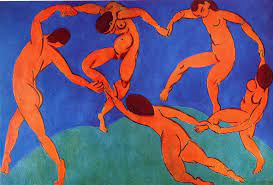
Later, in the work of Matisse and Monet, emphasis comes to be placed not only on the foreground of the subject but on the background as well. When both the near and the far hold up the picture, balance appears in the painting.

The vanishing point and walking
When observing walking, I watch where the vanishing point of the gaze is directed. Is it a concrete object — a desk, a chair, a window, a building? Is the field of vision narrowing, or widening?
When the vanishing point does not settle, the perception of space narrows. Conversely, when awareness widens to include the background, the vanishing point can be taken further out, and effort drains out of walking and posture. What happened in painting, when both foreground and background came to be treated, happens in the body.
What takes place here is different from letting go by trying to let go. It lets go the moment the background is perceived. It is the same kind of event as in session 2, where merely supposing an eye on the sole of the foot changed the tone of the pelvic floor. When the placement of perception changes, the body redistributes its tone.
In Rolf Movement, taking in the space behind is called Finding Back Space. The name corresponds to the fact that most of the muscles that support posture without fatiguing lie along the back. A body that only looks forward is not using the side that supports it.

Peri-personal space — how distance is kept
Once the depth of front and back returns as sensation, the sense of distance between the body and its surroundings becomes easier to hold.
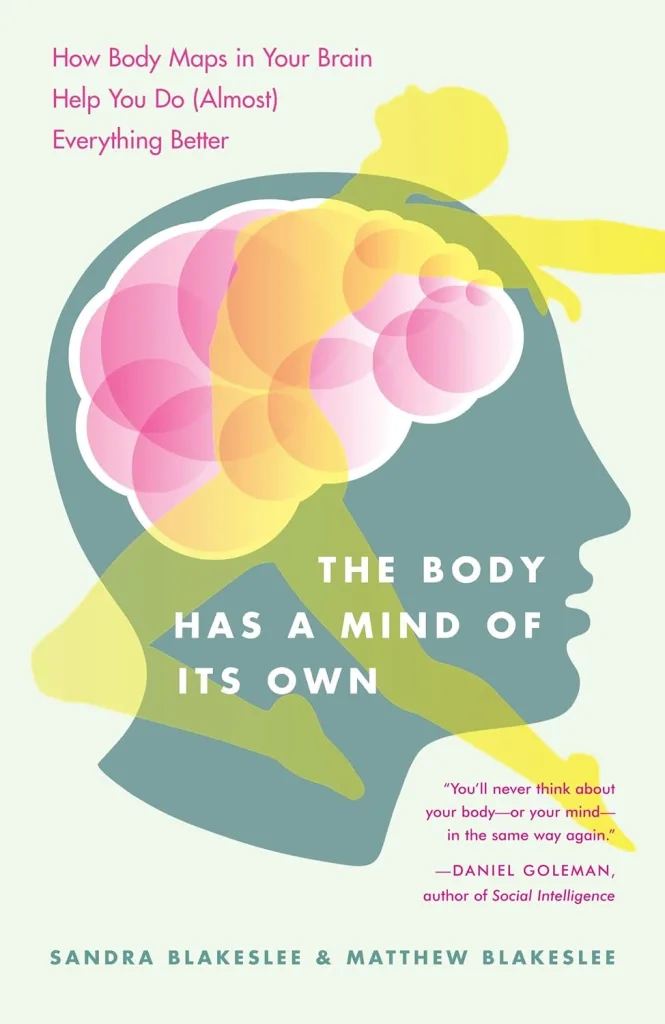
Sandra Blakeslee, in The Body Has a Mind of Its Own, describes the following.
She invites you to stretch both arms out in front of the body, fingers extended flat, then to swing them up and down and side to side, sweeping them in a wide arc from overhead down to your flanks — as though you were the many-armed Shiva, spreading your territory as wide as it will go. Then she asks you to picture the whole of the space your arms have passed through. That is the personal space surrounding your body, which neuroscientists call peri-personal space, from the prefix meaning “around.” It is mapped, corner to corner, inside the brain.
This peri-personal space differs from person to person, and it shows up in how people hold distance from one another.
How the body map works becomes easier to see when it breaks down. In phantom limb, a lost hand or foot is still felt to be there. Conversely, there are documented cases in which the body is present but can no longer be sensed. Something absent felt as present, and something present that cannot be felt. What Rolfing works with lies between them: making sensible what is present but has not been felt.
Two layers are distinguished within this map. One supports posture and movement without reaching awareness — the body schema. The other is the picture you hold of what your body is like — the body image. In session 3, what changes first is usually the former. How you support yourself changes before your sense of it does.
It is because this map is working that you can reach out, draw back, or take distance in time when a car comes near or a person approaches. When the sense stays vague, both your own position and an appropriate distance from others are hard to gauge.
To grasp the body as a volume is also to secure your own space. This is a stage worth having in place before the medial line is organized.
What is looked at as the session opens
In the Body Reading at the start — watching how you stand and walk — the points include:
- Seen from the side, how the ear, shoulder, hip, and ankle line up
- Whether the head is carried forward
- The front-back offset between the rib cage and the pelvis
- Whether the arm swing differs left to right while walking
- Where the gaze goes, and how wide the field of vision is
The conditions the session works toward
For the front-back balance to change, session 3 works with three places.
The shoulders and arms. Both lie on the side of the body, at the boundary between front and back. The arms swing when you walk in order to keep the front-back balance from going unsteady. When they are free, the way walking steadies itself changes.
The spine. The S-curve formed by the cervical, thoracic, and lumbar vertebrae and the sacrum is often collapsed by fascial tension. For the front-back balance to return is also for those curves to recover their function. The load on the lower back eases as a result.
The sides of the thighs. This is where the front-back balance below the pelvis is held, and when it is tight, the ground contact gained in session 2 does not reach the pelvis.
What the body takes in during this session
Describing session 3 as working the sides of the body or releasing the erector spinae moves away from what is actually happening.
What is taken in, as I understand it, is the information that there is space behind as well. Support does not lie only in front; there is a place at the back that the body can lean into. When that information arrives, a center of mass that had been pressing forward begins to find the support behind it.
What counts as organized
Whether the posture looks good is not, in itself, taken as the result. Making appearance the criterion produces another kind of effort: pulling the head back and lifting the chest.
What is looked at as the session closes is the relationship with gravity. Does the weight of the head pass down through the spine into the pelvis? Are the front and back tensions balanced, so that neither side has to carry it alone? Is gravity working as an axis that runs through the body rather than a force that tips it forward?
The frequently reported sense of having grown taller appears as a consequence of that relationship having changed.
After the session
- The surface of the back feels wider
- The head sits over the spine
- The arm swing lightens, and effort drains out of walking
- The field of vision widens, and distance from your surroundings is easier to hold
- The load on the lower back eases
On to the next session
Over these three sessions the sleeve is released and the body comes to be grasped as a volume. From session 4 the work goes into the core, growing the sense of the medial line from the surfaces that meet the floor.
- Session 4: From Sleeve to Core — Finding Where You Stand
- What Is Rolfing’s Ten-Series? — Three Phases in Which the Body Changes, and the Flow of Each Session
- A Glossary for Reading the Ten Sessions
Related Articles on the Rolfing Training
- Session 3: Organizing the Sides of the Body
- The History of Painting and the Body (1) — Viewing the Body Through the History of Western Painting
- The Body Map and the Phantom Limb
- Psychological and Perceptual Change — The Body Map
Hidefumi Otsuka, Ph.D. | Certified Advanced Rolfer™ / Rolf Movement® Practitioner Ph.D. from the Graduate School of Medicine, the University of Tokyo. After eleven years in medical marketing at a foreign pharmaceutical company, he has offered Rolfing® sessions in Shibuya, Tokyo since 2015, working under the theme of integrating science and practice.