With a way in from the contact surfaces to the center established in session 4, session 5 moves to the front of the spine. The psoas, the viscera, and the diaphragm.
Where Session 5 Sits
Sessions 4 through 7 make up the second phase, the one that threads the medial line. Where session 4 built footing at the adductors and the pelvic floor, session 5 passes through that footing into the front of the body and carries the line up into the torso.
This is also where breathing and walking meet again, further down. Session 1 took the breath, session 2 the foundation of walking, and in session 3 the two met. In session 5 they meet in the deep layer, at the diaphragm and the psoas — because the place that moves with every breath and the place that works with every step turn out to be the same place.
What the Psoas Is
The psoas group is made up of psoas major and iliacus, sometimes with psoas minor included. It begins at the front of the lumbar spine, passes through the pelvis, and attaches at the lesser trochanter of the femur. It is one of the very few muscles that connect the spine directly to the leg.
It sits near the body’s center of mass — near what the Japanese tradition calls the hara. It matters for holding posture and for walking alike. It works in flexing and extending the hip, and it lifts the thigh. When psoas major stops working well, walking and running are affected, and people trip more easily.
For all that, it lies too deep to reach with your own hands. Which is why the way in is through attention rather than pressure.
What a Short Psoas Has Been Holding
A shortened psoas is not treated here as a fault.
Part of it is how long we sit. Sitting in a chair means the hip stays flexed and fixed. Spend most of the day in that shape and the shape becomes the body’s default setting. The psoas has simply decided its length to suit the life around it.
There is a second reason, and it is a different kind of reason.
The psoas connects to the diaphragm, and this region is what is known as the solar plexus — the softest part of the front of the body, where the organs gather. Sense danger and a person curls forward to protect it. Where anger or fear has stayed with someone, this area tends not to move, and that is probably why. In practice, meeting someone whose psoas is not working is not unusual.
The workshop on bringing trauma work into bodywork made the same point: whatever the body did in response stays in the tissue. A shortened psoas is one of the most typical forms that takes.
You cannot demand that something holding on for protection let go. What session 5 does is build the conditions in which protection is no longer required.
Some traditions treat the solar plexus as the manipura chakra, with trust, fear, and self-worth as its keywords. Chakras did not come out of Rolfing theory. I use them here as a description of the same place seen from another door.
The Viscera
The Japanese word for the psoas is written with the characters for intestine and lower back, and the muscle does sit close to the gut.
The sigmoid colon, where things most readily slow down, lies just inside the psoas. When the psoas hardens, it is reasonable to expect the movement around it to be affected.
Not only the gut. The intestines, kidneys, liver, spleen, pancreas, bladder, stomach, and reproductive organs all move with the breath. Keeping that movement is said to be one of the conditions of health. When the diaphragm moves, the liver and stomach move with it.
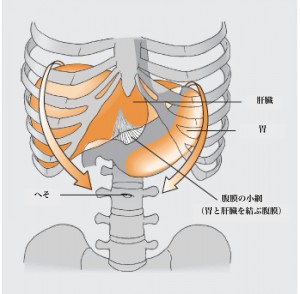
The organs are arranged around the psoas, and as the psoas works in concert with the diaphragm, something like a massage arises for them. The conditions that let the organs move get set up. And the aorta and major nerves run alongside the psoas, so circulation and nerve conduction are in the picture too.
What Overtraining the Abdominals Does
For psoas major to work, it needs a balance with the abdominals, rectus abdominis in particular.
Core training is widely recommended, and plenty of people train rectus abdominis for the look of it. That can make psoas major harder to use. The sequence I have in mind runs like this.
- Rectus abdominis, running from below the ribs to the pelvis, gets too strong
- The organs inside it lose the space they need to move
- With the organs restricted, psoas major, further in, gets compressed
- The body becomes one in which psoas major does not work
The Belly as a Place
That this session works with the belly has another side to it.
The belly is the part of the body most talked about in terms of appearance. Ideas about the shape it ought to be are stronger here than anywhere else. Touch the belly in a session and those ideas can come up. I don’t want to let it go. I don’t want it seen. If I stop holding, it will lose its shape.
Behind the habit of firming the abdominals, this is often part of what is going on. The previous section described overuse of rectus abdominis as a question of strength; it is equally a question of how someone wants to be seen.
So the pacing matters in this session. The breath is involved and the belly is touched directly, so the work goes in a little at a time and watches how the body answers. As in session 4, questions of boundary can surface again.
The Other Direction: Moving the Belly
Yoga has a practice for moving the belly deliberately. It is called nauli.
You empty the breath, draw the abdomen up, and roll rectus abdominis from side to side. I learned it in teacher training and worked with it again in a pranayama course. It is taught in person, not from a page, so I am not going to describe the method here.
The point is that there are two directions available for the belly.
One is tightening. That is how bandha gets learned, and I had it wrong for years — using the belly as something to clamp down, which narrowed my own range of motion. It took a Rolf Movement training for someone to point it out to me. The longer you have practiced, the more such habits stay.
The other direction is movement. Nauli assumes the inside of the belly is something that can move. It does not work at all on a rigid abdominal wall.
And nauli moves what is deep in the belly without touching it from outside. I said earlier that the psoas cannot be reached directly. Touch is not the only route. What session 5 is doing points the same way.
Knowing this from my own practice made the session easier to understand. The belly is not a place to hold. It is a place that moves.
The Psoas, the Diaphragm, and the Parasympathetic
The psoas and the diaphragm both have a relationship with the parasympathetic system, and both attach to the front of the spine.
That location is the point. The tissue that suspends the pericardium attaches to the front of the spine as well.

When these release together, the autonomic balance tips toward the parasympathetic. That so many people fall deeply asleep in session 5 has a lot to do with this work in the deep layer.
Rolfing’s effect on the autonomic nervous system was one of the subjects taken up in the basic training. Less a question of technique than of what state the body has to be in for change to happen at all.
What Is Looked At as the Session Opens
In the Body Reading at the start — watching how you stand and walk — the points include:
- Whether the pelvis tips forward or back in standing
- The distance between the bottom of the ribs and the top of the pelvis
- Whether the breath reaches the abdomen or stops at the chest
- Whether lifting the thigh starts from the lower back or gets compensated at the front of the thigh
- The quality of tension when the abdomen is touched
The Conditions the Session Works Toward
Nobody presses the psoas. When the muscles around it release and space appears for it to move, the psoas starts moving on its own.
The principle common to all the core work holds here too. Given the right stimulus, the body goes of its own accord to the place it senses as the one. The practitioner stays neutral and shows the way.
What the Body Takes In During This Session
Describing session 5 as releasing the psoas or working the viscera moves away from what is actually happening.
What is taken in, as I understand it, is the information that the front no longer has to be held for protection. There is space in the abdomen; the organs are free to move with the breath; there is support at the front of the spine as well. When that arrives, a body that had been supporting itself by firming the front starts reorganizing toward support that comes from front and back pulling against each other.
What Counts as Organized
Whether the psoas has released is not, in itself, the result. Press deeply enough and something changes for a while.
What is looked at as the session closes is the relationship with gravity. Does the support coming up from the pelvic floor pass through the psoas and out along the front of the spine? Has the abdomen stopped being a place to hold and become a place that moves with the breath?
After the Session
- Power comes from deep in the belly again
- Walking gets easier; the thigh lifts more lightly
- Breathing reaches the abdomen
- The arch of the lower back settles
- Sleepiness during the session, and deep relaxation
On to the Next Session
With the front of the spine organized, the back comes next. Session 6 turns to the sacrum and the pelvis.
- Session 6: The Sacrum and the Pelvis — Your Own Axis, and Other People
- The Core Sessions: Working Beneath the Sleeve
- What Is Rolfing’s Ten-Series? — Three Phases in Which the Body Changes, and the Flow of Each Session
- A Glossary for Reading the Ten Sessions
Related Articles on the Rolfing Training
Hidefumi Otsuka, Ph.D. | Certified Advanced Rolfer™ / Rolf Movement® Practitioner Ph.D. from the Graduate School of Medicine, the University of Tokyo. After eleven years in medical marketing at a foreign pharmaceutical company, he has offered Rolfing® sessions in Shibuya, Tokyo since 2015, working under the theme of integrating science and practice.