With the front of the spine organized in session 5, session 6 goes around to the back. The focus is the sacrum and the coccyx, and the pelvis that surrounds them.
Where Session 6 Sits
Sessions 4 through 7 make up the second phase, the one that threads the medial line. Session 4 built the footing, session 5 came up the front. Session 6 is the far side of that.
What the Sacrum Is
The sacrum is part of the pelvis, sitting at the end of the spine, at the center of the body.
Because it connects to the spine, a tilted sacrum means a tilted center, and the vertebrae above tend to follow. The sacrum also connects, by way of ligament, to the femur — to the leg. The pelvis itself is wrapped in layer upon layer of ligament. How closely pelvis, spine, and leg are bound together is legible in the anatomy.

The pelvis is made of the hip bones — ilium, pubis, ischium — and all of it is continuous.

What an Unmoving Sacrum Has Been Holding
Tell someone in a session that the sacrum moves with the breath and most are surprised. It does move, and in people whose breathing is shallow the movement tends to be small.
Ida Rolf listed a set of recognizable marks of an organized body, and one of them was that the sacrum moves with each breath. That state is what session 6 is heading for.
An unmoving sacrum is not treated here as a fault.
The pelvis sits at the center, so if it sways, everything sways. A period of strain on the lower back, a body that has been through a fall or a birth, a life spent mostly sitting — in every case, firming the pelvis is a way of securing stability. By not letting it move, the person was able to stand.
Movement returns when the conditions for stability without firming are in place.
The Sacrum Moves, with the Breath
The movement of the sacrum is read by how it faces the ilia on either side. The joint between sacrum and ilium is the sacroiliac joint.
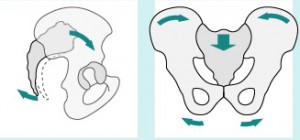
Sitting, the ilia narrow, the sit bones widen, and the sacrum tips forward relative to the ilia. This is nutation, the nodding motion, from the Latin for nodding.
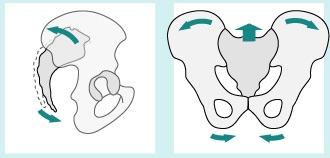
Standing, the ilia widen, the sit bones narrow, and the sacrum tips back. Counter-nutation, the rising motion.
Forward and back, the rhythm repeats with the breath. Put a hand under your sit bones and move between standing and sitting, and you can feel the sacrum and pelvis for yourself.
People who feel stiff in yoga or Pilates are often people who have not sensed this movement. Once the sacrum becomes something you can feel, poses that had been difficult can suddenly open, and it becomes possible to move without gripping.
When I was working on the deep backbends in ashtanga yoga, kapotasana — one of the hard ones — went noticeably deeper right around the time I received session 6. It surprised me.
The Pelvic Lift: Taking the Hand Away
Before the table work ends, a hand goes under the sacrum. And when the sacrum starts to move, the hand comes away. This is the pelvic lift.
What that technique shows is the character of session 6 itself. You do not move the sacrum. You wait for it to move. Once it moves, you stop being involved. How long the hand stays is decided by the body, not by the practitioner.
People often say afterward that the sacrum dropped, or that the breath got deeper. Movement returns at the middle of the body, and the top and the bottom get connected.
Craniosacral Work
One of osteopathy’s techniques is craniosacral therapy: light contact from the skull to the pelvis, said to change the flow of cerebrospinal fluid. Improving the movement of fluids is thought to make the body’s own healing more available.
I have met someone who developed allergy symptoms after a hard fall onto the sacrum. There is no way to establish cause there, but it made me think about how far the state of this region reaches.
The background to this work I learned at a supplemental Source Point Therapy course in Osaka: the history of cranial work beginning with William Sutherland, how it traveled outside osteopathy, and how it relates to energy work. The sacrum and the skull are the two ends of the same current.
Once the sacrum begins to move, the autonomic balance tips toward the parasympathetic and abdominal breathing arrives more easily. So many people fall asleep during session 6 that I take it as evidence of the region letting go.
The Session with the Least Force in It
Session 6 has something the other sessions do not: the lightest touch of the ten.
The pelvic lift is a hand resting and waiting. Craniosacral work is built around light contact. Nothing is pressed, nothing is entered. And yet this is the session in which people most often fall asleep, and in which the felt change is large.
Force and change do not scale together.
That is not only true of this session. It describes the direction Rolfing itself has traveled.
From the 1980s onward, biodynamic craniosacral thinking spread beyond osteopathy, and the Rolfing community took a great deal from it. Unlike the strong pressure of Ida Rolf’s era, the emphasis moved toward the practitioner’s presence — toward what allows the body and the space around it to reorganize on their own. That Ray McCall and Hiroyoshi Tahata both favored light touch in the 2025 advanced training belongs to that current.
All of which connects to what gets called the energetic side of Rolfing. Except that “energy work” is a vague term. Not touching, using imagery, working at a distance, using little force — none of these defines it. Every manual method uses energy in the physical sense of the word.
Which is why there is a case for describing interventions not by their tools but by what information is passing. That this piece includes a section on what the body takes in, in every session, follows that view. What passes in session 6 is the information that the middle is allowed to move. Conveying it takes very little force.
- What Is Energy Work?
- Journey to Becoming an Advanced Rolfer — A Summary of the Road to Certification
The Second Chakra, and Other People
The sacrum sits at what the chakra system places as the second chakra: relationships, feeling, appetite, sexuality.
An unbalanced second chakra is said to show up as difficulty adapting to change, difficulty with other people, emotional instability. Balanced, it is said to show up as expressiveness, honesty about one’s own feelings, and creativity available.
Chakras did not come out of Rolfing theory. I use them here as a description of the same place seen from another door. When you borrow the vocabulary of another tradition, you need to know which one you are using, and to say so.
That said, when the pelvis stabilizes, people often do report that something changed about how they stand, how they walk, and how they hold distance from other people. If organizing the medial line means acquiring an axis you can judge from, session 6 is where the social dimension gets added to it.
You can account for that without the chakras. What happens in this session is that the back of the body becomes sensible, and the relation between the inside and outside of the torso becomes graspable at the same time — with support arriving from below. There is something behind you, holding you up, that you cannot see.
That can be a powerful thing to discover. How you understand your own body changes, and how you understand yourself follows.
This session involves a long stretch of lying face down. Which is why it matters to have people move partway through and check together what is going on. Whatever has changed needs to be tied, on the spot, to words and to movement. Otherwise it does not stay.
What Is Looked At as the Session Opens
In the Body Reading at the start — watching how you stand and walk — the points include:
- How the tilt of the sacrum changes between standing and sitting
- Whether weight is even across the two sit bones
- Any difference in the height of the ilia
- How the pelvis moves front to back and side to side while walking
- Whether the sacrum moves with the breath
The Conditions the Session Works Toward
Nobody goes in to move the sacrum or the sacroiliac joint. When the surrounding muscles — the shins, the glutes — release and there is room to move, the sacrum starts moving on its own.
The front-back balance of the spine settles as a result, so the psoas worked with in session 5 releases further.
What the Body Takes In During This Session
Describing session 6 as mobilizing the sacroiliac joint or releasing the glutes moves away from what is actually happening.
What is taken in, as I understand it, is the information that the middle is allowed to move. The pelvis is not a place to be firmed for stability; it is a place that moves with the breath. When that arrives, stability held by firming starts being replaced by stability held while moving.
What Counts as Organized
Whether the sacrum has started moving is not, in itself, the result.
What is looked at as the session closes is the relationship with gravity. Do the weight coming down and the support coming up meet at the sacrum? Is the pelvis working as the place that receives weight and passes it on?
After the Session
- Sitting rests on the sit bones
- Congestion deep in the lower back eases
- Breathing reaches the pelvis
- Standing, walking, and holding distance from others all change
- Deep sleepiness during the session
On to the Next Session
With the pelvis organized, the head and neck get set on top of it. Session 7 works with the shoulders, neck, face, and head, and wakes the vestibular sense.
- Session 7: The Neck and Shoulders — Waking the Vestibular Sense
- The Core Sessions: Working Beneath the Sleeve
- What Is Rolfing’s Ten-Series? — Three Phases in Which the Body Changes, and the Flow of Each Session
- A Glossary for Reading the Ten Sessions
Related Articles on the Rolfing Training
- Session 6: Organizing the Sacrum
- Taking the SPT Supplemental Course — How Should One Deepen Knowledge? Learning Through Practice
- Journey to Becoming an Advanced Rolfer — A Summary of the Road to Certification
Hidefumi Otsuka, Ph.D. | Certified Advanced Rolfer™ / Rolf Movement® Practitioner Ph.D. from the Graduate School of Medicine, the University of Tokyo. After eleven years in medical marketing at a foreign pharmaceutical company, he has offered Rolfing® sessions in Shibuya, Tokyo since 2015, working under the theme of integrating science and practice.