
With the medial line organized as far as the chest over sessions 4 to 6, session 7 sets the neck and head on top of it. It closes the core work.
Where Session 7 Sits
The session moves through the hands, arms, shoulders, upper spine, face, and head, in that order. Since the head sits at the top of the body, this is where the sense of the medial line is finally recovered.
Two lines close at once here. The core phase, sessions 4 through 7, and the upper-body series — sessions 1, 3, 5, and 7. There is a saying that the head is the last vertebra. This is the session where the last one gets set on the line that support has been travelling up.
Session 7 as the Center of the Ten
There is another way to place it.
Ida Rolf described sessions 1 through 6 as accumulating toward session 7, and sessions 8 through 10 as integrating what session 7 had done. On that account, session 7 is not the end of a phase but the center of the series. The six sessions before it are preparation for it; the three after it are the time in which what happened there settles.
When I studied Cranio Work with Sharon Wheeler in Seattle, the course ran on that premise. She is one of the few Rolfers who learned directly from Ida Rolf, and circumstances gave her an unusual amount of experience with session 7 — enough to teach it. The technique is built to make session 7 efficient. So the course proceeded as an inquiry into how Ida Rolf taught session 7, and how Sharon understood it.
Read the ten as three phases and session 7 ends the second one. Read it as a center and the whole series opens outward from here, in both directions. Neither reading is wrong, and knowing the second one changes how you receive this session.
What a Set Jaw and Neck Have Been Holding
The head is heavy. When there is no route carrying that weight from below, the neck and jaw take the job on.
Most people have the habit of setting the jaw under pressure. Clenching is the quickest way to make the body into one piece. Concentrating, bearing pain, swallowing something you were about to say — the jaw is working each time.
Neck tension is the same. In a body with the head carried forward, the back of the neck is pulled on constantly. That is not idleness; it is the continuous work of holding up a head that would otherwise fall.
Once support comes through from below over sessions 4 to 6, that substitute job is no longer needed. Which is why session 7 is placed last. Reverse the order and you would be taking tension out of a neck that still has nothing underneath it.
The Position of the Head Says Something
In session 3, the shift from plane to volume was explained through the history of painting. That story continues here.
Piero della Francesca, working in the Renaissance, treated the face and head as volume, and painted the sense of the world opening out along with the head. You could say he expressed steadiness of mind through the face.
The same treatment shows up in the Gandhara Buddhas of the second and third centuries. The position of the head produces balance, unity, wholeness — a figure turned inward and reflecting, a steady head and steady feet, hands brought together.
Early in the twentieth century, Modigliani painted faces by lengthening necks. What emerges is the quality of the person — beauty, intelligence — as it appears within a volume.
How the position of the head is drawn changes what the person seems to be thinking, and how they seem to feel. Session 7 takes up that subject from the side of the body.
And there is a pairing. The Eye of the Foot, worked with in session 2, takes in space from the sole. Session 7 takes in space from the position of the head. Sole and head, one at each end.
Three Senses Behind Posture
Looking at posture means looking at three systems that work on one another.
- Vision
- The vestibular sense
- The kinesthetic sense

Only with all three does balance hold. There is also a way of putting it as a triangle, with eyes, feet, and inner ear at the vertices — the Triangle of Support.
Session 2 works the kinesthetic sense; session 7 works the vestibular. As those two come online, vision is affected in turn and posture changes. Two vertices of the same triangle, touched five sessions apart.
Vision: the Only One That Gets Learned
Most of what we take in from outside is said to come through the eyes. Declining acuity, presbyopia, a difference between how the two eyes are used — any of these and vision stops doing its job well.
The body then recruits the kinesthetic and vestibular senses to cover what is missing. In a life spent at a desk, the load concentrates on the eyes.
Something Rita Geirola said in a Rolf Movement training has stayed with me: of the three senses, vision is the only one that gets learned. How you look is something acquired — and anything acquired can be changed.
Correcting vision is not the exclusive job of bodywork; glasses will do it. But if the other two senses stay undeveloped, trying to improve posture gets you halfway at best.
The Kinesthetic Sense: Are Hands and Feet Receiving?
The kinesthetic sense is the state in which the outer sense organs — hands, feet, head, face — can take in information from the environment.
Rolfing uses the words palpatory and haptic for it. Palpatory comes from palpation, the hands-on examination you learn in anatomy; haptic comes from the Greek for touch. Both point at the same thing: hands and feet in a condition to receive when they make contact.
The feet were session 2. Three arches working as a foundation, space appearing between the foot and the lower leg, so the lower body can meet the ground — and the upper body gains that much freedom.
- Session 2: Organizing the Feet — The Superficial Lower Body and Its Relation to the Ground
The same holds for the face and head. Rather than being crushed by gravity, the head hangs as if suspended from above, and the body organizes in two directions at once against gravity. The lower body reaches the ground and makes a foundation; the upper body, by that much, becomes free to move upward.
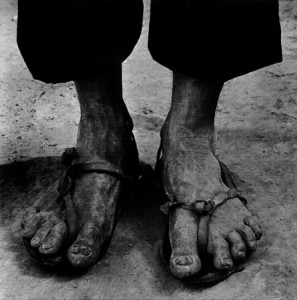
Rolfing calls these two directions palintonicity. The word comes from Heraclitus and his bow and lyre — form held by forces pulling opposite ways. Downward support and upward freedom do not exist without each other.
When the head becomes free to move, the senses work more readily and information from outside arrives more easily. That is also why session 7 works the hands and arms. With the whole palm resting on the floor without gripping, serratus anterior, the rhomboids, and the deep muscles binding scapula to spine come into play.
The point is not to put force into hands and feet, but to send attention there.

The Vestibular Sense: Waking the Sense of Balance
The vestibular sense is the sense of balance. What registers gravity is the inner ear, deep in the skull, where the balance organs work with the nervous system to detect the body’s orientation, tilt, and motion — and to get balance back.
Seasickness is the clearest example: the waves disturb the sense of balance.
The ear is part of the face and head. So session 7 wakes the vestibular sense by working the fascia of the face and head. What Rolfing’s seventh session is known for is that it works inside the mouth and nose as well — the jaw and its surroundings, the area around the nose, the muscles of the tongue.
What Is Looked At as the Session Opens
In the Body Reading at the start — watching how you stand and walk — the points include:
- Whether the head sits over the spine or in front of it
- The height of the two shoulders, and where the scapulae sit
- Any asymmetry in the jaw, and any bias in the bite
- Balance in standing with the eyes closed
- The quality of contact when a palm meets the floor
Inside the Mouth and Nose: the Bite and the AO Joint
What sets Rolfing apart from other bodywork is that hands go inside the mouth and nose to release fascial tension.
Working inside the mouth matters for the balance of the bite. Even in people who have had orthodontics, had wisdom teeth removed, or had teeth reduced during dental work, a bite that has thrown the balance off is common enough.
That said, going inside the mouth and nose is something almost no other bodywork does. Some people need the session explained carefully beforehand. The mouth and nose are also the border between your inside and your outside. Being touched there can carry meaning beyond the scope of a session. So what will happen gets said in advance, and the pace gets checked as we go.
When I went through the ten-series in training, the AO joint was one of my own open questions. At the end of session 4 I listed three things still to work on: letting go of psoas major, being able to breathe from the collarbones through the chest, and being able to move at the AO joint. By session 6 I was still writing that the tension around my neck would not come out.
At the same time as I was looking at the position of the head in paintings, the position of my own head was unfinished business. Session 7 is where that gets addressed directly.
Between the skull and the cervical spine is the AO joint, the atlanto-occipital joint. Working inside the mouth and at the neck reaches it indirectly, and tension throughout the body comes undone.
There is a method built on attending to the relation between head and spine, noticing the body’s unnecessary automatic responses and learning to stop them: the Alexander Technique, developed by Frederick Matthias Alexander. I studied it for six months, and I remember being surprised at how much tension left the whole body when the AO joint released.
Ida Rolf is said to have been strongly influenced by the Alexander Technique when she put session 7 together.
Waiting, and Not Giving Too Much
What takes the most judgment in this session is not where to touch but how much time to spend.
In 2017 I received two opposite answers, on two sides of the world.
In January I learned Cranio Work from Sharon Wheeler in Seattle, and a session took three and a half hours. The demonstrations ran close to three. Change takes as long as it takes, and you wait for it.
Six months later I attended Peter Schwind’s workshop in Munich. He had originally worked in sessions of about an hour, until meeting Ida Rolf’s son changed his mind. The son finished in as little as fifteen minutes. Spend too long, and you end up teaching the brain a great deal of information it did not need. Since realizing that, Schwind has kept to about forty-five minutes.
Three and a half hours, and forty-five. Within one method, that much difference. Neither is wrong; what differs is the view of what happens in a body. Does it need waiting, or does it need restraint? Both are judgments about what the practitioner refrains from doing — and they treat time in opposite ways.
When neutral became a subject in the 2025 advanced training, waiting was treated as part of the technique itself. How long to wait was not addressed. The two answers I received in 2017 remain unsettled for me. It depends on the session, is as far as I have gotten.
What the Body Takes In During This Session
Describing session 7 as releasing cranial fascia or working intraorally moves away from what is actually happening.
What is taken in, as I understand it, is the information that the head does not have to be held up. Support from below has already come through the pelvic floor, the psoas, and the sacrum, and it reaches as high as the base of the neck. The head can simply rest there; the neck and jaw do not have to lift it. When that arrives, the head moves over the spine on its own.
What Counts as Organized
Whether the neck feels less stiff is not, in itself, the result.
What is looked at as the session closes is the relationship with gravity. Does the weight of the head pass down through the spine? And does the support from below come back up in a form that carries the head? Is gravity working as an axis you can rest a head on, rather than a force that drops it?
Once the vestibular sense comes online, the horizontal planes of the body line up: the diaphragm and psoas from session 5, the pelvic floor from session 6, the sternoclavicular region from session 7. A medial line running through is also a stack of those planes.
What people most often report from this session is a lift on the inside happening at the same time as a release on the surface. The core rises and the sleeve lets go, together.
And perception widens. From looking only forward to taking in the full circle. A sense of freedom, a sense of being one piece, a sense of being here. That such words come up in session 7 has to do, I think, with four sessions of core work closing.
After the Session
- The head sits over the spine without being placed there
- The field of vision widens
- The voice changes
- Breathing deepens further
- The jaw lets go
On to the Next Session
Session 7 ends the work of taking up regions one at a time. From session 8, the integration sessions begin, for the sake of a body that moves as an organic whole.
- Session 8: The Two Girdles — Shoulder and Pelvis
- The Integration Sessions: Bringing It Together
- What Is Rolfing’s Ten-Series? — Three Phases in Which the Body Changes, and the Flow of Each Session
- A Glossary for Reading the Ten Sessions
Related Articles on the Rolfing Training
- Session 7: The Head and Face
- The Three Elements of Posture: Visual, Vestibular, and Kinesthetic
- The History of Painting and the Body (2) — How Do We View the Face and Head Through the History of Painting?
- Cranio Work – Sharon Wheeler (1) — A Technique for Carrying Out Session 7 Efficiently
- Basic Concepts — Bidirectionality (Palintonicity)
- On the Relation Between Rolfing and the Alexander Technique (1) — Two Ways of Learning to “Let Go” Through the Body
Hidefumi Otsuka, Ph.D. | Certified Advanced Rolfer™ / Rolf Movement® Practitioner Ph.D. from the Graduate School of Medicine, the University of Tokyo. After eleven years in medical marketing at a foreign pharmaceutical company, he has offered Rolfing® sessions in Shibuya, Tokyo since 2015, working under the theme of integrating science and practice.