
Posture and Movement Science Series — The Science of the Relationship Between Gravity and the Body | Part 2. Posted: December 2022. Updated: April 2026.
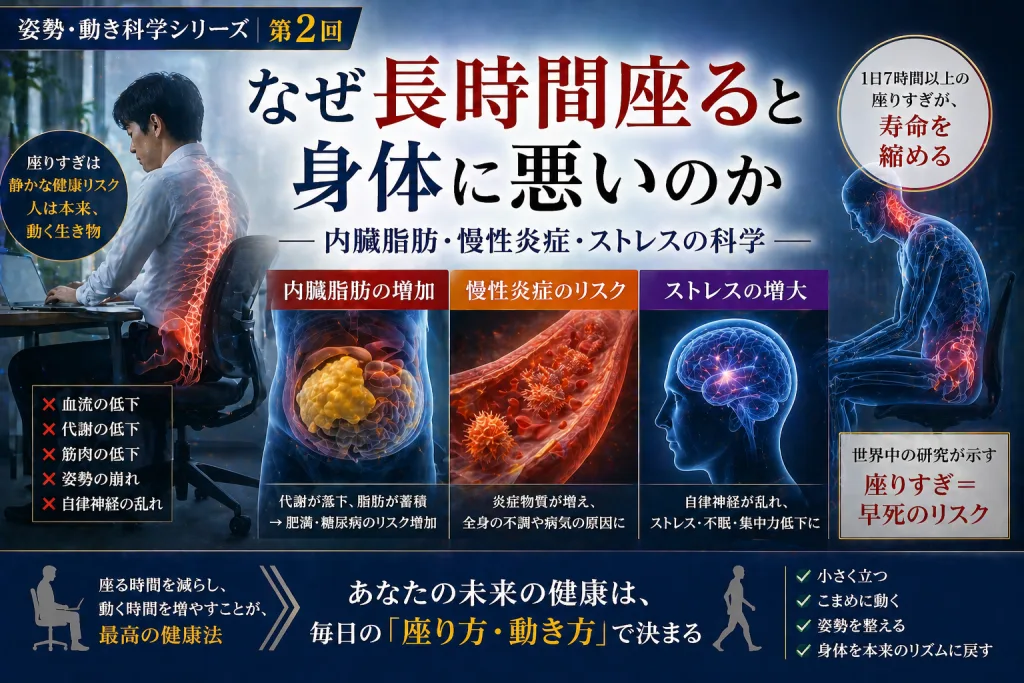
Introduction
In Part 1, I explored how humanity has “sat,” from the perspective of anthropology. From the squatting posture to the backrest chair — I looked at what this change brought to the body.
In Part 2, I change the viewpoint. Not the problem of “sitting itself,” but what “sitting for long periods” triggers inside the body — I unravel it from the science of metabolism, inflammation, and hormones.
→ Part 1: What Is the Difference Between Squatting and Sitting — The Influence of Chair Culture on the Body
A Physical Therapist’s Experience — What a 10 kg Weight Loss Shows
A man in his thirties working as a physical therapist (Mr. Kouki Yamada) began receiving Rolfing, carrying weight gain in addition to knee pain, low-back pain, and insomnia. As a specialist in the body, he “understood with his head” what the problem was. Even so, he could not change.
After completing the ten sessions, his weight had decreased by 10 kg, the low-back pain and knee pain had almost disappeared, and the insomnia, too, had cleared.
The 10 kg weight decrease is not merely the result of calorie restriction or exercise. It is the result of the cycle treated in this article — “the visceral fat, metabolic decline, and chronic inflammation that accumulate from sitting for long periods” — being cut off by the body’s structure becoming organized. The sitting posture changed, the tension of the fascia was released, and the body recovered its original metabolic function — that appeared in the number that is weight.
Is “Sitting” Really Bad?
There must be many who have heard the claim that “sitting is as dangerous as smoking.” However, this is not accurate.
Gorillas and chimpanzees, too, sit to eat, yet there is no health harm. Sitting itself is a natural human behavior. Since it consumes 8–10% fewer calories than standing, it is less tiring and the body is stable — sitting has a rational meaning.
The problem is not “sitting,” but “a motionless state continuing for a long time.” Daniel Lieberman, in his book Exercised, points out that, rather than sitting itself, “the body not moving while sitting” is the essence of the problem.
The Four Risks That Arise from Sitting for Long Periods
There is a physiological basis for recommending, during a Rolfing session, “standing every 30 minutes.” When sitting continues for long periods, four risks accumulate within the body.
① The Accumulation of Visceral Fat — the Trigger for Chronic Inflammation
There are two kinds of fat. Subcutaneous fat is the fat that attaches to the buttocks, breasts, cheeks, and feet, and exists to cope with long-term calorie shortage. On the other hand, visceral fat is the fat that attaches around the heart, abdomen, liver, and muscles, and functions as a short-term energy reserve.
The problem is when visceral fat accumulates excessively. When fat cells swell too much, they release substances that cause inflammation (adipokines) and draw in immune cells (white blood cells), causing a chronic inflammatory state. The accumulation of visceral fat carries a higher health risk than subcutaneous fat — a potbelly or an apple-shaped figure is a sign of it from the outside.
When sitting continues, the muscles do not move, energy consumption drops, and visceral fat accumulates more easily.
② The Decline in the Metabolism of Blood Sugar and Triglycerides
When sitting for long periods, the ability of cells to take in the glucose and triglycerides in the blood declines. This is because, when the muscles do not move, the insulin sensitivity that takes in blood sugar drops.
When this becomes chronic, a state of high blood sugar and triglyceride levels continues, entering a vicious cycle that accelerates the further accumulation of visceral fat and chronic inflammation.
③ A Rise in Cortisol — the Vicious Cycle of Stress and Visceral Fat
When sitting continues for long periods in a state where commuting, harsh desk work, and mental pressure overlap, the stress hormone cortisol rises.
Cortisol is a hormone that mobilizes blood sugar and triglycerides and puts energy into a form that can be used immediately. But when it rises chronically, it accumulates visceral fat further, disturbs the immune system, and causes chronic inflammation. The modern desk-work environment of “continuing to receive stress while sitting” can be called a condition that maximizes this risk.
④ The Inactivation of Muscles — the Acceleration of Chronic Inflammation
When a state in which the muscles do not work for long periods continues, the muscles themselves become prone to chronic inflammation. By moving moderately, muscles secrete anti-inflammatory substances (myokines) and play a role in suppressing the body’s inflammation. When sitting continues and this secretion stops, the risk of chronic inflammation rises.
The Solution Is Simple — Stand Every 30 Minutes
The cause common to the four risks is “the body not moving.” That is precisely why the solution, too, is simple: standing up every 30 minutes to an hour.
Just standing and moving for a few minutes improves the uptake of blood sugar, lowers cortisol, and restarts the muscles’ secretion of myokines. There is also research that standing frequently has a greater effect on metabolism than long-duration exercise.
In a Rolfing session, this habit is recommended together with organizing the “sitting posture.” When the way of sitting is organized, the burden on the body decreases, and standing up itself also becomes easier.
Sitting for Long Periods and Posture — Rolfing’s Perspective
The problems that sitting for long periods gives the body are not metabolism alone. Posture itself also changes.
When sitting on a chair continues for long periods, the hip flexors and the iliopsoas shorten, the pelvis tilts backward, and the natural curve of the lumbar vertebrae is lost. This postural pattern is recorded in the fascia, and even after standing up, the “shape of sitting” keeps remaining in the body.
As will be treated in detail in Part 5, this can be understood as a dysfunction of Tonic Function (the working of the deep muscles that keep posture unconsciously). Sitting on a chair for long periods lowers the working of the Tonic Muscles, and the Phasic Muscles (the superficial action muscles) substitute for maintaining posture — this is the structural cause of chronic stiff shoulders and low-back pain.
Posture and Movement Science Series — The Science of the Relationship Between Gravity and the Body (All 6 Parts)
Part 1: What Is the Difference Between Squatting and Sitting — The Influence of Chair Culture on the Body
→ Read Part 1
Part 2: Why Sitting for Long Periods Is Bad for the Body — The Science of Visceral Fat, Chronic Inflammation, and Stress (this article)
Part 3: Why “Standing” Is Not Tiring — The Mechanism of Gravity and the Antigravity Muscles
→ Read Part 3
Part 4: Why Is “Walking” Fundamental to Being Human? — The Science of Bipedal Locomotion, Center-of-Gravity Shift, and Gravity
→ Read Part 4
Part 5: Why Good Posture Is Not a Matter of Muscle Strength — Tonic Function and Its Relationship to Gravity
→ Read Part 5
Part 6: Why Does an “Easy Posture” Exist? — From the Perspective of Gravity, Fascia, and Rolfing
→ Read Part 6
Understanding posture and movement scientifically is one entry point for updating the “Recognition OS.” The theme of integrating thought, emotion, and body is explored in greater depth in the “Recognition OS” series at Mind and Bodywork Lab.
→ Mind and Bodywork Lab: How to Navigate This Site (only in Japanese)
A trial session is a place to begin by confirming what is happening within the body.
Hidefumi Otsuka, Ph.D. | Certified Advanced Rolfer™ / Rolf Movement Practitioner
Completed the doctoral program at the University of Tokyo Graduate School of Medicine. After a career in the pharmaceutical industry, has offered Rolfing® sessions in Shibuya since 2015, working under the theme of “the integration of thought, emotion, and body.”