How Can “Letting Go of Tension” Be Understood in Relation to “the Muscles”?
Since June 2015, I have offered Rolfing sessions in Shibuya.

Rolfing is a method in which hands-on work is carried out once every one to two weeks, each session following its own theme.
Because it refines “bodily sensation” while bringing the body into order, physical complaints such as stiff shoulders and lower-back pain improve as well.
It consists of ten sessions.
Sessions 1 through 3 work with the superficial muscles:
- In Session 1, settling the breath.
- In Session 2, ordering the soles of the feet.
- In Session 3, ordering the front-to-back balance.
In each, bodily sensation is awakened, and the view toward the mind and toward the world gradually shifts.
Sessions 4 through 7 work with the deep muscles, because they approach the central axis (located within the body). The sequence is:
- In Session 4, ordering the lower body (the adductors through the area of the pelvic floor).
- In Session 5, ordering the front side of the spine in the upper body (the psoas, the viscera, the diaphragm).
- In Session 6, ordering the back side of the spine in the upper body (the shins, the gluteal muscles, the sacrum, the spine).
- In Session 7, ordering the shoulders and the whole of the neck in the upper body.
From Session 8 onward, the body that has been ordered so far is integrated.

In the previous post, I introduced “letting go of tension” (used here to mean letting go of “the excess force of the muscles”).
That said, a question likely remains: “Even if it is excess force, which muscle should be released?”
This time, I would like to dig into this point a little further.
The Two Muscles That Work Under Gravity — “Transient” and “Sustained”
From birth to death, a human being is placed within the environment of gravity. Within that environment, the muscles work in order to maintain posture. At such times, how do the muscles work inside the body?

In Rolfing, the body is understood to work two kinds of muscles when placed under gravity. (This idea is based on the Tonic Function of the Rolfer and dancer Hubert Godard.)
Under gravity, there are two: muscles that work transiently (Phasic) and muscles that work continuously (Tonic).
The “Transient” Muscles — Accompanied by a Sense of Fatigue
The transiently working muscles are used in sprinting, weightlifting, lifting objects, and the like. They work when lifting something with effort, and they use glucose as their energy source. Because they burn glucose, lactic acid accumulates quickly, fatigue sets in, and the body tires.

These muscles are governed by the alpha motor nervous system (which makes up two-thirds of the motor nervous system). Because it is one of the nervous systems operated by the human brain, the brain can influence it directly — in other words, these are the muscles moved consciously.
When tension grips the body through daily stress, the transiently working muscles also fire. These muscles exist largely on the outside of the body (the superficial layer). In a world full of stress and desk work, they are left in a state of tension. Stiff shoulders and lower-back pain are often a matter of the outer muscles being tense.

In Sessions 1 through 3, the work centers on these muscles, gradually bringing the body into order so that awareness can turn toward the continuously working muscles described next.
The “Sustained” Muscles — Tireless
The continuously working muscles are involved in maintaining posture. They use oxygen as their energy source. Because they work slowly and continuously, they are not easily overcome by fatigue.
Ideally, it is these muscles that should be working, but they tend to exist on the inside of the body (the deep layer). Unless the superficial layer is released, they do not engage.
When practicing yoga or Pilates does not improve stiff shoulders or lower-back pain, it is often because the superficial muscles are not released, so awareness never reaches the inner muscles (the deep muscles).
A defining feature of this muscle group is that “it holds many muscle spindles.”
A muscle spindle is a sensor of the muscle, known as a sensory organ that detects the stretching and shortening of the muscle. For example, in yoga or meditation, there is often the instruction “bring awareness to the body.” What switches on at that moment is the muscle spindle.
When the body detects gravity, the muscle spindle switches on. Because of this, even without consciously attending to gravity, the spindle-rich continuously working muscles can move unconsciously.
These muscles are governed by the gamma motor nervous system (gamma motor neuron), which makes up one-third of the motor nervous system. A feature of the gamma motor nervous system is that, rather than being directly conscious, it is governed by the cerebellum and the medulla oblongata, which are involved in the unconscious and in habit.
What is interesting about the gamma system is that it can engage only the necessary muscle without engaging the antagonist.
I have written before that reciprocal inhibition exists as a way to relax a muscle. The body is built so that, when one tries to relax a muscle one actually wants to release — say, the hamstrings at the back of the thigh — putting force into the opposing quadriceps (the muscle at the front of the thigh) relaxes the hamstrings. In the arm, too, when the biceps is contracted, the muscle behind it is relaxed. This is called reciprocal inhibition of the muscles (the hamstrings are the antagonist to the quadriceps).
In the case of the transiently working muscles, the alpha motor nervous system becomes dominant, and the antagonist begins to fire.
The deep muscles, meanwhile, lie not in the superficial layer but in the depths, so there is a high chance that hands-on work cannot reach them. In Rolfing, the deep work is done in Sessions 4 through 7. What draws particular attention there is “kinesthetic sense.”
Why focus on “kinesthetic sense”? Because it is deeply connected to the gamma motor nervous system.
“Kinesthetic Sense” and the “Deep Muscles” — The Hands and Feet Are Connected to the Depths
To activate the gamma motor nervous system, the key is a state in which “kinesthetic sense” is being used.
As I have introduced repeatedly in this column, “kinesthetic sense” means: “whether the organs in charge of the five senses — which receive the external environment, including the hands, the feet, and the head and face — can firmly receive information and convey it accurately into the interior of the body.”
Why does this matter?
When the hands and the feet (the hands meaning the whole palm, the feet meaning everything including the arch) can be used fully, the muscle groups in the deep layers of the spine stabilize.
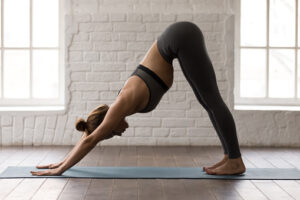
For example, when a yoga-mat pose (say, Downward-Facing Dog) is taken so that the whole palm “suctions in” without any force applied, the serratus anterior, the rhomboids, and the deep muscles linking the spine come into use. These deep muscles correspond to the continuously working muscles, and they can activate the gamma motor nervous system.
The ultimate aim of Rolfing is “how to activate the gamma motor nervous system and make the fullest use of the energy-efficient, continuously working muscles within the body.” It is for this that the ten sessions are constructed, and through them the central axis comes into order of its own accord.
世の中に対する見方と「持続的」に働く筋肉
The View Toward the World and the “Sustained” Muscles
Interestingly, the continuously working muscles are known to be influenced by four factors.
- 1, Bodily structure (the body’s posture and composition, gravity, and so on) — structure
- 2, How the whole body coordinates its movement — coordination
- 3, How the world is seen — perception
- 4. How meaning is assigned to the world — meaning
What Rolfing does is 1.. As for 2, practicing yoga, Pilates, or other exercise works on the continuously working muscles.

As for 3. and 4., through counseling, coaching, or a tarot session — by re-examining one’s own values — the continuously working muscles may change.
For instance, while offering a tarot session, I have witnessed, on several occasions, the moment when force drains from the body the instant a person finds their own solution. I believe this is precisely the result of working on the continuously working muscles by way of 4.
Conclusion
This time, I have summed up “letting go of tension” from the standpoint of the relationship between gravity and the muscles.。