

“Releasing Effort” and Rolfing
Since June 2015, I have offered Rolfing sessions in Shibuya, Ebisu, and Daikanyama.
Rolfing is one method in which, once every one to two weeks, using manual technique, treatment is carried out each time along a theme. Because it polishes “bodily sensation” while organizing the body, the body’s troubles (stiff shoulders, low-back pain) improve as well!
It consists of ten sessions. Sessions 1–3 treat the superficial muscles: the first session, organizing the breath; the second, organizing the soles of the feet; the third, organizing the front-back balance — all of these awaken bodily sensation and gradually shift the way of seeing the mind and the world.
Sessions 4–7 treat the deep muscles. This is because they approach the central axis (on the inside of the body).
The procedure is as follows:
- Session 4: organizing the lower body (the adductors to around the pelvic floor)
- Session 5: organizing the front side of the spine in the upper body (the iliopsoas, the viscera, the diaphragm)
- Session 6: organizing the back side of the spine in the upper body (the shins, the gluteal muscles, the sacrum, the spine)
- Session 7: organizing the shoulders and the whole neck in the upper body
From session 8 onward, the body that has been organized so far is integrated.
This time, I’d like to explain using the keyword “releasing effort” (used here to mean releasing “excess muscular force”).
The reason for taking this up is that it was in the course of exploring how to widen the flexibility and range of motion of yoga poses that I encountered Rolfing and bodywork.
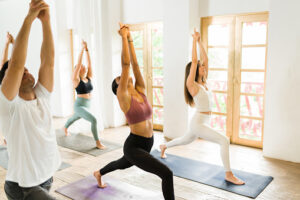
“Releasing Effort” — Three Methods Learned in Yoga
From August to December 2012, I took a yoga teacher-training course at Under the Light Yoga School. There, I learned that, from the standpoint of anatomy, there are three methods for “releasing the force of the body” (which can also be put as “no excess force entering”).
The first: force is released by putting force in.
First, to release force, it is important to know “why force is entering.” When stiff shoulders occur, without knowing which muscle the force is entering (in the case of stiff shoulders, it is the trapezius…), there is no way to know how to release the force.
In much of stiff shoulders, how the force enters there is not understood. And once putting force in is learned, releasing it becomes possible.
The second: using the reciprocal action of muscles.
To loosen the muscle to be loosened — for example, to loosen the hamstrings on the back of the thigh — putting force into the opposite side (the front), the quadriceps (the muscle on the front of the thigh), loosens the hamstrings.
In the arm too, when the biceps muscle contracts, the muscle behind it loosens. This is called the reciprocal action of muscles. In yoga poses, reciprocal action is often used.
The third: being conscious of the “central axis.”
Sitting and standing are postures that resist gravity. Without firm awareness of the central axis (the spine), excess muscular force enters the body.
When sitting, if the line from the top of the head to the sit bones becomes a firm axis and the spine lengthens, there is no need to put force into the other muscles, so force becomes easier to release.
In this way, to release force, a certain awareness of the muscles and the central axis is necessary.
And as force is released through these three, the spine lengthens, the chest opens, and so the breath deepens too. As the breath deepens, the mind grows calm, leading to relaxation.
What these three express is this: how to sit for long periods and breathe deeply — the essence of releasing effort is within the yoga poses.
Unfortunately, although I studied anatomy, I felt that, through yoga poses, a larger theory of how to release force was lacking, and I came to feel that a different approach was needed.
So, regarding “releasing effort,” I came to turn my attention to the “bodywork” developed in the West.

The Alexander Technique and Releasing Effort — The Shoulders Become Easier
The first thing I encountered was the Alexander Technique. Introduced by Toshihiro Aramaki — an Alexander Technique instructor and one of the friends with whom I practiced Ashtanga yoga at Mysore Tokyo — I went to Body Chance, an Alexander Technique teacher-training school within walking distance of Meguro Station.
By attending to the relationship between the head and the spinal column, it notices the body’s unnecessary automatic reactions and learns to stop them. It is a method of teaching the body to “release effort” by accumulating this learning.
Explained in words it is like this, but feeling it directly is best. In fact, when I received a group session from Jeremy Chance, the representative of Body Chance, I still remember the shock of how, just from being touched by the hand, the force released greatly and the shoulders became easier.
The Alexander Technique is a method developed by the Australian playwright Frederick Matthias Alexander, and it brings dramatic, temporary improvement. Because it was so wonderful, in 2012 I took Body Chance’s six-month professional course.
In fact, Rolfing is a method developed by Ida Rolf, and Ida Rolf, Frederick Alexander, and Moshe Feldenkrais — who developed the Feldenkrais Method — are said in the West to be the three great masters of bodywork.
Ida Rolf and Feldenkrais lived in the same era, and it seems they were on terms of large mutual influence regarding bodywork methods; Alexander lived earlier than them. However, during Rolfing training, the names of Feldenkrais and Alexander came up many times, so the influence is certain. And it was in the midst of studying the Alexander Technique that I encountered Rolfing.
Encountering Rolfing — Yoga Poses Open Up
By receiving Rolfing’s ten sessions in December 2012, through the process of the superficial part of the body (sessions 1–3), the deep part of the body (sessions 4–7), and integration (sessions 8–10), I came to feel the body becoming, “in the end, a body that does not use unnecessary muscles, with force released to a certain degree.”
That, by working on the body’s structure and having a specialist carry out treatment, the body becomes still more organized — this was a great discovery for me. Having experienced it directly, I became convinced of its effect. Stiff shoulders and a stiff neck improved more than ever before.
And yoga poses, backbends in particular, became easier to take.
Furthermore, whereas the Alexander Technique takes 2,400 hours, the Rolfing qualification can be obtained in 700 hours. For this reason, I obtained the Rolfing qualification in Munich from August 2014 to March 2015.

The Body Knows Its Original Place — Widening the Space to Move
While taking Rolfing training in Munich, the word Articulation came up often. It is an anatomical term meaning “joint,” even though there is another word for joint, Joint. Deliberately, Articulation was used more frequently.
Why was Articulation being used? In fact, Joint, as the word “join” suggests, carries the nuance of bringing two things together (connecting them). Taking the part that links bone to bone as the joint is, at first glance, not wrong.
On the other hand, the word articulation means, rather than “connecting,” “space” or “the interval”; it is also a derivative of the verb articulate (to make clear), which gives a sentence its “spacing.”
Rolfing holds that the body knows its original place, and turns attention to awareness. And it offers sessions with this in mind: “by directing awareness to the fact that there is space within the body (in English, to evoke), excess muscular force is released.”
Articulation (= holding the awareness of widening the space within the body) expresses exactly the characteristic of Rolfing.
For example, when there are stiff shoulders or low-back pain, the various muscles involved in the shoulders or lower back are tense, in a state where the muscles cannot work together (a biased way of use), or it occurs because the space to move to some degree has not been formed. In Rolfing, by releasing fascial tension, the whole body — including the shoulders and lower back — is organized. As a result, the awareness of the space within the body widening becomes available, and the movement of the muscles improves.
Let me also look at the relationship between space and sessions 1–3.
In session 1, by widening the space of the upper body, “the breath is organized.” In session 2, the space of the lower body; and in session 3, by instilling awareness of widening the front-back space of the body — improvement of breathing and walking becomes possible.
In this way, a body that had become superficial-dominant through tension and daily stress, as the excess tension is released and space is given, has its deep layer begin to work. In the end, because gravity comes to give an appropriate stimulus to the deep layer, the body comes to settle, experientially, into a more suitable place.
Yoga and Space — The Open State and the Closed State
This kind of awareness of space exists in yoga too. When I participated in Leslie Kaminoff’s teacher training held in Japan (May 2013), he explained yoga philosophy by contrasting two words, duhkha and sukha. “Kha” means space, and the meanings of duhkha and sukha are:
- duhkha: a state where the space is cramped (suffering, bad space) — the Buddhist notion of “suffering” comes from this.
- sukha: a state where the space is open (good space — freedom, space).
Considering that the body cannot breathe properly without sufficient space, the thinking resembles Rolfing. Kaminoff also said, “Yoga is to widen sukha and narrow duhkha (= yoga makes space within the body and makes breathing easier).”
Conclusion
It was in the course of exploring “releasing effort” that I encountered Rolfing, and this connects to the sessions I offer today.