Posture and Movement Science Series — The Science of the Relationship Between Gravity and the Body | Part 1. Posted: February 2024. Updated: April 2026.
Introduction
This series, taking as its axis the three actions Rolfing most emphasizes — “sitting,” “standing,” and “walking” — unravels the relationship between gravity and the body from the perspectives of science, anthropology, and Rolfing. Six parts in all. Part 1 begins with “sitting.”
Why begin with sitting? Because it is the posture modern people spend the longest time in, and the posture that has most changed the body. And because re-examining the “way of sitting” becomes the first entry point to reviewing posture as a whole.
There must be many who have heard the claim that “sitting is as dangerous as smoking.” But wait. Gorillas and chimpanzees, too, sit to eat, yet they suffer no health harm. The problem is not “sitting,” but “how to sit” and “what kind of chair to sit on.”
The postures looked at in a Rolfing session are three: “sitting,” “standing,” and “walking.” Of these three, the one that occupies the most time is the “sitting” posture, and what has most changed the modern body is also the “change in the way of sitting.”

How Has the Human Being Sat — The 300 Ways of Sitting Revealed by Anthropology
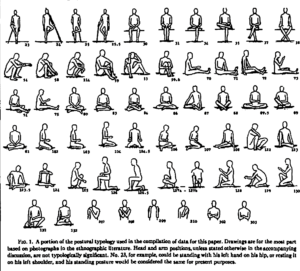
This is content introduced in Hidemasa Yatabe’s The Civilizational Theory of Sitting: the anthropologist Gordon Hewes gathered iconographic material written up in ethnographic research papers from around the world and classified the sitting postures humans take into more than 300 kinds. This research, introduced in Yatabe’s The Civilizational Theory of Sitting, shows that chair culture is no more than one part of the world.
The main ways of sitting that Hewes classified are these:
- Chair sitting posture
- Deep squatting posture
- Sitting with legs stretched out
- Cross-legged posture
- Kneeling on knees and feet (seiza)
- Sitting with the legs folded to the side
- One knee up, the other down and flexed
In Japan, within the life on tatami, these ways of sitting have been used daily. For Westerners with no habit of sitting on the floor, these postures had not even had names, and the fact that Hewes had to classify them anew shows how special Western chair culture is.
“坐” and “座” — The Memory of Bodily Culture That Japanese Holds
Interestingly, Japanese has two kanji regarding “sitting”: “座” and “坐.”
“坐” means the very form or posture of a person sitting. Zazen, seiza, the sit bones (坐骨) — all are words directly related to the body’s posture or bones. “坐” comes from the form of a person sitting on the earth, and means a direct connection with the floor.
On the other hand, “座” means a space where people gather and live, as in zashiki (the tatami room), miyaza (a shrine guild), and Kabuki-za. With Western chair culture coming in, “sitting (座る)” became common; but by knowing the depth of bodily culture that the kanji “坐” had retained, the background of the Japanese sense of posture comes into view.
The Power the Squatting Body Holds — The Talar Squatting Facet and Bodily Adaptation
When the posture of squatting on the floor is taken habitually, a small smooth area called the “talar squatting facet” forms on the talus on the inner side of the ankle. It is a record of bodily adaptation, often seen in Japanese people for whom the squatting posture at a Japanese-style toilet was everyday.
Daniel Lieberman, in his book Exercised, points out that people without a squatting habit have stiff calves and cannot place the soles of the feet flat on the ground, so the feet, calves, and quadriceps tire easily, and the risk of low-back pain also rises.
The posture of squatting is not merely “a kind of way of sitting,” but also an exercise for maintaining the balance and flexibility of the whole body.
What the Backrest Chair Changed — Facts Shown by a Study in Kenya
In sitting on the ground and in sitting on a chair without a backrest, the muscles of the back and abdomen work constantly to support the upper body. When squatting, the calf muscles also work. The burden on the muscles is not large, but by continuing, the body is trained.
The research of the anthropologist Eric Castillo showed a startling fact. Kenyan teenagers, who hardly ever sit on a backrest chair, had back-muscle strength 21–41% stronger than urban teenagers who often sit on chairs. Other studies, too, have made clear that with a backrest, posture is maintained with fewer muscles.
The backrest chair spread in late-16th-century Europe, and at first it was used only by people of high status. A comfortable way of sitting was historically a “privilege,” but that is not necessarily good for the body — this paradox lies at the root of the modern spread of low-back pain and stiff shoulders.
A Company Employee’s Testimonials — From “Unable to Sit” to “Able to Stand with Ease”
Before receiving Rolfing, Ms. Yasuko Fukuda held these troubles:
“Low-back pain that persistently troubles me. Stiff shoulders and a stiff neck so chronic I no longer notice them. Even trying to straighten my posture, a vague sense that something somewhere is misaligned won’t go away. I can’t sit with both legs thrown out in front (the left knee won’t fully extend).”
The state of “being unable to sit with both legs thrown out in front” is the same structure as the loss of the squatting habit treated in Part 1. The fascia of the calves, the hamstrings, and the hip joints has stiffened, and the very posture of sitting on the floor can no longer be taken.
After completing the ten sessions, she wrote this:
“Above all, I can stand up straight with ease. The force in my body has released, in a good way.”
What changed was not “the power to consciously correct posture,” but “a body that can stand naturally even when force is released.” By the fascia of the feet being released, the balance of the whole body changes — this is the reason Rolfing organizes the whole body starting from the “sitting posture.”
→ Ms. Yasuko Fukuda’s Ten-Session Experience
“Sitting” and Rolfing — The Connection from the Feet to the Spine
What Rolfing pays attention to is the “fascia.” Fascia wraps each part of the body, including the muscles, viscera, bones, and nerves, and can be called the “organ of posture” that transmits energy efficiently.
Of Rolfing’s ten sessions, the second approaches the “fascia of the feet.” Why begin with the feet? Because if the whole foot is tense, that tension chains, through the fascia, to the lower back, shoulders, and even the neck. Conversely, when the feet loosen, the whole back loosens.
What is done in the session is these three points: releasing the fascia of the whole foot, including the arch; strengthening the awareness of the connection between the lower body and the feet; and connecting the awareness from the feet to the upper body (the spine). Through this, a sensation arises of the soles of the feet sticking to the ground, and the balance of the whole body, including the sitting posture, improves.
What is occurring at this time is the recovery of “Tonic Function,” treated in Part 5. By recovering a state in which the deep muscles can respond naturally to gravity, posture comes to be organized without conscious effort.
→ Part 5: Why “Good Posture” Is Not a Matter of Muscular Strength — Tonic Function and Its Relationship to Gravity
Posture and Movement Science Series — The Science of the Relationship Between Gravity and the Body (All 6 Parts)
Part 1: What Is the Difference Between Squatting and Sitting — The Influence of Chair Culture on the Body (this article)
Part 2: Why Is Sitting for Long Periods Bad for the Body? — The Science of Visceral Fat, Chronic Inflammation, and Stress
→ Read Part 2
Part 3: Why Is “Standing” Not Tiring? — The Mechanism of Gravity and the Antigravity Muscles
→ Read Part 3
Part 4: Why “Walking” Is Fundamental to the Human Being — The Science of Bipedal Walking, Weight Shift, and Gravity
→ Read Part 4
Part 5: Why Good Posture Is Not a Matter of Muscle Strength — Tonic Function and Its Relationship to Gravity
→ Read Part 5
Part 6: Why Does an “Easy Posture” Exist? — From the Perspective of Gravity, Fascia, and Rolfing
→ Read Part 6
Understanding posture and movement scientifically is one entry point for updating the “Recognition OS.” The theme of integrating thought, emotion, and body is explored in greater depth in the “Recognition OS” series at Mind and Bodywork Lab.
→ Mind and Bodywork Lab: How to Navigate This Site (only in Japanese)
A trial session is a place to begin by confirming what is happening within the body.
Hidefumi Otsuka, Ph.D. | Certified Advanced Rolfer™ / Rolf Movement Practitioner
Completed the doctoral program at the University of Tokyo Graduate School of Medicine. After a career in the pharmaceutical industry, has offered Rolfing® sessions in Shibuya since 2015, working under the theme of “the integration of thought, emotion, and body.”