
November 12, 2016. Sharon Wheeler’s Bone Work reached its fourth day.
Three entries have covered the Bone Work so far.
- “The First and Second Days“
- “The Atmosphere of the Workshop“
- “Through the Third Day: What Sharon Said (1)“
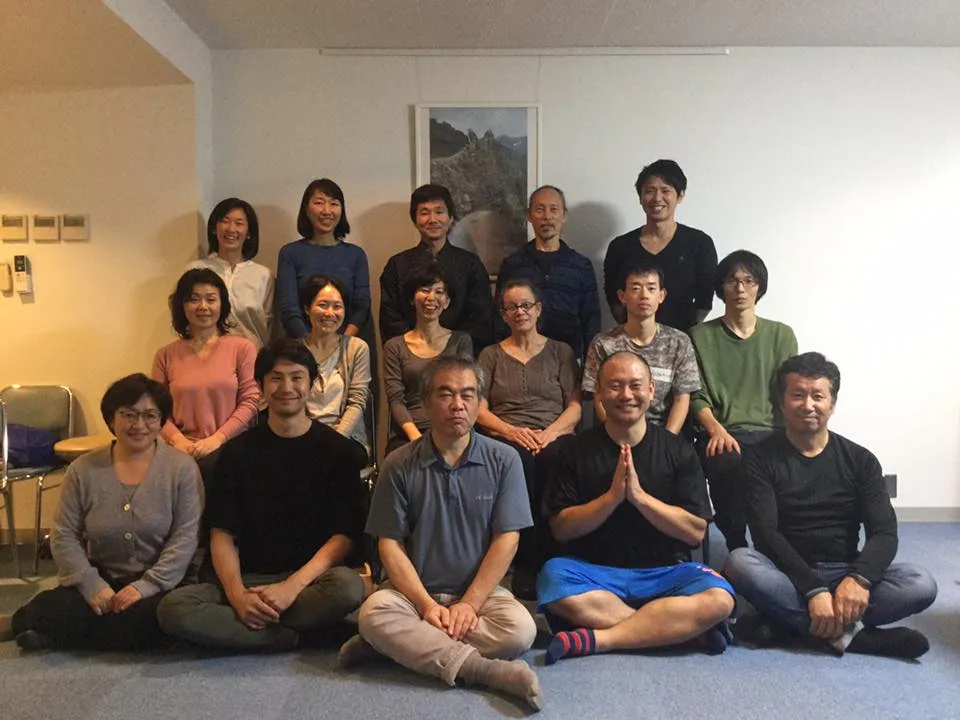
What is normally three days of content ran across five (November 9 to 13), partly because of the interpretation. And there were twenty-one outside clients in total (seven each over three rounds), along with exchange sessions among the participants. It was a genuine run of good fortune, and there was a great deal to take in.

Many of the outside clients reported dramatic change. A few examples:
“Someone who had struggled to rise from a chair after a traffic accident was able to stand with no support at all. I was truly moved.”
“A slipped disc, bow legs, and hallux valgus all moved to some degree toward improvement.”
Alongside the Bone Work, Rolfing sessions were scheduled after the workshop finished each day. Comments from those clients were largely favorable, but a question arose: how should the techniques learned in Bone Work and in Rolfing be used differently?
So I asked about it during the fourth day’s check-in — thirty minutes each morning in which each person reports on what they learned through the previous day and on their physical condition.
The reason is that Bone Work involves taking hold of the bone and using the flexors and extensors, so compared with an ordinary Rolfing session the muscles in use are different, and it depletes the practitioner’s stamina (for details, see “The Atmosphere of the Workshop“). It is an extremely powerful method that produces results immediately, but it uses stamina and destabilizes the posture, making it an approach that places a burden on the practitioner.

So: how should it be brought into the ten sessions? Can it substitute for a Rolfing session, or should it be treated as something separate?
Sharon’s answer was that when a fascial approach, Rolfing included, does not seem to be working, Bone Work is available as the deeper work, and Scar Work — not covered this time — as the more superficial work. In short, it does not replace the Rolfing work.
With the neural manipulation studied under Jonathan Martine in September and October 2016, it became clear that it can be applied in the fifth, sixth, and seventh sessions. As for Bone Work, it seems appropriate to bring it into the integration sessions in the second half — the eighth, ninth, and tenth — for clients whose fascial work over the preceding seven sessions has not gone well.
One day left. The final day is to be given over to review.
Note, August 2026
What this entry asks is how to use the different techniques differently. Bone Work produces powerful and immediate results, but it depletes the practitioner’s stamina and destabilizes the posture. How should it be handled within the ten-series? Can it substitute, or is it something separate?
Sharon’s answer came as a hierarchy. When a fascial approach does not seem to be working, Bone Work is available as the deeper work and Scar Work as the more superficial one. Rather than placing the techniques side by side and choosing among them, they are arranged in order of depth, and the next one is used when the previous one has not reached. It is an answer built out of experience.
Nine years later, the Advanced Training gave the same question an answer in the form of a system. Taxonomy: choosing which of five standpoints to work from — structural and segmental, biomechanical, functional, psychobiological, energetic. It is the framework Jeff Maitland introduced into Rolfing, meant to reorganize a complex work of wholeness from distinct standpoints. The arrangement is by kind, not by depth.
This record from 2016 holds a judgment that sits between the two. Neural manipulation can be applied in the fifth, sixth, and seventh sessions; Bone Work seems appropriate for the integration sessions in the second half — the eighth, ninth, and tenth — for clients whose fascial work has not gone well up to that point. The existing order of the ten-series is preserved, and the thinking concerns where within it to insert what. The stage of designing without the sequence has not yet arrived.
From placing things within the order to building without it. That transition took nine years. And it became possible, I think, because during this period several techniques were being learned in parallel, with each one tested by hand for where it worked and where it did not. A system of classification, without material to compare, is only a table.