Introduction
A new academic and professional year has begun.
This is a time when many people naturally start thinking about learning and decision-making—not only for exams or school paths, but also for:
- starting something new
- preparing for certifications
- rethinking career direction
And sooner or later, we all face questions like:
How should I learn?
What direction should I take?
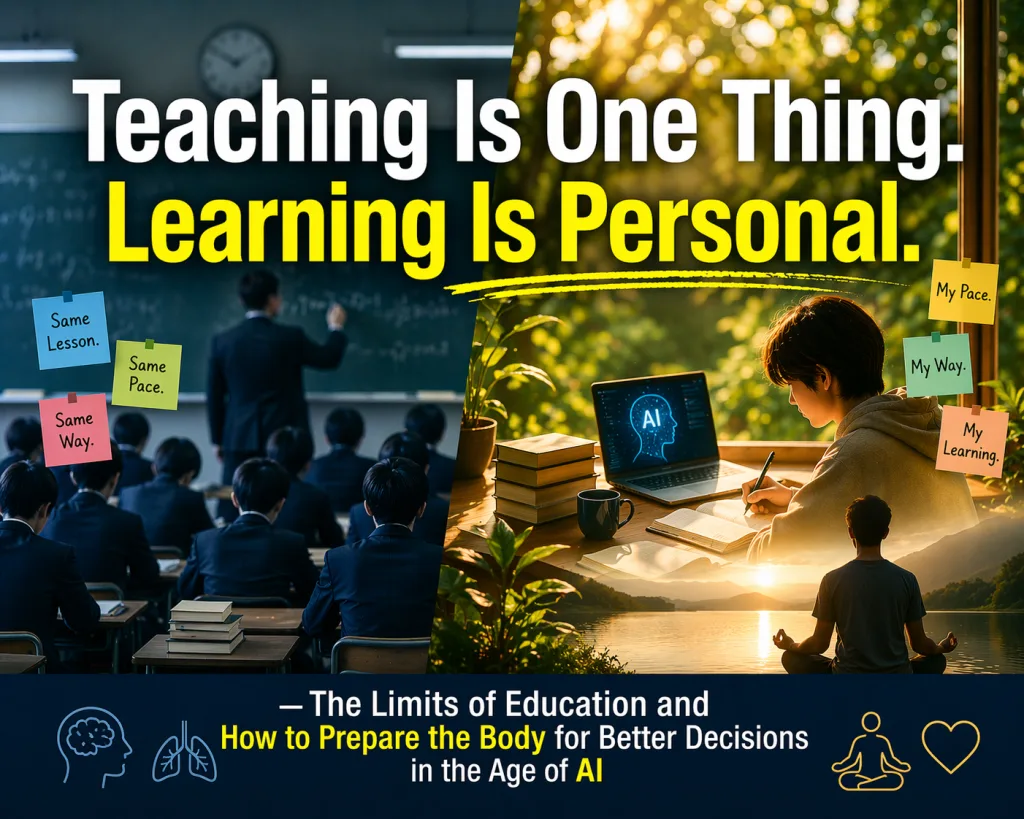
Options have never been wider, and with AI a “rational optimal answer” is available in an instant. And yet something remains unresolved. A hesitation. A lack of clarity.
Recently, I came across news about Artemis II. It symbolizes humanity stepping once again into the unknown. At the same time, our everyday lives are being reshaped by AI at an unprecedented pace. As boundaries blur and possibilities expand, how do we find a decision we can truly stand behind?
Why Education Is No Longer Working
In recent years, Elon Musk has made a striking observation about education:
Education is like an assembly line—everyone is taught the same thing, in the same order, at the same speed.
Those who grasp things quickly are forced to wait; those who struggle are pushed forward too soon. Neither group is truly being served.
The issue is not ability. It is structural.
Peter Drucker pointed this out long ago in The New Realities:
Teaching and learning are not two sides of the same coin.
And in the future, learning will matter more than teaching.
For decades, education has been designed around the act of teaching. But what actually happens is always the process of learning—on the learner’s side.
Drucker goes further:
Each person learns differently—like a fingerprint.
When pace, rhythm, and interest don’t align, learning barely happens.
This reveals a fundamental mismatch: the structure of education does not reflect how humans actually learn.
How Effective People Actually Learn
This idea becomes more concrete in The Effective Executive. Drucker emphasizes that effective individuals share one critical trait:
They understand how they learn.
Some people learn best by reading. Others by writing. Others by discussing. Others by doing.
And if you rely on a method that doesn’t fit you, you simply won’t produce results.
I went through a doctoral program myself. What finally made the difference was not how much I was taught, but whether I had found the way of learning that fit me. Sometimes reading a paper moved my understanding forward; sometimes it only fell into place when I explained it to someone; sometimes nothing became visible until I worked with my hands.
Yet most education systems assume a single way of learning. This is where the disconnect begins.
Elon Musk also highlights something important:
AI teaches a student, not a classroom.
AI can skip what you already know, revisit where you’re stuck, approach problems from different angles, and adapt in real time. For the first time, learning can be optimized for the individual.
Two Sides of the Capacity to Decide
The same applies to deciding, not only to learning.
A useful framework here comes from Raymond Cattell, later popularized in From Strength to Strength by Arthur Brooks:
- Fluid intelligence: solving new problems, thinking from first principles
- Crystallized intelligence: integrating knowledge, recognizing patterns
The key is not choosing one, but using both. Exams and formal study lean heavily toward the second. Choosing a direction in a fast-changing world requires the first.
Crossing Fields: What Carries Over
This question is not abstract to me.
I began my career in academia, working on basic immunology research during my PhD, where clear answers were rare. Later, in the pharmaceutical industry, I worked on launching new drugs and expanding indications, bridging science and business. Eventually, my path led me into yoga, meditation, and bodywork.
Looking back, these may seem like very different fields. But what connects them is not the domain itself, but the capabilities required to navigate them.
Through this, I’ve seen how scientists often struggle when leaving academia—not due to lack of ability, but because they haven’t yet translated their strengths into new contexts.
For those early in their career:
- Use your fluid intelligence fully — seek complexity, not clarity
- Convert experience into knowledge — write, explain, connect
- Develop the ability to “translate” — between disciplines, cultures, and contexts
In fields like medtech or biotech, those who stand out are not only technically strong, but able to connect domains. They explore with fluid intelligence, and integrate with crystallized intelligence.
So perhaps the question is no longer “which path is the right one?” but rather:
What kind of problems do you want to stay with for a long time?
Training Perception: How I Was Taught
Here I want to write about the education I received myself.
The Rolfing training gave out materials, but there was no textbook in any real sense.
At the time I took this for an inconvenience. So I would make my own, I thought. Only later did I learn that this was not a gap but the shape Rolfing education had held from its beginning. Ida Rolf took the anatomy and physiology textbooks away from her students. What is written in books is not fact — that was her position (see “Phase III (11) — How the Teaching Proceeds“).
The absence of a textbook was not an oversight. It was a design for growing seeing and feeling outside of what is written.
The same showed in how words were handled. In Phase II, Giovanni did not explain the definitions one by one; he had the students think. What is Articulation? What is Embodiment? Not a definition, but an answer arrived at through the movement of one’s own body (see “Phase II (16) — The Widening of Words and Human Diversity“).
When the definition comes first, it becomes the standard, and the intellect runs ahead. Give the name first, and a person begins to see only what fits that name.
On the last day of the basic training, Pierpaola Volpones separated Teach from Educate. To teach is to pass on a procedure step by step so that the student learns a technique. To educate is to have students think for themselves about how to proceed, so as to draw out what is already in them — edu in the sense of “drawing out” (see “The Last Day“).
In other words, “each person learns differently” is also what the Rolfing training has actually been doing. Each person takes hold of it in a different order, at a different speed, through a different entrance. So instead of handing over definitions, it hands over time.
And this way of teaching has a sequel.
Before touching the body in a session, I take time to listen. For a first visit this can run to an hour. What I am looking at is four things: what the person is dealing with, what matters to them, the words they use, and which senses they rely on — whether they listen, look, or feel their way (see “The First Hour — Four Things I Listen For in a Rolfing Consultation“).
Why those four? The basis is a definition from Drucker’s The New Realities:
Communication is perception.
It holds only when the receiver perceives, and only within what the receiver is able to perceive. So you have to know first how the other person perceives.
And in the Rolf Movement training, the choice of words was part of the practical work. Whether you say “lengthen” or “it lengthens” changes how the person uses their body. Change the words and the feeling changes; change the feeling and the movement changes.
In choosing words to work on another person’s perception, teaching and giving a session are the same skill.
Organizing the body is also changing perception. And when perception changes, the way the world looks changes.
Then Why Do We Still Struggle?
We now have access to information, powerful tools, and flexible learning systems. And yet—why do people still struggle to learn, and to act?
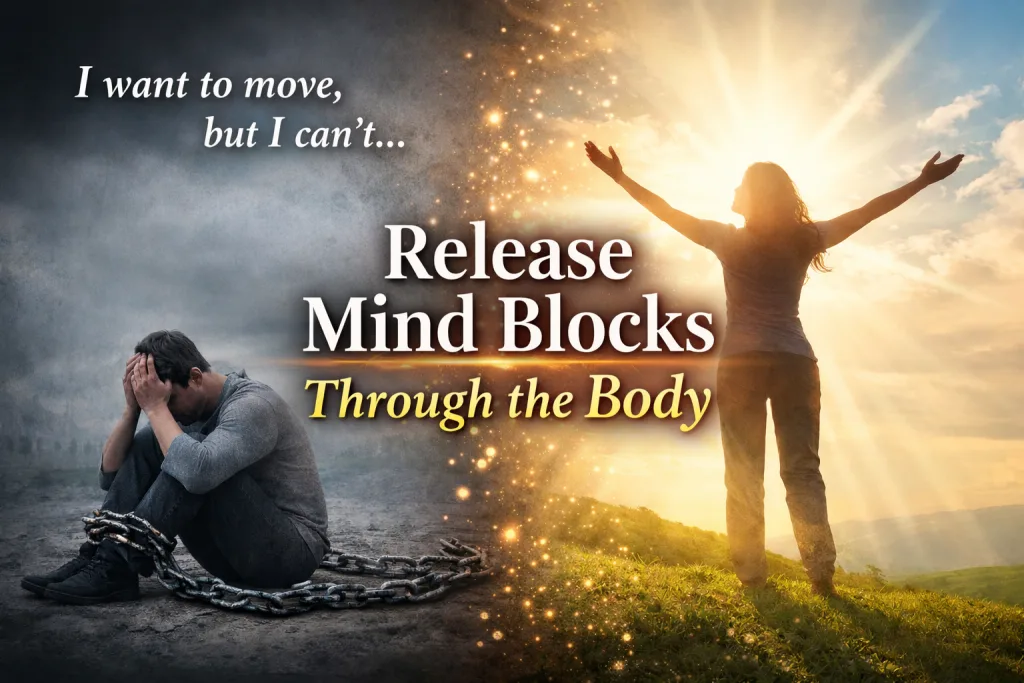
You know what you should do. In fact, you may feel that you have to do it. And yet, you don’t move.
In these moments, we tend to think: “Maybe I have a mental block.” “Something inside me is holding me back.” So we try to remove that block through thinking—analyzing, reframing, motivating ourselves.
But more often than not, it doesn’t work. Because the block is not located in thought. It is formed and held within the body.
Our experiences are not stored as abstract memories alone. They are encoded as bodily responses. The breath stops. The body tightens. The chest or abdomen contracts. These reactions do not simply disappear; they remain as patterns within the body. And when we encounter similar situations again, the same response is triggered.
Our present inability to act is often a reactivation of past bodily responses.
We tend to interpret this as a cognitive issue. “I lack confidence.” “I feel anxious.” But the sequence is actually reversed. The body reacts first. Then thought arises to explain that state.
So what we call a “mental block” is not primarily mental. It is a pattern of response expressed through the body.
The autonomic nervous system is always working to protect us. When it detects uncertainty or potential risk, it shifts the body into a defensive mode: muscles tighten, breathing becomes shallow, movement is restricted. From this perspective, not acting is not a failure. It is the body doing exactly what it is designed to do.
I have written about this mechanism in more detail elsewhere.
- Why “the Head Understands, but the Body Won’t Move” — An Introduction to Somatic Psychology
- Why Do Emotions Stay in the Body? — Understanding Rolfing Through the Body’s Memory
- The Three Approaches That Break Through “Understanding Yet Unable to Change” — The Difference Between Therapy, SE, and Rolfing
The Quality of a Decision Is Set by the State of the Body
If the block exists as a bodily response, then thinking alone cannot fundamentally resolve it. What is required is not a change in thought, but a rewriting of the body’s patterns. And here, one key element becomes essential: our relationship with gravity.
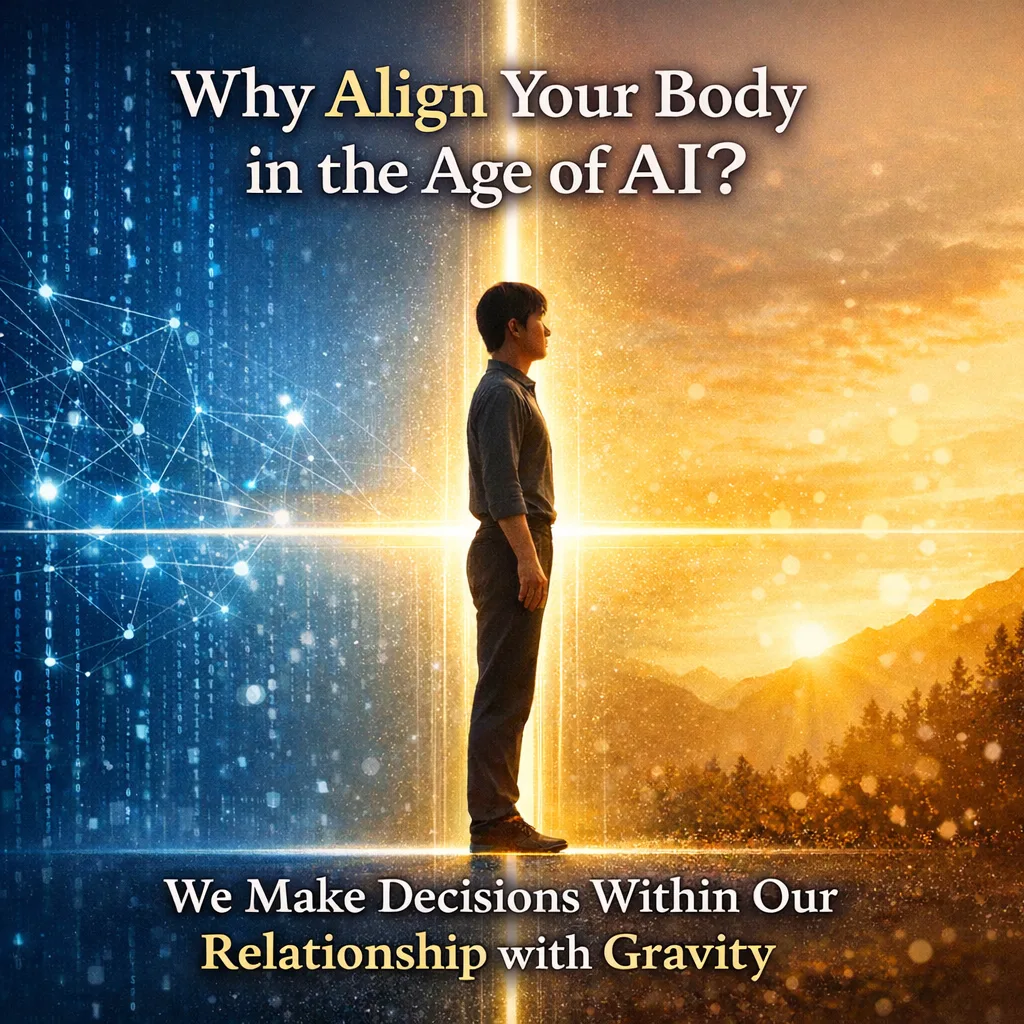
We are not just thinking minds. We are physical beings, constantly shaped by gravity. From the perspective of Rolfing, our decisions are deeply influenced by how our bodies relate to gravity.
When we feel anxious or uncertain, our bodies subtly resist gravity—lifting the shoulders—or collapse under it—rounding the back. In this state, perception narrows, and we default to conservative, defensive choices.
But when the pelvis aligns naturally, something changes. As the pelvis stabilizes and the spine organizes along the line of gravity, unnecessary tension dissolves. In this state of alignment with gravity, the nervous system settles, and clarity emerges—along with the capacity to catch the subtle interoceptive signals we call a gut feeling.
The quality of our decisions is not determined by thinking alone, but by the state of our body.
On gravity and posture, I have written separately.
- Why Is “Standing” Not Tiring? — The Mechanism of Gravity and the Antigravity Muscles
- Why Does an “Easy Posture” Exist? — From the Perspective of Gravity, Fascia, and Rolfing
- Why Does Organizing the Body Let You Decide for Yourself? — Rewriting the Subconscious Through the Body
In actual sessions, I have seen this repeatedly. As the body reorganizes, confusion around decisions often dissolves naturally. Choices that felt impossible to make before suddenly become simple. It is not so much a “conclusion reached by thinking,” but rather a sense of knowing.
As the body regains movement, balance no longer needs to be “held” or controlled. It emerges naturally from the integration of the whole system. And the same applies to action. You no longer force yourself to move. Movement becomes the natural expression of your state.
What happens to the “block” at this point? It fades. Not because it was removed through effort, but because the underlying state has changed. The body has learned a different response.
“Felt Certainty” Does Not Exist in Data
These days, I regularly use tools like Gemini and ChatGPT for research and structuring my thoughts. What’s remarkable is the precision of the “logical optimal answers” they provide.
This is especially evident in career decisions: academic performance, income projections, market stability. Feed in the data, and AI will generate “the best choice” for you.
But here is the deeper question:
Can we truly stay committed to a path chosen this way?
AI excels at producing probabilistic answers based on past data. But the sense of inner certainty—what we might call “felt conviction”—does not exist in data. It lives in the body. In particular, in the deep stability of the lower center—the gut.
Just as spacesuits in the Artemis Program are designed not only for protection but for freedom of movement, our decisions should not be rigid constructs built from information alone. They must emerge from a body that can move, adapt, and align with gravity.
The Day of My University Entrance Exam
Through my work in Rolfing sessions, I’ve observed something consistent: if the body is not in a stable state, people cannot perform at their full capacity.
Shallow breathing, constant tension, a lack of recovery. In such conditions, concentration drops, decision-making becomes unclear, and memory does not consolidate well.
I experienced this myself.
On the day of my university entrance exam, I suddenly developed a fever and couldn’t perform at all. I did not pass. Afterward my health broke down badly enough that I was hospitalized.
At the time, I thought it was simply bad luck. But now I see it clearly: my body had already reached its limit.
The following year, I recovered my own standard for deciding, and without being swayed by test scores, I was accepted where I had wanted to go. That experience is the origin of what I do now.
For students preparing for exams, the body is often exposed to constant external evaluation—scores, rankings, expectations. Over time, breathing becomes shallow, the pelvis tilts back, posture collapses. In this state, authentic decision-making becomes extremely difficult.
Knowledge Only Matters When It Becomes Action
Peter Drucker defines knowledge as:
something that enables action and brings about change.
Knowing is not enough. Understanding is not enough. Knowledge only matters when it translates into action. And that action depends heavily on one thing: the state of your body.
If you want to perform at your best when it matters, improve learning efficiency, or make better decisions aligned with yourself, then the first thing to work on is not information. It is the state of your body.
1. Regulate your breathing
Shallow breathing reduces cognitive performance. Restoring depth and rhythm is the first step.
2. Reorganize posture
Aligning the pelvis and spine stabilizes the nervous system.
3. Balance tension and recovery
Constant activation prevents integration. A body that can recover is essential for learning.
These are not matters of willpower. They are structural.
Final Thoughts
Peter Drucker highlighted the importance of learning. Elon Musk pointed out the structural limits of education. Through a doctoral program, I came to feel the reality that learning is personal. And in practice, we see another layer: the condition of the body.
When these four connect, learning turns into results.
In the age of AI, information is no longer scarce. What matters is no longer what you know, but the state you are in when you use it.
A direction is not a single correct answer chosen once. It may be closer to building a state in which you can keep choosing for yourself.
Exams, certifications, career decisions—all of them ultimately happen within the state of your body.
If you feel that you know what to do but can’t move forward, or that you are trying hard but not getting results, it may be time to look at your foundation.
Working from the Body: Support for Learning and Direction
1. A trial session
How does your own body relate to gravity? How does organizing it change the way you decide? These are things to feel first. In a quiet studio in Shibuya, I work with you to wake up the intelligence your body already holds.
▶ Details and inquiries about a trial session
2. For students: a six-month program on the body and direction (open on a rolling basis)

A six-month program for recovering the harmony with gravity described in this article, and for building a standard of your own that does not waver.
- Rolfing (ten sessions, roughly twice a month): organizing the body so that it does not collapse when it matters
- Coaching (up to six sessions, once a month): sorting out where to go and how to decide, with support for food, sleep, and condition
- Vision design (where needed): building a state in which decisions come from your own center
Open to high school students preparing for university entrance exams, to those preparing further ahead, and to students retaking a year. Not open to those within a few months of their exams — this is a program for organizing the body while there is still room.
The understanding and cooperation of a parent or guardian is essential; they are welcome to sit in.
A free consultation (up to one hour) is available at any time. No specialist knowledge is needed, and there is no pressure to continue.