Posture and Movement Science Series — The Science of the Relationship Between Gravity and the Body | Part 3
Introduction
In Part 1, I explored the anthropology of “sitting.” In Part 2, I looked at the influence that sitting for long periods has on metabolism, inflammation, and hormones. And as the solution in Part 2, I recommended “standing every 30 minutes.”
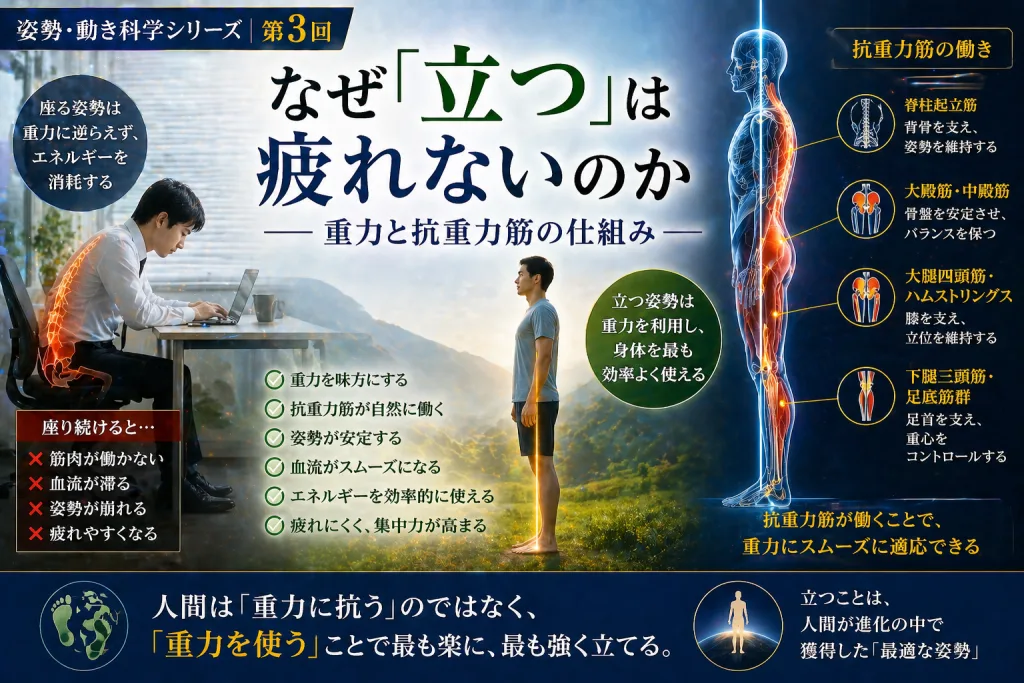
So, with “standing,” what is happening inside the body? Why is it not tiring when standing correctly, and why is an incorrect way of standing tiring? In Part 3, I unravel the science of the action of “standing.”
→ Part 1: What Is the Difference Between Squatting and Sitting
→ Part 2: Why Sitting for Long Periods Is Bad for the Body
“Tiring Just from Standing” Is Strange
Standing for long periods at a checkout or an exhibition makes the lower back and legs hurt. The experience of “being tired from standing” is common to many people.
But by nature, standing should be an action that is not tiring. Hunter-gatherers work standing for several hours a day, yet rarely carry low-back pain. Why have modern people become poor at standing?
The answer lies in Tonic Function, treated in Part 5. In a state of standing correctly, the deep antigravity muscles (Tonic Muscles) that respond to gravity work automatically. They are muscles that do not tire easily, use oxygen as an energy source, and can be sustained without conscious effort.
The problem is when these deep muscles do not function and the superficial action muscles (Phasic Muscles) support posture in their place. The Phasic Muscles tire easily and are not suited to maintaining posture for long periods. “Being tired from standing” is because the wrong muscles are made to do the wrong work.
Why Can the Human Being Stand on Two Legs — The Perspective of Evolution
It was about seven million years ago that humanity acquired bipedal walking. Compared with apes such as chimpanzees, the human bipedal stance is astonishingly energy-efficient.
The reason lies in the structure of the skeleton. The human spine draws an S-curve, and the pelvis is tilted at an angle suited to standing upright. The cranium rides directly above the spine, and the center of gravity comes directly above the feet — when this structure is in place, almost no muscle is needed to stand. The bones, ligaments, and fascia receive gravity, and the body is supported with minimal muscle activity.
Daniel Lieberman, in his book Exercised, points out that the bipedal stance can support the body with less energy than quadrupedal walking. The problem is not “standing,” but “modern lifestyle habits breaking down the original standing posture.”
→ Upright Bipedal Walking — Energy-Efficient, but with a Risk of Falling
The Anatomy of “a Way of Standing That Is Not Tiring”
A way of standing that is not tiring has three conditions.
That the pelvis is in a neutral position. When the pelvis tilts too far forward (anterior tilt), the lumbar vertebrae arch too much; when it tilts backward (posterior tilt), the lower back rounds. Both are states in which the deep muscles cannot work correctly. A neutral-position pelvis lets the iliopsoas, the pelvic-floor muscles, the diaphragm, and the transversus abdominis coordinate naturally, and activates Tonic Function.
That the S-curve of the spine is kept. The lordosis of the lumbar vertebrae, the kyphosis of the thoracic vertebrae, the lordosis of the cervical vertebrae — when this S-curve collapses, the weight of the upper body concentrates locally and becomes tiring.
That the head is directly above the spine. The weight of the head is about 5–6 kg. Just by the head coming forward, the burden on the neck, shoulders, and back increases many times over. The posture of looking at a smartphone (forward-head posture / “straight neck”) is the typical case.
When these three conditions are in place, the body comes into a state of “standing in coordination with gravity.” Not bracing with the muscles, but standing using gravity — this is a stance in which Tonic Function is alive.
Two-Directionality (Palintonicity) — the Core of Standing
In the Tonic Function theory of Hubert Godard, described in Part 5, there is an important concept: “two-directionality (Palintonicity).”
Palintonicity is the idea that, by giving the body two directionalities at the same time, the Tonic Muscles become naturally organized. For example, when sitting in a chair, the feet are on the ground and the sit bones are supported by the chair (downward), and at the same time, with the sit bones as the base, the upper body extends upward (upward) — when these two directions hold simultaneously, it becomes the most efficient posture. The same principle works when standing.
To stand correctly, two directionalities are needed simultaneously. The lower body feels gravity and “heads toward the ground.” The soles of the feet firmly feel the ground, and the sit bones and pelvis receive the downward weight. At the same time, the upper body, on top of that foundation, “extends toward the sky.” The spine extends naturally, and the crown of the head heads upward.
When this two-directionality holds, the body can stand with minimal force while in dialogue with gravity. The sensation not of “standing by trying hard,” but of “floating up within gravity” — this is the essence of a way of standing that is not tiring.
Conversely, when it becomes only one side, a problem arises. Being aware of only the downward direction makes the body heavy; being aware of only the upward direction makes for a tense state in which the feet are not on the ground.
→ Basic Concepts — Bidirectionality (Palintonicity)
→ Tonic Function ②: The Details of Tonus and Two-Directionality
The Real Reason Standing for Long Periods Is Tiring
Why is standing for long periods at an exhibition or a checkout tiring? In many cases, one of the following is occurring.
The center of gravity is biased. By putting weight on one leg, or swaying back and forth and side to side, the burden concentrates on particular muscles. When weight is not evenly distributed, the Tonic Muscles cannot work correctly.
The floor is too hard. On a concrete floor, the information of proprioception from the soles of the feet is poor, and the neural signals to the Tonic Muscles weaken. This is the true nature of the sensation that “it is tiring on concrete.”
The iliopsoas has shortened and the pelvis has tilted backward through “sitting for long periods,” treated in Part 2. In this state, even when standing, the pelvis cannot return to a neutral position, and the Tonic Muscles are hard to activate.
Much of “being tired from standing” actually comes from “a body that is not ready to stand because of sitting too much.”
Rolfing and “Standing”
In a Rolfing session, the “standing and walking” postures are observed every time. As the session progresses, the client’s way of standing changes.
“The soles of my feet came to feel as if sticking to the ground,” “my head feels lighter,” “just standing, my back lengthens” — these are all signs that the Tonic Muscles have recovered their original work.
When the tension of the fascia is released, the skeleton returns to its natural position with respect to gravity. Then, without conscious effort, the body stacks up correctly, and a way of standing that is not tiring is “automated.”
→ Ms. Yasuko Fukuda’s Ten-Session Experience — “Above all, I can stand up straight with ease; the force in my body has released, in a good way.”
Posture and Movement Science Series — The Science of the Relationship Between Gravity and the Body (All 6 Parts)
Part 1: What Is the Difference Between Squatting and Sitting — The Influence of Chair Culture on the Body
→ Read Part 1
Part 2: Why Sitting for Long Periods Is Bad for the Body — The Science of Visceral Fat, Chronic Inflammation, and Stress
→ Read Part 2
Part 3: Why Is “Standing” Not Tiring? — The Mechanism of Gravity and the Antigravity Muscles (this article)
Part 4: Why Is “Walking” Fundamental to Being Human? — The Science of Bipedal Locomotion, Center-of-Gravity Shift, and Gravity
→ Read Part 4
Part 5: Why Good Posture Is Not a Matter of Muscle Strength — Tonic Function and Its Relationship to Gravity
→ Read Part 5
Part 6: Why Does an “Easy Posture” Exist? — From the Perspective of Gravity, Fascia, and Rolfing
→ Read Part 6
Understanding posture and movement scientifically is one entry point for updating the “Recognition OS.” The theme of integrating thought, emotion, and body is explored in greater depth in the “Recognition OS” series at Mind and Bodywork Lab.
→ Mind and Bodywork Lab: How to Navigate This Site (only in Japanese)
A trial session is a place to begin by confirming what is happening within the body.
Hidefumi Otsuka, Ph.D. | Certified Advanced Rolfer™ / Rolf Movement Practitioner
Completed the doctoral program at the University of Tokyo Graduate School of Medicine. After a career in the pharmaceutical industry, has offered Rolfing® sessions in Shibuya since 2015, working under the theme of “the integration of thought, emotion, and body.”