This article began as a summary I wrote in 2015, just after finishing the training. It has since been expanded and reviewed from the perspective of August 2026, preserving the original record while adding what has become clearer since then and how the system itself has changed.
Introduction
Certification as a Rolfer through the European Rolfing Association (ERA) involved three stages of training. I completed all three in Munich, Germany, between August 2014 and March 2015, and became a Certified Rolfer. In December 2016, I took the Supervision Workshop, which completed the basic training.
What follows is centred on what is learned at each stage. The details of each item can be reached through links to the articles I wrote at the time, one by one.
This article focuses primarily on the training system as it existed from August 2014 to December 2016. The system has since been reorganized into Levels, and I summarize those changes at the end. For the latest information, please refer to the ERA’s official website.
Before Rolfing
Everything began on December 23, 2013, with a chance meeting with Akinori Ito (How I Found Rolfing — Searching for a Way to Deepen the Postures). He was practicing at Relief Space at the time, and I signed up for the Ten Series on the spot. He now works at The Circle.
I had been looking for a way to deepen my yoga postures. By the time I completed the Ten Series, I had decided to become a Rolfer (After Completing the Ten Sessions).

Getting into the Training
What the Application Asks For
Several conditions had to be met at the application stage.
Applicants were required to have received a Ten Series from a Certified Rolfer; five movement sessions from a Certified Rolf Movement Practitioner; a university-level degree; and a qualification or experience in hands-on work involving direct contact with soft tissue, such as massage.
On top of this came the Admission Paper, which was five to eight thousand words long. The first part asked why the applicant wanted to become a Rolfer, what had led to that decision, why this was the right time, and what the applicant had experienced in their own Ten Series.
The second part covered anatomy and physiology: degrees of freedom and planes of movement in the joints, types of connective tissue and their functions, and the muscles and structures involved in breathing. These three topics were required, with three additional topics chosen from six: the foot, shoulder, spine, thigh, pelvis, and muscular contraction.
The paper was written in English. It was read anonymously, so the applicant’s name was not included.
You needed a reasonable level of English, along with some basic knowledge of anatomy and physiology. For an applicant whose first language was not English, the bar was high.
Enquiring in June, Starting in August
Work had left me no time to deal with any of this, and I sent my first email to the association on June 14, 2014. I asked about the course beginning on August 4: Could I still apply? What would it cost? What did I need to prepare? Would everything be taught in English? Was there any help with finding accommodation?
I asked everything at once.
The next day, I received a reply from Martina Berger, the ERA course coordinator. Yes, I could still apply. She would send me the application package and the Admission Paper questions on Monday.
I had already completed the Ten Series. The problem was the touch requirement, since I had no qualification in massage or shiatsu.
When I explained this, they told me what level of experience they were looking for. For a massage or shiatsu course, they expected at least a three-day intensive followed by roughly fifty hours of practice with at least thirty different people. The idea was to become comfortable with hands-on work, help clients feel at ease with touch, and develop a practical understanding of anatomy through the hands.
So I described my own experience in detail.
I had completed a 200-hour Yoga Alliance teacher training and had more than fifty hours of hands-on experience with over thirty students. In teaching yoga, I used my knowledge of anatomy to guide students physically through backbends, forward bends, and twists, helping them find proper alignment and avoid injury.
In addition, I had a doctorate in molecular cell biology and experience in basic medical research and the pharmaceutical industry, so I already had a solid foundation in anatomy and physiology.
They asked me to send my CV so that the Education Committee could decide.
A few days later, the answer arrived: my touch experience was sufficient for me to apply for Phase I.
There was one condition. Before Phase I began, I was asked to practice working directly on the skin with clients in their underwear. During Phase I, all the teachers would also be assessing the students. If my anatomy or touch skills were judged insufficient, I would not be permitted to continue directly into Phase II.
The deadline for the documents was Monday, June 23. I sent the application papers and essay that day, although several pieces were still missing. My university transcript would not be issued until the 25th. The signature of the Rolfer who had given me the Ten Series would come the following day. And I had not yet found anyone for the movement sessions.
They accepted the application anyway.
For the movement sessions, I was told that I could complete them in Munich if I arrived before Phase I began. They recommended two practitioners: Kaori Nakamura, a Japanese Rolfer based in Munich, and Dorit Schatz, who worked near the training center.
They also sent me a list of movement practitioners across Germany, a list of accommodation options, and a map of the venue.
As for the touch requirement, I decided to use the opportunity to obtain a Thai massage qualification. I completed Levels 1 and 2 between late June and July (Completing ITM Thai Massage Level 1 — A First Bodywork Skill / Completing ITM Thai Massage Level 2 — On Offering Something Good).
I initially did this to satisfy a requirement, but Thai massage became the first bodywork skill I acquired.
My acceptance arrived at the end of June. Less than two months after my first enquiry, I was in Munich (Preparing for the Training).
Even if a deadline has passed, or you do not fully meet the stated requirements, it can still be worth writing and asking. The requirements may look fixed on paper, but in my case they were willing to consider my actual experience (Why I Chose to Study in Munich: The Application Process and the Costs).

After Entering the Training
What Is Learned in Phase I
Phase I lasted three weeks, or fifteen days. It was called Foundations. I took it in Munich from August 4 to 22, 2014.
It was divided into three subjects: Movement, Anatomy, and Touch. Each lasted one week and was taught by a different teacher. Movement began on August 4 with Rita Geirola, Anatomy on the 11th with Konrad Obermeier, and Touch on the 18th with Giovanni Felicioni.
Each instructor had an assistant. Rita was assisted by Fuensanta Muñoz de la Cruz from Spain, a Certified Advanced Rolfer who also holds a medical degree. I would meet her again two years later at the Supervision Workshop. Konrad was assisted by Caroline May. Giovanni was assisted by Patricia von Weichs, who would assist him again in Phase II. From Patricia, I learned a way of organizing the body through the vibration of sound.
These three subjects form the foundation of Rolfing: how the body moves, how the body is built, and how to touch.
The manual work itself is not yet taught. Neither is the Ten Series.
This is what comes before.
The first day was devoted mainly to introductions. I had just left my job and moved abroad, and I entered the training at a point in my life when letting go of what I had known seemed to be making space for something new (Training Phase I — On Letting Go, and the First Day).
There were sixteen participants from ten countries: three each from France, Germany, and Switzerland, and one each from the United States, Belgium, Sweden, Denmark, Ukraine, Poland, and Japan. Native English speakers were in the minority.
Two of the sixteen were not taking the full course. One attended only the Movement week, while another attended Movement and Touch but not Anatomy. As a result, the number of participants varied from week to week. At the time, there was also an option to take the three subjects individually, so Phase I included both students completing the full course and those attending only selected weeks. They all studied together in the same classroom.
During Movement week, each student observed how their own body moved.
Anatomy week involved learning anatomy through the body rather than only through books — confirming structures through touch and through movement.
Touch week dealt with how to touch: how pressure enters the body, which layer it reaches, and what the other person feels.
I recorded the three weeks in three articles (Completing the First Week / Completing the Second Week / The Third Week and the Final Evaluation).
How Students Are Assessed
Phase I ended with an important assessment. On the final day, each student had an Admissions Interview to determine whether they could proceed to Phase II. This was what the condition mentioned during my application referred to: if my knowledge of anatomy or my touch skills were considered insufficient, I would not be allowed to continue directly to Phase II.
The assessment, however, was not confined to the final day. Each week, that week’s teacher filled out an evaluation form, rating a list of items on a five-point scale and indicating whether they believed the student should continue to Phase II. By the end of the three weeks, each student had been assessed independently by three teachers.
The criteria differed from week to week.
Movement looked at how students related to their own process, to the other students, and to the teachers, as well as whether they were able to ask for help.
Anatomy looked at their understanding of terminology, their ability to absorb the amount of information presented, their ability to locate bony landmarks, and their confidence in palpation.
Touch looked at whether they could work across a range from listening touch to active, directive touch, whether the two hands could perform different functions, and whether they could work with fascia as a three-dimensional tensegrity web.
The Anatomy week also included a written test in two parts. I scored 25 out of 51 on the first and 42 out of 64 on the second. In my application, I had written that my doctorate had given me a foundation in anatomy and physiology, and that background had been taken into account when I was admitted. But the kind of anatomy required in the classroom was something different.
Two of the three teachers recommended that I continue without conditions. Konrad, who taught Anatomy, gave conditional approval. His assessment was that I needed more anatomy and more hands-on experience; that I was already well aware of this myself; and that certain cultural patterns, which we had discussed, were limiting my expressive potential.
He recommended that I slow down and study anatomy textbooks rather than relying on images in an atlas.
My previous experience had been taken into account when I was admitted. Phase I was where those assumptions were tested in practice.
Three Teachers Pointing to the Same Thing
Three teachers, three different sets of words, but the same underlying point.
Rita wrote that it was sometimes difficult to tell whether I was actually experiencing what we were exploring or simply performing it. She also felt that I did not give myself enough time to stay with the process. She encouraged me to step further into the foreground, to let the teacher see where I was, to ask for help when I needed it, and to take the time to feel and explore when something was not immediately clear.
Giovanni wrote that I should trust my own experience and stay with myself, especially after receiving work and when finishing work with another person.
Konrad’s comment about cultural patterns pointed in the same direction.
What these three teachers told me would keep coming back later in the training. The midterm interview in Phase III also focused not on technique, but on my way of being as a practitioner. The same issue had already been identified during those first three weeks.
Among the handouts we received were two that would become important to me later: a paper on body schema and body image, and a chronology of research on postural control.
I did not read them at the time.
The ideas outlined in that chronology, however, would come up repeatedly in the courses that followed.
The final interview on August 22, 2014, went well. Phase II did not begin until October 6, so with time available, I traveled through Asia and Turkey.


What Is Learned in Phase II
Phase II lasted eight weeks, or thirty-three days. It was called Embodiment. I took it from October 6 to November 26, 2014 (The Training Restarts).
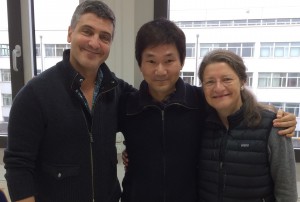
The teacher was Giovanni Felicioni, an Italian living in Britain, assisted by Patricia von Weichs, who had also assisted him during the Touch section of Phase I.
Takami Kamata, a Rolfer based in Frankfurt, has written about Giovanni in more detail in her own column.
Phase II is where students learn the Ten Series.
The Ten Series is a sequence of ten sessions, each focusing on a particular area of the body and serving a particular purpose within the series as a whole. By practicing on one another, students learn both the overall structure of the series and how to work through each individual session.
Each student both gives and receives the complete Ten Series.
Over the eight weeks, everyone gives ten sessions and receives ten sessions. In this way, students learn from both sides of the experience: what they observe through working with another person, and what they experience in their own body as a client.
This is why Phase II was called Embodiment (Bodily Sensation: What Is Embodiment?).
There were eight students, all men, with one teacher and one assistant.
And there was no textbook. There was no procedural manual either.
The teacher explained and demonstrated, the students practiced it on one another, with the teacher stepping in when necessary. The approach was close to an apprenticeship (How the Teaching Proceeds (1) / How the Teaching Proceeds (2)).
I wrote separately about the living arrangements and the structure of our days (The Practical Side of ERA (European Rolfing Association) Training in Munich).
I also wrote about the differences between training in Boulder in the United States and Munich in Germany (Foundation and Sensation).
How the Ten Series Is Built
The ten sessions are divided into three groups.
Sessions one through three make up the Sleeve, focusing primarily on the outer layers of the body (The Sleeve Sessions). The first focuses on the breath (Session 1: Organizing the Breath), the second on the feet (Session 2: Organizing the Feet), and the third on the sides of the body (Session 3: Organizing the Sides of the Body).
Sessions four through seven make up the Core, shifting the focus to deeper structures (The Deep (Core) Sessions). The fourth focuses on the pelvic floor (Session 4: Organizing the Pelvic Floor), the fifth on the psoas major (Session 5: Organizing the Psoas Major), the sixth on the sacrum (Session 6: Organizing the Sacrum), and the seventh on the head and face (Session 7: The Head and the Face).
Sessions eight through ten focus on Integration, bringing together the changes from the earlier sessions (The Integration Sessions). The eighth and ninth connect the upper and lower body (Session 8: The Shoulder Girdle and the Pelvic Girdle / Session 9: Continuity), and the tenth brings the whole series together (Session 10: Integration).
The series also alternates between the upper and lower body: odd-numbered sessions focus on the upper body, while even-numbered sessions focus on the lower body.
There is a reason for this arrangement: it reflects the principle of bidirectionality — organizing the body in two opposing directions.
After the Ten Series, old and new patterns may coexist in the body. How to work with these different patterns then becomes a question in itself (Old Patterns and New Patterns).
How the Body Is Seen
Working through the Ten Series requires learning how to see the body.
This is one of the central themes of Phase II.
Body reading means observing the body and recognizing what is happening within its overall organization.
This takes time to learn. At first, there is simply too much information. Until you know what to look for, it is difficult to know what you are actually seeing (Seeing with the Eyes, Feeling with the Body).
Bidirectionality, or Palintonicity, is a central concept in Rolfing. The body organizes itself through two opposing directions — downward and upward. Both are necessary (Basic Concepts — Bidirectionality (Palintonicity)).
Tonic Function addresses how posture is supported and how patterns of muscular activity change depending on how the body is being used. It was systematized by Hubert Godard, who has taught in Europe for many years, and I see it as one of the ideas that gives the ERA its distinctive character (The Muscles That Tire and the Muscles That Don’t — Tonic Function and the Support of Posture / Bidirectionality Brings the Body into Order — Tonic Function in Walking and Sitting).
Postural control relies on three main sources of sensory information: vision, the vestibular system, and kinesthetic sense (The Three Elements of Posture: Visual, Vestibular, and Kinesthetic).
Articulation is the idea that bringing awareness to space within the body can allow unnecessary effort to fall away (The Word Articulation — On Making Space Within the Body).
We also explored the importance of having a foundation that allows sensation to emerge (Foundation and Sensation).
The Body and the Mind
The state of the body cannot be separated from the state of the mind. Phase II also explored this aspect of the work.
We studied trauma and the body (Trauma Stays in the Body, Not in the Event — What Happens in the Deep Sessions), drawing on Peter Levine’s Somatic Experiencing.
We also studied polyvagal theory (The Face Makes Safety — Polyvagal Theory and the Two Vagus Nerves / Freezing, and Immobilization Without Fear — Neuroception and Social Bonds): Stephen Porges’s theory of the autonomic nervous system, which emphasizes the relationship between safety, threat, and physiological state.
Another subject was the body map (The Body Map and the Phantom Limb).
We carry an internal map of our own body: the body image, which involves how we consciously perceive and picture our body, and the body schema, which guides movement and bodily organization largely outside conscious awareness.
Seeing the Body Through the History of Painting

There was one class that only Giovanni could have given.
Drawing on Hubert Godard’s thinking, he used the history of painting — from the Renaissance to the Impressionists — to explore how people have seen the human body (The History of Painting and the Body (1)— Viewing the Body Through the History of Western Painting / The History of Painting and the Body (2) — How Do We View the Face and Head Through the History of Painting?).
The class drew on Giovanni’s knowledge of art and led me to a realization:
Ways of seeing the body have a history.
Words and Diversity
With participants from so many different countries, the same word could carry different meanings for different people.
One session addressed this directly (The Widening of Words and Human Diversity).
Beginner’s mind was also discussed (Beginner’s Mind and the Expert’s Mind).
Interviews, and the Self Seen from Outside
Phase II included both a midterm and a final interview.
The teacher gave each student direct feedback on their strengths and on areas that needed further development (The Midterm Interview: What Was the Feedback? / The Final Interview).
These interviews helped us understand where we stood and what we needed to work on.
I think that is the value of an interview: it allows you to see things about yourself that are difficult to see from within.
The same was true of the day-to-day feedback we received during the training, which was often given on the spot (Feedback: How Is It Given and Received in the Training?).

The Final Week
During the final week, two clients were invited for each Rolfer.
They were not fellow students. This was our first encounter with clients from outside the training (Client Sessions).
That experience became the foundation for working with clients in Phase III.
Phase II ended with a ceremony (The Closing and the Completion Ceremony).

Assignments Before Phase III
There were two assignments to complete between Phase II and Phase III.
One was the Mid Term Paper, an essay reflecting on the Ten Series we had both received and given during Phase II. It was evaluated by the Phase II teacher.
Phase III did not begin until February 2, 2015, so I used the time between the two phases to travel through South and North America.
I worked on the paper while traveling. At high altitude, I developed altitude sickness and ended up finishing it while I was unwell (The Mid Term Paper and Altitude Sickness: Finishing the Assignment Mid-Journey in South America).
The paper was later accepted (Before the Start, and the Acceptance of the Mid Term Paper).
The cold I caught in South America lingered for a month and a half and did not begin to improve until the second week of Phase III.
So I began Phase III without having fully recovered. In the end, however, that turned out to be useful: it helped me stop trying to do everything perfectly.
The other assignment was to complete two mentoring sessions with an Advanced Rolfer.
I will return to those later.
What Is Learned in Phase III
Phase III lasted eight weeks, or thirty days. It was called Clinical Application of Rolfing Theory. I took it from February 2 to March 25, 2015 (The Introduction, and Organizing What Is Known). The teacher was Jörg Ahrend-Löns, a physiotherapist, with Andrea Clusen assisting. Both are German.
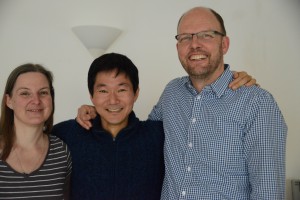
There were ten students: the eight from Phase II, joined by two more from Singapore and Mexico.

This is where students begin working with actual clients. By this point, the manual work itself is assumed to have been learned in Phase II. Each student works with two clients, giving each of them a complete Ten Series. The two teachers also work with one client each.
On a session day, six sessions therefore take place in the room: two given by the teachers and four by students. Each student gives two sessions and observes the other four.
Over the course of ten rounds, this means being present for sixty sessions. Each student gives twenty of them and observes the remaining forty. This amount of observation is one of the defining features of Phase III.
Every body is different. Even when working with the same session in the Ten Series, each client takes the work in a different direction.
You see this again and again.
Phase III did not feel like learning new things in the same way Phase II had. The focus had shifted from acquiring new knowledge to learning what to do when things did not go as expected.
How to Narrow Things Down
When everything learned in Phase II is brought to an actual client, the first difficulty is the amount of information available.
- What should you look at?
And what should you focus on?
We were given a framework for deciding what to prioritize in each session (Body Reading and the Quantity of Information).
Then came the idea of Less is More: paying attention not only to what needs to be worked on, but also to what does not. Jörg also emphasized the importance of intuition (Beyond Technique). Doing more does not necessarily produce better results. You also need to leave time for the client’s body to register and respond to the work.
This is also where holding the space becomes important: creating an environment in which clients can pay attention to their own bodies, while the practitioner remains present without judging, criticizing, or blaming (Space and the Room in the Mind / On Knowing the Importance of Holding the Space).
What to Do When It Isn’t Going Well
After each session, the teacher gave us feedback.
The point was not simply whether the session had gone well, but to understand what had happened during the session and what to pay attention to next.
Three questions came up repeatedly:
- What do you do when you become anxious?
- What do you do when you no longer know what to do and lose your connection with the client? (When You Don’t Know What to Do)
- What do you do when something unexpected happens? (The Body Map and the Phantom Limb)
We also explored the themes of insecurity and security (Insecurity and Security), including from the perspective of the autonomic nervous system (Effects on the Autonomic Nervous System).
Seeing and Perceiving
One of the papers distributed during Phase III explored the difference between seeing and perceiving. It introduced the Saturation Method, Jeff Maitland’s theoretical framework for understanding what Ida Rolf had taught.
I found it extremely useful.
Without a concept to guide us, we may look at something without actually seeing it. Once we have a concept, however, we begin to see what was there all along (Seeing and Perceiving (1): Seeing Begins with a Concept).
We also learned that simply adding up the parts does not necessarily give us the whole (Seeing and Perceiving (2): The Sum of the Parts Is Not the Whole).
Another lesson was to trust the recipe and keep moving forward (Trusting the Recipe).
The Five Principles
Rolfing has five principles. These principles provide a framework for thinking about what each client needs (The Five Principles).
Does the person need more support, or more adaptability?
The five principles help us make that kind of assessment. We also discussed body awareness (On Awareness of the Body), and the diversity of alternative approaches (Alternative Therapies and Diversity).
Movement and Modality
In the later sessions, there are more occasions when the client moves for themselves rather than having the practitioner move the body (Movement and the Session).
Changing how the body is used can itself allow unnecessary effort to release.
Change the timing of the breath. Change the rhythm. Use imagery (Modality (1): What Modality Means, and How It Is Used in Rolfing / Modality (2): When the Rhythm Changes).
Case Presentations
After the third session and again after the seventh, each student gives a five-minute case presentation to the class (Case Presentation (1): After the Third Session / Case Presentation (2): After the Seventh Session).
Hearing how the others were working and what they were thinking broadened my own range of possibilities.
Choosing Words
Once Phase III began, we had more opportunities to receive feedback on how we spoke to clients.
We learned to recognize where a person was coming from and to choose our words accordingly.
The way we speak about someone’s body image matters. The wrong choice of words can make a person feel that their own experience of their body is being dismissed (Body Image, and How Words Are Addressed to a Client).
Differences in Teaching
Phase II and Phase III differed in how they were taught and how ideas were communicated (Individuality and Education).
I also wrote separately about how the classes themselves were conducted (How the Teaching Proceeds). Learning from different teachers exposed us to a range of perspectives and ways of thinking.
I found that genuinely valuable.
The Practitioner’s Own Body
One theme that repeatedly emerged in Phase III was that the way a practitioner has worked with their own body comes through to the client (How You Have Dealt with Your Own Body Comes Through in the Session).
Before refining technique comes the question of whether the practitioner can come into Neutral. The midterm interview pointed to the same thing (The Midterm Interview).
Through to Certification
The turning point in Phase III came, I think, during the second week.
The cold I had brought back from South America was finally beginning to lift. Because I had not fully recovered, I stopped forcing things and turned instead toward what I could feel in the moment.
I kept body reading brief and moved forward by trusting what I sensed through my hands.
The final client sessions ended (After the Client Sessions), followed by the final interview, and I became a Certified Rolfer (The Final Interview and Certification as a Rolfer).
It was March 25, 2015.
During the question-and-answer sessions, we also discussed what to consider when working with children and how Rolfing can be applied to musicians and athletes (Is It All Right to Give a Rolfing Session to a Child?).
I also wrote during the same period about the relationship between Rolfing and yoga (The Relation to Yoga: Which Part of Yoga Has Rolfing Taken In?), and about what Rolfing shares with the Alexander Technique (On the Relation Between Rolfing and the Alexander Technique (1) — Two Ways of Learning to “Let Go” Through the Body / On the Relation Between Rolfing and the Alexander Technique (2) — Two Different Approaches That Complement Each Other).
What a Mentoring Session Is
The training also included assignments outside the classroom: mentoring sessions, in which a student visits an Advanced Rolfer at their practice and receives individual guidance.
Two were required between Phase II and Phase III, and three more between Phase III and the Supervision Workshop — five in total.
The content was not fixed. Sometimes the mentor gave the student a session; other times, the time was spent discussing questions. The point was to see firsthand how an experienced practitioner actually worked in their own setting.
Between Phase II and Phase III, I was in the middle of a journey around the world. I took both mentoring sessions in London, with Keith Graham and Alan Richardson (An Experience in the UK (1): Keith Graham / An Experience in the UK (2): Alan Richardson).
I took the other three mentoring sessions after Phase III, while working as a Rolfer in Tokyo.
From late August into September 2016, I returned to Keith Graham in London (An Experience in London (3): Keith Graham (2)) and then visited Hubert Godard in Paris (An Experience in Paris: Valuing the Foundations — Hubert Godard). Then, in December, I had my final mentoring session with Kathrin Grobelnik in Leipzig (An Experience in Germany: Kathrin Grobelnik).
Having learned about Tonic Function in the classroom, I was able to receive a session directly from the person who had systematized it.
The structure of the training made that possible. Each of these practitioners worked differently.
Each of these practitioners worked differently.
What struck me was how different the same Rolfing could look in different hands. Being able to experience these different approaches one after another within a relatively short period was one of the great strengths of the mentoring system.

What the Supervision Workshop Is
One distinctive feature of the European training was that it did not end with certification.
After about a year of working as a Rolfer, participants were required to take a six-day Supervision Workshop (On the ERA Mentoring Sessions and the Supervision Workshop Ahead).
I took it in Munich from December 13 to 18, 2016.
The teacher was Pierpaola Volpones from Italy, assisted by Fuensanta Muñoz de la Cruz from Spain. It was the first time I had seen Fuensanta since the Movement section of Phase I two years earlier.
Thirteen people took part: three men and ten women.
Takami Kamata has written about Paola in her column. Rolfers tend to have highly individual approaches, but Paola stands out for how well balanced hers is. She clearly explains the techniques developed by earlier practitioners and connects them back to the fundamental principles of Rolfing.
For someone wanting to revisit the fundamentals, she was exactly the right teacher.
What Kind of Place It Is
In a word, it is a chance to go back to the fundamentals.
By this point, about a year after certification, each Rolfer has been giving sessions in their own way and has inevitably developed certain habits.
The workshop gives us a chance to examine those habits and revisit the work from the ground up (The First Day, and Going Back Over the Basics).
- How is the Ten Series structured?
- How does each session connect to the next?
- How should we approach body reading in the first and second sessions?
Everything is revisited.
Phase IV required us to give two sessions to one client (Through the Third Day — What Paola Said). We also paid attention to how we used our own bodies as practitioners. Most of the time, we work with the thumb or the whole hand. But when should we use the elbow, forearm, back of the hand, or palm?
- How can we work without becoming fatigued?
- How can we avoid injuring our own bodies? (The Last Day)
The workshop also provides a place to address questions that arise only after working with actual clients. What should we do when the Ten Series does not seem to have worked for a particular client? A question like this could become the starting point for an entire day’s work.
On Teaching
One of the things Paola explained was the difference between teaching and educating.
- To teach, in her explanation, is to show students a procedure step by step so that they can learn a technique.
- To educate, by contrast, is to encourage students to think for themselves and find their own way forward, drawing out what is already within them — edu in the sense of “drawing out.”
Paola’s approach was closer to the latter.
There was no textbook for this workshop either.
As Paola explained the material, Fuensanta took notes on large sheets of paper, which were then put up on the walls one by one. That was how the six days unfolded. This marked the end of the basic training.
The Learning Environment
One of the reasons Munich turned out to be the right choice for me had to do with language. Among the participants, only those from the United States and Singapore came from countries where English is widely used as a first language. The other countries represented were Belgium, France, Switzerland, Germany, Ukraine, Mexico, Japan, Sweden, and Denmark.
Among the teachers, only one used English as his primary working language: Giovanni, who was Italian but living in Britain. The others were from Italy, Spain, and Germany. For almost everyone in the room, then, English was a second language.
As a result, people tended to speak more slowly and carefully. The classroom also made room for people from different cultural backgrounds to speak and ask questions.
At the beginning of Phase III, Jörg told me that he had little experience teaching Japanese students and asked me to speak up if anything came up.
Something a Swiss colleague told me has stayed with me.
He had taken Phase I in Colorado and joined us in Munich from Phase II onward. In Colorado, he said, people spoke English very quickly, leaving hardly any opportunity to ask questions. Swiss people generally have little difficulty with English, so hearing this from him suggested to me that the issue was not simply one of language ability.
Even with the slower pace of English in Munich, fully understanding the material required considerable effort. The content was dense, and by the end of each day most of us were exhausted. Had the pace been faster, with little opportunity to ask questions, I think I would have understood only about half as much (What Comes into View When You Study Alongside People Whose First Language Is Not English).
There is value in studying in Colorado, where Rolfing began. But Munich offers another option, one that is much less widely known.
The Teachers
Who teaches matters.
In the basic training, however, students do not choose their teachers directly. The teachers for each course are announced in advance, so in practice, choosing when to take the training also means choosing who will teach you. For mentoring sessions and continuing education workshops, on the other hand, practitioners can choose whom they want to study with.
Hubert Godard’s Influence on the ERA
Many of the teachers at the ERA have been influenced by Hubert Godard.
Godard is French. He studied chemistry before turning to dance, and through his own experience of changing how he moved as a dancer, his interest shifted toward human movement itself. He has taught dance and movement analysis at the University of Paris.
Receiving Rolfing was a turning point for him. He has said that seeing the body in terms of how it organizes itself in gravity brought together the knowledge and techniques he had accumulated up to that point.
From this came Tonic Function: a way of understanding how posture is organized, what happens in the body before movement begins, and how perception can change habitual patterns of coordination.
This perspective has had a strong influence on Rolfing in Europe (Tonic Function Model: The Human Gravity Response System).
The Influence of Feldenkrais
This is an important part of the story.
The development of Rolf Movement included exchanges between Ida Rolf and Moshe Feldenkrais. Godard’s Tonic Function also developed through exchanges with movement researchers of his time.
Rita Geirola, who taught Movement in Phase I, became a certified Feldenkrais practitioner in 1992 and says that the Feldenkrais perspective has deeply influenced the way she teaches. The influence of Feldenkrais can therefore be seen across three generations.
Ida Rolf, F. Matthias Alexander, and Moshe Feldenkrais are often regarded as three major figures in the development of modern bodywork. Of these three traditions, the influence of Feldenkrais can be seen directly in the development of Rolf Movement.
Teachers with a Background in Movement
In addition to Rolfing, there is a separate certification in Rolf Movement, and several of the teachers trained in Rolf Movement either before becoming Rolfers or alongside their Rolfing training.
Rita Geirola has a background in physical education and the Mézières Method and is also a certified Feldenkrais practitioner and Pilates instructor. She draws on several different approaches and chooses what best suits the person she is working with. Rita was also my teacher when I completed my Rolf Movement certification in 2019.
In other words, she taught me both at the beginning of my Rolfing training and later during my Rolf Movement training.
Pierpaola Volpones, who taught the Supervision Workshop, has a background in teaching physical education and swimming. Her training followed a similar path: she trained in Rolf Movement first and became a Rolfer afterward. For someone with a background in yoga, dance, or sports, this movement-based approach may provide a more accessible way into Rolfing.
Teachers with Backgrounds in Medicine and Anatomy
Jörg Ahrend-Löns, who taught Phase III, is a physiotherapist.
Fuensanta Muñoz de la Cruz, who assisted with Movement in Phase I, is a physician.
Konrad Obermeier, who taught Anatomy in Phase I, is a senior instructor at the ERA and has continued teaching the same subject for the twelve years since I studied with him. The anatomy he teaches goes beyond what is found in textbooks.
He studied visceral manipulation directly with its founder, Jean-Pierre Barral, and also teaches the embryology of Erich Blechschmidt. His approach looks at the body not only as an adult structure, but also in terms of how it develops and takes shape. Konrad has also worked to bring some of Blechschmidt’s unpublished writings into print.
His own background is unusual as well.
He studied communication and folklore at university, spent ten years studying yoga, and trained as a yoga teacher in Kerala, India. For someone wanting to deepen their understanding of anatomy, Konrad has a great deal to offer. But studying with him is less about acquiring more anatomical knowledge than about changing the way you see the body.
Teachers with Backgrounds in the Nervous System and Trauma
Fuensanta is a Somatic Experiencing practitioner and has organized official SE trainings in Spain. She first studied with Peter Levine in 1992. Rita Geirola has also studied with Levine.
This background informed the material on polyvagal theory and trauma covered during the training.
Teachers with Backgrounds in Other Forms of Bodywork
Andrea Clusen, who assisted in Phase III, works with SourcePoint Therapy and energy work. While Rolfing focuses on the structure of the body, SourcePoint Therapy approaches the body through the field around it.
She also works with scar tissue.
Teachers with Backgrounds in Perception and Art
Giovanni Felicioni, who taught Phase II, was a stage actor. His teaching reflects the idea that ways of seeing the body have a history. His classes on the history of painting were something only he could have taught.
Differences in Teaching
Giovanni keeps the atmosphere in the room open and informal. During a demonstration session, students could eat and drink, or even move around to get a better view, without disrupting the session.
Jörg took a very different approach. If a sound came from a computer, for example, he would stop and address it firmly. He saw it as his responsibility to create and maintain the right environment for the session.
Rita Geirola says that she shapes the flow of a course according to the students’ backgrounds and interests, as well as the dynamics of the group. Her aim is to build confidence and encourage curiosity.
Pierpaola Volpones distinguishes between Teach and Educate and says that her approach is closer to the latter: rather than having students memorize a procedure, she encourages them to think for themselves about how to proceed.
It is not that one approach is better than another. Learning from different teachers allowed me to experience a range of teaching styles and ways of thinking (Individuality and Education / On Knowing the Importance of Holding the Space).
For Those Coming from Outside Europe
Several of the teachers are accustomed to working with students who have traveled a long way to attend the training and are studying in a language that is not their first.
Konrad Obermeier has taught in Japan many times. Giovanni Felicioni has studied there. Both understand the kinds of difficulties that can arise when students come from a different language and cultural background.
At the beginning of Phase III, Jörg Ahrend-Löns told me, without my asking, that he had little experience teaching Japanese students and asked me to speak up if I encountered any difficulties. But previous experience is not the only thing that makes a teacher trustworthy.
Different Lineages Often Meet in the Same Person
Rolfing includes several different lineages: one that continued the approach originally taught by Ida Rolf, another that developed its theoretical foundations, the functional approach that developed in Europe, and approaches influenced by work with the nervous system and trauma.
From the outside, these may look like separate schools. But when you look at the backgrounds of the teachers themselves, several of these lineages often come together in the same person.
Someone may have trained in the United States, completed advanced training in Europe, and later studied methods from an entirely different tradition.
This kind of background is not unusual. There are connections across these lineages as well. Among the teachers mentioned in this article, two studied visceral manipulation with the same teacher, and two studied with Peter Levine.
So choosing a teacher based solely on lineage may not tell you very much. From the student’s perspective, these different influences ultimately come together in the same learning experience.
With No Textbook, the Teacher Is the Content
I have already mentioned that there was no textbook at any stage of the training. What is passed on is not only a body of knowledge, but also the way each teacher sees the body and approaches the work. In that sense, the teacher becomes part of the curriculum.
In the basic training, students cannot choose their teachers. Instead, they have the opportunity to learn from several different teachers. I think that is part of the design. After certification, through mentoring and continuing education, each practitioner can choose whom they want to learn from.
What the System Looks Like Now
Everything above describes the training system as it existed from 2014 to 2016. It has since changed substantially.
Reorganization into Levels
The former three-stage structure of Phase I, Phase II, and Phase III has been reorganized into Levels 1, 2, and 3.
Level 1 is the Myofascial Foundation: nine three-day courses organized around the same three pillars of Movement, Anatomy, and Touch. Completing Level 1 leads to the Myofascial Foundation certificate and allows students to move on to Level 2.
Level 2 is where students learn the Ten Series. Students practice on one another and, toward the end of the course, work with an external client for the first time.
Level 3 leads to certification. Over a period of ten to twelve months, students give a complete Ten Series to an external client under the supervision of their instructors.
The Entry Requirements Have Been Relaxed
This is the largest change.
In 2014, admission to Phase I involved a review of the applicant’s background and documents. The requirements included completion of the Ten Series, five movement sessions, a university degree, a qualification or experience in hands-on work, and the Admission Paper. Only those who met these requirements could enter the training.
Level 1 today has no such requirements. Apart from being eighteen or older, there are no prerequisites, and no background in medicine or healthcare is required.
The first three courses — Movement 1, Anatomy 1, and Touch 1 — can also be taken individually, allowing prospective students to experience the training before committing to the full program. Before that, there is also a two-day introductory course and a free online session.
The gate has moved from the front to the back.
In the old system, students were assessed before entering the training. In the current system, completing Level 1 is what qualifies them to move on to the next stage. The minimum age has changed as well: from twenty-five to eighteen.
The Supervision Workshop Is No Longer Compulsory
The six-day Supervision Workshop I took is now offered as a continuing education course called Deepening the 10 Sessions, with “former Supervision” noted in brackets. It has been shortened to four days. The workshop itself has not disappeared. What has changed is when supervised practice takes place: it has moved from after certification to before it.
Level 3 now includes giving a complete Ten Series to an external client under the supervision of instructors. In the old system, I returned to the fundamentals at the Supervision Workshop after about a year of working independently as a Rolfer. In the current system, that supervised process takes place before certification.
What Changed and What Did Not
The stages have changed, the entry requirements have been relaxed, and something that was once compulsory has become optional. At the same time, the three pillars of Movement, Anatomy, and Touch have remained the same.
So has the structure of the Ten Series. There is still no textbook. And many of the same teachers are still involved in the training.
Anatomy in Level 1 in 2026 is taught by Konrad Obermeier — the same person who taught me in 2014. Twelve years later, he is still teaching the same subject.
Rita Geirola’s name is still listed for Movement. Touch is taught by Andrea Clusen and Pierpaola Volpones. Andrea was an assistant during my Phase III, while Paola taught the Supervision Workshop at a later stage of my training. Today, both are teaching at the beginning of the program.
The structure of the training has been reorganized. Many of the people passing on the work have remained.
After Certification
The learning continues after certification. This part of the system has changed relatively little since my time.
Rolf Movement Practitioner
The ERA also certifies Rolf Movement Practitioners. This is a separate but complementary thirty-day training, divided into three Parts.
I began the training in 2017 and was certified on December 1, 2019.
While Rolfing works directly with the body through the practitioner’s hands, Rolf Movement works through the client’s own movement and awareness. It gave me the opportunity to explore in greater depth what had only been introduced during Phase III. I have described that path separately (On the Path to Becoming a European Rolf Movement Practitioner — The Road to Certification).
Continuing Education
Maintaining certification requires continuing education workshops. A minimum of eighteen days is required over a period of three to seven years in preparation for Advanced Training.
Which workshops fill those days, however, is not specified. I have written separately about the framework, the five taxonomies, and the leanings of teachers and regions — and about what I actually look at when the options are in front of me.
- Continuing Education After Rolfing Certification — The 18-Credit Framework and a Map of the Teachers
- How to Choose Continuing Education — Four Things I Look At Before Signing Up
Advanced Training
Rolfers take Advanced Training after three to seven years of practice. At the ERA it is now called Level 4 and consists of twenty-four days, or 168 hours.
The training I took was not the ERA’s but the one organized by the Japan Rolfing Association. I completed it in July 2025 and became a Certified Advanced Rolfer. I have described that path separately (Journey to Becoming an Advanced Rolfer — A Summary of the Road to Certification).
Back in 2016, I had planned to take the ERA’s Advanced Training in 2018. That is not how things turned out. The rules allow some flexibility: for those who complete the Rolf Movement certification, the three-to-seven-year period can be extended to nine years. Because I completed the Rolf Movement training between 2017 and 2019, that provision applied to me.
Choosing to complete the Rolf Movement training first meant postponing the Advanced Training, and in the end I took it in Japan.
Related Articles on the Rolfing Training
- What It Takes to Become a Rolfer — An Overview of Qualifications, Organizations, and Training, Explained by a Rolfer
- Continuing Education After Rolfing Certification — The 18-Credit Framework and a Map of the Teachers
- How to Choose Continuing Education — Four Things I Look At Before Signing Up
- On the Path to Becoming a European Rolf Movement Practitioner — The Road to Certification
- Journey to Becoming an Advanced Rolfer — A Summary of the Road to Certification