
It has been a while since I wrote about Rolfing.
About four weeks have passed since finishing the Phase II Rolfing training. The Phase III training takes place in Munich on February 2, 2015. Between Phase II and Phase III, two mentoring sessions are required (before the Phase III training begins), along with the submission of a Mid Term Report (deadline: December 31, 2014). The mentoring sessions were completed in the UK, and the experience has been written about on this blog (see “Experiences in the UK (1)” and “Experiences in the UK (2)”).

Preparation for the Mid Term Report began after arriving in Buenos Aires, and it was written over two and a half weeks, finishing in Sucre. The Mid Term Report called for 1,000 words each on the experience of receiving and of giving Rolfing among students, and 4,000 to 5,000 words on the ten Rolfing sessions.
That it deepened my own understanding of Rolfing goes without saying, though finding the time to write it alongside the travel blog was a struggle. In any case, it is good to have submitted a first draft.
What I feel now, having received Rolfing, is that I have come to understand my own body better. That the strength of the vestibular sense on the left side contributes to the tension in the neck and shoulders; and where the effort is held within the body — my understanding of both has progressed further than it did through yoga practice.

At present (December 24, 2014), the journey through South America has entered the Andes, and the daily travel continues at somewhere between 3,500 and 4,500 meters. Something interesting about the changes in the body came to my attention on this trip, and I would like to write about it.
Altitude sickness is said to affect roughly two or three people out of fifteen. I felt a mild case myself on the first night at a hotel near the Uyuni salt flats (at an elevation of about 4,000 meters). There was a fairly strong headache, with pain felt around the temples near the ears. The fascia of the face was under considerable tension, so it occurred to me that the Rolfing work might be of use, and I decided to try it.

Of the ten Rolfing sessions, the seventh corresponds to work on the face and head (see “Session 7: The Head and the Face”). So I worked on my own face to release the fascia, to see what changes would follow. After releasing from the crown of the head down to around the neck, something around the eyes seemed to be the key, and the headache eased considerably.
Since it had helped in my own case, I worked on three or so fellow travelers who were lying down with altitude sickness, and noticed that in every case there was tension in the fascia of the face and head. It was surely a stopgap, but the recovery that followed the work was startling.
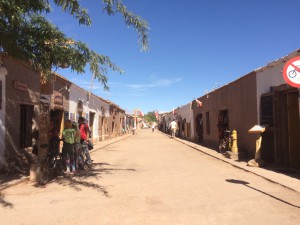
Beyond altitude sickness, there was the horseback riding in the city of Salta, Argentina. Dismounting from the horse, I twisted my ankle and injured it. Thinking Rolfing might help here as well, I worked on releasing the fascial tension in the surrounding area. This too had a remarkable effect, and the pain went away within a few days.
The Rolfing work helps not only in understanding my own body but in recovering from injury while traveling. I was struck once more by the power of this work. Various things may yet happen along the way, and I would like to continue the journey while looking back over the Rolfing work from time to time.
Note, August 2026
What happens here is that a single technique is lifted out of the ten-series and used outside it. At a hotel near the Uyuni salt flats, at an elevation of about 4,000 meters, the work corresponding to session 7 was applied to my own headache and to the tension in the fascia of my face. It worked, so it was applied to three fellow travelers lying down with altitude sickness. There were no six sessions before it and no three sessions after it; the recipients were strangers, and the occasion was singular.
In Ida Rolf’s teaching, session 7 does not occupy that kind of position. Sessions 1 through 6 accumulate in order to make session 7 possible, and what is done in session 7 is integrated through sessions 8 to 10. It sits at the center of the ten-series and was not designed to stand alone. This is what Sharon Wheeler explained in Seattle in January 2017 (see “Cranio Work – Sharon Wheeler (1): A Technique for Carrying Out Session 7 Efficiently”). In South America, just after finishing the training, the session at the center of the structure was being used cut loose from that structure.
That Seattle workshop was organized as a set of techniques for carrying out session 7 efficiently. Sharon described it as useful for people whose left–right balance is disturbed, and for people with shoulder tension and trouble at the AO joint. What is written in this 2014 entry is exactly those two. That the strength of the vestibular sense on the left was producing tension in the neck and shoulders. And that releasing from the crown of the head down to around the neck eased the headache. The indications for a workshop I would take three years later were already recorded here, from the side of the symptoms.
That this work took place mid-journey matters. The real motive behind the trip around the world was to see with my own eyes the places where medicine is practiced without pharmaceuticals. Seen from eleven years on, this entry marks the point where that motive first reversed. In the place I had gone to observe, I was the one doing the work. The first time the technique left the classroom was in the high country of South America, before Phase III began.