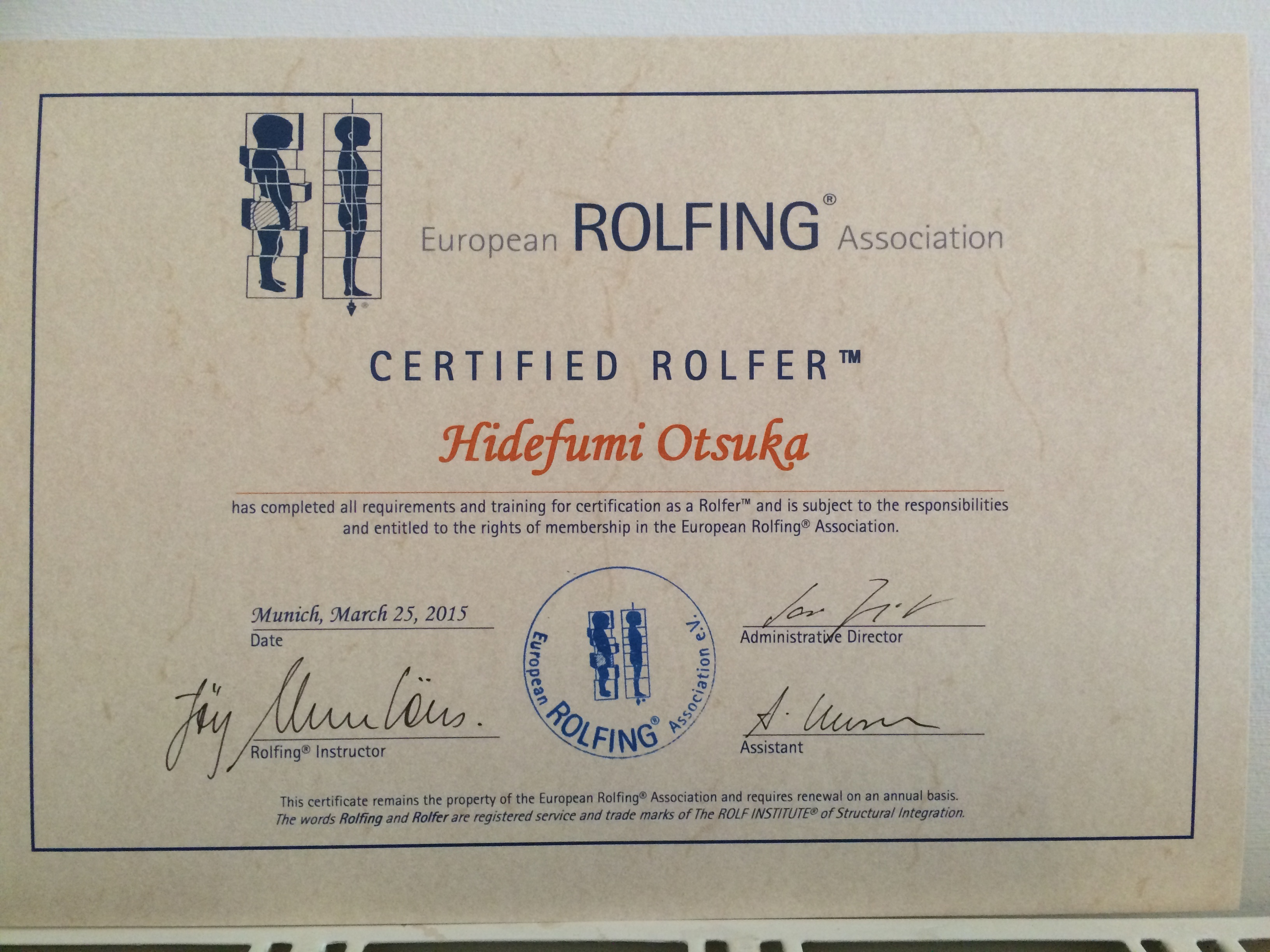
The Rolfing training is made up of three stages. I took each of them in Munich, Germany, on the following dates.
Phase I: 4 August to 22 August 2014
Phase II: 6 October to 26 November 2014
Phase III: 2 February to 25 March 2015
On the European training, please see On the Training in Munich (1) — Why I Chose to Study in Munich: The Application Process and the Costs and What Comes into View When You Study Alongside People Whose First Language Is Not English.
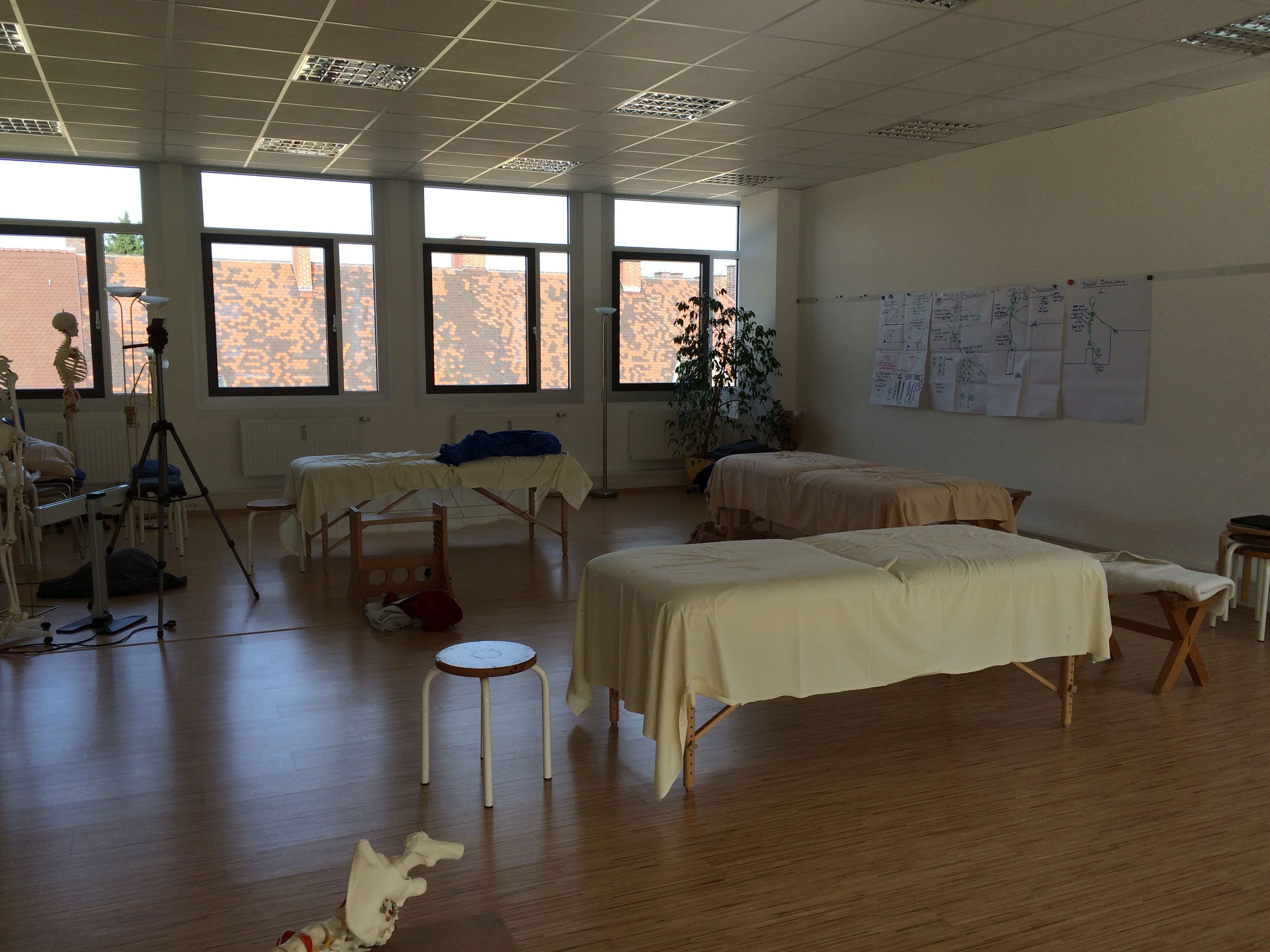
What is interesting is that in Europe there is an age requirement of twenty-five or over, and that people of varied cultural backgrounds take part. Perhaps for that reason, individual views are respected during class, and an interval is left in which to listen. I heard from someone Swiss that in America, time can be taken up by particular people speaking, leaving others unable to ask questions.
Having lived in America for seven years and gone through primary and middle school there, I learned the importance of asserting oneself, so I can understand that. But for Rolfing, where a deep understanding of people is required on top of learning something new, I feel that Europe is an excellent setting in which to train.

What is characteristic of the European training is that it does not simply end when the training ends: a fourth stage (Phase IV), the Supervision Workshop, is held over six days (13 to 18 December 2016).
Nothing of the kind is held in the training that takes place in Boulder, America. For my own part, even after building up a fair number of sessions, some anxiety remains as to whether I am technically all right. Being given an occasion to ask questions a year later strikes me as something to be grateful for.
Another feature of the European training is that two mentoring sessions must be taken between Phase II and Phase III (between 27 November 2014 and 2 February 2015), and three between Phase III and the Supervision Workshop (between 25 March 2015 and 12 December 2016). Mentor means a guide.
A mentoring session, as I wrote in Experiences in the UK (1), means going to the office of an Advanced Rolfer and learning about technique and approach.
Between Phase II and Phase III I was partway through a journey around the world, so I took my mentoring in London (see Experiences in the UK (1) and Experiences in the UK (2)).
Between Phase III and the Supervision Workshop, on the other hand, the sessions are taken while working as a Rolfer in Tokyo. From 29 August to 4 September 2016, I plan to take mentoring with Keith Graham in London and with Hubert Godard in Paris. And I plan to take one more during a stay in Munich from 11 to 19 December 2016 (currently being arranged). I would like to describe the mentoring sessions in this column.
At the Supervision Workshop I will be studying with the Italian Rolfer Pierpaola Volpones (Paola below).
According to a column (only in Japanese) by Takami Kamata, a Rolfer living in Frankfurt, on the European Rolfing Association, Paola is a well-balanced person even among Rolfers, who tend to be strikingly individual, and she sets out the techniques assembled by the field’s most gifted figures in a way that is easy to grasp, measured against the basic definition of Rolfing.
Paola has absorbed a great deal from the previous generation — Peter Schwind, Robert Schleip, Hubert Godard — and teaches her students how to carry it on to the next. Seen that way, this fits what I need at present, which is to go back over the fundamentals.
While I was writing this column, the dates for the 2018 Advanced Rolfing training were announced. Rolfers take the Advanced Rolfer training somewhere between three and seven years in (there is apparently some move toward making it compulsory in future). Three years on falls exactly in 2018.
That a title matters for working as a Rolfer abroad is something I felt during my years in a company. Having a doctorate, as a title, was far from a disadvantage when joining a foreign-affiliated company; it brought respect, and a considerable difference in salary as well.
On the reasoning that having it is better than not having it when going abroad, I plan to take the training on the following dates.
4 to 15 June 2018 (Vienna, Austria)
1 to 18 October 2018 (Bologna, Italy)
I would like to write about the advanced training, its content included, in this column.
Note, August 2026
This article describes it as characteristic of Europe that things do not end at certification. A Supervision Workshop comes a year later, with three mentoring sessions before it. And it says that since some anxiety remains about whether one is technically all right, even after building up a fair number of sessions, being given an occasion to ask questions a year later is something to be grateful for.
That course now sits in the continuing education listings. It is called Deepening the 10 Sessions, with former Supervision added in brackets. It has moved from being a compulsory fourth stage to a course taken by those who want it. The length has gone from six days to four.
It has not disappeared. What moved is the stage of practising under supervision. In the present Level 3, before certification, a full ten-series is given to an external client under the supervision of the instructors. The end of Level 2 also includes a first occasion to work with an external client. What stood after certification has come to stand before it.
That changes where the anxiety in this article belongs. It was the anxiety of someone who had been certified, had begun working alone, and still had it a year on. In the present design, the part corresponding to that year is passed through inside the course. Passing through it while someone is watching, or passing through it alone and asking afterwards. The order has been reversed.
The condition at the entrance moved as well. This article gives the age requirement as twenty-five or over. It is now eighteen or over.
This article names dates in 2018, three years on, and says the training will be taken then. It did not work out that way. What I took was a course in another year, completed in 2025. The rule itself has some latitude: for those who take the Rolf Movement certification, the three-to-seven-year period extends to nine. I took that course between 2017 and 2019, which brought me under the provision. Putting the course on movement first pushed the advanced course back by that much.
Watching only the frame, though, misses something. The people standing in the classroom have changed rather little.
Phase I in August 2014 had Movement taught by Rita Geirola, Anatomy by Konrad Obermeier, and Touch by Giovanni Felicioni. In Level 1 in 2026, Anatomy is taught by Konrad Obermeier. Twelve years, the same subject. Rita Geirola’s name is still on Movement. And Touch is taught by Andrea Clusen and Pierpaola Volpones — the first an assistant in Phase III, the second the teacher of Phase IV. Someone who was then an assistant, and someone who was then teaching a later stage, now stand at the entrance.
The division into stages moved, compulsory became optional, the age line moved. What did not move was who is in the room. If what a course without a textbook hands over is the people themselves, then it is that side which has stayed the same.