
Rethinking Embodiment and Skill Acquisition Through Artificial Intelligence — Part 2 of 3
Introduction
This series looks at Mind over Machine (1986) by Hubert Dreyfus and Stuart Dreyfus.
Part 1 set out the five stages of skill acquisition described in the book’s first chapter.
Novice, advanced beginner, competent, proficient, expert.
At the start you act on rules you were taught. With experience, differences you had not noticed become available. With further skill, you take in the whole situation and what to do becomes apparent.
Improving is not simply a matter of accumulating knowledge and technique. It is also a change in the way the situation in front of you appears.
Here I want to lay that idea over my own experience of learning Rolfing.
From beginning the basic training in 2014 to completing the advanced training in 2025 took eleven years.
In that time I learned from a good many teachers, received the same comment more than once, and met theory that took me years to understand. Looking back now, much of that process overlaps with the Dreyfus brothers’ five stages.
- Becoming a Certified Rolfer in Europe — The Certification Training of the European Rolfing Association
- On the Path to Becoming a European Rolf Movement Practitioner — The Road to Certification
- Journey to Becoming an Advanced Rolfer — A Summary of the Road to Certification
From the Side of the One Learning
At First, You Are Taught What Is Correct
In August 2014 I began the basic Rolfing training in Munich.
Phase I ran three weeks, in three subjects: Movement, Anatomy and Touch. No hands-on technique is taught at this stage.
Each week the teacher responsible writes an assessment sheet, scoring each item on a five-point scale.
Can you locate a bony landmark accurately? Is your palpation reliable? Can you give your two hands different roles? Can you work with fascia as a three-dimensional web? All of these are basic capacities a practitioner needs. But at this stage they are still separate from who the client in front of you is, and from what that person needs.
They are close to what the Dreyfus brothers call context-free elements at the novice stage.
A novice cannot yet take in the whole situation. So you are first given concrete tasks, and told what is working and what is not. I met the difficulty of that myself, in the written anatomy examination. On the first half I scored 25 out of 51.
In my application I had been admitted on the strength of holding a doctorate, with a background in anatomy and physiology. But the anatomy I knew as a researcher and the anatomy needed in order to touch a body were not the same thing. Knowing the names of muscles and bones does not mean you can find them reliably on the body in front of you.
Knowing that and knowing how are different. The training made that plain to me almost immediately.
Experiencing It, or Performing It?
At the end of the three weeks of Phase I, I had assessments from three teachers. What interests me is that all three, in different words, pointed at nearly the same thing.
Rita Geirola wrote that it was sometimes hard to tell whether I was actually experiencing what we were exploring or performing it as a task.
Giovanni Felicioni pointed to the importance of trusting my own experience and staying with myself.
At the time, I think my attention was on carrying out the given task correctly. Understand what the teacher explains; do it as described; be careful not to get it wrong. But that leaves you unable to feel fully what is happening in your own body.
Suppose you are told to let the shoulders soften.
You can follow the instruction and lower your shoulders. But the experience of the shoulders releasing and the correct performance of lowering them are not the same. I think of the manual car in the Dreyfus brothers’ example.
Someone who was changing gear smoothly starts thinking about the correct sequence, and the movement turns clumsy. My attention, too, may have gone so far toward doing it correctly that I left my own experience behind.
The same comment came back six months later, in the mid-term meeting of Phase III. The issue was not only that technique was lacking. It was how the practitioner was relating to his own body. What I had been told in the first three weeks was still there as a task half a year on.
Too Much Becomes Visible to Choose From
In Phase II you learn the ten-session series. Where to observe on the body. How to touch. What to take as a sign of change. There was suddenly a great deal to learn.
Reading my notes from the time, I wrote that even when I observed a body, there was too much information and I did not know what to look at. At first you see nothing. Then, with a little experience, there is suddenly too much.
This is very like the Dreyfus brothers’ competent stage. The novice acts by rule. But with experience there is more to weigh, and rules alone can no longer settle it.
Observing a body, for instance, you take in the tilt of the pelvis, the direction of the feet, the movement of the spine, the breathing, the difference between left and right. Which of these should come first? You cannot work with all of them at once.
In Phase III I began working with actual clients. What I was taught there was a way of ordering the knowledge I had, and of setting priorities.
Alongside it came a phrase I heard again and again. Less is more. Consider not only what to do but what not to do. Rather than trying to change everything in a body, choose what matters for this person now.
What is required here is not simply the ability to perform a technique correctly. It is to observe the person in front of you, to judge for yourself, and to be answerable for that judgment.
The Rolf Movement training taught me the same thing. That no procedure is laid down does not mean anything goes. It means your own judgment is in question. The greater the freedom, the more often I lost sight of where a session was going and when it would end.
But that uneasiness was part of what I was learning, I think — learning to judge for myself.
I Let Go of Trying to Do It Perfectly
There was a turning point in Phase III.
It came in the second week. A cold I had picked up in South America had not cleared for about six weeks, and I was in the training without being fully well. Just as I began to recover, partly because I could not push myself, I let go of trying to do everything perfectly. Until then I had spent a long time on body reading, carefully working out what to do.
From that point on, I kept the observation short and went ahead trusting the sense in my hands. And, oddly, the sessions began to move more naturally than before.
It was not that I stopped observing. What decreased was the time spent turning things over in order to work out what was needed. In the brothers’ terms, I may have had a small taste of the difference between analyzing a situation and then acting, and acting while sensing it.
That the trigger was ill health is, in retrospect, funny. In the same Phase III, a paper was circulated on the Saturation Method, in which Jeff Maitland gave theoretical form to Ida Rolf’s teaching.
It argued that without a concept you cannot see what is in front of you, and that no amount of adding up the parts yields the whole.
The expertise the Dreyfus brothers describe overlaps with this. The expert is not analyzing each part of a body and assembling the results into an understanding of the whole. Through experience, the whole situation comes to be meaningful as it stands.
Something learned in one place had led to the same problem as something learned in another.
The Teachers Did Not Lay Out a Procedure
Looking back over eleven years of training, something else becomes clear. As the stages of learning advanced, the teachers set out fewer answers and fewer procedures.
To begin with, the Rolfing training had no set textbook. A teacher explains and demonstrates. A student tries it. The teacher comments on the spot.
What you learn is not only knowledge and technique. It is how to see and how to sense the body in front of you.
At the supervision workshop, Pierpaola Volpones explained the difference between Teach and Educate. To teach is to pass on a procedure step by step and have it memorized. To educate is to draw out what a student already has, so that the student can think for herself.
She pointed out that the root of educate carries the sense of drawing out.
The distinction became clearer still in the Rolf Movement training.
How to design a three-session series, for instance, was not laid down as a procedure. In the first half of Part 3 we were given six questions for building a class. In the second half, nine points and five considerations. But no answer was supplied as to how one ought to teach.
In the advanced training in 2025, what was offered was Jeff Maitland’s three questions.
- Where do you start?
- What do you do next?
- When are you done?
They look simple. But once you are actually in a session, you find how hard these three are to answer. Every client in front of you is different. Applying the same procedure does not produce the same result.
Which is exactly why what is asked of you is not to memorize a settled answer but to observe and judge for yourself.
The same direction can be seen in the history of Rolfing education.
After the organization divided in 1989, the difference grew clearer between an approach that held to the traditional procedure and an approach described as non-formulaic, which does not hold to a fixed sequence. In the basic training you learn the ten-session series as a shared framework.
In the advanced training, by contrast, you respect what is particular to that person’s body and build the session as it is needed. Improving, in other words, did not mean memorizing a more complicated procedure.
It meant learning a procedure and then becoming able to meet the situations a procedure cannot cover.
It Was the Fourth Teacher Before I Understood
There is one more experience I have not forgotten.
It took me about four years to understand Hubert Godard’s theory. Godard is a researcher who approached movement and posture not only through muscle and skeleton but through perception and the body’s relation to space.
I first met the theory in 2014. Giovanni explained it, and I understood almost none of it. In 2016 I had a mentoring session with Godard himself in Paris. In 2017 I learned it from Gael Rosewood through concrete examples.
Then in 2018, when Aline Newton explained Godard’s theory organized into five factors, it finally began to connect for me.
I had learned the same theory from four teachers. Why did the first three not land? Thinking about it now, I do not believe the explanations were lacking. What was lacking was experience of my own for the explanation to connect with.
Explain the fine differences of heat to someone who has never cooked, and the words are hard to understand. But cook many times, burn things, get things right, and the same explanation can suddenly begin to mean something.
The content of the explanation had not changed. The experience of the person hearing it had. This overlaps with what the Dreyfus brothers describe at the advanced beginner stage.
Through experience, differences that are hard to define in words become available. And then explanations you could not understand before begin to carry concrete meaning.
At the meeting on the day I was certified in Rolf Movement, all three teachers said that what one learns in this course takes time to digest.
All three had learned directly from Godard. At the time I was taking a thirty-day course across two years and five months. During Part 1, Giovanni had recommended Guy Claxton’s Hare Brain, Tortoise Mind, which I remember as well.
The book contrasts a mind that judges quickly with a mind that takes its time and waits for understanding to take shape. To understand something, trying to produce an answer at once is not enough. Experience accumulates, and understanding forms over time.
The four years it took to understand Godard’s theory were exactly that.
Seeing Is Learned
In Part 3 of the Rolf Movement training, Rita said something that stayed with me.
Human beings learn to see, through education and experience. We are equipped with a sense of balance from the inner ear, and with a sense of the body’s position and movement from muscles and joints.
But how we use those senses, and what we attend to, changes with experience. The first time I observed someone walking, for example, I did not know what to look at. The movement of the feet, the tilt of the pelvis, the swing of the arms, the breathing. There is no end to what you could look at.
With experience, though, I came to notice different things in the way a person walks. Before examining each part of the body in detail, the character of the movement as a whole would arrive.
This is the change the Dreyfus brothers describe across the five stages.
As you improve, what matters becomes apparent on its own. Which, I think, is why so much time in the Rolfing training went to observation. In Phase III I had twenty occasions to work with my own hands, and forty to observe the sessions of other students and teachers.
According to Volpones, the Munich training of the 1980s spent nine weeks on observation alone, with no hands-on work during that period. Learning technique was not the sole purpose of the training.
How to see a body. Cultivating that seeing was itself the learning.
The Problem That Remains for the One Teaching
So far I have looked back on my own learning. What, then, is asked of someone standing on the teaching side?
Mind over Machine describes an interesting experiment with cardiopulmonary resuscitation. Six people performing CPR are recorded on video. Five are students; one is an experienced paramedic.
The recordings are shown to students, to paramedics and to CPR instructors. Each is asked whom they would want resuscitating them if their own life depended on it.
The paramedics chose the experienced performer nine times out of ten. The students, five times out of ten. The CPR instructors chose him only three times out of ten.
Why should the result come out that way?
On the brothers’ reading, the instructors were looking for whoever was most faithful to the rules they themselves teach. The experienced paramedic, meanwhile, was moving as the situation required. His movement did not necessarily look like the procedure in the manual.
The experiment puts a serious question to teaching.
For a beginner, being taught the correct procedure is necessary. But being able to explain a procedure correctly and being able to do it well are not the same. And being good at teaching a procedure does not guarantee that you can judge the performance of someone who has gone beyond it.
The brothers hold that teaching facts and procedures is useful from the novice through to the competent stage. To go beyond that, however, the teacher needs experience of her own that rules cannot capture.
Perhaps that is also what my teachers in the Rolfing training were asking me, again and again. Not only what you know. What are you seeing now? What are you sensing? And why are you doing what you are doing?
What was valued was not being given the answer, but becoming able to sense and to judge for oneself.
From the Side of the One Receiving
So far I have written about my own process of learning Rolfing.
Does something similar happen for the person receiving it?
The Rolfing ten-session series is generally worked through in three phases: the sleeve sessions (1–3), the core sessions (4–7) and the integration sessions (8–10).
While working with the structure of the body, we revisit breathing, movement and the body’s relation to gravity. One thing should be said plainly here: what follows is not what the Dreyfus brothers describe in the book.
It is my own clinical experience, considered in the light of the five-stage model.
Trying to Hold a Correct Posture
Most people coming to Rolfing for the first time hold some rule about posture. Straighten the back. Lower the shoulders. Engage the abdomen. All of them are widely known ways of arranging posture.
In practice, though, they often last only as long as the attention does.
You lift the chest in order to straighten the back. For a while the posture holds. Then your attention goes elsewhere, and it returns to what it was.
Why should that be?
Perhaps because the posture is being held by the deliberate, continuous use of a rule. The form resembles the Dreyfus brothers’ novice stage. Follow the rule you were taught and you can produce a certain shape. But the rule is not necessarily connected to the sense of your own body.
The aim of Rolfing is not to replace that rule with another, more correct rule. What matters, as I see it, is becoming able to sense for yourself what is happening in your body.
Noticing a Difference You Could Not Notice Before
The first three sessions of the series work with breathing, the feet and the sides of the body.
Standing before and after a session, some people notice that the ground feels different under the right foot and the left. Others feel that breathing has become easier than it was.
Until then, the thought that the two feet might feel different may never have come up. But once that difference is felt, the way you regard your own body begins to shift. What is happening here is not learning a correct posture.
It is becoming able to sense a difference you had not been aware of.
It resembles what the brothers describe at the advanced beginner stage. Through experience, features that cannot be clearly defined in words become available. Something similar, I suspect, happens with bodily sensation.
More Becomes Available to Sense
The four core sessions work with the pelvis, the legs and the trunk — the deeper parts of the body. Connections that had gone unnoticed can then become available.
Change how the foot meets the ground, and the movement of the pelvis changes. Change the movement of the pelvis, and the feel of the breathing changes. What began as a local sensation — a stiff shoulder, a sore low back — can come to be felt as a connection through the whole body.
At the same time, the more there is to sense, the less obvious it becomes what to do. “In a situation like this, how should I move?” I am asked that too.
This resembles the problem described at the brothers’ competent stage. Precisely because more has become visible, a judgment about what to treat as important becomes necessary.
None of which means that a person receiving Rolfing passes through five stages in order. What is being compared here is not better or worse skill, but a change in what one notices about one’s own body, and in how one relates to it.
Moving Without Having to Attend to It
The last three sessions are the integration phase. What has been sensed so far is settled into ordinary movement — walking, standing, sitting.
During a session the shoulders may soften, and then tighten again once a person is back at work. Noticing that is the first thing. But the goal is not to go on attending to “let the shoulders soften” indefinitely.
What matters is that the extra effort becomes unnecessary even while moving without thinking about it.
The direction is like that of the expert driver who no longer attends to the wheel and the gears. Rather than going on working out how to move the body, one moves as the situation calls for.
And then the ten-session series ends. Why should it have an end? Because, I think, the series has the role of training wheels. Training wheels help a child ride a bicycle. But remaining on them is not the point.
Nor is the point of Rolfing that a practitioner should go on arranging your body indefinitely. It is that you come to sense your own body and move by yourself. A practitioner is involved for a bounded period, for the sake of that.
Not everyone, of course, experiences the same change over ten sessions. The state of a body, and the experience behind it, differ from person to person. Where a body has become hard there is a reason, and that hardness has also been supporting the person until now.
So rather than forcing a body toward a correct shape, what matters, as I see it, is to be involved in a way that lets the person build a new relationship with their own body.
This Is Not an Argument Against Analysis
Read this far, you might think that thinking and analyzing get in the way of improving. The Dreyfus brothers do not hold that. In the book’s concluding chapter, Blaise Pascal’s Pensées is quoted.
What it sets out is two extremes.
Shutting reason out entirely. And admitting nothing besides reason. Both are dangerous. What the brothers criticize is not thinking itself. It is the assumption that human intelligence can be explained by analysis and rules alone.
Experts Think Too
In ordinary action, an expert does not need to recall rules one by one. That does not mean she acts without thinking at all. A strong chess player, for instance, may find a promising move coming to mind the moment she looks at the board.
But she does not necessarily play it as it stands.
Is it really the right move? Is there another possibility? How will the opponent answer? The move that arrived intuitively can be examined further. The brothers call this kind of thinking deliberative rationality.
The difference from a novice’s analysis lies in where it starts. The novice breaks the situation into elements and looks for an answer by rule. The expert first takes in the whole, and then reconsiders whether the view that arrived is appropriate.
Analysis, in other words, is not discarded. What intuition has grasped is examined, as needed.
What It Means to Change How You See
The book uses the example of a line drawing of a cube. Look at a cube drawn on paper and one of its faces usually appears to be in front.
Keep looking, though, and front and back can swap.
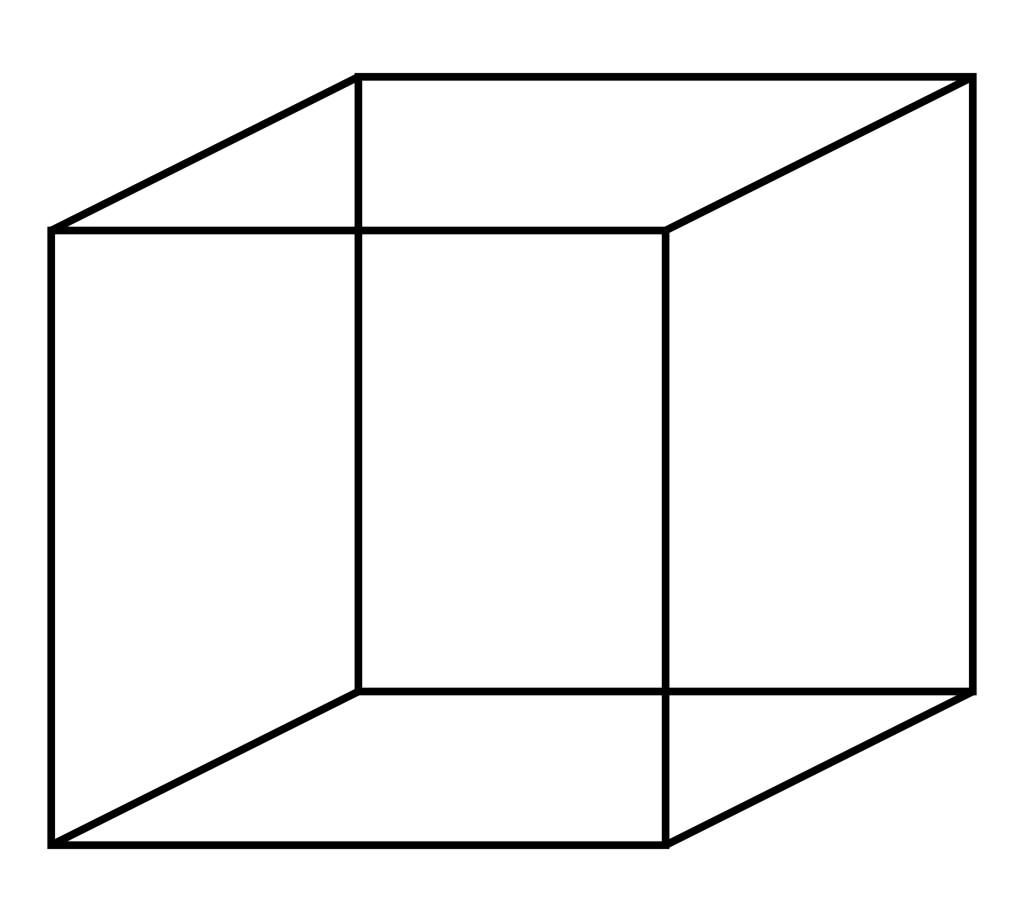
It is the same drawing, and yet it looks different. Why? We are not recalculating the lengths and angles of the lines. The way we see the cube as a whole has switched.
The brothers use this example to explain the expert’s deliberation. Looking at a situation, we naturally arrive at one interpretation. But held captive by that interpretation, we can stop seeing other possibilities. So we deliberately turn attention to what we had taken to be unimportant. And sometimes a different view arises.
Suppose, observing a body in a Rolfing session, the tilt of the pelvis catches my attention.
At first I will think from the pelvis. But if I deliberately turn my attention to the feet or to the breathing, the tilt of the pelvis can come to mean something other than it did. What looked like a problem of the pelvis alone becomes intelligible within the movement of the whole body.
This is not abandoning analysis.
It is checking the first view from another angle. And if the view does not change, that is fine too. Having checked another possibility can strengthen confidence in the first judgment. What matters is not clinging to a single way of seeing.
Let Calculation Serve Intuition
The chapter on chess contains a striking formulation: let calculation serve intuition. That a move arrives intuitively does not make it right. So you calculate when you need to. But if you try to settle everything by calculation first, the expert’s grasp of the whole situation goes unused.
Calculation is not a replacement for intuition. It is used to check and to supplement it.
And when you meet a situation your own experience cannot cover, the brothers write, you may return to deliberate analysis.
I think that is an important point.
Being expert does not mean every situation can be met by intuition alone. Faced with a problem you have not met before, you need to stop, gather information and judge carefully. If anything, telling apart the situations where your intuition holds from those where it does not is itself part of expertise.
Learning Also Requires Looking Back
The Dreyfus brothers also write something interesting about learning. To acquire a skill you have to be deeply involved in the situation.
But that alone is not enough.
What did I do? What followed from it? What should I do next time? The work of reviewing experience and carrying it into the next action is needed as well.
Suppose a Rolfing session goes well. You can simply be satisfied and finish there. But reviewing what was good about it, and which judgments helped, produces learning for the next session.
The same holds when it does not go well. Why did I touch there? Why did I end at that moment? Was there another option? Holding such questions is what carries one experience into the next.
That said, it is not necessary to monitor yourself continuously while acting. The book also touches on the state in which that monitoring stops for a time.
This is what is usually called flow — deep absorption in which thinking and acting are continuous with each other. The brothers do not treat it as a sixth stage.
They treat it as a state in which the reviewing that ordinarily remains, even in an expert, has temporarily stopped. In other words, improving requires both deep involvement in the situation and the capacity to step back a little and review.
Conclusion: Learning a Procedure, and Leaving It
I have looked back on eleven years of Rolfing training in the light of the Dreyfus brothers’ five stages.
At the start I learned the basics of anatomy and palpation, and followed what my teachers told me. With experience, differences between bodies gradually became available. At the same time, so much became visible that I could not tell what to put first.
With further experience, the character of a body as a whole began to arrive without my having to analyze everything. And what my teachers asked me again and again was not only what I knew. What are you seeing now? What are you feeling? And why are you doing it that way?
Learning a procedure is necessary. But memorizing a procedure is not where learning ends.
If anything, beyond the procedure you have learned, what a procedure cannot capture comes into view. The same can be said for the person receiving Rolfing. From deliberately holding a correct posture, toward sensing the differences in your own body and moving freely.
Supporting that change is, I believe, one of the important roles of Rolfing.
And a question remains for the one teaching. What to teach. How far to teach. When to stop teaching. No rule is laid down in advance for deciding that. Which is exactly why a teacher, too, is asked to sense the situation and judge.
Next: Why Did a Philosopher Criticize Artificial Intelligence?
So far I have written about the Dreyfus brothers’ five stages, and about laying them over my experience of learning Rolfing.
But this is, after all, a book about artificial intelligence.
Why did discussing artificial intelligence have to begin with human skill acquisition?
Behind that lies Hubert Dreyfus’s encounter with artificial intelligence research in the 1960s, and the doubts he came to have about its assumptions.
In the next part I will look back at how this book came about, and consider artificial intelligence, phenomenology, and the question of perception — which matters for thinking about embodiment.
Articles in This Series
This is Part 2 of Rethinking Embodiment and Skill Acquisition Through Artificial Intelligence — Reading Dreyfus’s Mind over Machine, a three-part series.
※入稿時に、第3回の英語版URLをリンクとして入れます。
- Part 1: Why You Get Worse the Moment You Think About It — Dreyfus’s Five Stages of Skill Acquisition
- Part 2: I Was Never Taught a Procedure — Eleven Years of Training, Read Through the Body (this article)
- Part 3: Perception, Not Analysis — Why a Philosopher Was Hired to Evaluate Artificial Intelligence