
Why Life Changes When You Receive a Bodywork Session (Part 2 of 4)
Introduction
The same room feels wide on one day and narrow on another. The walls have not moved. So what has?
The same thing happens with people. In front of one person the body gets smaller. In front of another the breath goes deeper and the whole room seems to open out. The distance between you has not changed, and yet the width you feel is different.
You could put this down to how you happened to be feeling that day.
What is interesting is that on Jeffrey Maitland’s account the order runs the other way. It is not that a mood comes first and alters how space feels. The emotion itself has the shape of a space.
The whole layout is set out on the overview page. Part 1 was about there being something settled before thinking — what is called the prereflective.
- Why Life Changes When You Receive a Bodywork Session
- Why Good Posture Never Lasts — What “Prereflective” Means
This second part takes up core and surface.
Is it the other person’s fault that you are angry?
Again I will start from an example Maitland uses in the book.
Walking barefoot, you step on a nail that was lying on the floor. It hurts. And you are angry at the friend who left it in your path.
Pain and anger are two different kinds of thing here. The pain was caused by the nail. There is no option of stepping on a nail and not hurting. The anger, though, is an emotion that arose out of what happened. Not being angry is an available option.
Which is why the phrasing changes too. You do not say “you are the reason it hurts.” You do say “you are the reason I am angry.” The friend is not the cause of the anger but the reason for it.
Every emotion has this aboutness — a directedness toward something. In phenomenology that directedness is called intentionality. Intentionality itself is taken up in the article below.
Here Part 1 connects. When you are furious, what is overwhelmed is the side that thinks. On the near side of that, you are given over to the anger and its direction. Emotion is not experienced after thinking. So being unable to analyze your own anger calmly while it is going on is not because emotion is irrational. It is because the emotion and the analysis of it are happening in different places.
Emotions are four directions
Back to that directedness.
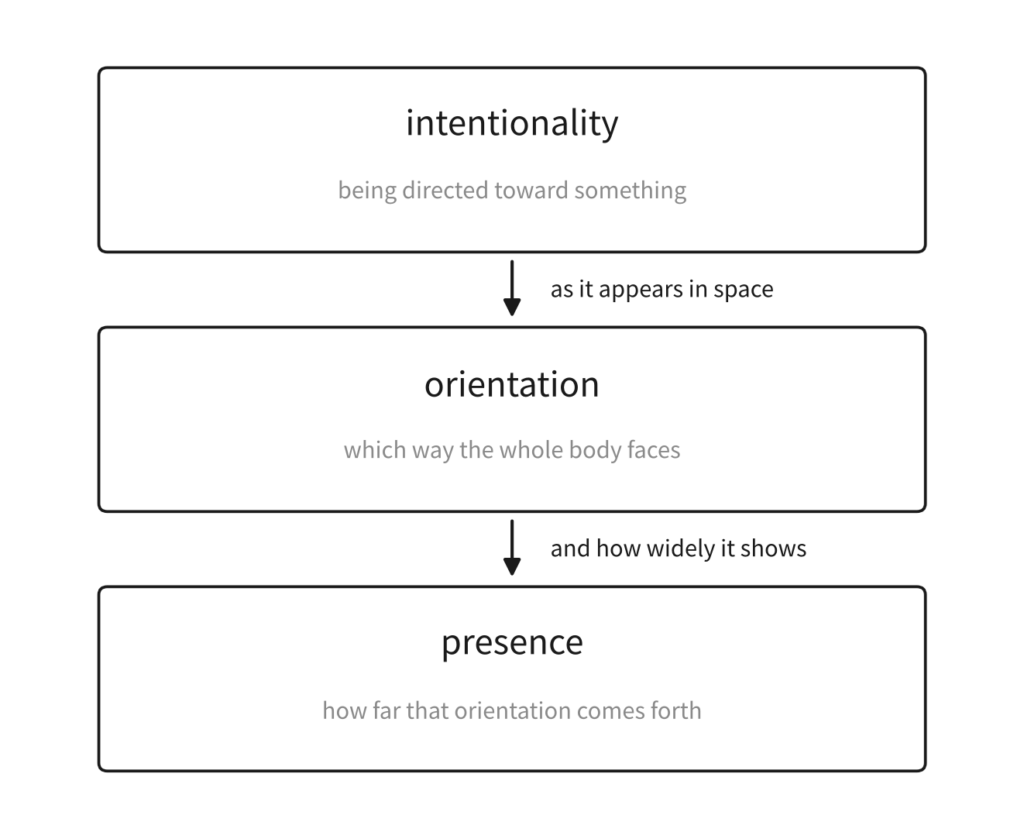
Maitland does not see the body as a thing located in space. He sees it in terms of which way the whole body is turned in relation to space. Not the direction the face is pointing. How you stand, how deeply you breathe, how open the chest is — together they make one direction. This is orientation.
And it is the same thing as intentionality. Orientation is the form intentionality takes once it appears in space. The directedness in an emotion being about something is not in the head; it shows itself as which way the body is turned.
A desk is in a room. Measured, it occupies so many centimetres. But a desk has no orientation toward the room. A person does. And that orientation is on the prereflective side. It was not put together by thinking.
What a person lives in is not measurable space but oriented space. Maitland calls this lived-space. It belongs on the near side we saw in Part 1 — neither subjective nor objective.
Orientation has a range. There are people who occupy so much lived-space that they draw everyone toward them. There are people whose lived-space has shrunk so far that they go almost unnoticed. We say of someone that they are not all there.
The way orientation toward space shows itself is called presence.
In English the phrase is not “to be present” but “to come to presence.” The form survives from translating Heidegger’s German: the original, Anwesen, is the word for being with a sense of toward-here attached. The direction is inside the word. Heidegger is a twentieth-century philosopher whom Maitland refers to again and again.
And the four emotions are differences in that orientation.
Fear is not wanting to come to presence. Not wanting to be oriented there. So the direction turns away from the world.
Sadness is the loss of presence. What one was oriented toward is gone. Not a turning away: the orientation itself thins out, contracts, grows small.
Anger is defending some aspect of presence. The orientation stays turned toward the world, but in a guarded form. It goes toward the world braced to push back — against an actual attack or an imagined one.
Joy is presence overflowing. The orientation spreads outward and embraces the world with an abundance that spills over.
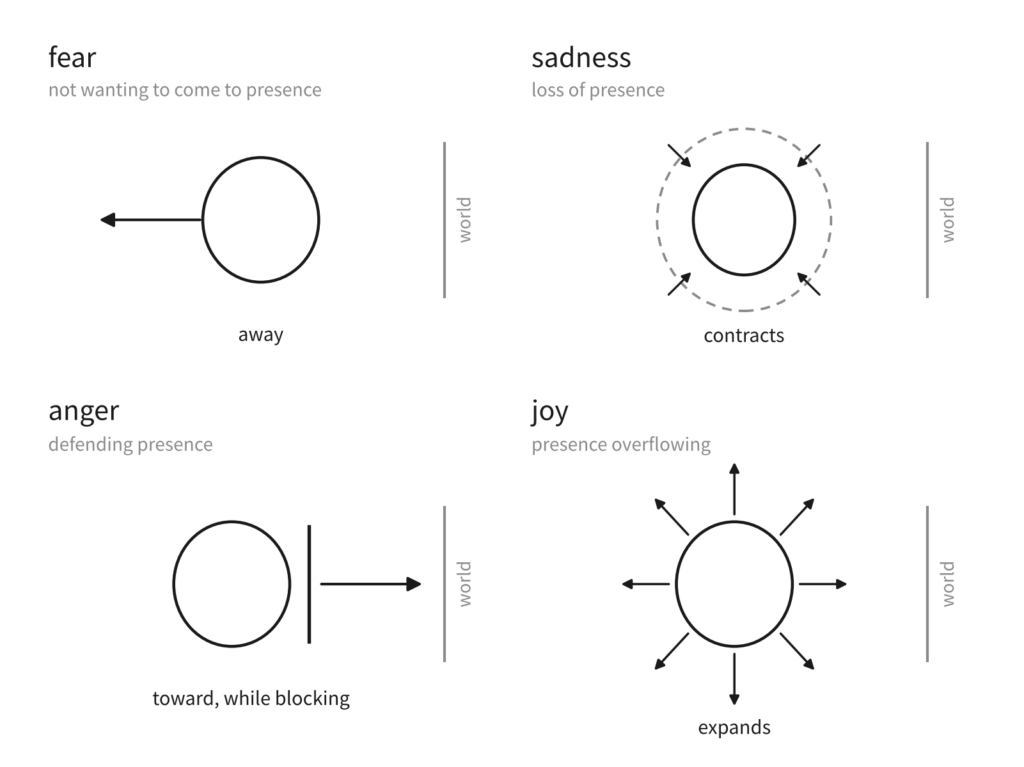
Set side by side, a shape appears. Fear moves away. Sadness contracts. Anger goes toward while guarding. Joy expands. The difference is which way the orientation works, and how wide.
One pair that is easily run together should be separated first: fear and anxiety.
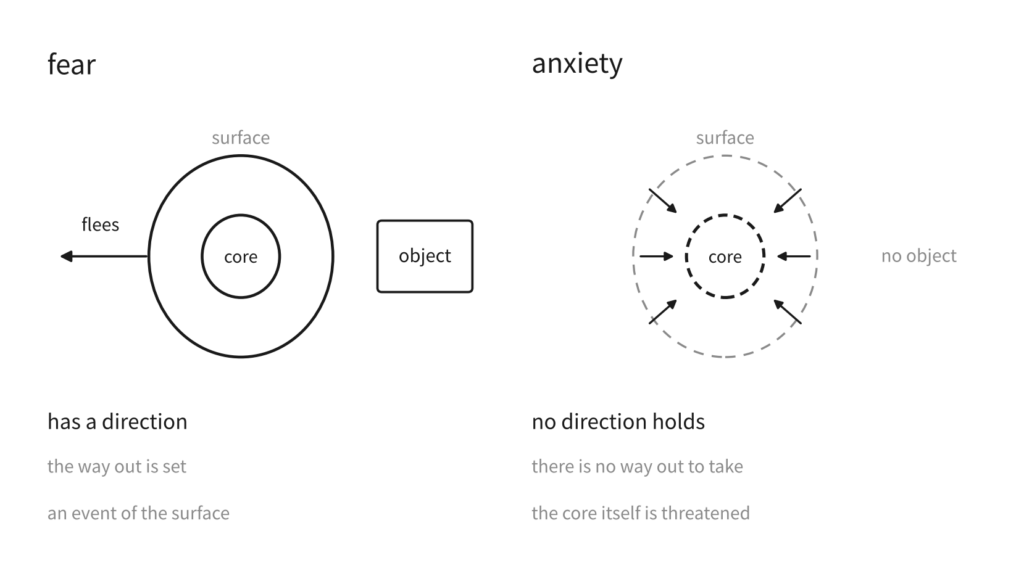
Fear always has an object. Something is frightening. So the direction of escape is settled too. Anxiety has none. You cannot say what it is you are afraid of. With no direction, there is no direction to escape in. Anxiety therefore does not stand in the same row as the four emotions. It is not one of the directions; it is the state in which direction itself fails to hold. What that means is taken up again after core and surface.
The words say it too. Emotion divides into e and motion — a moving outward. Expression is a pressing out. We speak of letting a feeling out, but the words say that the going out comes first.
Back to the room. It feels narrow because your orientation has contracted, and wide because it has spread. What changed is not the impression but how much space is being occupied.
There is a version of this on the Rolfing side as well. That space is felt differently by different people, and that the size of personal space shifts with the state of the body, I have written about before.
What shape does a frightened body have?
Maitland describes the shape of the body in fear. Soft, and collapsed.
The reason follows from the definition. Not wanting to come to presence means it suits you for your own outline not to be clear. A body whose boundaries are vague, where it is not settled how far you extend. It is close to fainting. A form that has a form and wants to stop having one.
Here a sentence appears that runs through the whole book. To be is to be a form. And every form has its own boundary and its own limitation. Take the boundary away and the form is gone.
This comes back in Part 4, on limitation and possibility.
To orient, you need a place to orient from
This is where Maitland adds something of his own.
He describes a scene. A friend asks where that book is, and you turn and say, over there.
Now suppose the question comes from someone who is always losing your things and making you look for them. The same “over there” becomes an entirely different thing. The hand that points may never quite commit. The pitch of the voice may shift as you try to hide the irritation.
When you point and say over there, the fingertip is turned toward the book. But it is not only the finger that moves. To turn, a foot presses the floor, the trunk rotates, the breath keeps running without catching. All of that has to be there before the finger can point at the book.
In both cases there is something oriented toward — the place where the book is. And in both cases there is a body orienting from somewhere. That second half, Maitland writes, has gone unsaid.
Phenomenology up to now has looked only at the fingertip. It has made what one is directed toward the whole question, and has not looked at the body that is directed from. Intentionality has been shrunk to the part that shows.
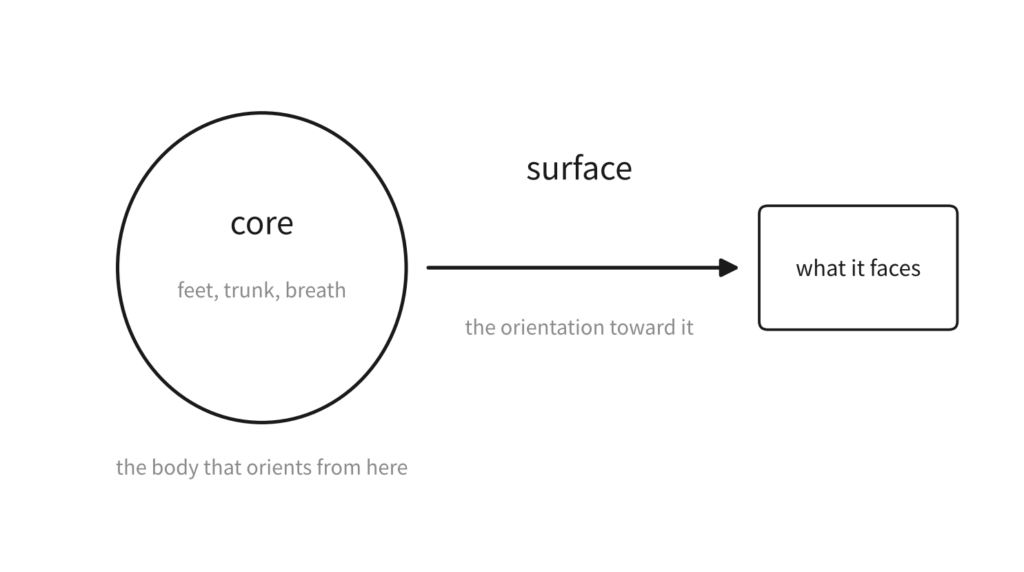
What is oriented toward is the surface. The body orienting from is the core.
Core and surface can be said at four levels
Maitland does not fix these two words to a single meaning. In the glossary at the back of the book he sets out four levels of definition, from the shallower toward the deeper.
The first is the objective level. The spine is the core; the shoulder and pelvic girdles are the surface. He also puts it as the inner space bounded by the pelvis, the abdominal myofascia, the rib cage and the jaw, with the structures surrounding that space as the surface. It was at this level that Ida Rolf called the surface the sleeve. What Rolfers mean by the intrinsic and extrinsic musculature belongs here.
The second is the subjective level. The core is felt as a lightness and lift that runs from the top of the head, down in front of the spine, through the centre of the legs, and out onto the soles just forward of the heels. The surface is the outer body, surrounding that core without being separate from it. When things are integrated, he writes, the outer body seems to float freely around the core.
The third is the psychological level. The core is our innermost sense of identity and self. The surface is our presentation to the world and our dealings with it. And here, he writes, the psychological core can be called the true self, and the psychological surface the ego-self.
The fourth is the phenomenological level, which he places deeper than the objective, the subjective and the psychological. The core is allowing; the surface is the will. The core is the place from which we orient; the surface is the orientation. Rolf’s saying that the core is our being and the sleeve our doing belongs at this level. He also notes the irony that we call ourselves human beings while mostly behaving as human doings.
So the intrinsic-and-extrinsic account is not wrong. It is the first of the four, the one he places shallowest. What this article has been working with so far is the fourth.
And the third level connects directly to the title of this series. Core and surface are not two locations inside the body. They are two aspects of one whole — body and self.
If there is a sense that no amount of doing fills the gap, the account would be that the place one does it from has grown thin.
Here is how one person described her state before the ten sessions.
Being swayed by other people, so that my own axis wavered. Noticing that my own axis was wavering, and still letting myself be swayed.
Swayed is exactly the word. There is something she is oriented toward — the other people. What is not settled is the place she is oriented from. Noticing and still not being able to come back means that what she would come back to is thin.
After the ten sessions the answer reads like this.
Along with what is going on inside me, I can feel for myself where my body is blocked or slow.
Along with, she writes. Neither the inside nor the body comes first. They are two sides of one thing. At the psychological level, what this amounts to is the true self and the ego-self coming apart in experience. That this coming apart is itself the transformation is taken up on the overview page.
Anxiety is a different thing from fear
Earlier I said that anxiety is not one of the directions. With core and surface in hand, what that means becomes clear.
Fear is one of the directions, so it is an event of the surface. Anxiety is not. It is direction failing to hold, so what is threatened is the body one orients from. It strikes the core.
Maitland gives the example of one client here. She had a soft, collapsed body. It was a form for not admitting fear, and at the same time a defence against anxiety. The surface is soft while the core is hard.
The opposite shape exists too: a hard, unyielding body. That is another way of defending against the same thing.
Surface and core do not necessarily face the same way. Looking soft and having an open core are two different matters.
The other person has not changed, and the relationship has
Someone who finished the ten sessions wrote this.
A senior colleague at the company whom I had utterly hated, who was always only complaining and making snide remarks to me, came to praise me a great deal. Did the senior colleague change? No — I think it was I who changed.
There is another line in the same record. About how he responds to people: he came to put a pause in before acting, and stopped getting irritated. Room had opened up on the near side of the reaction.
The other person has not changed. What changed is his orientation in front of that person. If a body that used to contract stops contracting, the space between the two of them is different. When the space is different, the quality of the exchange is different. And then the other person comes at it differently too.
This is why touching a body reaches as far as a person’s relationships. Nobody’s character changed, and nobody revised their opinions. How much space is being occupied changed.
And what Rolfing works on is not only structure. The system that assembles the body in gravity is at the same time the system that makes meaning. If how you take another person changes, your orientation in front of them changes. If the orientation changes, how the body occupies space changes. The order runs in either direction.
The limits of this view
Four things are worth saying.
The first is that emotions do not actually come in four. They mix, and some have no name. The four definitions are not a classification table but a way of cutting into what you are looking at. The moment you try to fit something into one of the four, something gets missed.
The second is the use of reading emotion off the shape of a body. Apply it as soft body means fear, hard body means anger, and the practitioner has decided something the person has not said. The examples Maitland gives were not arrived at by looking; they are written as things that came out in the course of working with that person. This is not a tool for assessment.
The third is that the distinction between cause and reason does not deny the physiology of emotion. Investigating what happens in the body during anger is worth doing. However closely you investigate it, though, what the anger is about will not come out. Neither one is right; they answer different questions.
The fourth is that the four levels are presented in order of depth. That the phenomenological is deepest is Maitland’s placement, not something demonstrated by measurement. The two terms at the psychological level are also brought in from several traditions and set side by side. Here they are being treated as names for distinguishing experience.
Summary
An emotion is about something, so it always has a direction. And the direction is not in the head; it appears as how the body occupies space. Fear moves away, sadness contracts, anger comes forward, joy expands.
To orient, there has to be a body orienting from somewhere. What is oriented toward is the surface; the body orienting from is the core. Core as being and surface as doing is another way to put it. And at the psychological level, the core is the true self and the surface the ego-self.
The same room feeling narrow one day and wide another is not imagination. When the core has thinned, the orientation of the surface contracts with it. That is when the room gets smaller. Relationships change in the same place.
Part 3 is about what happens when you try to do something about this. You try to open the core by letting go of tension — and at the moment of trying, you are still on the side of the surface.
References
Jeffrey Maitland, Spacious Body: Explorations in Somatic Ontology, North Atlantic Books, 1995
Jeffrey Maitland, Embodied Being: The Philosophical Roots of Manual Therapy, North Atlantic Books, 2016