
Why Life Changes When You Receive a Bodywork Session (Part 3 of 4)
Introduction
You are asked to let go of the tension. You try. Nothing lets go. You are asked again. This time you try harder, and get tighter. It happens often enough in a session. And most people conclude that they are bad at relaxing.
They are not. It will not let go because they are trying to let it go.
Part 1 looked at how standing and breathing are settled before thinking. Part 2 looked at how a person holds a direction in relation to space — what is oriented toward being the surface, and the body orienting from it being the core.
The whole layout is set out on the overview page.
- Why Life Changes When You Receive a Bodywork Session
- Why Good Posture Never Lasts — What “Prereflective” Means
- Why the Same Room Feels Wide One Day and Narrow the Next — What “Core” and “Surface” Mean
This third part takes up allowing and will.
Trying to let go of tension is also will
Jeffrey Maitland sets up a distinction here.
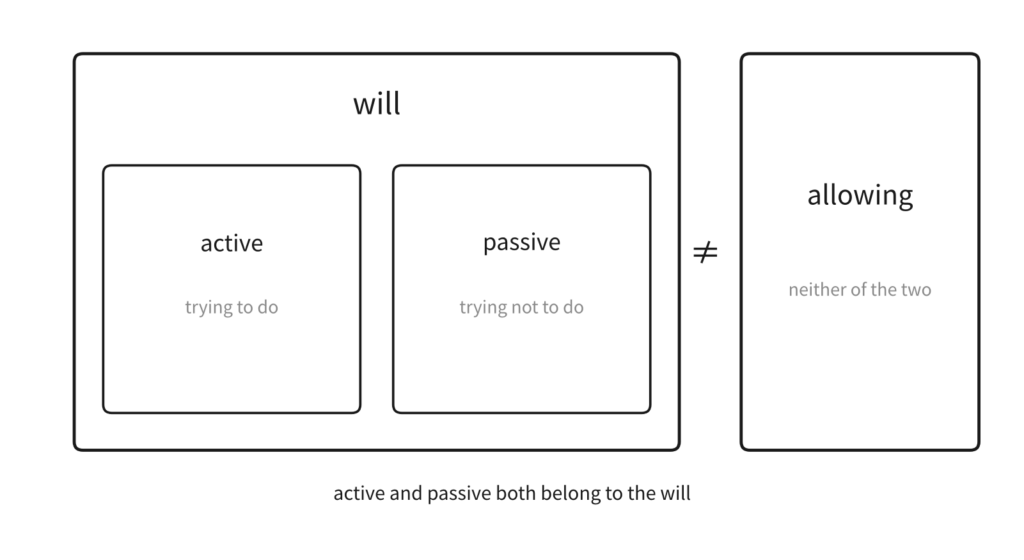
The distinction between active and passive, he says, is not the distinction between will and allowing. And active and passive are both forms of the will.
That trying to do something is will is easy enough. The difficulty is that trying not to do anything is equally will. Deciding to stay still. Deciding to wait. Deciding to let go of the tension. In each case, at the moment of deciding, will is at work.
So trying to release tension and failing is exactly what you would expect. The work of trying to release is not compatible with the state of being released.
Laid over the four levels from Part 2, the position becomes clear. The surface is the ego-self, the will, and the orientation toward the world, Maitland writes. And the core is the true self, allowing, and the place from which we orient toward the world. The three are set out side by side in a single sentence.
So trying to release tension and failing means reaching for the core from the side of the ego-self. The hand doing the reaching is itself the surface, so it does not arrive.
It should be said that the will is not being treated as the villain here. Maitland writes the opposite. Self and will are born together as two sides of one thing. Without will, freedom cannot be realized. Creative work, and transformation, cannot be accomplished without it. It is in our decisions and our actions that we meet who we are.
Will is needed. There is simply somewhere that will alone does not reach.
The three forms of unwilling-will
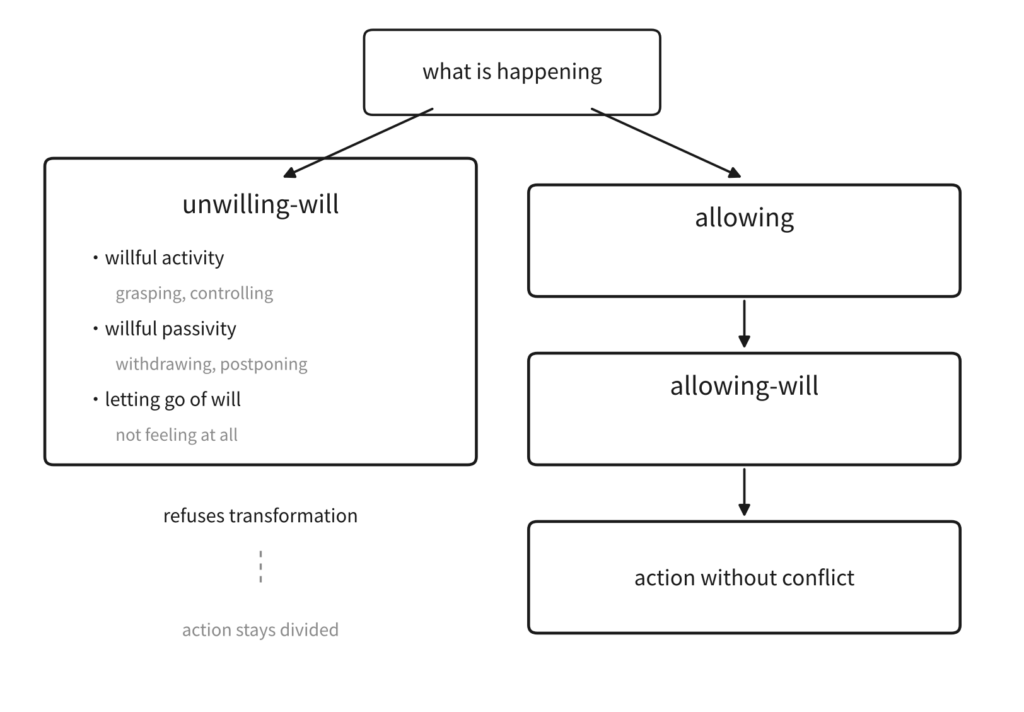
Maitland calls a will that has not yet become free the unwilling-will — a will that is refusing what could change. It takes three forms.
The first is willful passivity. Withdrawing from what is happening. Holding off on acting. Not looking. Waiting for it to pass. None of it looks like doing anything, and all of it is choosing to withdraw.
The second is willful activity. The reverse: gripping, controlling, making things go your way — with yourself as much as with others. And by doing so, avoiding what you do not want to face.
The third is a passivity that lets go of will and of forming. Daydreaming. Falling asleep. Going faint. Setting the will down in the face of something hard. Maitland states plainly that this is neither an act of will nor allowing.
The phrase “let go of the tension” tends to head for this third one. Stop feeling anything. Let awareness go dim. The hardness may well decrease. But what is happening there is not allowing.
What allowing is
So what is it?
Maitland says outright that he is using the word in a sense other than its everyday one. In ordinary English, to allow is to permit, to let something go ahead. That is not what is meant.
The account in the book runs like this. Allowing is not a way of doing. It is a way of being.
And: not interfering with what is happening, and at the same time not leaving it. Both at once. Not reaching in, and not withdrawing. Staying with what is happening.
In the language of Part 1, this holds on the near side of thinking. So the moment you decide to be in allowing, you are already outside it.
Maitland adds one more thing. This is not something you newly produce. At depth it is always already the case. It is not lost; it is covered over by something else.
The same place can be pointed at from the side of grammar. Ancient Greek had a voice that was neither active nor passive: the middle voice. Not doing, not being done to. Something that comes about within a relation. Pulling the shoulders back to correct your posture is active. Having your shoulders moved by someone massaging them is passive. Your breath deepening when you are touched is middle. I have written before about this and about neutrality in Rolfing.
Here, though, I will keep to Maitland’s own framing. Discussions of the middle voice sometimes speak of giving oneself over. His allowing is not that. There is no one to give yourself over to, and no current to go along with. It points at one thing only: not interfering with what is happening, and not leaving it.
Surrender is not giving up
There is one more word to separate out: surrender.
Maitland writes that surrender is never submission and never resignation. Submission is a form of the unwilling-will: out of step with the situation, you push yourself into there being no other way. Resignation is the same — having tried to change something and failed, you put your hands up.
What he calls surrender is staying where you are and taking on what is happening. It faces the opposite way from giving up.
Put it into the session and the difference is visible. What looks like a client letting go of tension splits into three. Withdrawing and merely hiding the hardness. Awareness going dim until nothing is felt. And staying in contact with what is happening while giving up interference. They look alike. What is going on inside them is not the same.
Allowing-will
So far this may sound like an argument for stopping the will. Maitland does not say that.
Freedom arises within allowing, he writes, but it is completed in appropriate will and action. Allowing is not the end of it. What comes out of it has to take shape as actual action before it is complete.
The will that comes out of allowing he calls the allowing-will: action that is without conflict and undivided.
Someone in a quite different field says the same thing. Joe Hudson, an executive coach in Silicon Valley, puts it as: a want that comes from the head needs willpower, while a want that comes from the heart moves on its own. Action you are forcing and action you are not are two different things.
There was a line in the testimonial quoted in Part 1.
Above all, I can stand upright, and easily. The effort has gone out of my body, in the good sense.
The effort is gone and she is standing upright. She did not let go by trying to let go. She is not standing by trying to stand. Both holding at once is what is being described here.
Which is why we work with the hands
If allowing is not something you can produce by deciding, then what?
Not being producible by decision means it has to come from outside that person’s will. This is where the hands do their work. As Part 1 showed, what the hands touch is not where thought reaches. Hardness decreases, and not because the person decided to decrease it.
What are they working on, then? The system that assembles the body in gravity. As Part 2 showed, that system is at the same time the system that makes meaning. So touching it is not only a matter of reducing hardness. That system is set out on another page.
The order shows up in the session records too. In the entry on the eighth session I wrote about walking. The person was walking in a way that loaded the body, without being aware of it. You do not say, let go of the tension. You show that another way of walking exists.
A new option feels odd at first, but a posture that puts less load on the body is better for it, so in time the change can be expected to take.
Session 8 — How to Arrive at a Walk Without Effort: Tasuku Suzuki, Session Record 8
What starts to feel odd is the old way of walking. Rather than deciding to let go, the reason it could not let go gives way. And at the end of that same session I wrote that the effort is gradually coming out of the soles of his feet. Gradually, because it was not let go of by decision.
The same thing is happening on the practitioner’s side. If the practitioner lays a hand on with the intention of making something happen, the other body braces to meet it. If the practitioner decides to do nothing and withdraws the hand, nothing happens either. Both are on the side of the will.
I have written about this before using the word zero: the closer the practitioner is to zero, the more what should happen happens. A word that came from a Zen teacher and a word that came from phenomenology are pointing at the same place.
- How Healing Comes About — Jeffrey Maitland’s Four Approaches
- When a Name Appears, You Stop Seeing — What Phenomenology Changes in Practice
The limits of this view
Three things are worth saying.
The first is that this distinction is not the kind you can confirm and display. Is the person trying to let go, or in allowing? There is no way to tell from outside. The person cannot tell while it is going on either. All that can be said is, afterwards, that it was not that. So if anyone claims to be able to tell, that is worth doubting.
The second is that asking for allowing can work as a danger for the person. Take only the hardness out of a body that is hardened in order to protect itself, and there is nothing left guarding. It is not allowing that is needed first; sometimes safety is. The book has nothing on that order of things. For that, one has to rely on work from another field.
The third is how it is used in the room. Say to a client that trying to let go of tension is also will, and it sounds like being blamed for not letting go. This distinction is for a practitioner to review their own hands with, not something to ask of the person in front of them.
Summary
Active and passive both sit on the side of the will. Not only trying to do something, but trying not to do anything, is will. So failing to release tension by trying is not a matter of being bad at it.
Allowing is not a way of doing but a way of being. Not interfering with what is happening, and not leaving it. It cannot be produced by decision, and at depth it is always already the case. Where the will sits on the side of the surface, the side of the ego-self, this sits on the side of the core, the side of the true self.
And it does not stop there. The will that comes out of allowing takes shape as action, and that is the completion. That is the allowing-will.
Part 4 brings all of this together. Why aiming at an ideal self does not work: limitation and possibility.
References
Jeffrey Maitland, Spacious Body: Explorations in Somatic Ontology, North Atlantic Books, 1995
Jeffrey Maitland, Embodied Being: The Philosophical Roots of Manual Therapy, North Atlantic Books, 2016