
はじめに
Introduction
I am Hidefumi Otsuka, offering Rolfing® sessions based in Shibuya.
As I work with clients through these sessions, there is a question I often keep in mind.
That is:
“Where does change in a person actually begin?”
People want to reduce anxiety.
They want to improve relationships.
They want to act more naturally and freely.
For these kinds of themes, therapy or counseling is generally chosen.
However, in reality, similar changes can also occur through working with the body.
In this article, I would like to explore
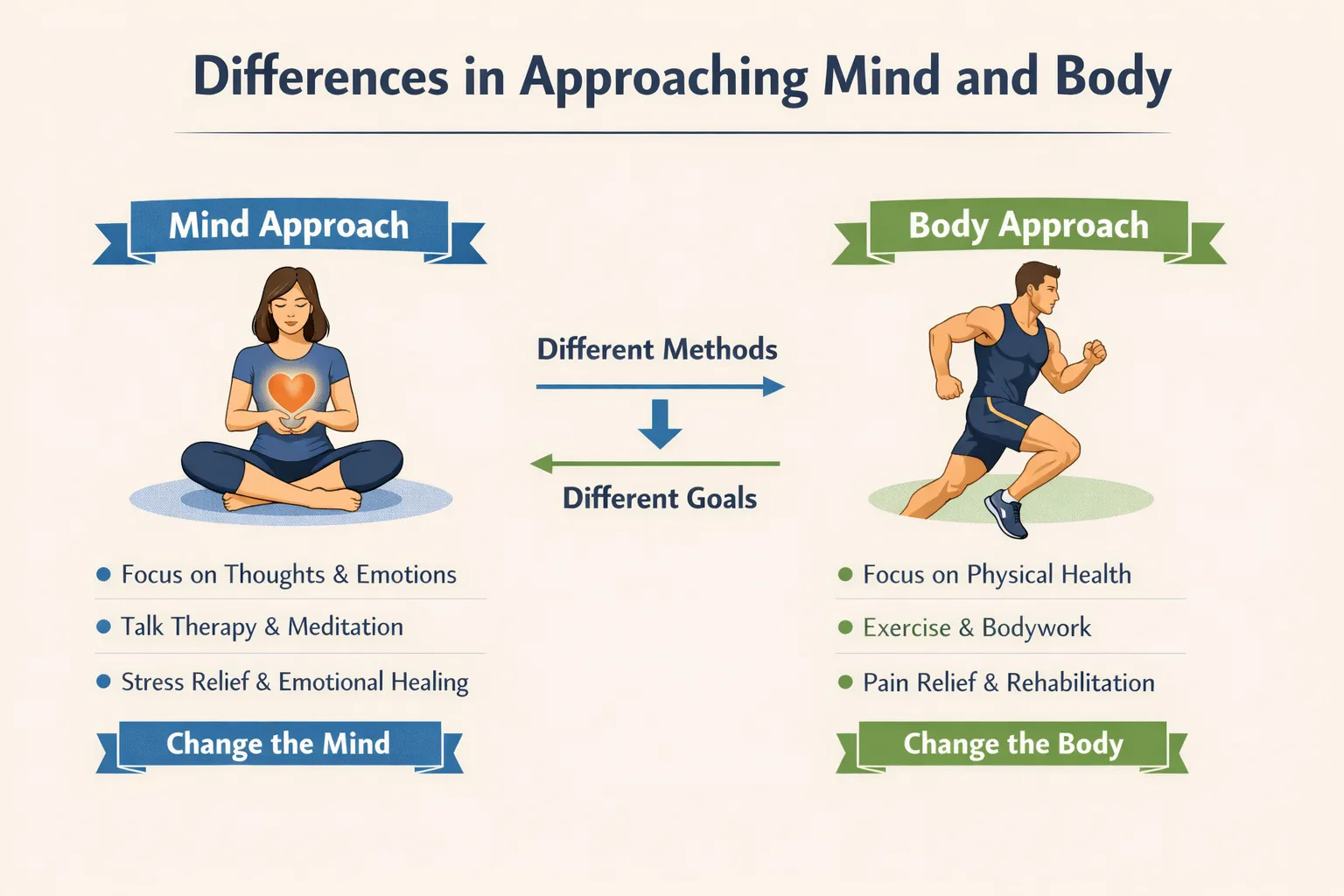
where change actually occurs, by comparing therapists (language-based approaches), Rolfers (body-based approaches), and somatic-oriented approaches.
Therapists: Working with the Mind Through Language
Therapists include professionals such as:
- Clinical psychologists
- Counselors
- Psychotherapists
They primarily use language as their main tool.
Their approach focuses on:
- Verbalizing emotions
- Organizing thought patterns
- Making meaning of past experiences
In this way, they aim to create change through understanding.
The underlying model here is that:
the mind changes through being understood.
However, there is a limitation to this.
The Phenomenon of “Knowing but Not Changing”
- You understand it
- You know the cause
- You can even put it into words
And yet,
you cannot change.
What is happening in this situation?
From this question, body-based approaches offer a different perspective.
Somatic-Oriented Therapy: Working in the Space Between Mind and Body
Somatic therapies emerged to address areas that language alone cannot reach.
One representative approach is
Somatic Experiencing developed by Peter Levine.
This approach is based on the idea that:
trauma remains in the body as unfinished responses.
Therefore, the process involves:
- Bringing attention to bodily sensations
- Tracking small changes carefully
- Ensuring safety within the nervous system
Through this, it aims to regulate the nervous system.
What is being addressed here is:
the layer of sensation and the nervous system—between “meaning” and “structure.”
Rolfers: Working with the Mind Through Structure
Rolfing takes yet another entry point.
It works directly with the structure of the body:
- Fascia
- Posture
- Relationship with gravity
Its defining characteristic is that:
it does not directly work with the mind or emotions.
And yet, as a result:
- Emotions naturally arise
- Thoughts become clearer
- Behavior changes
Why does this happen?
Because:
the mind is already expressed within the body.
Three Approaches: Which Layer Do They Address?
If we organize these approaches, we see the following:
Therapists (Top-Down)
- Target: meaning, thoughts, language
- Direction: mind → body
Somatic Experiencing (Intermediate Layer)
- Target: sensation, nervous system
- Direction: sensation ↔ mind
Rolfing (Bottom-Up)
- Target: structure, gravity, fascia
- Direction: body → mind
What is important here is:
it is not about which is correct.
Which Should You Choose? — The Perspective of “Appropriate Use”
Therapy, Somatic Experiencing, and Rolfing are often compared with the question:
“Which one is better?”
However, the essence is not about which is correct, but rather:
which to use, and when.
- When deep understanding and meaning-making are needed → Therapy
- When trauma or nervous system regulation is needed → Somatic Experiencing
- When patterns and behavior need to change at a fundamental level → Rolfing
In other words:
it is important to use them appropriately depending on the situation and purpose.
Furthermore, there is no need to limit oneself to just one.
Human beings consist of multiple layers:
- Language
- Sensation
- Bodily structure
The Perspective of Integration
When we integrate these perspectives:
- Therapists work with meaning
- SE works with sensation and the nervous system
- Rolfing works with structure
We begin to see a three-layer model.
And:
real change occurs when these three layers are connected.
Conclusion
When we want to change the mind, we tend to try to change our thinking first.
However:
- The mind appears in the body
- The body is supported by structure
Human beings exist within this continuity.
Therefore:
- There are aspects that change through talking
- There are aspects that change through sensing
- There are aspects that can only change through the body
And most importantly:
it is not about choosing one, but about using them appropriately.
The difference between therapists and Rolfers is not simply a difference in method.
It is:
a difference in where change actually occurs.「変化が起きる場所」の違いなのである。