
Introduction
My name is Hidefumi Otsuka, and I offer Rolfing® sessions based in Shibuya.
Through my work, there is a question that repeatedly emerges:
How do people actually change?
When people feel the desire to change or improve,
they often stand on an implicit assumption.
That assumption is:
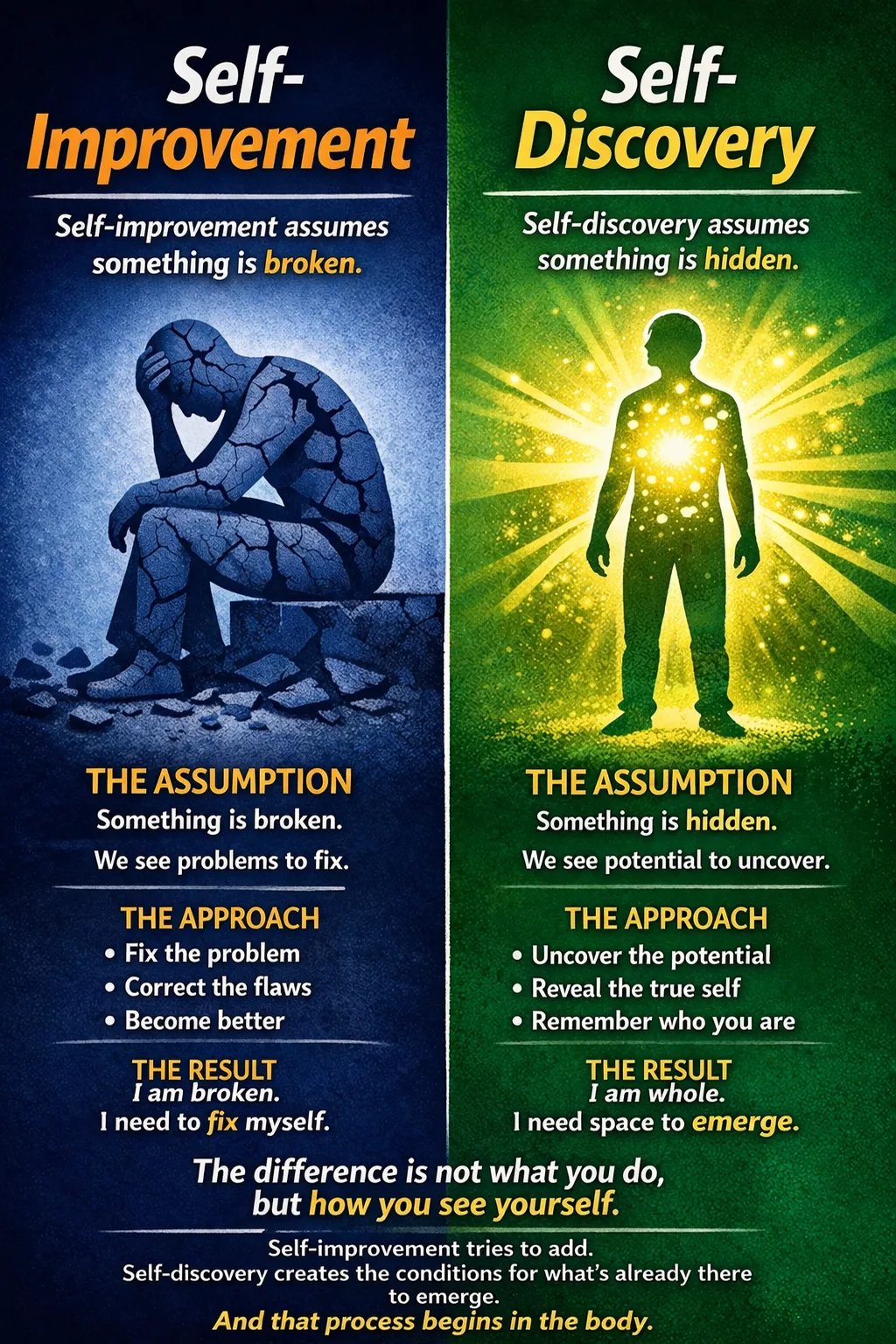
Self-improvement
However, what unfolds in Rolfing sessions revealsa fundamentally different process.
The Assumption of Self-Improvement— “Something is broken”
Self-improvement is a powerful and widely accepted concept.
Yet, underlying it is the following assumption:
Self-improvement assumes something is broken.
In this framework, we tend to see:
- Poor posture
- Weak willpower
- Lack of emotional control
- Inability to take action
as “problems” to be fixed or corrected.
While this approach is highly effective in fields such as medicine, education, and business, it also carries a limitation.
It can reinforce the belief that:
“There is something fundamentally lacking in me.”
The Perspective of Self-Discovery— “Something is already there, but hidden”
In contrast, what happens in a Rolfing session is of a completely different nature.
It is based on the following perspective:
Self-discovery assumes something is hidden.
From this view:
- The body already knows how to organize itself
- The breath naturally tends toward depth and ease
- Human beings inherently have the capacity to act appropriately
The issue is not that something is missing.
Rather, the capacity is present, but not accessible.
Patterns Held in the Body
Why, then, do we lose access to what we already have?
From the perspective of Rolfing,this can be understood as:
patterns held in the body
These include:
- Adaptations to gravity
- Long-standing postural habits
- Fascial tension shaped by stress and experience
- Restrictions in breathing
As these patterns accumulate:
- Breathing becomes shallow
- Perception narrows
- Movement becomes limited
- Decision-making and action are affected
In other words,
It is not that we cannot act. It is that, in that state, we cannot act.
Rolfing Is Not “Improvement,” but “Discovery”
In a Rolfing session, there is very little “teaching.”
Nor is there an imposition of a “correct posture.”
Instead, what takes place is:
- Releasing unnecessary tension
- Reorganizing the body’s relationship with gravity
- Restoring perception and awareness
As a result:
- The breath naturally deepens
- The body feels lighter
- Perception expands
- Action arises spontaneously
This is not improvement.
It is a process in which:
what was already there begins to emerge.
“I Know, But I Can’t Act”
A common experience many people have is:
“I know what I should do, but I can’t act.”
Within the framework of self-improvement, this is often interpreted as:
- Lack of willpower
- Lack of motivation
However, from the perspective of self-discovery:
the state of the body is limiting action.
When the body is tense, breathing is shallow, and perception is narrow, action does not arise easily—no matter how much one understands.
Conversely, when the body opens:
action can occur before thought.
Conclusion
— Not changing, but emerging
The difference between self-improvement and self-discovery is not merely a difference in words.
It is a difference in:
how we fundamentally see human beings.
- Self-improvement: fixing what is broken
- Self-discovery: uncovering what is hidden
Rolfing stands in the latter perspective.
Human beings already possess vast potential.
It is simply that this potential is restricted and not fully visible within the body.
Therefore, what is needed is not:
adding something new,
but rather:
creating the conditions in which what is already there can emerge.
And that process begins, in the body.