
Introduction
Somatic Psychology Series — Toward the Integration of Thought, Emotion, and Body | Part 4 (Final). Posted: April 2026.

In Part 1, I stated that “unable to move even though the head understands” is a structural problem of the division of body and mind. In Part 2, I looked at how trauma is inscribed in the fascia and remains as a memory of the body that words cannot reach. In Part 3, I showed that organizing the body directly raises judgment and performance.
In Part 4 (the final part), I compare three approaches for answering this question, and organize how to use them differently.
→ Part 1: Why “the Head Understands, but the Body Won’t Move” — An Introduction to Somatic Psychology
→ Part 2: Why Trauma Does Not Heal Through Words — The Mechanism of Fascia, the Autonomic Nervous System, and Body Memory
→ Part 3: Why Organizing the Body Raises Judgment and Performance — From the Perspective of Rolfing and Brain Science
Why Does “Understanding Yet Unable to Change” Occur?
To reduce anxiety. To improve relationships. To become able to act more naturally.
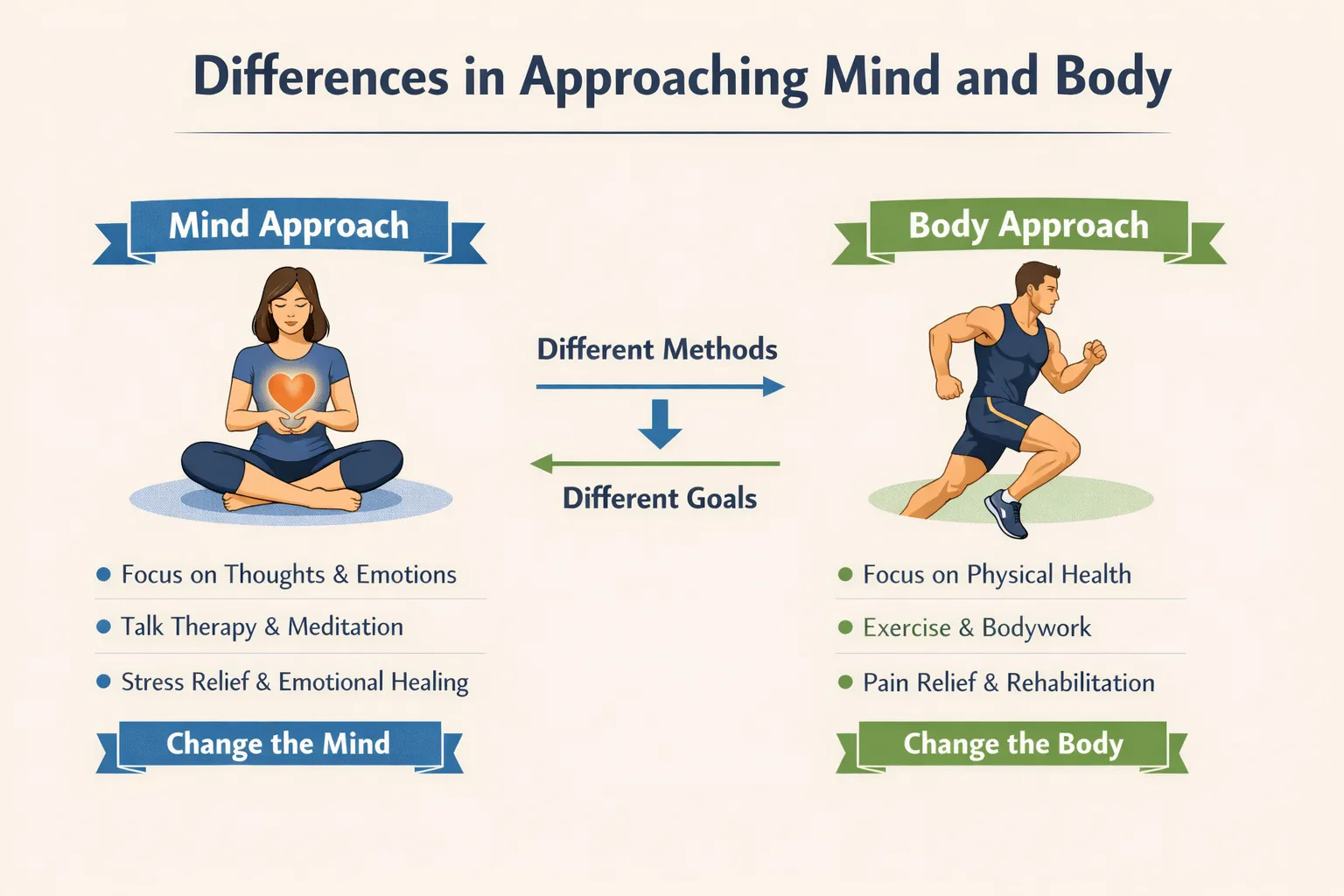
Toward such themes, many people first try to “change the way of thinking.” They receive counseling, understand the cause, and try to change cognition.
But there must be many who have had the experience of “I understand it. I know the cause. I can put it into words. And yet I cannot change.”
What is occurring at this time is not a problem of ability. It is that the approach trying to bring about change is not reaching the “layer” of the problem.
A person is made up of three layers — meaning, sensation, and structure. The approach that reaches each layer differs.
Approach ①: Therapy (Top-Down) — Reaching the Layer of Meaning
Professionals such as clinical psychologists, counselors, and psychotherapists use language as their main tool. Through:
- putting emotion into words
- organizing patterns of thought
- giving meaning to past experiences
it is an approach that “brings about change through understanding.” The direction is top-down, “mind → body,” and it works on the layer of meaning, thought, and language.
When deep insight is needed, when there is a wish to organize a personal story, when there is a wish to change cognitive patterns — these are the scenes where therapy exercises the most power.
But as stated in Part 1, the “language area” and the “system that governs the body’s autonomic reactions” operate as separate circuits within the brain. It is for this structural reason that an approach through language reaches “understanding” yet has trouble reaching the patterns soaked into the body.
Approach ②: Somatic Experiencing (Middle Layer) — Reaching Sensation and the Nervous System
Somatic Experiencing (SE), developed by Peter Levine, grasps trauma as “the body’s frozen response,” and works on the layer of sensation and the nervous system. Through the process of:
- directing attention to bodily sensation
- carefully following small changes
- securing the safety of the nervous system (the activation of the ventral vagal system)
it performs the regulation of the nervous system. The direction is bidirectional, “sensation ↔ mind,” and it is positioned in the middle layer between therapy and Rolfing.
As stated in Part 2, trauma is recorded not as verbal memory, but as the body’s tension patterns, posture, breathing, and reactions. SE brings about transformation by releasing that “response that did not complete.”
Approach ③: Rolfing (Bottom-Up) — Reaching the Layer of Structure
Rolfing works on the body’s structure itself — the fascia, posture, and the relationship with gravity. The direction is bottom-up, “body → mind.”
Its characteristic lies in not directly handling the mind or emotion. And yet, in a session, emotion naturally rises up, thought becomes organized, and behavior changes. That is “because the mind is already appearing within the body.”
As shown in Part 3, when the pelvis stabilizes and the axis passes through the tanden, the autonomic nervous system becomes organized and the brain’s resources are freed. By changing the “hardware” that is the body, the “software” that runs on it (thought, emotion, judgment) changes.
Here, the comparison with physical therapy becomes important. Recall the three paradigms of body therapy stated in Part 1. Relaxation aims to ease pain and tension and return to a comfortable state. Corrective aims to return distortion and poor posture to a “correct state” — physical therapy stands on this paradigm. Chiropractic and postural correction are likewise, and are based on a Western view of the body of “returning a minus to zero (recovery).” The body is an object to analyze and correct.
And Holistic (whole) aims at the integration of the whole human being, without cutting apart body, emotion, thought, and relationship — Rolfing stands on this paradigm. It is a viewpoint of “widening zero into plus (integration, transformation),” and is close to an Eastern view of the body in which the body is an existence that changes within relationship.
Rolfing is a method born in the West, but its practice naturally connects to an Eastern viewpoint of integration — there is a premise there that body, emotion, and perception are one process that cannot be divided.
→ Part 1: Why “the Head Understands, but the Body Won’t Move” — An Introduction to Somatic Psychology
→ What Is the Difference Between Physiotherapy and Rolfing?── Recovery vs Transformation, and the Underlying View of the Body
The Structure of the Three Approaches
| Therapy (Top-Down) | SE (Middle Layer) | Rolfing (Bottom-Up) | |
|---|---|---|---|
| Object | Meaning, thought, language | Sensation, nervous system, trauma response | Structure, fascia, gravity |
| Direction | Mind → Body | Sensation ↔ Mind | Body → Mind |
| View of the body | Western (the mind controls the body) | Integrative (nervous system and mind are bidirectional) | Close to Eastern (body, emotion, and perception cannot be divided) |
| Purpose | Corrective — correcting past cognitive patterns | Corrective + Holistic — from release to integration | Holistic — integration and transformation that widens zero into plus |
What is important is not which is correct. Depending on which layer the problem is in, the optimal approach differs.
Which to Choose — Using Them Differently by Situation
When deep understanding or meaning-giving is needed → therapy When trauma or the regulation of the nervous system is needed → Somatic Experiencing When there is a wish to change the body’s patterns from the root → Rolfing
And there is no need to limit it to one. A person is made up of multiple layers — meaning, sensation, and structure — and essential change occurs when these three layers connect.
Insight of “the reason it became so is now understood” is gained in therapy, the nervous system is regulated in SE, and the body’s structure changes in Rolfing — when these three overlap, transformation becomes the deepest.
To Close the Series — What Is Transformation
What I have consistently kept asking throughout this series was the question “why can a person not change even though the head understands.” And as the answer, I have presented the standpoint of somatic psychology.
Finally, I’d like to organize once more the theme running through this whole series.
Transformation Has “Three Times”
The insight through therapy is a transformation that “rewrites the meaning of the past.” By understanding why it became so, a person’s own story changes.
Somatic Experiencing is a transformation that “releases the memory of the body.” By completing the frozen response of the nervous system, there is release from past trauma binding present behavior.
Rolfing is a transformation that “changes the present structure.” By changing the state of the body in this very moment, future patterns of reaction change.
Past, present, future — transformation has these three axes of time, and there exists an approach that bears each.
The “Recognition OS” Is Updated From the Body
The keyword that appeared repeatedly throughout this series is the “Recognition OS.”
How a person sees the world — its premises, filters, and frameworks — is inscribed not only inside the head, but as the body’s structure, the patterns of the nervous system, and the tension of the fascia. That is precisely why a true update of the OS requires an approach from the body.
In Part 1, I introduced Joe Hudson’s concept of “Head, Heart, and Gut.” These three correspond to the three layers shown in this series — the layer of meaning (Head), the layer of sensation (Heart), and the layer of structure (Gut).
Therapy bears the layer of the “Head,” SE the layer of the “Heart,” and Rolfing the layer of the “Gut” — when these three are aligned, the Recognition OS is updated from the root.
From Medical Marketing in the Pharmaceutical Industry to Rolfer
Looking back on my own path, the 11 years of medical research and of medical marketing in the pharmaceutical industry were a time of thoroughly training the layer of the “Head.” Logic, analysis, evidence — that was necessary training. But I experienced many times that with that alone, the wall of “unable to move even though the head understands” cannot be crossed.
The turning point was a round-the-world journey of 26 countries and 65 cities. The night spent in a ger in Mongolia, when lost in the medina of Morocco, when traveling by night bus across the highlands of Bolivia — within experiences of the body directly receiving the world, something moved that a Western “analyzing view of the body” cannot reach. By touching the cultures of Asia, the Middle East, and South America, an Eastern view of the body that does not divide body and mind was inscribed not as “knowledge” but as “experience.”
Within that journey I received Rolfing training, and after returning to Japan, began to work as a practitioner. What I have conveyed in this series is distilled from those 12 years of practice.
The Essence of Transformation Lies in “Integration”
There is a part that changes by talking. There is a part that changes by feeling. There is a part that changes only from the body.
And when those three are integrated — when what the head understands is felt in the body and flows out as natural behavior — at that time, transformation becomes not “effort” but “inevitability.”
This is what I wanted to convey throughout this series.
Somatic Psychology Series — Toward the Integration of Thought, Emotion, and Body (All 4 Parts)
Somatic Psychology Series — Toward the Integration of Thought, Emotion, and Body (All 4 Parts)
The question “unable to move even though the head understands” is unraveled from four angles.
Part 1: Why “the Head Understands, but the Body Won’t Move” — An Introduction to Somatic Psychology
→ Read Part 1
Part 2: Why Trauma Does Not Heal Through Words — The Mechanism of Fascia, the Autonomic Nervous System, and Body Memory
→ Read Part 2
Part 3: Why Organizing the Body Raises Judgment and Performance — From the Perspective of Rolfing and Brain Science
→ Read Part 3
Part 4: The Three Approaches That Break Through “Understanding Yet Unable to Change” — The Difference Between Therapy, SE, and Rolfing (this article)
For Those Who Want to Update the Recognition OS “From the Body”
Handling the questions “why do I think this way” and “why does my judgment waver” from the perspectives of philosophy, brain science, and cognitive bias is Mind and Bodywork Lab’s “Recognition OS” series. An approach from the body, and an approach from thought. By knowing both, transformation becomes deeper.
→ Mind and Bodywork Lab: How to Navigate This Site (in Japanese)
For Those Who Want to Change from the Body
It is possible to begin by confirming, in a trial session, what is happening in the body.
→ Applying for a Trial Session
Hidefumi Otsuka (Ph.D.) | Certified Advanced Rolfer™ / Rolf Movement Practitioner
Completed a doctoral program at the Graduate School of Medicine, the University of Tokyo. After a career in the pharmaceutical industry, has offered Rolfing® sessions in Shibuya since 2015. Works under the theme of “the integration of thought, emotion, and body.”