Over the past few months, I’ve had conversations with students in what I would call a “rewiring phase.”
They are thoughtful and motivated, yet facing a common question:
“What should I focus on, when there are too many options—and when even the future of work feels uncertain?”
This uncertainty doesn’t come from a lack of direction, but from having too many possibilities—combined with the rapid rise of AI, which makes it harder to define what will remain valuable.
This question is not abstract to me.
I began my career in academia, working on basic immunology research during my PhD, where clear answers were rare.
Later, in the pharmaceutical industry, I worked on launching new drugs and expanding indications, bridging science and business.
Eventually, my path led me into yoga, meditation, and bodywork.
Looking back, these may seem like very different fields.
But what connects them is not the domain itself, but the capabilities required to navigate them.
Through this, I’ve seen how scientists often struggle when leaving academia—not due to lack of ability, but because they haven’t yet translated their strengths into new contexts.
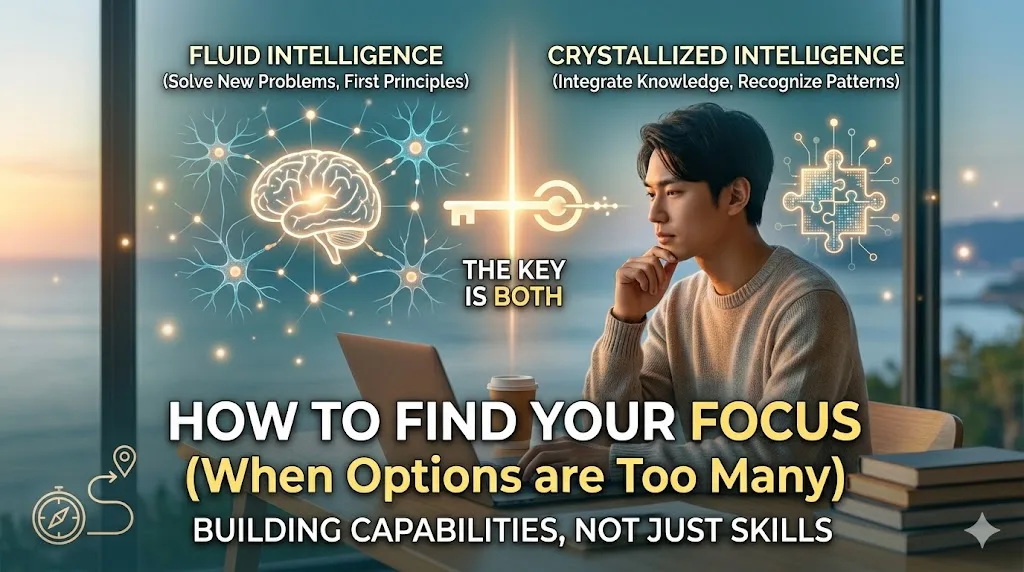
A useful framework here comes from Raymond Cattell, later popularized in From Strength to Strength by Arthur Brooks:
- Fluid intelligence: solving new problems, thinking from first principles
- Crystallized intelligence: integrating knowledge, recognizing patterns
The key is not choosing one, but using both.
For those early in their career:
• Use your fluid intelligence fully
→ Seek complexity, not clarity
• Convert experience into knowledge
→ Write, explain, connect
• Develop the ability to “translate”
→ Between disciplines, cultures, and contexts
In fields like medtech or biotech, those who stand out are not only technically strong, but able to connect domains.
They explore with fluid intelligence, and integrate with crystallized intelligence.
So perhaps the question is no longer:
“Which path is the right one?”
But rather:
What kind of problems do you want to stay with for a long time?
And in a world shaped by uncertainty and AI—
Are you building skills tied to a fixed path, or capabilities that remain valuable across changing contexts?