
25 March 2015, the last day of the training. Seventy-eight days counted from August of the previous year, some seven hundred hours, and the day finally came. The Final interview was held, and each student went into a fifteen-minute, two-on-one conversation.
What is characteristic of the Rolfing training is that feedback on what to strengthen comes during the training itself, so one has a fair idea of what the final interview will be about.
Giovanni in Phase II kept the atmosphere free, so that each person could take flight in their own way. Even while he was demonstrating a client session, eating, drinking and looking at a PC were all permitted, and one could take in the class at one’s own pace.
At the Phase II stage I had my hands full simply learning, and observing a body left me overwhelmed by the sheer quantity of information.
The truth is that I did not really know what to do. Even so, looking back now, what I learned from Giovanni was the importance of leaving an interval — Hold the space, which I have taken up in On Knowing the Importance of Holding the Space and in The Midterm Interview — and one more thing, to trust my own inner perception, the perception felt from within.
That became the ground on which I went into Phase III. The turning point in Phase III came, I think, in the second week. A cold I had caught in South America would not clear, and it took a month and a half before it began to lift, in that second week. Precisely because my condition was not fully back, I was able to stop resisting.
Not forcing anything, keeping to what I felt in the moment, I kept body reading brief and went ahead trusting my own bodily sense, above all in the hands.
At the midterm interview (see The Midterm Interview), Jörg gave me this advice:
step back from the client, observe the body with a wider view through the approach used in the sleeve sessions, and respond according to what you sense, and it will improve
From there, gauging the distance to the client, I made it my task to work out how to come into Neutral myself. Ordinarily one would think about refining technique, but technique follows of itself once you trust your inner perception and can hold an appropriate distance from the client. I went forward trusting those words of Jörg’s.
What I held to above all was this:
to meet the client valuing the sensation felt in this present moment
To do that, I found myself letting go of knowledge and going into client sessions from a blank state. There was fear in it, but strangely, when I concentrated on organising my own body, I could watch that fear disappear, which was interesting.
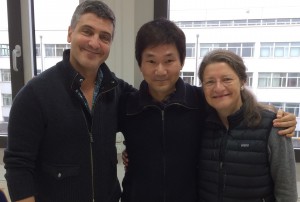
At the final interview I talked over these things with Jörg and Andrea, looking back.

What I regret is that, being taken up with the present, I found less time than I had hoped for short Rolfing sessions from Jörg and Andrea, or for the kind of conversation in which each of them might have described their own experiences in Rolfing.
Rolfers of the European Rolfing Association (ERA) are required to attend the Supervision Workshop (one week) to be held next year, and to receive three mentoring sessions beforehand. We ended by talking about how it might be interesting to take a mentoring session with one of them.

Finally, seated in a circle, each of us had our name called by Sabine of the office staff, and the certificate of a Certified Rolfer was handed over. Now that it is over, it went by in no time. It has been a deeply full nineteen weeks, and there has been a large change within me, so the coming ten or twenty years have begun to look like something to anticipate.


There is still more about the training I would like to take up in this column, so I will write it, but I am relieved to have become a Certified Rolfer. It is sad to part from the many companions I studied alongside, and what adventure lies ahead is the real thing to look forward to from here.
Note, August 2026
The system this article describes no longer exists. It states that attendance at next year’s Supervision Workshop is required, and that three mentoring sessions must be received beforehand. The Supervision Workshop has been abolished. The three stages of Phase I, II and III have been reorganised into Levels, and the number of mentoring sessions has been reduced. The route to certification recorded here cannot be followed in this form.
What changed includes the order. Phase I in 2014 involved a review of documents, a qualification and experience in massage practice, a written assignment in anatomy, a statement of motive, completion of a ten-series, and five movement sessions.
Only those who passed entered the classroom. The present Level 1 is an open course that asks for no prior experience and is available to anyone. And having completed it counts as credit toward the next stage. The gate has moved from the front to the back.
This was not the first such rearrangement. Pierpaola Volpones, who taught the Supervision Workshop, took her own training in Munich in the 1980s, and the course then had two stages, Audit and Practitioner.
The nine weeks of Audit consisted of watching the work without putting one’s own hands on. Only in the nine weeks of Practitioner did the work itself begin. And there were no texts, no photographs, no practice of technique — it proceeded, she said, simply by carrying out sessions.
Two stages in the 1980s, three stages plus the Supervision Workshop in 2014 and 2015, and Levels now. Across some thirty years there have been at least three forms. This article stands at the end of the second of them.
What changed and what did not cannot be read off from the shape of the system alone. Whether what is taught has been brought into line is not something the external changes reveal. What they do show is that the opening of the entrance and the division into stages have moved.
And what this article looks back on is not the acquisition of technique. What came at the midterm interview was advice to step back and observe with a wider view. From there, how to come into Neutral became the task.
Technique follows of itself once you trust the perception felt from within and can hold an appropriate distance from the client — those words were what I went forward on. I came to let go of knowledge and enter sessions from a blank state, and though there was fear in it, concentrating on organising my own body made the fear disappear.
What this article names as having been gained in nineteen weeks is only that. Whatever happens to the shape of the system, what is written here has not moved.