
Introduction
The other day I finished The Infinity Machine, a biography of Demis Hassabis. Shortly before that, I had reread Walter Isaacson’s Elon Musk, which I had first picked up three years ago. Reading the two in succession, a sense grew quietly in me. Artificial intelligence is not merely a technology; it reflects, in strong colors, the worldview of the person who made it — what I call the “Recognition OS.”
Hassabis and Musk share an unexpected point in common. Both were avid players of games from an early age. Yet while loving the same games, what each found there was entirely different.
A Founder’s Worldview Appears in the Artificial Intelligence
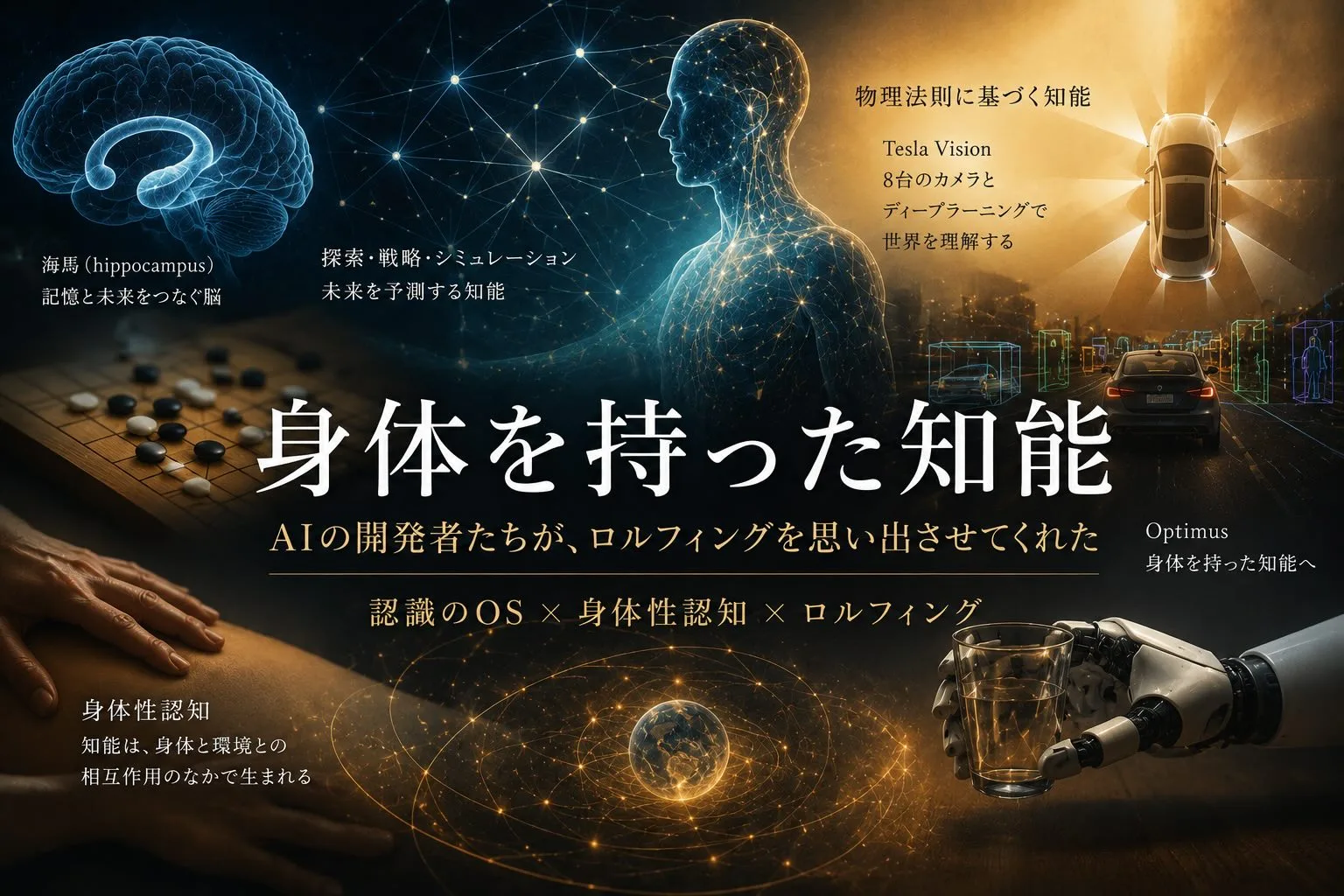
What drew Hassabis was the question of how a person thinks. Through chess and game development, his interest went toward search, strategy, and the simulation of the future, and along that line he moved into neuroscience. The hippocampus he studied is deeply involved not only in memory but in the capacity to imagine the future. The brain is not a mere storage device; it is a device that draws the future out of the past. That idea carried into DeepMind, and on to AlphaGo and the reasoning models of recent years.
Musk, on the other hand, seems to have been drawn to the question of what rules the world runs on. At Tesla and at SpaceX, the starting point is always the same: does this violate the laws of physics? Where this shows most symbolically is in autonomous driving. While many companies rely on radar and LiDAR, Musk has kept saying that LiDAR is a crutch. Humans do not have LiDAR. And yet they can drive. So the information needed for driving must be within vision, and the problem lies not with the sensors but on the side of intelligence.
And beyond that lies the humanoid robot Optimus. It is an attempt to place the structure raised through autonomous driving — perceive, predict, act — into a human-shaped body. Even the simple act of lifting a single cup holds together only by recognizing position, predicting weight, and balancing within gravity. So the essence of Optimus is less a matter of robotics than a challenge toward Embodied Intelligence.
What this brings to mind is the idea of Embodied Cognition, spoken of in cognitive science in recent years. Intelligence is not completed inside the brain alone; it is born within the interaction between body and environment. Walking, touching, using a tool — that experience itself shapes cognition.
What Is Embodied Cognition?
Having written this far, it finally settled in me. This is the very thing I touch in every Rolfing session.
When tissue and balance change in Rolfing, something strange happens. The field of vision feels wider. The soles of the feet begin to converse with the floor. The breath deepens, and the very sense of distance from the world changes. Many people say, after a session, that the scenery looks different. This is not a metaphor. When the body changes, the way the world is received changes. That is exactly what Embodied Cognition tells us. Perception is not an event inside the head; it is alive in the place called the body.
So I no longer think of Rolfing as a technique for “setting the body in order.” I feel it as work that sets perception in order, through the body. Posture changing is a result, not the aim. What actually changes is how that person relates to the world — the way of receiving the world itself, what might be called the “Sensory OS.”
Life Science and Artificial Intelligence
In graduate school I specialized in life science, looking at the phenomena of life from the level of molecules. What meaning is there in an attempt to build intelligence, or life, artificially? For a long time, I could not put it into words. But looking through the mirror of AI, the view changes. Hassabis, Musk, cognitive science, and Rolfing — the starting points differ, but in the end they may be heading toward the same single point.
What is an intelligence that can understand the world, predict the future, and act?
Setting out to learn about AI, I find I have been learning about human beings, and about the body. That sense has been growing quietly in me of late.