
Ida Rolf: The Scientist
Why did a biochemist at the Rockefeller Institute leave the laboratory and turn her hands toward the body?
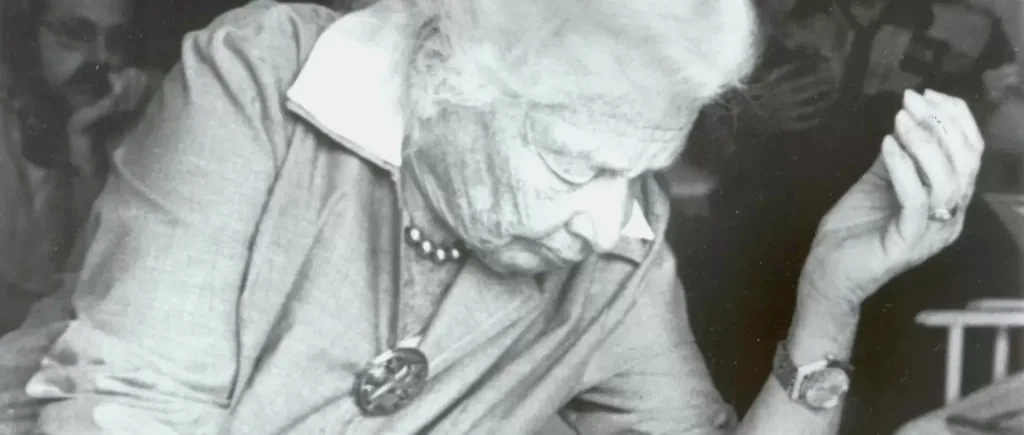
IDA ROLF, 1896–1979
Introduction
Understanding Rolfing begins with its origins. Before developing this bodywork, Ida Rolf (1896–1979) worked at a leading research institution as a biochemist. Why did a scientist leave the laboratory and choose the living body as her subject?
A BIOCHEMIST
Ida Rolf as a Biochemist
Born in New York in 1896, Rolf graduated from Barnard College in 1916 and began biochemical research at the Rockefeller Institute the following year, when women scientists were rare. In 1920 she earned a doctorate in biological chemistry from Columbia University and worked at the frontiers of biochemistry under nucleic-acid researcher Phoebus A. T. Levene.
She remained at Rockefeller after her degree, became an associate in 1922, and continued research for roughly twelve years, publishing more than a dozen papers on lecithin and cephalin.Rolfing emerged from the hands of a formally trained scientist —an important fact to keep in view.
A NETWORK
The Intuition that the Body Is a Network
In the late 1920s, Rolf left the institute and studied mathematics and atomic physics in Zurich and biochemistry in Paris. As she confronted health problems affecting herself and her family, her attention moved toward areas conventional medicine did not reach.
At the heart of her view was one intuition:the body is not a collection of independent parts, but one continuous network connected through connective tissue . A biochemist trained to understand by breaking things into elements turned in the opposite direction, toward whole-body structure. Just as a wrinkle at one edge of a cloth changes tension throughout the fabric, tension in one area affects the balance of the whole. This is the foundation of Rolfing’s approach.
GRAVITY
Gravity: An Invisible Structure
Her other key insight concerned gravity.Health is a state in which the body can exist in its most natural harmony with gravity . When the body no longer fights this invisible force but finds support through it, standing and moving can require less effort. Rolfing reorganizes our relationship with gravity rather than manufacturing “good posture” through muscular effort.
MODERN RESEARCH
A Biochemist’s Intuition and Modern Fascia Research
Rolf described connective tissue as a continuous network long before fascia became a scientific subject. Once treated mainly as empirical observation, this view now sits alongside a growing international body of fascia research. Work centered at Ulm University in Germany has helped show that fascia is not passive wrapping, but active tissue involved in sensation and force transmission.Science is now beginning to give clearer form to Rolf’s biochemical intuition.
LINEAGE
A Lineage: From PhD to the Body
I earned a PhD in Medical Science in immunology at the University of Tokyo. The work was rooted in molecular biology, combining biochemistry and molecular genetics—ground not unlike where Rolf began. After doctoral study and the pharmaceutical industry, I moved toward somatic practice: from a place that trained logic to one that works with sensation, a path resembling Rolf’s.
In the same era, another scientist earned a doctorate in physics at the Sorbonne, researched nuclear physics, and developed his own bodywork: Moshe Feldenkrais. Rolf entered through gravity and Feldenkrais through movement, yet both reached toward nearly the same question: how can we understand a living, moving body? My own Rolf Movement teacher was also trained in the Feldenkrais Method. After pursuing science through reduction, one may turn toward the irreducible whole. Rolf stood there almost a century ago; I find myself within the same question.
Background and further reading
In this guide
Introduction
Understanding Rolfing begins with understanding its origins. The person who systematized this hands-on method, Ida Rolf (1896–1979), was a front-rank research biochemist before she developed her bodywork.
This post traces a single question: why did a scientist leave the laboratory and choose the body as her subject?
Ida Rolf, the biochemist
Ida Pauline Rolf was born in New York in 1896. She graduated from Barnard College in 1916 and, the following year, took up research in biochemistry at the Rockefeller Institute (now Rockefeller University) — at a time when women in scientific research were rare.
In 1920 she earned a doctorate in biological chemistry from Columbia University’s College of Physicians and Surgeons. Her advisor was Phoebus A. T. Levene, known for his work on nucleic acids, and her dissertation addressed the chemistry of unsaturated phosphatides. She was trained at the frontier of the biochemistry of her day.
After her doctorate she remained at Rockefeller, rising to associate in 1922 — then the highest rank open to a non-tenured researcher. Over roughly twelve years, in the departments of chemotherapy and later organic chemistry, she published more than a dozen papers on compounds such as lecithin and cephalin.
One point bears emphasis: Rolfing emerged from the hands of a formally trained research scientist.
From science to the body
In the late 1920s, Rolf left the Institute and traveled through Europe — studying mathematics and atomic physics in Zurich, biochemistry in Paris, and encountering the various views of health then current. Family circumstances eventually drew her away from academic life, and as she confronted health problems in herself and her family, her attention moved toward territory that conventional medicine did not reach.
What Rolf drew on in that period, and how those influences crystallized into the principles of Rolfing, is traced in detail elsewhere. This page turns instead to what came next: how she saw the body.
→ The History of Rolfing and Alternative Medicine
The intuition that “the body is a network”
The core of Rolf’s vision can be distilled into a single intuition. The body is not an assembly of separate parts. Through the connective tissue that wraps, supports, and threads through muscle, bone, nerve, and organ, it exists as one continuous network.
For someone trained as a biochemist — trained, that is, to understand by breaking things into their elements — this meant looking deliberately in the opposite direction: toward the structure of the whole. Rather than a local symptom, the body is grasped within the connections of the whole.
Just as a crease at the edge of a stretched cloth alters the tension across the entire fabric, tension in one region of the body affects the balance of all of it. And so, rather than chasing the symptom itself, the work is to restore the balance of the whole. Here lies the foundation of Rolfing’s approach.
Gravity, an invisible structure
Rolf’s other insight concerned gravity. Health, she held, is the state in which the body can exist in the most natural possible harmony with gravity.
Gravity is a structure that acts without cease yet rarely rises into awareness. When the body can form a relationship in which it is supported by this invisible force rather than fighting it, a state emerges in which standing and moving take the least effort. The idea that good posture is built not by muscular force but by re-weaving the body’s relationship to gravity marks a dimension that manipulation and massage do not touch.
→ Why Good Posture Is Not a Matter of Muscle Strength — Tonic Function and Its Relationship to Gravity
The biochemist’s intuition and modern fascia research
When Rolf understood connective tissue as a continuous network, fascia was still far from being a subject of science. For a long time this view was regarded as no more than a rule of thumb.
In recent years, however, research taking fascia itself as its object has accumulated internationally. Fascia research based at Ulm University in Germany has shown that fascia is not a mere wrapping but an active tissue involved in sensation and in the transmission of force. Several types of mechanoreceptor have been identified within fascia, and a plastinated human specimen (FR:EIA) has made the continuity of fascia throughout the body visible to the eye.
The biochemist’s intuition, in other words, is now being given definition from the side of science. This fact leads directly to a question. When Rolfing is called “pseudoscience,” on what is that judgment based? And how is that judgment affected by the fact that the person who created this practice was a front-rank biochemist — and that her intuition is coming to be supported by contemporary research?
This question is taken up directly in the article below.
→ Is Rolfing Pseudoscience? — Understanding Rolfing Through the Science of the Body
A lineage — from PhD to the body
A biochemist left the laboratory and reached for the body.
I earned a doctorate in Medical Science (immunology) at the University of Tokyo Graduate School of Medicine. My degree is in immunology, yet the substance of the research was rooted in molecular biology — biochemistry joined with molecular genetics. By a curious coincidence, this placed me on the same ground where Rolf first stood: biochemistry.
After my doctoral studies I worked in medical marketing in the pharmaceutical industry, and in time turned toward the practice of the body — from a place that sharpens logic to one that engages sensation. This resembles the path Rolf walked.
And this path is not a line joining only two points, Rolf and myself. In the same era there was Moshé Feldenkrais. A scientist who earned a doctorate in physics at the Sorbonne and worked on nuclear research in the laboratory of Joliot-Curie, he nonetheless — after a knee injury of his own — spent his life exploring the relationship between movement and awareness, and built a bodywork of his own.
The subtitle of his first book carries the word “gravitation.” Rolf through gravity, Feldenkrais through movement: two scientists reached, each from their own side, toward nearly the same question — how to understand the living, moving body.
And these two currents meet within me. I learned Rolf Movement from Rita Gerolia, a Rolf Movement instructor who also holds certification as a Feldenkrais Method Practitioner. Rolf’s regard for structure and Feldenkrais’s regard for movement were not two distant, separate lineages; they came together within one teacher — and they have profoundly shaped my own hands-on work.
This is less a coincidence than something close to a necessity. At the far end of pushing the scientific training that breaks things into elements, one comes to want to face the “whole” that cannot be broken down — the living, moving body.
The logic that a doctorate trains, and the intelligence that lives in the body: their convergence is what this site calls PhD × Somatic Intelligence. Rolf stood at its threshold nearly a century ago. I stand within the same question.
Rolfing today
The practice Rolf shaped in the 1940s and began teaching in the 1950s is still carried on around the world. Certified Rolfers number roughly 1,950 worldwide, of whom about 130 are in Japan. A discipline that began from the intuition of a single scientist has continued for more than half a century.
Further reading
Is Rolfing Pseudoscience?
Its founder was a leading biochemist, and modern research is beginning to support aspects of her intuition. Read a careful assessment through the science of the body.