Introduction
This article examines how humans make decisions under uncertainty, and contrasts this process with AI-generated reasoning, focusing on implications for evaluation, judgment, and error detection.
In particular, it examines why logically optimal answers can still fail in real-world decision-making, and how such gaps can be identified through evaluation and judgment.
Have you ever felt this?
“I know what I should do… but I just can’t move.”
At the start of a new season, when environments shift and decisions matter more,
many people find themselves facing questions about their future—education, career, direction.
Today, we live in a world where options are endless.
With AI, we can access “optimal answers” instantly.
And yet, something remains unresolved.
A hesitation. A lack of clarity.
Why is that?
In my daily practice in Shibuya, working with clients through Rolfing sessions,
I often encounter this exact state—
people who understand, but cannot act.
Recently, I came across news about Artemis II.
It symbolizes humanity stepping once again into the unknown.
At the same time, our everyday lives are being reshaped by AI at an unprecedented pace.
As boundaries blur and possibilities expand,
how do we find a decision we can truly stand behind?
The Dilemma of “Optimal Answers”
These days, I regularly use tools like Gemini and ChatGPT
for research and structuring my thoughts.
What’s remarkable is the precision of the “logical optimal answers” they provide.
Based on vast amounts of data, their responses are often more objective—and seemingly flawless—than human reasoning.
This is especially evident in career decisions:
- Academic performance
- Income projections
- Market stability
Feed in the data, and AI will generate “the best choice” for you.
But here is the deeper question:
Can we truly stay committed to a path chosen this way?
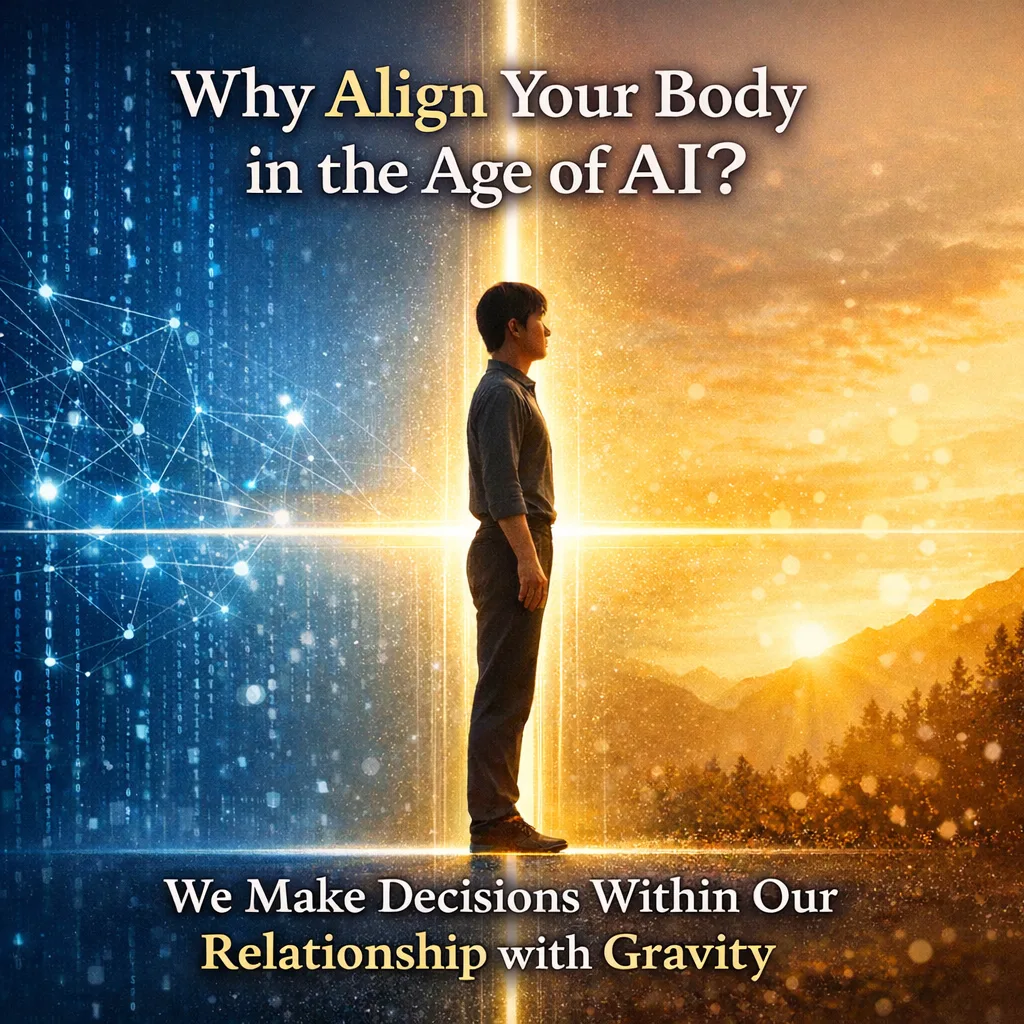
We Decide Within Our Relationship to Gravity
We are not just thinking minds.
We are physical beings, constantly shaped by gravity.
From the perspective of Rolfing,
our decisions are deeply influenced by how our bodies relate to gravity.
When we feel anxious or uncertain,
our bodies subtly resist gravity—lifting the shoulders—or collapse under it—rounding the back.
In this state, the nervous system shifts into survival mode.
Stress hormones increase, perception narrows,
and we default to conservative, defensive choices.
But when the pelvis aligns naturally,
something changes.
As the pelvis stabilizes and the spine organizes along the line of gravity,
unnecessary tension dissolves.
In this state of alignment with gravity,
the nervous system settles, and clarity emerges.
The quality of our decisions is not determined by thinking alone,
but by the state of our body.
When the Body Changes, Decisions Change
In actual sessions, I have seen this repeatedly.
As the body reorganizes,
confusion around decisions often dissolves naturally.
Choices that felt impossible to make before
suddenly become simple.
It is not so much a “conclusion reached by thinking,”
but rather a sense of knowing.
This is not something extraordinary.
It is a natural process—
when the body and nervous system stabilize,
our inherent decision-making capacity returns.
“Felt Certainty” Does Not Exist in Data
AI excels at producing probabilistic answers based on past data.
But the sense of inner certainty—what we might call “felt conviction”—
does not exist in data.
It lives in the body.
In particular, in the deep stability of the lower center—the gut.
Just as spacesuits in the Artemis Program are designed not only for protection but for freedom of movement,
our decisions should not be rigid constructs built from information alone.
They must emerge from a body that can move, adapt, and align with gravity.
Reclaiming a Body Hijacked by External Metrics
For students preparing for exams,
the body is often exposed to constant external evaluation—scores, rankings, expectations.
Over time, breathing becomes shallow,
the pelvis tilts back, posture collapses.
In this state, the brain shifts into survival mode,
making authentic decision-making extremely difficult.
Restoring the body is not simply about relaxation.
It is more like updating an unstable operating system.
By realigning the pelvis and reconnecting with gravity,
we regain the capacity to stay present in uncertainty
and to discover our own “north star.”
Conclusion
In the age of AI,
we no longer need to compete in knowledge or logical processing.
What ultimately matters is this:
Can you entrust your life to the decision you make?
Rather than searching for the “correct answer” externally,
we must learn to generate answers from within—
from a body grounded in gravity.
Moments like entrance exams or career decisions
can become opportunities to cultivate this lifelong capacity to choose.