
I had the chance to visit “BEYOND EARTH” (Japanese title: Kanata to no Kōshin, “Communication with the Beyond”), a solo exhibition by YOSHIROTTEN, an artist I know, at TOKYO NODE in Toranomon Hills, Tokyo.
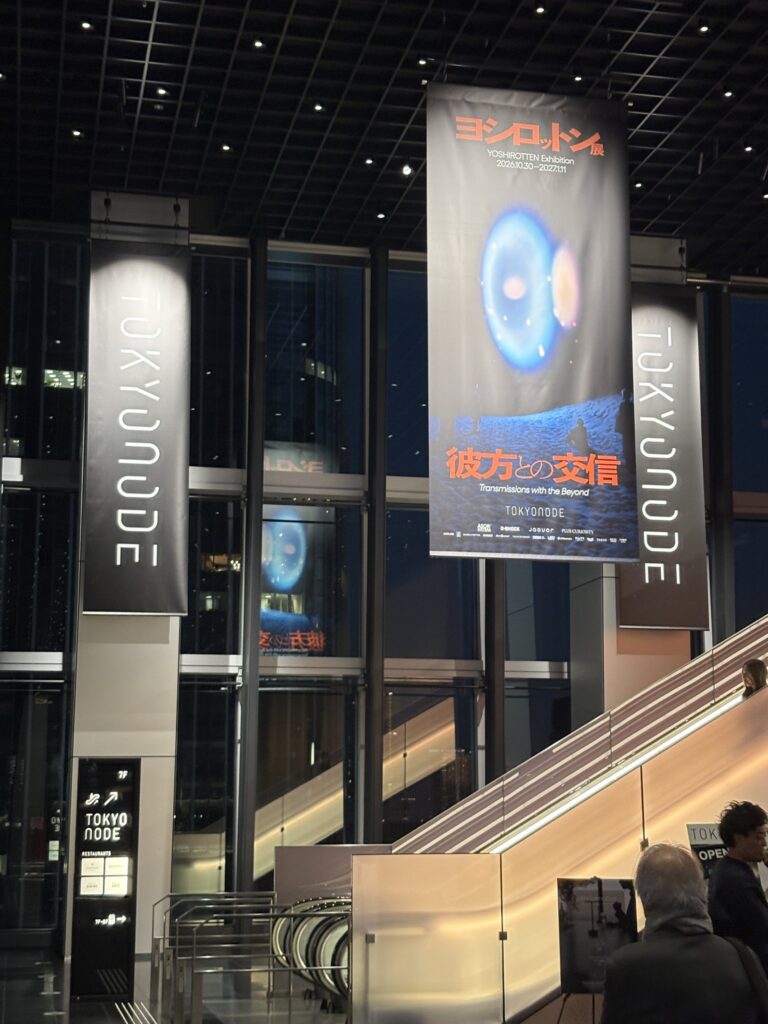
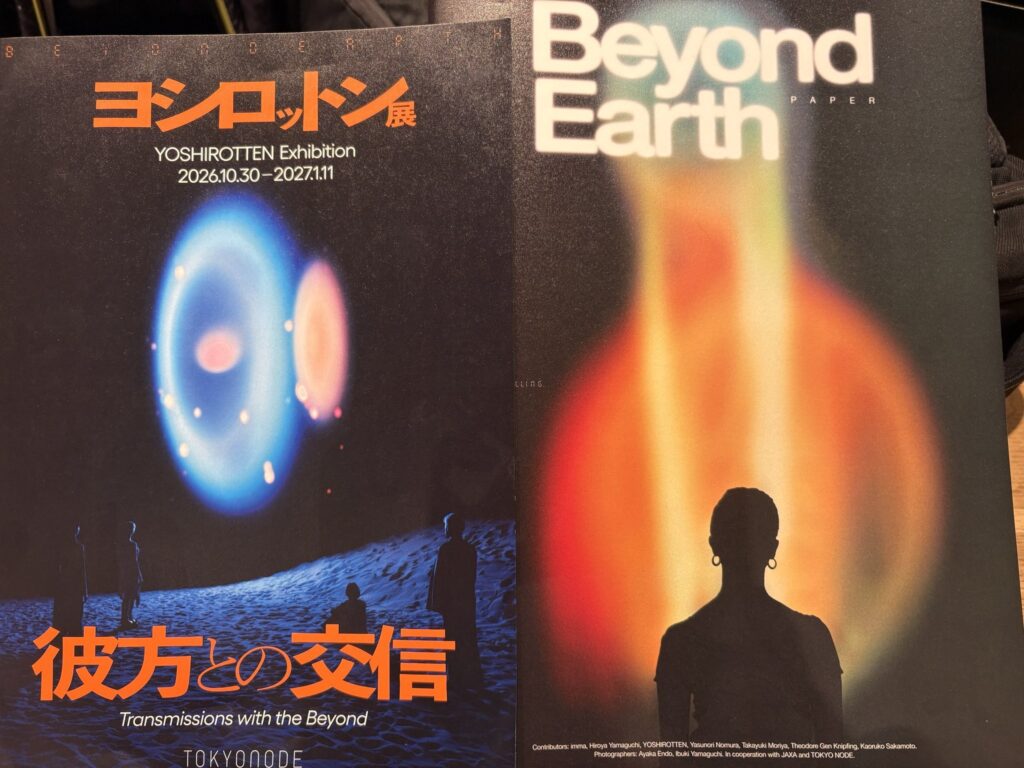
The exhibition runs from October 30, 2026 to January 11, 2027. JAXA (the Japan Aerospace Exploration Agency) collaborated on the project, and real observational data, along with equipment once used at research facilities, are shown as part of the works.
YOSHIROTTEN guided me through the show himself, and we spent about 40 minutes going through it. Here I want to write about what stayed with me, drawing on BEYOND EARTH PAPER, a free publication he gave me.
When the Light Outside Changes Color
Colored film covered the gallery windows, changing the color of the light coming in from outside. In the first room, home to the RGB series, the windows were tinted blue; in the next room, orange.
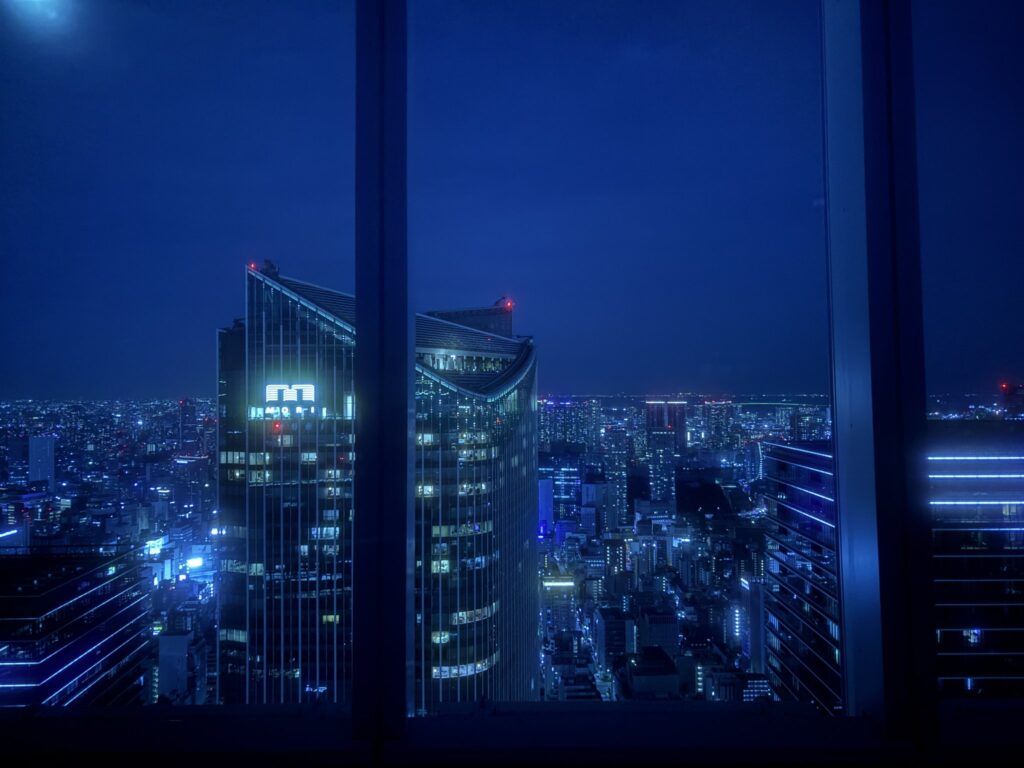
How does the world look when only the color of light changes? I enjoyed the night view of Tokyo through the blue film, and the same city glowing red through the orange.
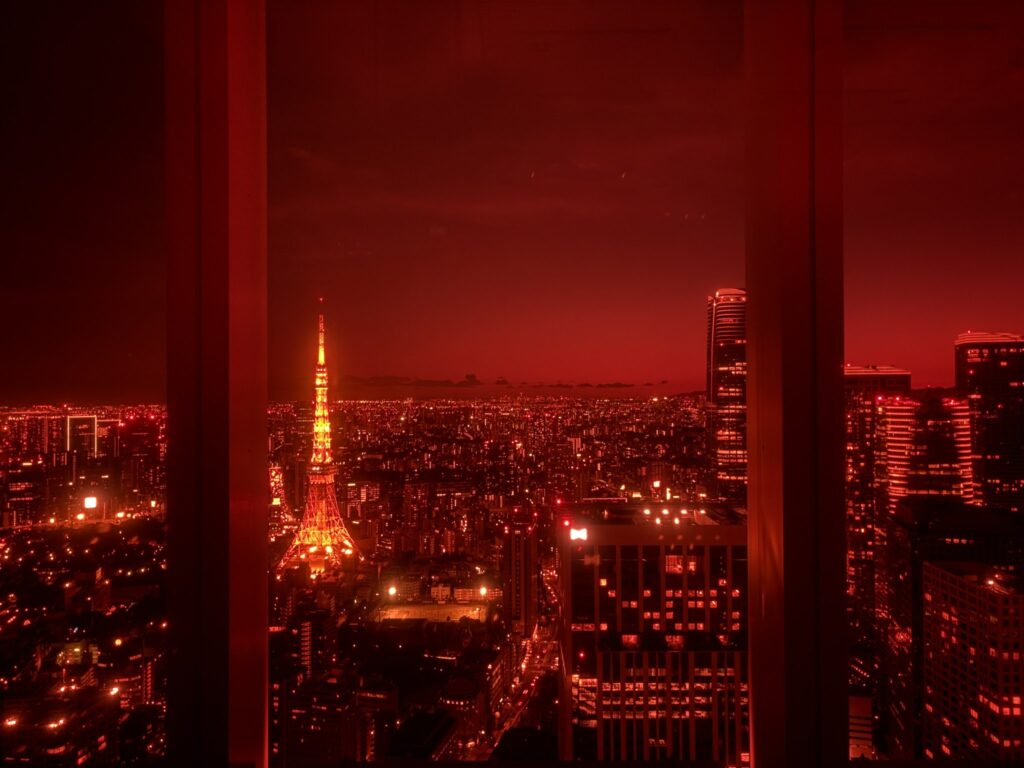
As the color shifted, so did my sense of the space. It struck me again that the way we grasp space depends on vision.
In a conversation printed in the paper, the theoretical physicist Yasunori Nomura, a professor of physics at the University of California, Berkeley, points out that human senses respond to only a very narrow range of things. We can perceive roughly 5 percent of the universe.
In that sense, he suggests, what we can see is the exception rather than the rule.
Black Holes and Supernovae as Graphics
I was also fascinated by how black holes and supernovae were rendered as graphics.
Puddle – Cygnus X-1 is built from X-ray data on Cygnus X-1, a system that contains a black hole, observed by JAXA’s X-ray Imaging and Spectroscopy Mission (XRISM).
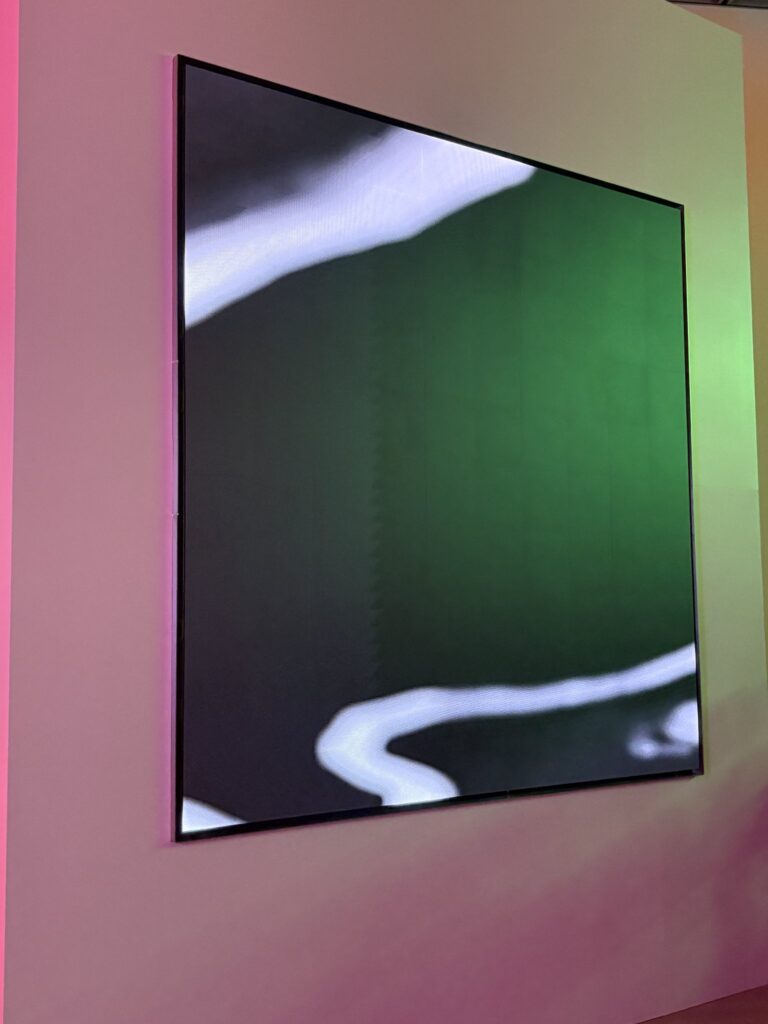
The data become raindrops falling onto a virtual water surface, and the ripples they leave form the image of a puddle. A new work, Supernova, traces the process of a stellar explosion.
These works grew out of conversations with Hiroya Yamaguchi, a professor at JAXA’s Institute of Space and Astronautical Science and the principal investigator of XRISM.
An interview with an XRISM researcher in the paper explains that a black hole itself cannot be seen. What can be observed are the X-rays from the gas drawn in around it, heated into plasma at one million or even ten million degrees.
Iron, Gold, and Neutron Stars: Where Do the Elements Come From?
Supernovae are something I find deeply fascinating.
Right after the universe began, there were only three elements: hydrogen, helium, and lithium. A star is born when gas gathers under gravity and nuclear fusion begins. Through fusion, stars forge new elements, and the last one they produce this way is iron.
Remarkably, elements heavier than iron are created in supernovae, the explosions that end a star’s life. New elements appear only when an event releases an enormous amount of energy.
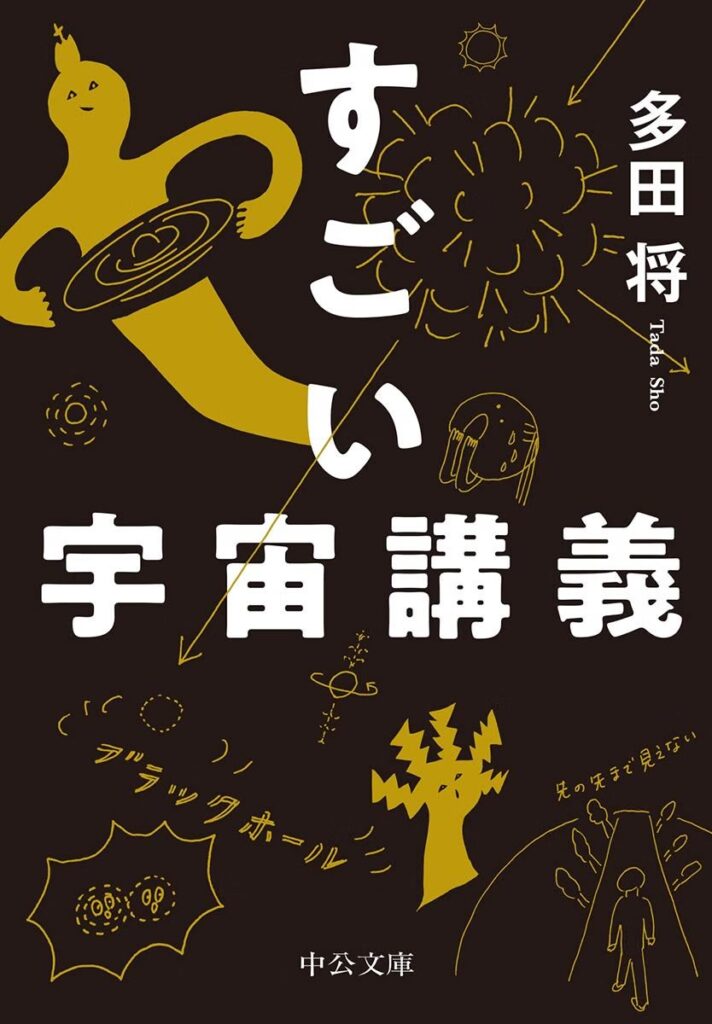
I learned this from the physicist Masashi Tada’s book Sugoi Uchū Kōgi (roughly, “Amazing Lectures on the Universe,” available in Japanese). According to Tada, how a star dies depends on its mass. A star of 10 to 20 times the mass of the Sun becomes a neutron star; one of 30 times or more collapses even further into a black hole.
How gold is made is still not fully understood. One possibility is that it came from a rare event: two extremely dense stars colliding.
If so, gold needs something close to a miracle to exist at all. In a sense, it may be truly precious.
Nomura, however, offers another view in the conversation. The structure of the universe looks miraculous, he says, but modern science knows it is not truly a miracle.
There are countless stars and galaxies, and complex structures like us can arise only where the conditions happen to line up. So wherever we look around us, it will always seem as if a miracle has occurred.
The researcher interview also explains that the solar system and Earth took in elements scattered by supernovae that exploded before the solar system formed. The oxygen, carbon, and calcium in our bodies have all “been inside a star at least once.”
YOSHIROTTEN also told me about the supernova of 1054. A “guest star” suddenly appeared in the sky over Heian-kyo, the old capital now known as Kyoto, and the record of it was later copied by the poet Fujiwara no Teika into his diary, Meigetsuki. Nearly 900 years later, astronomers identified the remnant of that explosion as the Crab Nebula. Today, XRISM is reading its light.
The 1970 Control Console of Ohsumi
Also on display was the control console from the Uchinoura Space Center in Kagoshima, which in 1970 guided Ohsumi, Japan’s first artificial satellite, into orbit. In the exhibition, its buttons and lamps blink in response to data from MAXI, an X-ray monitor aboard the International Space Station (ISS).
SUN on a Large Screen
And it was a pleasure to see SUN on a large screen.
SUN is an art project that grew out of 365 images YOSHIROTTEN created continuously during the COVID-19 pandemic. Since its debut in 2023, it has taken many forms, including installations, prints, records, and books, as well as a large-scale installation at Japan National Stadium that same year. For this exhibition, he made a new video work about 10 hours long.
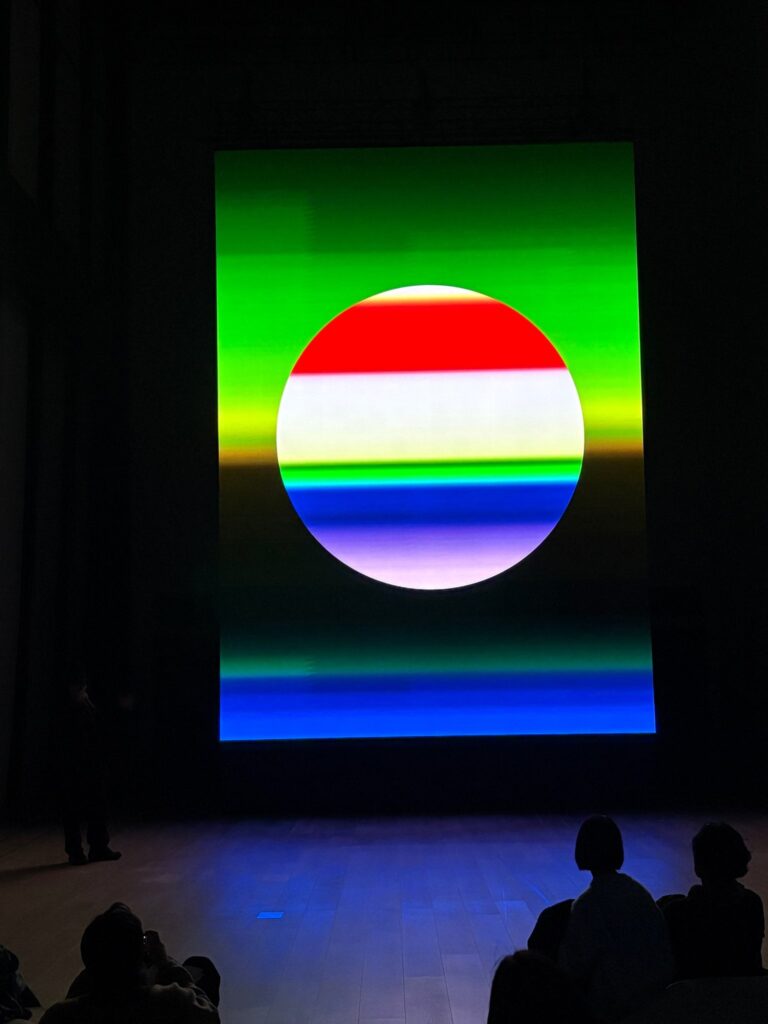
Its starting point is one hypothesis about Earth’s core: that a silver landscape may lie deep beneath the ground. Unknown minerals and substances shift through colors, and their light reflects off a silver surface. While depicting an unknown world, the work also holds universal themes, such as the seasons and the way things change.
Conclusion
According to an interview in the paper, YOSHIROTTEN was looking out at Tokyo from the gallery windows when his gaze drifted upward. The moment he saw the sky, he thought, “Space.” The theme of the exhibition was nearly settled that same day.
If you are interested in space, I recommend seeing the works created in collaboration with JAXA.