
Introduction
“I know what I should do, but I just can’t act.”
You want to change jobs, yet you remain in the same place for years. You clearly know what needs to be done, but somehow you keep postponing it. You want to change your relationships, yet you find yourself returning to the same patterns.
This state is not simply laziness or a lack of willpower. In fact, in many cases, the person has already thought deeply, struggled, and made significant efforts. And still, they cannot move.
So what is really happening?
Inability to Act Is Not a Problem of Will
We tend to think, “If I just try harder, I should be able to act.”
But in reality:
- we set goals but cannot sustain them
- we cannot maintain motivation
- we stop right before making a decision
These patterns repeat themselves.
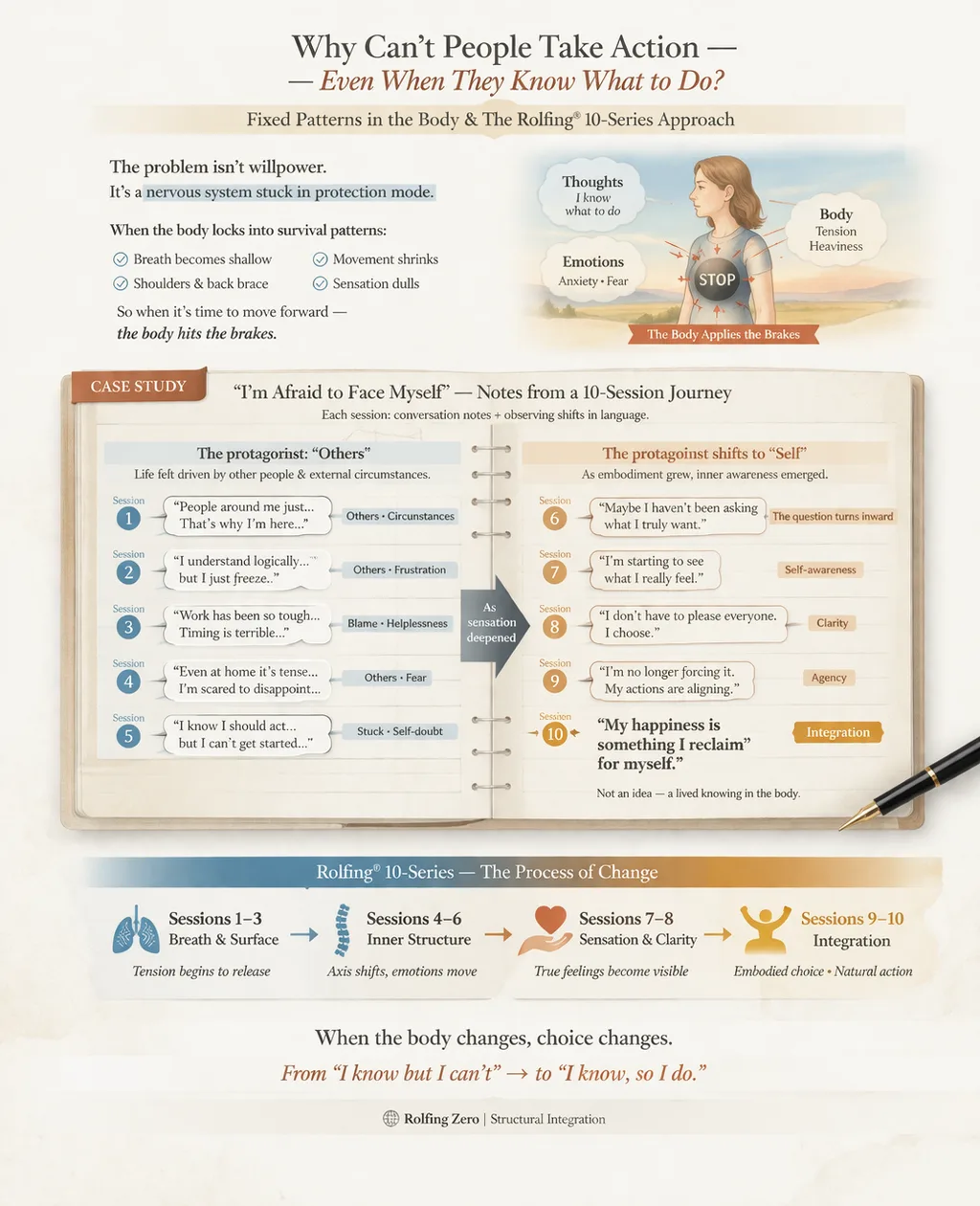
This is not a problem of will. It is because the body is functioning in the direction of “stopping.”
The “Structure of Stopping” Fixed in the Body
The human body creates patterns based on past experiences:
tension, anxiety, fear, past failures.
In order to cope with these, the body unconsciously learns certain responses.
For example:
- breathing becomes shallow
- tension accumulates in the shoulders and back
- movements become smaller
- perception becomes dulled
All of these are responses designed to maintain safety.
However, once these responses become fixed, the same patterns are repeated even in situations where they are no longer necessary.
As a result, when we try to move forward, the body unconsciously applies the brakes.
Where Does “Attachment” Remain?
Many people who cannot move forward feel that they “cannot let go.”
- past events
- relationships
- roles
- ideals of who they should be
They understand intellectually that these are no longer necessary.
And yet, they cannot release them.
This may appear to be a psychological issue, but in reality, it is a state in which patterns are maintained at the level of the body.
In other words, attachment is not a “thought,” but a form or tension remaining in the body.
Why Changing from the Mind Doesn’t Work
Many people try to change themselves through thinking or emotions.
However, if the body’s patterns remain unchanged, the same reactions will repeat.
This is because the body reacts faster than thought.
A Client’s Transformation
I once worked with a client like this:
“I am afraid to face myself.”
At the same time, there was also curiosity: “I want to change.”
This person came to each session, but at first, our conversations were mostly casual, like small talk.
Whenever we tried to touch something essential, fear would arise immediately, and their words would stop.
What was particularly interesting was that the change did not occur during the session, but after the session.
As the body became more organized, the strong “fear response” gradually weakened on its own.
As a result, each time, one business-related issue became clearer, and their mind became lighter step by step.
Change Did Not Come from Conversation, but from the Body
I did not give any special advice.
Rather, what I focused on was simply organizing the body.
Then, gradually, the state shifted from:
“I know what to do, but I can’t act”
to:
“I know what to do, so I can act.”
When the Subject Changes, Movement Begins
I make it a practice to take notes during sessions as much as possible.
When I reviewed this client’s record over ten sessions, one symbolic change stood out:
the change of the “subject.”
At the beginning, the subject was always external:
- “Other people are like this…”
- “The company is like this…”
- “The environment is…”
However, as the sessions progressed and bodily awareness deepened, the language naturally shifted toward:
- “What do I want?”
- “What am I feeling?”
Bodily Sensation Brings Us Back to the Present
Bodily sensation has the power to bring us back to the “here and now.”
Thought tends to move toward the past or the future, but the body always exists in the present.
As bodily awareness is restored:
- reality can be perceived more accurately
- one’s own state becomes clearer
- choices become simpler
The Change That Ultimately Occurred
After completing the ten sessions, the client said:
“I realized that my happiness is something I must reclaim myself.”
This was not a statement understood intellectually.
It was a lived realization that emerged when body, sensation, and thought became aligned.
What the Rolfing 10-Series Brings
The Rolfing 10-Series is not simply about adjusting the body.
It is a process that transforms how a person chooses.
- perception changes
- the way of seeing changes
- the subject changes
And ultimately, behavior changes.
Conclusion
People cannot act not because they lack thinking, nor because their will is weak.
It is because there exists a “structure of stopping” in the body.
Rolfing works with this structure.
And before asking,
“What should I do?”
it creates a state in which
one can move naturally.
If you feel that:
- you know what to do, but cannot act
- you are repeating the same patterns
- you cannot let go even though you want to
then the issue may not be your way of thinking, but your bodily patterns.
Rolfing is a method for revisiting those patterns.
And within that process, space naturally opens for new choices to emerge.