Introduction
In a recent conversation with an executive client, something familiar emerged.
He already knew the answer.
The data was clear.
The strategy made sense.
And yet—he couldn’t move.
This kind of hesitation is often misunderstood.
It is not a lack of intelligence, nor a lack of information.
It is something deeper.
The Illusion of Rational Decision-Making
In modern business, decision-making is treated as a cognitive process.
We gather data.
We analyze options.
We optimize for outcomes.
With the rise of AI, this tendency has only intensified.
We now have access to faster, clearer, and more logically consistent answers than ever before.
But something essential is missing.
Because even when the “right” answer is clear—
action does not always follow.
Where Hesitation Actually Lives
Through my work in Rolfing®, I began to notice a pattern.
Hesitation is not located in thought.
It is felt in the body.
A subtle contraction.
A lack of grounding.
A sense that something is “off,” even if it cannot be explained.
This is why people often describe decisions in physical terms:
“I can’t move forward.”
“Something is holding me back.”
“It doesn’t feel right.”
These are not metaphors.
They are direct experiences of the body.
Three Dimensions of Decision-Making
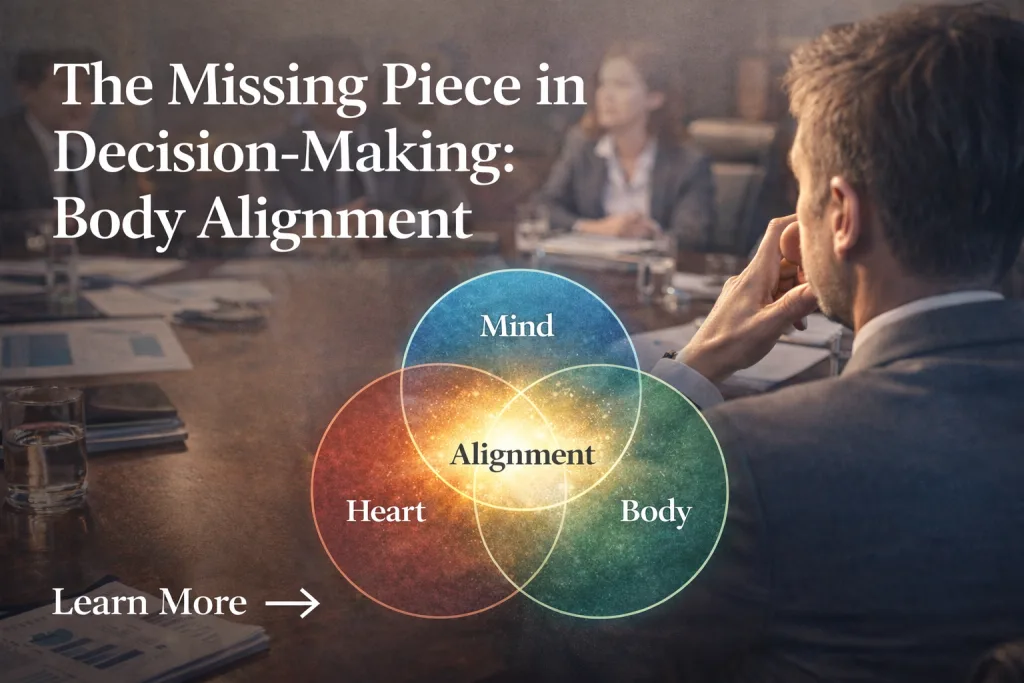
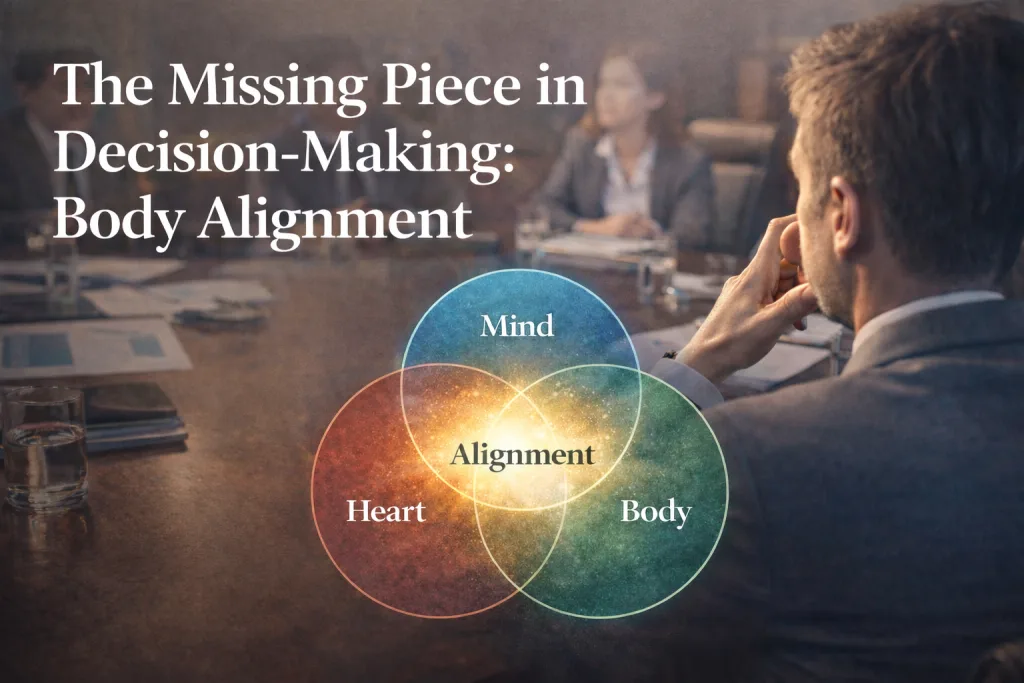
When a decision flows naturally, three dimensions are aligned:
- Mind — what you think
- Heart — what you feel
- Body — what you do (or cannot do)
When these are aligned, action becomes almost effortless.
When they are not, hesitation appears.
And no amount of additional thinking resolves it.
Why AI Cannot Solve This
AI operates almost entirely within the domain of the mind.
It can optimize logic.
It can structure reasoning.
It can simulate understanding.
But it cannot sense:
- internal tension
- emotional incongruence
- loss of embodied conviction
Because these signals do not exist as data.
They exist as experience.
The Role of Rolfing®
This is where Rolfing® offers a fundamentally different approach.
Rather than working only with thought,
it works directly with the body’s organization in gravity.
As the body becomes more aligned—
- breathing changes
- support increases
- unnecessary tension releases
And something else happens.
Decisions begin to feel different.
Not because the external situation has changed,
but because the internal alignment has shifted.
From Thinking to Alignment
The question is not simply:
“What is the right decision?”
But:
“Is my whole system aligned with this direction?”
When mind, heart, and body move together,
decision-making becomes clearer—and action follows naturally.
Sometimes, the shift we need is not more thinking—
but a different kind of awareness.
Conclusion
In an age where answers are abundant,
alignment has become the real challenge.
And perhaps the most important skill is not thinking better—
but sensing more clearly.
Closing Question
Have you ever known the answer—
but still couldn’t act on it?
Working with the Body
If this resonates, it may not be something to “solve” through thinking alone.
In my sessions, we explore how the body organizes itself in gravity—
and how that directly affects perception, emotion, and decision-making.
Often, when the body finds a different kind of support,
clarity emerges without forcing it.
If you’re interested in experiencing this shift firsthand,
you can learn more about how this work supports decision-making and alignment here:
Learn More