
Yoga × Rolfing Five-Part Series | Part 3 | First draft: May 2025. Updated 2026.
Introduction
“My lower back hurts when I sit.” “My pelvis won’t settle.” “The harder I try to meditate, the more the body distracts me.” When the way of sitting refuses to deepen despite years of yoga, the problem is not how well the poses have been mastered — it is a sign that the body’s “space” has been lost.
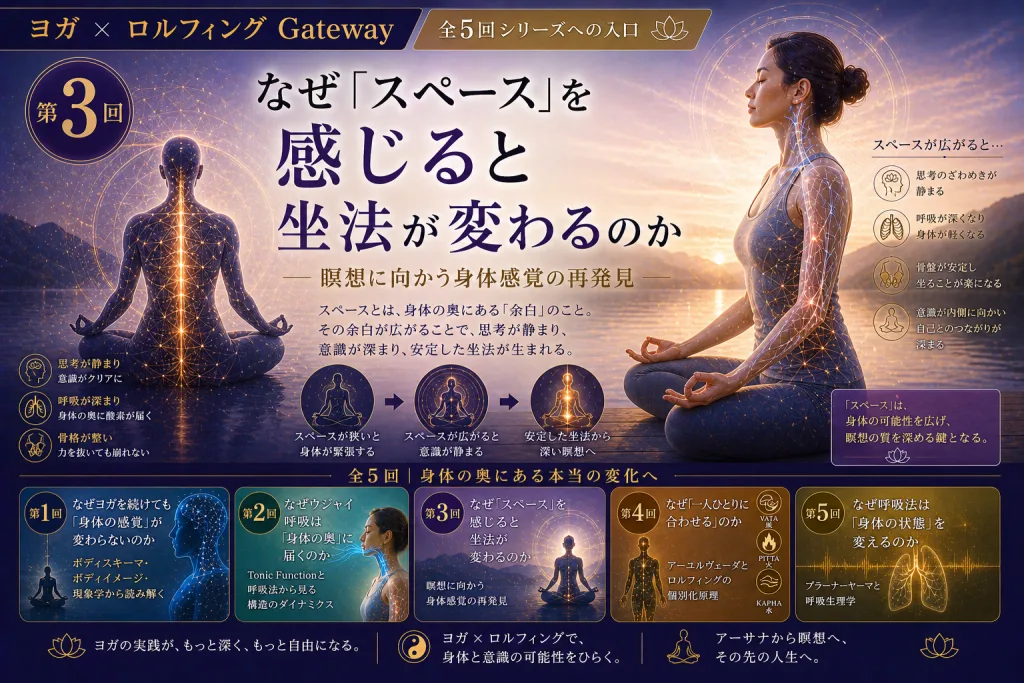
Part 1 dealt with the “gap in the body schema,” and Part 2 with “breath and Tonic Function.” This third article, which closes the opening trilogy, takes the concept of “space” — shared by yoga and Rolfing — as its axis, and explores how the way of sitting changes and how the body prepares for meditation.
Parts 4 and 5 build on this theoretical ground with experiential inquiry, starting from an Ayurveda stay in Sri Lanka and a continuous pranayama course.
→ Gateway: Yoga × Rolfing — 20 Years of Ashtanga, and the Encounter with Rolfing
→ Part 1: Why Does “the Sensation of the Body” Not Change Even After Continuing Yoga
→ Part 2: Why Does Ujjayi Breathing Reach “the Depths of the Body”
Yoga Is Bodily Training for “Sitting for a Long Time”
Practicing Ashtanga Vinyasa Yoga since 2006, the first thing my teacher, Tarik Thami, taught me was this:
“The aim of yoga is to become able to sit for 20 minutes without strain on the body.”
These words changed my view of yoga profoundly. A pose was not exercise for improving flexibility; it carried a clear intention — bodily training that organizes the “structure” for sitting, a preparation for meditation.
Why “20 minutes without strain”? Because turning inward requires both structural stability and a stillness of sensation. When the body is unstable, attention is pulled back to pain or discomfort, and entering meditation becomes difficult.
Yet the voices are many: “sitting is hard,” “my shoulders and lower back ache,” “my breath is shallow.” Behind these problems lies a lack of structural and sensory integration.
→ What Is the Difference Between Squatting and Sitting — The Influence of Chair Culture on the Body
Ida Rolf’s Reading of Yoga — Making Space
Ida Rolf, the founder of Rolfing, said this about yoga:
“The principle aim of yoga asanas is to increase the space at bony interfaces.”
But Rolf also saw something else.
When poses are repeated unconsciously, or when excessive flexibility is chased, the joints and fascia can contract and structural freedom can be lost — far from widening the space at the joints, the poses often narrow it instead.
Getting the “shape” of a pose right and “making space” do not necessarily coincide — this was Rolf’s insight. Rolf observed that when yoga poses are practiced unconsciously or with excessive emphasis on flexibility, joints and fascia often become compressed, reducing structural freedom.
Duhkha and Sukha — a Bodily Philosophy of Space
At a workshop by Leslie Kaminoff held in Japan in 2013, what left a deep impression on me was his explanation of sukha and duhkha.
“Sukha is ‘good space,’ duhkha is ‘bad space.’ Yoga is the practice of widening sukha and narrowing duhkha.”
The “kha” here means “space.”
Duhkha is a state where space is cramped — pain, suffering. This is also the root of “dukkha (suffering)” in Buddhism: a state where the joints of the body are congested, the breath is shallow, and movement is restricted.
Sukha is a state where space is open — comfort, freedom, ease of breathing. It is a state where the skeleton rides on the axis of gravity, the tonic muscles work naturally, and nothing collapses even when force is released.
“Yoga is making space within the body and making the breath easier” — these words resonate deeply with the Rolfing view. A body with space is precisely a body in which the breath deepens and sitting becomes possible.
Articulation — the “Interval” That Rolfing Works With
An anatomical term used often in Rolfing training is “articulation.”
Its difference from “joint,” which also means a place where bones meet, matters. “Joint” comes from “join,” and works in the direction of closing structure. “Articulation” comes from “articulate” — to make an interval, to segment, to make distinct — and it is a word that presumes the existence of space.
Rolfing places importance on evoking this “interval (articulation)” within the body, so that unnecessary muscular tension drops away on its own. Not “trying to correct the structure,” but “noticing that space is there” — and through that noticing, movement and breath organize themselves. This is the process of transformation from “doing” to “being.”
→ Why a “Comfortable Posture” Exists — From the Perspective of Gravity, Fascia, and Rolfing
Rolf Movement and the Felt Sense of Space
The sense of “space” in the way of sitting deepens not only through Rolfing — an approach to structure — but also through Rolf Movement’s “awareness within movement.”
In Rolf Movement’s observation of Pre-movement — the movement before movement — the moment just before rising from sitting to standing is felt carefully: where the body engages, and where it releases. Through this observation, a sense grows that “there is space, a foundation, beneath the pelvis.”
The “power to look inward” that yoga practitioners hold is fertile ground for entering this process. The sense of “moving while feeling,” grown through every morning’s Ashtanga practice, is refined further still by Rolf Movement.
→ What Is Rolf Movement — Bodywork That Explores the Quality of Movement
When Space Opens, Meditation Changes
In my own practice, too, combining the structural adjustment of Rolfing with yoga practice transformed the “sense of space” in the way of sitting.
The spine could lengthen without strain, and the breath no longer stalled. A sense of “space, a foundation, beneath the pelvis” emerged, and sitting grew stable. The shoulders and ribcage opened, and gaze and awareness turned inward on their own.
I think of meditation as “a device that updates the Recognition OS.” But for that device to work to its fullest, the “stand” it rests on — the body — must be in order. To “be” in a body that has space — this is the structural condition for meditation to “happen” naturally.
Presence is not “having correct posture.” It is to “be” in a state that has space. This way of inhabiting the body, shared by yoga and Rolfing, is what makes it possible to sit quietly for 20 minutes.
→ Yoga and Meditation — How to Incorporate Meditation into Yoga Practice (in Japanese)
Looking Back on the Series
Looking back on the opening trilogy. Across these three parts, the meeting points of yoga and Rolfing have been explored from three angles — body schema, breath, and space. Running through the whole is the complementary relationship touched on in the Gateway: yoga has a side that is “practice in moving within the fascial pattern that already exists,” while Rolfing is an approach that “rewrites the fascial pattern itself.”
The two do not oppose each other; they complement each other. Part 1 showed that unless the body schema changes, the same pattern repeats no matter how correctly a person tries to move with awareness. Part 2 showed that the breath is not something deepened by intention, but something that deepens naturally once the structure is in order. And Part 3 showed that space is not born within a shape, but appears from within when “structure and awareness” work together.
Yoga is a practice that grows sukha (free space) and releases duhkha (cramped space). Rolfing is a method that brings articulation (interval) to the body’s structure and guides it toward an integrated state free of tension. When these two meet, the original aim — “to sit for 20 minutes without strain on the body” — is realized more deeply.
Toward Parts 4 and 5 — individualization and a map of breathing, explored through experience. If the opening trilogy is the “theoretical ground,” Parts 4 and 5 form the second half, developing the inquiry from concrete experience.
Part 4 takes the Ayurveda I experienced in Sri Lanka in June 2015 as its starting point, treating the “principle of individualization” shared by Rolfing and Ayurveda. It is a theme that resonates with the fact that Krishnamacharya conveyed a different yoga to each of his four disciples (Pattabhi Jois, Iyengar, Indra Devi, Desikachar).
Part 5 starts from the continuous pranayama course that began in September 2015, rereading the map of breathing methods spreading behind Ujjayi from the viewpoint of modern respiratory physiology. It is a wider inquiry into breathing, on the extension of the Tonic Function and the Bohr effect treated in Part 2.
Yoga × Rolfing (Five-Part Series)
→ Gateway: Yoga × Rolfing — 20 Years of Ashtanga, and the Encounter with Rolfing (Gateway Article)
Part 1: Why Does “the Sensation of the Body” Not Change Even After Continuing Yoga — Reading It Through Body Schema, Body Image, and Phenomenology
→ Read Part 1
Part 2: Why Does Ujjayi Breathing Reach “the Depths of the Body” — the Dynamics of Structure Seen from Tonic Function and Breathing Methods
→ Read Part 2
Part 3: Why Does Feeling “Space” Change the Way of Sitting — Rediscovering the Bodily Sense Toward Meditation (this article)
Part 4: Why “Tailor to Each Person” — The Principle of Individualization of Ayurveda and Rolfing, Experienced in Sri Lanka
→ Read Part 4
Part 5: Why Do Breathing Methods Change “the State of the Body” — Pranayama and Modern Respiratory Physiology
→ Read Part 5
The sensation of the body and the transformation of the body schema are deeply connected to the process of updating the “Recognition OS.” What handles more deeply the theme of the integration of thought, emotion, and body is Mind and Bodywork Lab.
→ Recognition OS and Meditation Gateway (MBL) (in Japanese)
→ Mind and Bodywork Lab: How to Navigate This Site (in Japanese)
It is possible to begin by confirming, in a trial session, what is happening in the body map.
→ Applying for a Trial Session
Hidefumi Otsuka (Ph.D.) | Certified Advanced Rolfer™ / Rolf Movement Practitioner / Yoga Alliance certified instructor (RYT200)
Completed a doctoral program at the Graduate School of Medicine, the University of Tokyo. After a career in the pharmaceutical industry, has offered Rolfing® sessions in Shibuya since 2015. Has practiced Ashtanga Vinyasa Yoga since 2006. Works under the theme of “the integration of thought, emotion, and body.”