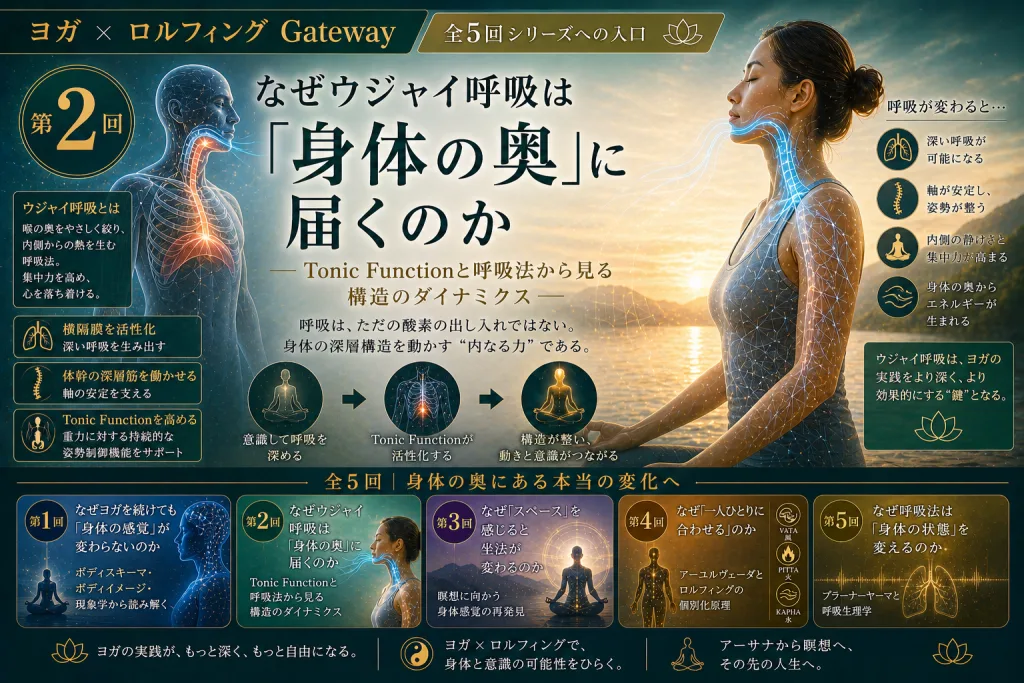
Yoga × Rolfing Five-Part Series | Part 2 | First draft: May 2025. Updated 2026.
Introduction
“The harder I try to deepen the breath, the more tension creeps in.” “I’m supposed to be doing Ujjayi breathing, yet it never feels like it reaches deep into the body.” These are things I hear again and again from Ashtanga practitioners.
Part 1 dealt with a gap in the “map of the body” — the mismatch between body schema and body image. This second part looks at how that same gap shows up in the breath, drawing on Tonic Function, respiratory physiology, and Rolf Movement.
→ Gateway: Yoga × Rolfing — 20 Years of Ashtanga, and the Encounter with Rolfing
→ Part 1: Why Does “the Sensation of the Body” Not Change Even After Continuing Yoga
What Is Tonic Function
Tonic Function was proposed by the French Rolfer Hubert Godard, who built the theoretical backbone of Rolf Movement. It points not to “posture” but to coordination within gravity.
“Tonic function is not a posture but a coordination in gravity.” — Hubert Godard
The Difference Between Tonic and Phasic Muscles
The tonic muscles — the sustained, deep antigravity muscles — work unconsciously and continuously against gravity, carrying postural stability, breathing, and the holding of the axis. They resist fatigue and keep working around the clock.
The phasic muscles — the transient, superficial muscles of movement — are the ones that produce large, momentary force: deliberate action, lifting weight, jumping. They tire quickly.
Stiff shoulders, low-back pain, and the sense of “getting tired even though it’s yoga” are all signs that the phasic muscles are standing in for the postural work the tonic muscles are meant to do.
Ujjayi Breathing and Tonic Function
Ashtanga’s Ujjayi breathing (Ujjayi Pranayama) narrows the back of the throat, producing a wave-like sound as the breath accompanies each movement. It is far more than a “breathing technique”: it has a structural mechanism that switches Tonic Function on.
Narrowing the throat slows the movement of the diaphragm, and the deep muscles of the trunk — the transversus abdominis, the pelvic floor, and the multifidus, all tonic muscles — begin to work in concert. This is what lies behind the sense that “Ujjayi breathing steadies the core.”
When the fascia has hardened, however, that coordination struggles to happen. The feeling of “breathing without any sense of depth” comes from fascial restriction blocking the neural signals to the tonic muscles. → Why “Good Posture” Is Not a Matter of Muscular Strength — Tonic Function and Its Relationship to Gravity
The Breath Speaks of Structure
The breath is the most honest barometer of the state of the structure and the nervous system. A breath that is shallow, easily held, or rapid points to a sympathetically driven state of tension or to an imbalance in posture.
Excess tension in the abdomen, reduced mobility of the diaphragm, and a locked neck and shoulders all disturb the natural wave of the breath. Simply setting out to “inhale deeply” and “exhale slowly” will not change the quality of the breath over the long term. Only when the structure changes does the breath deepen on its own.
Breathing and the Bohr Effect — the Role of CO₂
Patrick McKeown, in his book The Oxygen Advantage, explains the relationship between breathing and carbon dioxide.
“A reduction in carbon dioxide leads to decreased oxygen delivery to tissues.” — the Bohr Effect
When breathing is too fast, or tips into hyperventilation, too much CO₂ is flushed from the body. Oxygen then reaches the tissues less readily, bringing on chronic fatigue and a drop in concentration.
Yoga’s Nadi Shodhana (alternate nostril breathing) shifts the balance toward the parasympathetic nervous system and gently raises tolerance to CO₂. Kumbhaka (breath retention) deliberately raises the CO₂ level, training the body to deliver oxygen to the tissues more efficiently. Traditional breathing methods line up with modern respiratory physiology because, through experience, they discovered this deep mechanism of the body. A systematic map of these methods is treated in detail in Part 5, as the meeting point of pranayama and modern respiratory physiology.
Why Rolf Movement Reaches the Breath
Rolf Movement changes the quality of the breath because of one thing: it grows Tonic Function within movement itself.
Ashtanga’s movement leans toward the sagittal plane — front-to-back motion. Repeat that lean over years of practice, and a “front-back movement pattern” becomes inscribed in the fascia, so the breath, too, tends to be confined to the sagittal plane. The ribcage moves only forward and back, and the spread of the breath into the sides and the back is lost.
Rolf Movement, through a process of moving slowly, carefully, and while putting sensation into words, teaches a way of moving that does not overuse the phasic muscles. The diaphragm then becomes able to expand in a full 360 degrees, and the sense that “Ujjayi breathing reaches the depths of the body” is born.
Yoga practitioners already hold “the power to look inward.” The Rolf Movement approach draws on that power to re-educate the breath at the level of the nervous system. → What Is Rolf Movement — Bodywork That Explores the Quality of Movement
The Integration of Breath, Structure, and Presence
Yoga’s pranayama and Rolfing’s fascial work share a common aim: to open the inner space needed to be “here, now.”
As the deep senses of the body — proprioception and interoception — sharpen, what comes to the foreground is not reaction to outer stimuli but a quiet awareness arising from within. This is the doorway to dhyana (meditation), the final destination of yoga.
Jeff Maitland, a Rolfer and philosopher, put it this way: “Right action arises when we allow what is to show itself.”
Deep breathing and structural stability are the doorway to the presence that senses this “what is.” The “integration of breath and movement” built up through Ashtanga practice comes, through Rolfing and Rolf Movement, to reach the deepest layers of the body.
Yoga × Rolfing (Five-Part Series)
→ Gateway: Yoga × Rolfing — 20 Years of Ashtanga, and the Encounter with Rolfing (Gateway Article)
Part 1: Why Does “the Sensation of the Body” Not Change Even After Continuing Yoga — Reading It Through Body Schema, Body Image, and Phenomenology
→ Read Part 1
Part 2: Why Does Ujjayi Breathing Reach “the Depths of the Body” — the Dynamics of Structure Seen from Tonic Function and Breathing Methods (this article)
Part 3: Why Does Feeling “Space” Change the Way of Sitting — Rediscovering the Bodily Sense Toward Meditation
→ Read Part 3
Part 4: Why “Tailor to Each Person” — The Principle of Individualization of Ayurveda and Rolfing, Experienced in Sri Lanka
→ Read Part 4
Part 5: Why Do Breathing Methods Change “the State of the Body” — Pranayama and Modern Respiratory Physiology
→ Read Part 5
The sensation of the body and the transformation of the body schema are deeply connected to the process of updating the “Recognition OS.” What handles more deeply the theme of the integration of thought, emotion, and body is Mind and Bodywork Lab.
→ Recognition OS and Meditation Gateway (MBL) (in Japanese)
→ Mind and Bodywork Lab: How to Navigate This Site (in Japanese)
It is possible to begin by confirming, in a trial session, what is happening in the body map.
→ Applying for a Trial Session
Hidefumi Otsuka (Ph.D.) | Certified Advanced Rolfer™ / Rolf Movement Practitioner / Yoga Alliance certified instructor (RYT200)
Completed a doctoral program at the Graduate School of Medicine, the University of Tokyo. After a career in the pharmaceutical industry, has offered Rolfing® sessions in Shibuya since 2015. Has practiced Ashtanga Vinyasa Yoga since 2006. Works under the theme of “the integration of thought, emotion, and body.”