Yoga × Rolfing Five-Part Series · Part 4
Introduction
In Parts 1 through 3 of this series, the meeting points of yoga and Rolfing were explored from three angles — body schema, Tonic Function, and the sense of space.
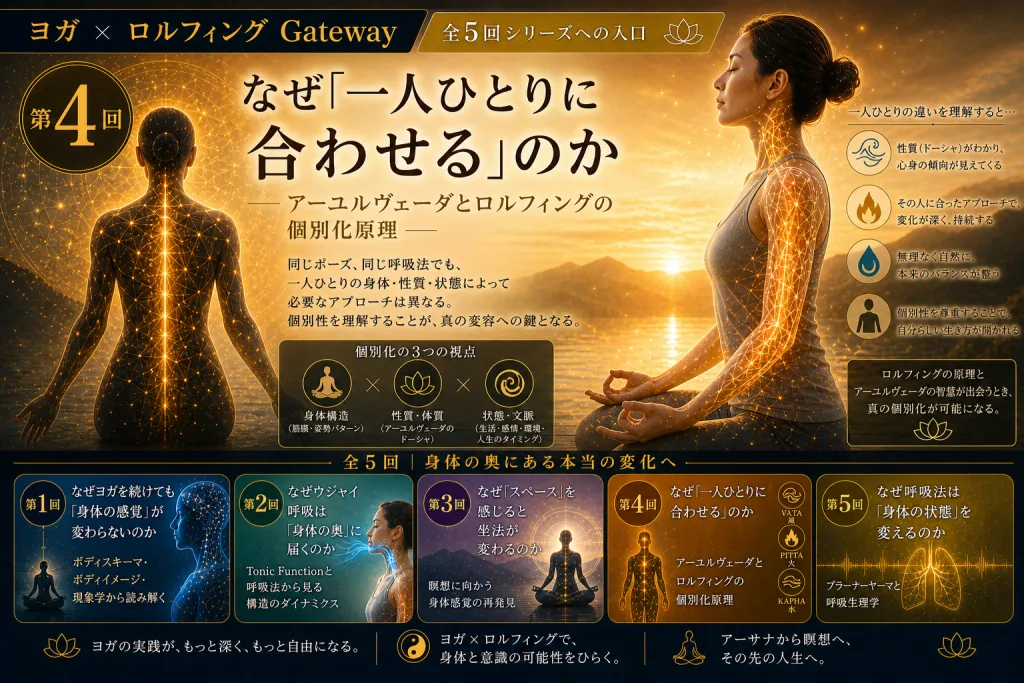
Part 4 shifts the view to practice. The theme is “individualization.” Ayurveda and Rolfing are entirely different systems, culturally and historically. Yet one principle runs through both — the stance of “responding to the state of the person, not to a manual.”
In June 2015, I spent four days receiving Ayurvedic treatment in Sri Lanka. Eleven years have passed since. That experience is still deeply dissolved into my work as a Rolfer. Drawing on the record of those four days, I want to set down where the “individualization” of the two overlaps and where it differs.
Four Days at Siddhalepa in Sri Lanka
In June 2015, midway through my round-the-world journey, I entered Sri Lanka. It was an eight-day program — four days of sightseeing plus four days of Ayurvedic treatment — arranged by the Ayurveda researcher Ms. Sachiyo Iwase.
The first four days were given to sightseeing through the land and its culture. The Temple of the Sacred Tooth Relic, the Buddhist ruins of Polonnaruwa, Sigiriya Rock, Pink Quartz Mountain — this followed Ms. Iwase’s principle that “to know Ayurveda, the best first step is to know its land.” The richness of Sri Lanka’s nature, the deep influence of polytheism and Buddhism, and a culture in which traditional medicine is handed down through generations — those four days of meeting all this with the whole body, looking back now, served as the groundwork for the Ayurveda experience that followed.
On the fifth day, June 17, 2015, I arrived at the Siddhalepa Ayurveda Health Resort in southwestern Sri Lanka. The four-day Ayurveda program Ms. Iwase had arranged began here.
I first came to know Ayurveda during the yoga teacher training at Under the Light Yoga School (UTL). I remember judging my own constitution with a checklist. Later, reading Tsuyoshi Takashiro’s Health Techniques for the Survival Era, I came to see Ayurveda anew — not as “mere treatment,” but as “a worldview toward the body.”
Two years from 2013, when I met Rolfing. Nine years from 2006, when I began Ashtanga Vinyasa Yoga. In a period of learning several bodily systems in parallel, I think, looking back, that I wanted to compare what each one was looking at and how they differed.
Siddhalepa is an Ayurveda-specialized health resort founded in 1999. Aimed at healing the “pre-disease” state and promoting health, it provides everything from herb cultivation to product development, treatment, and dietary therapy in one continuous whole. There I spent four days, each with the following structure:
- Morning: interview and confirmation of the treatment plan by an Ayurvedic doctor
- Late morning to early afternoon: oil massage plus herbal bath or steam bath (1.5–2 hours in total)
- Meals: food matched to the constitution (morning, noon, evening)
- Late afternoon: a lecture by an Ayurvedic doctor
All three doctors were women, and the treatment was handled by a therapist of the same sex (men for men, women for women). Becoming a therapist reportedly requires two years of training.
Let me note something first. I am not an Ayurveda practitioner. My position is to offer treatment as a Rolfer; as for Ayurveda, I only spent four days in June 2015 as a recipient. This article is a record of that experience. It is not intended to solicit Ayurvedic treatment or to recommend alternative medicine. It is meant to be read purely as a record of “what one body-practitioner who practices Rolfing observed within another system.”
Dosha (the Three Constitutions) — the Premise That “Nothing Is Good for Everyone”
“Ayurveda (Āyurveda)” is a Sanskrit word combining “ayur (life, lifespan)” and “veda (knowledge).” Translated literally, it becomes “the science of life.” It is a system that includes not only the treatment of illness but also prevention, the maintenance of health, rejuvenation, and the wisdom of how to live.
The concept placed at its center is the dosha. Dosha is translated as “temperament” or “constitution,” but it is not a fixed classification. It expresses the proportions in which three elements — Vata (wind), Pitta (fire), and Kapha (earth and water) — are at work within a person. Everyone holds all three elements, and their proportion characterizes the individual.
To sum up each tendency briefly:
- Vata (the quality of wind): light, fast, cold, dry / related to movement, change, and liveliness of thought
- Pitta (the quality of fire): hot, sharp, linear / related to metabolism, intellect, and judgment
- Kapha (the quality of earth and water): heavy, cold, stable / related to structure, nourishment, and endurance
The Ayurvedic doctor’s interview stretched to nearly an hour. Pulse, blood pressure, the state of the tongue, how far the legs rose while lying on the back, the condition of the skin, the quality of the voice. As she took my pulse, she guessed my symptoms — “You get chest pain from time to time, don’t you? There’s a rash on your feet, isn’t there?” — which astonished me. The diagnosis was carried out across the four days and handed over on the final day as a Clinical Report.
My constitution was described as strong in Pitta and Kapha: relatively resistant to cold and heat, with a tendency to combine analytical thinking with a soft manner toward others. Held against my own self-image, it felt right.
Here is a key viewpoint I want to stress. The basic premise of Ayurveda is that “there is not necessarily anything that is healthy for everyone.” This ties directly to a difference: whereas modern medicine looks at the disease, Ayurveda looks at “the quality of the person.” Even the same medicine, the same food, the same treatment is presumed to act differently in a person strong in Vata and a person strong in Kapha.
And one more thing. Dosha is not a fixed type. Even in the same Pitta-Kapha constitution, the proportion sways with the day’s weather, the season, food, sleep, and emotion. The diagnosis has the character not of “type classification” but of “grasping the tendency of the present state.”
Building the treatment on the premise of this “sway” is the core of Ayurvedic individualization.
The Practice of Oil Massage — the Change in Sensation Over Four Days
The treatment began around 11 a.m. First, a head massage and upper-body massage with oil, seated. Then, moving to the bed, the whole back while face down, and the whole front while face up. About an hour up to this point. Finally, sweating was encouraged with warm water containing herbal leaves (day one) or a steam bath (from day two on), then rinsed off in a shower. About two hours in total.
What was distinctive was that the base oil was chosen according to the constitution.
- Vata constitution: sesame oil (warming, nourishing; supplements cold and dryness)
- Pitta constitution: ghee (clarified butter; cooling, calming; quiets heat)
- Kapha constitution: coconut oil (moves heaviness and stagnation)
For me, of a Pitta-Kapha constitution, ghee and coconut oil were used mainly. From day two on, there were also moments when powder was used as an aid. Powder is used when aiming at an effect on a fatty constitution or on the skin, and is not used on thin people, it was explained; its purpose is said to be to promote metabolism.
The texture of the treatment was distinctive. Rather than pressing into a particular layer as in Rolfing, the movement seemed to “soak” the oil into the body. Slowly, repeatedly, over the whole body. During it, there were also moments when pressure entered points corresponding to pressure points.
The sensation changed decidedly over the four days.
- Day 1: the body felt somewhat heavy. A sluggishness lingered right after the treatment.
- Day 2: experienced both a head-only steam bath and a whole-body steam bath. Sweating was marked, and a flush lingered for a while. The word “detox” became understandable as a felt sense.
- Day 3: experienced Shirodhara (described below). Stray thoughts arose, and the head grew heavy.
- Day 4: a sense that the oil had “reached throughout” the whole body. The heaviness of the body turned into lightness.
There was something akin to the sense, in Rolfing’s ten-session series, of the body changing in stages. At the same time, it was clearly a different texture from Rolfing’s “direct intervention into a particular layer.” What this means I want to consider in the next section.
Rolfing and Ayurveda — Differences and Common Points in the Use of Oil
Placing the two side by side, while both use the same material of oil, the purpose, amount, pressure, and time all turn out to differ.
| Item | Rolfing | Ayurveda |
|---|---|---|
| Purpose | Securing the gliding surface of the fascial layers / direct intervention into tissue | Promoting whole-body circulation / adjusting dosha, expelling toxins |
| Amount of oil | Small (to reduce friction) | Large (to be absorbed through the skin) |
| Pressure | Strong, directed at a particular layer | Overall, flowing |
| Time | Part of the session | The whole treatment |
| Unit of individualization | Structure, history, lifestyle patterns | Dosha (constitution) |
Rolfing was systematized in the 1950s by Ida P. Rolf. It intervenes directly in the fascia and rebuilds the relationship with gravity. Within the ten-session series, tissue is released in stages, layer by layer. Oil is no more than a means of reducing friction.
Ayurvedic oil, on the other hand, is the “lead role.” Absorbed through the skin, it reaches throughout the body and promotes circulation. There is a structural difference: the treatment itself becomes the means of delivering the oil to the body.
The two do not oppose each other, I feel. Rather, they are complementary. “Even the same oil is used differently when the purpose differs.” Ayurvedic oil can be borrowed as self-care before Rolfing, as a “preliminary stage of settling the whole body.” Rolfing, as “direct intervention into a particular layer,” rewrites chronic fascial patterns.
And there is a principle common to both — “individualization.” Ayurveda takes dosha (constitution) as the unit of judgment. Rolfing takes the client’s structure, bodily history, and lifestyle patterns as its unit. The units differ, but the stance is the same: “responding to the person in front rather than applying a manual.”
Shirodhara, Steam Bath, Food — Multiple Points of Contact with the Body
The treatment is not oil massage alone. Ayurveda combines multiple entry points to the body.
I experienced Shirodhara on day three. Onto the center of the forehead — the place called the “third eye” — oil slightly warmer than body temperature is poured continuously for about 45 minutes. The eyes are covered with gauze, the ears with cotton. The recipient stays still on the treatment table. Afterward, I returned to my room with my head still wrapped in a bandana, and was instructed to refrain that day from washing my hair and from using a smartphone.
I had thought a relaxing effect would come, but in fact it was the reverse. Stray thoughts welled up one after another, and my head gradually grew heavy. Thinking about it afterward, it resembled a phenomenon that occurs in the early stages of meditation. The movements of thought usually held down rise to the surface through an external stimulus — the steady flow of the oil. Shirodhara is said to have an effect of balancing hormones, but the aspect I experienced felt closer to a loosening of the nervous system and, as a result, the making-visible of the “movements of thought.”
I experienced the steam bath on day two. There were two kinds.
- Head-only steam bath (herbal steam produced with a kettle, the head alone enclosed by a curtain): a working on the respiratory system
- Whole-body (except the head) steam bath (everything below the neck placed into a small wooden box): purification through sweating
Both together, about 30 minutes. Sweating was marked, and a flush of blood circulating through the whole body lingered for a while.
Dietary therapy was also built into the treatment. During the treatment period, a dietary restriction applies in order to suppress strong reactions. Pineapple, tomato, bread, and coffee are not allowed; banana, papaya, warm vegetables, and curry are fine. A feature of the Ayurvedic view of food is “avoiding cold things and things repeatedly frozen and thawed, and eating warm things.” A classic guideline was also conveyed: “Eat like a king in the morning, like a commoner at noon, like a beggar at night.” Finishing the evening meal within three hours after sunset was also recommended.
What these practices share is that, rather than intervention into a particular body part, they work as a “comprehensive construction of an environment” that loosens the body and nervous system. They have a quality close to bodily preparation before meditation, or to a Yoga Nidra–like reset.
“Individualization in Practice” — a Principle That Responds to Diversity
The Ayurvedic practice has been examined so far. Stepping back, I want to put into words the principle running through it.
In Ayurvedic treatment, the oil, food, and supporting therapies are chosen according to the diagnosis (dosha). Even with the same method, the oil and the food used differ between a Vata person and a Kapha person.
Rolfing is the same. The ten-session series has a large structure (sessions 1–3: the superficial layer / 4–7: the deep layer / 8–10: integration), but its contents are rebuilt for each client. Even the same “session 3” differs in approach and aim between a desk-working company employee and a professional dancer.
The common point of the two is clear — “responding to the state of the person, not to a manual.” “Individualization” appears not as an idea but as a continuous series of judgments working in practice.
But here is a caution. Pursued deeply as a philosophy, “individualization” is a principle that also runs to a figure who laid the foundation of modern yoga. T. Krishnamacharya is known for having conveyed an entirely different yoga to each of his four disciples (Pattabhi Jois, B.K.S. Iyengar, Indra Devi, T.K.V. Desikachar). He was one of the first to put into words, within 20th-century modern yoga, the philosophy of individualization — “changing yoga according to the person.”
The philosophical and intellectual background of individualization — Krishnamacharya’s philosophy of individualization, the 100-year history of modern yoga, and its place within Samkhya philosophy — is handled at another site, Mind Bodywork LAB. → Recognition OS and Meditation Gateway (MBL) (in Japanese)
In this article I want to focus on “individualization in practice” and leave the intellectual axis to MBL.
The Link with Rolf Movement — Constitution and Movement Habits
Bringing “individualization” down into the observation of movement, the context of Rolf Movement® arises.
Rolf Movement is a practice that fixes Rolfing’s structural change as awareness within movement. One of its core concepts is the observation of Pre-movement — the movement before movement. By observing “what the body is doing in the instant just before it moves,” the difference between a person’s own movement habits and a new pattern comes into view.
By constitution, clear tendencies appear in the pattern of movement.
- Vata-like movement: fast, light, changeable / breath tends to be shallow and quick / quick to start but not sustained
- Pitta-like movement: strong, linear, goal-directed / breath is strong and deep / a tendency to rush to conclusions
- Kapha-like movement: slow, stable, tenacious / breath is deep but few in count / takes time to get going
This is reflected not only in the quality of “movement” but also in the quality of “awareness.” A Vata person finds it hard to concentrate on observation. A Pitta person rushes to conclusions. A Kapha person takes time to get going.
What matters is to use this not “to diagnose a constitution,” but as “a clue for observing a person’s own habits.” The observation of Pre-movement makes visible the “usual pattern” within. Borrowing the Ayurvedic viewpoint of dosha, it becomes easier to see where that “usual pattern” is biased.
Organizing the structure with Rolfing, observing the movement with Rolf Movement, and weaving it into daily practice with yoga — the three-way circulation introduced in the series Gateway is at work here too.
Conclusion — an Experience of Eleven Years Ago, Still Alive Now
The four days at Siddhalepa are still dissolved into my work as a Rolfer.
In the interview before touching a client’s body, when asking about the rhythm of daily life, sleep, food, and seasonal changes in condition. During the treatment, when reading the body’s response in that day and that moment and changing how the pressure enters. When adjusting the build of the ten-session series little by little according to the person’s body and history. The viewpoint of “tailoring to each person” runs through everything from the build of the treatment to the choice of words.
To repeat, I am not an Ayurveda practitioner. I am in no position to speak of the whole system of Ayurveda. But the “sense of individualization” that soaked into my body in those four days of June 2015 lives on, in changed form, within the practice of Rolfing.
And one more thing. Three months after the four days in Sri Lanka, in September 2015, I met another body-practitioner — Ms. Motoko Saito, a teacher of pranayama (breathing methods). The sense of “individualization” learned in Ayurveda arose in the same way in the world of breathing methods. Breathing methods, too, were a practice of tailoring to each person.
This encounter, and the experience of the continuous course that began from it, are treated in Part 5 of the series.
Reference: Record of the 2015 Sri Lanka Stay (Original Record)
The travel diary of the time, which became the material for this article (held at Mind Bodywork LAB) (all in Japanese):
- Sri Lanka (9) — Oil Massage
- Sri Lanka (6) — Ayurveda and the Experience
- Sri Lanka (7) — Ayurveda and the Lectures
- Sri Lanka (8) — Shirodhara and Food
Yoga × Rolfing (Five-Part Series)
→ Gateway: Yoga × Rolfing — 20 Years of Ashtanga, and the Encounter with Rolfing (Gateway Article)
Part 1: Why Does “the Sensation of the Body” Not Change Even After Continuing Yoga — Reading It Through Body Schema, Body Image, and Phenomenology
→ Read Part 1
Part 2: Why Does Ujjayi Breathing Reach “the Depths of the Body” — the Dynamics of Structure Seen from Tonic Function and Breathing Methods
→ Read Part 2
Part 3: Why Does Feeling “Space” Change the Way of Sitting — Rediscovering the Bodily Sense Toward Meditation
→ Read Part 3
Part 4: Why “Tailor to Each Person” — The Principle of Individualization of Ayurveda and Rolfing, Experienced in Sri Lanka (this article)
Part 5: Why Do Breathing Methods Change “the State of the Body” — Pranayama and Modern Respiratory Physiology
→ Read Part 5
The sensation of the body and the transformation of the body schema are deeply connected to the process of updating the “Recognition OS.” What handles more deeply the theme of the integration of thought, emotion, and body is Mind and Bodywork Lab.
→ Recognition OS and Meditation Gateway (MBL) (in Japanese)
→ Mind and Bodywork Lab: How to Navigate This Site (in Japanese)
It is possible to begin by confirming, in a trial session, what is happening in the body map.
→ Applying for a Trial Session
Hidefumi Otsuka (Ph.D.) | Certified Advanced Rolfer™ / Rolf Movement Practitioner / Yoga Alliance certified instructor (RYT200)
Completed a doctoral program at the Graduate School of Medicine, the University of Tokyo. After a career in the pharmaceutical industry, has offered Rolfing® sessions in Shibuya since 2015. Has practiced Ashtanga Vinyasa Yoga since 2006. Works under the theme of “the integration of thought, emotion, and body.”